
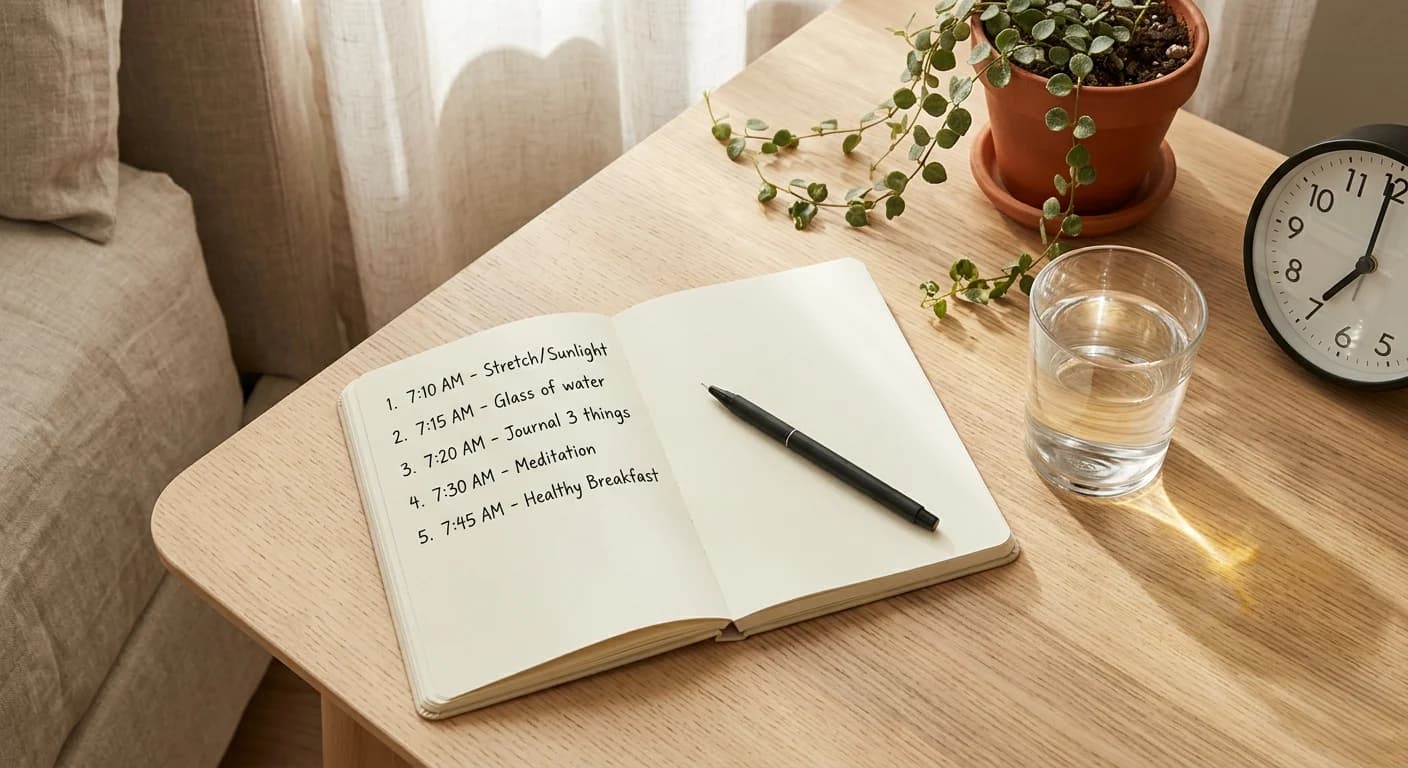
Forget the two-hour morning routine. Forget the month-long transformation challenge that collapses by day eleven. Forget the productivity system that requires a color coded notebook, three separate apps, and a personality transplant to maintain consistently.
You have been quietly sold the idea that meaningful personal change requires massive, sustained effort. The science, it turns out, disagrees with that assumption in the most useful possible way.
Behavioral psychology research consistently shows that the most effective habits are not the biggest ones. They are the ones with almost zero resistance to starting, the ones that fit invisibly into an existing day without demanding willpower, schedule restructuring, or motivation you may not have on a Tuesday afternoon. Tiny behaviors, performed consistently and anchored to the right moment, produce measurable and lasting changes in mood, cognition, stress levels, sleep quality, and physical health.
What follows is not a list of wellness trends or advice reverse-engineered from someone's viral morning routine video. These are ten habits supported by peer reviewed research, each taking under five minutes to complete, and each producing a documented, measurable benefit when practiced with consistency.
No supplements. No gym membership. No life overhaul required.
Just ten things you can genuinely start today.
Why Small Habits Beat Ambitious Ones Every Time
Before diving into the habits themselves, it helps to understand why brief practices consistently outperform ambitious ones in real world application, because the answer matters for how you will approach using this list.
Research by behavioral scientist BJ Fogg at Stanford University demonstrates that human motivation is not a stable or reliable resource. It rises and falls unpredictably across the day, the week, and the season. Any habit that depends on high motivation to initiate will be performed inconsistently. This is not a personal weakness. It is a neurological reality that applies equally to everyone.
Tiny habits, however, require almost no motivational energy to begin. They can be anchored to behaviors you already perform reliably each day, which removes the "when do I do this?" problem entirely. They produce a genuine sense of completion and accomplishment rather than overwhelm. And that sense of completion triggers a small but neurologically real dopamine reward, which reinforces the desire to repeat the behavior the following day.
The five minute ceiling in this list is not a compromise. It is a deliberate design principle rooted in habit formation science.
Habit 1: The Physiological Sigh
What it is: A specific two-breath pattern that resets your nervous system faster than any other voluntary action currently documented in neuroscience research.
The science: Research from neuroscientist Andrew Huberman's lab at Stanford University has identified the physiological sigh as the fastest known mechanism for reducing acute stress in the human body. The double inhale through the nose followed by a long, complete exhale through the mouth fully inflates the tiny air sacs in the lungs called alveoli, dramatically increasing the surface area available for gas exchange. This pattern rapidly shifts the autonomic nervous system from sympathetic (fight or flight) dominance toward parasympathetic (rest and digest) activation, producing a measurable reduction in heart rate and anxiety within seconds.
A 2023 study published in Cell Reports Medicine directly compared cyclic sighing against mindfulness meditation and box breathing over a five-minute daily practice period. The physiological sigh produced the most significant reductions in anxiety, the greatest improvement in mood, and the lowest resting respiratory rate of all three approaches.
How to do it:
Inhale through your nose until your lungs feel completely full.
Without exhaling, take one additional quick sniff through your nose to top off your lung capacity.
Exhale slowly and completely through your mouth until your lungs are entirely empty.
Repeat this cycle two to five times.
Time required: 30 to 60 seconds.
Use it before a difficult conversation, after a stressful email, first thing in the morning, or any time the anxiety in your chest needs somewhere to go.
Habit 2: Morning Sunlight Exposure
What it is: Stepping outside and allowing natural light to reach your eyes within 30 to 60 minutes of waking up each morning.
The science: Your brain's master circadian clock, located in the suprachiasmatic nucleus of the hypothalamus, is primarily calibrated by light input received through photosensitive cells in your retina called intrinsically photosensitive retinal ganglion cells. These cells respond specifically to the angle and wavelength of natural outdoor light, particularly the low-angle sunlight present in the early morning hours.
Research from circadian biologist Satchin Panda at the Salk Institute, alongside work from neuroscience labs at Stanford and Harvard, consistently demonstrates that morning light exposure triggers a precisely timed cortisol pulse that enhances alertness and focus throughout the morning, while simultaneously setting a melatonin release timer that improves evening sleepiness and sleep depth. Critically, artificial indoor light is between 50 and 1,000 times less intense than outdoor light, which is insufficient to fully trigger this biological response regardless of how bright your home feels.
How to do it:
Within 30 to 60 minutes of waking, step outside.
Face the general direction of the sky without looking directly at the sun.
Stay outside for 2 to 5 minutes without sunglasses.
On overcast days, extend your time to 10 minutes, as cloud cover significantly reduces light intensity reaching your retina.
Time required: 2 to 5 minutes.
This single habit has documented downstream effects on morning energy, afternoon focus, evening melatonin timing, and overall sleep quality. The return on two minutes is extraordinary.
Habit 3: Drink Water Before Your First Coffee
What it is: Consuming approximately 500ml of water as the very first thing you ingest each morning, before coffee, tea, or any food.
The science: The human body loses between 400 and 900ml of water overnight through respiration, perspiration, and metabolic processing, creating a consistent state of mild dehydration by the time you wake up. Research published in the Journal of Nutrition found that even mild dehydration of just 1 to 2 percent body water loss measurably impairs working memory, increases the perception of task difficulty, reduces concentration, and elevates feelings of fatigue and anxiety.
There is an additional layer of biology worth knowing here: adenosine, the sleep-promoting chemical that creates the heavy, groggy feeling upon waking, is more efficiently cleared when the brain is both awake and adequately hydrated. Coffee blocks adenosine receptors but does not clear the chemical itself. Hydrating first creates the physiological conditions that make your coffee more effective, not less.
How to do it:
Place a full glass or bottle of water on your nightstand or kitchen counter the evening before.
Upon waking, drink the entire 500ml before reaching for coffee, checking your phone, or beginning any other morning activity.
If plain water feels unappealing first thing in the morning, add a squeeze of lemon or a small pinch of sea salt.
Time required: 60 to 90 seconds.
This is arguably the simplest habit on this list. It costs nothing, requires zero skill, and the evidence behind it is remarkably robust.
Habit 4: The Three-Item Gratitude Practice
What it is: Writing three specific things you feel genuinely grateful for each morning, completed in under two minutes.
The science: Psychologist Robert Emmons at the University of California Davis conducted some of the most replicated research in positive psychology over the past two decades. His studies found that people who regularly wrote about things they were grateful for reported significantly higher levels of positive emotions, greater optimism about the week ahead, fewer physical health complaints, and meaningfully better sleep compared to control groups who wrote about daily irritations or neutral life events.
Research from Harvard Medical School confirmed that gratitude practice produces observable changes in neural activity in brain regions associated with reward, moral cognition, and interpersonal connection. Crucially, the specificity of what you write directly determines how much neurological activation occurs. "I am grateful for my family" produces far less measurable brain response than "I am grateful that my brother stayed on the phone for an hour when I was struggling last Thursday." The more specific, the more effective.
How to do it:
Keep a dedicated notebook or open a notes app as part of your morning routine.
Write three things you genuinely feel grateful for right now.
Each item must be specific, not general. Name the exact person, moment, sensory detail, or experience.
Challenge yourself to write items that are different each day rather than repeating the same three entries on autopilot.
Time required: 2 minutes.
The specificity requirement is what separates a meaningful practice from a mechanical one. Do not rush it. Write like you mean it.
Habit 5: The 5-4-3-2-1 Grounding Technique
What it is: A sensory awareness practice that interrupts anxiety, overthinking, and procrastination by deliberately anchoring attention to the present moment through all five senses.
The science: Anxiety is neurologically defined as a brain state in which the amygdala generates threat responses toward imagined future events rather than present ones, effectively pulling your cognitive resources away from now and directing them toward catastrophic scenarios that may never occur. The prefrontal cortex, which governs rational thought, planning, and decision-making, becomes significantly less active during amygdala-driven states.
Sensory grounding techniques work by flooding attentional bandwidth with present moment sensory input, which reduces amygdala activation and restores prefrontal cortex engagement. Research from the fields of Dialectical Behavior Therapy, trauma psychology, and clinical anxiety treatment consistently validates sensory grounding for acute anxiety, emotional dysregulation, panic responses, and procrastination driven by underlying fear.
How to do it:
Pause wherever you are and take one slow breath.
Name 5 things you can see right now, looking around your environment deliberately.
Name 4 things you can physically feel (your feet on the floor, the texture of your clothing, the temperature of the air on your skin, the weight of your body in your chair).
Name 3 things you can currently hear.
Name 2 things you can smell, even faintly.
Name 1 thing you can taste.
Time required: 60 to 90 seconds.
Use this at the onset of anxious thoughts, before starting a task you have been avoiding, or any time your mind has been cycling through the same worried thought for more than five minutes. It works.
Habit 6: The Cold Water Face Splash
What it is: Splashing cold water directly onto your face for 15 to 30 seconds during a moment of stress, overwhelm, or emotional escalation.
The science: Cold water contact with the face activates the mammalian diving reflex, an evolutionarily conserved physiological response present in all mammals that slows the heart rate, reduces blood pressure, and rapidly shifts the autonomic nervous system toward parasympathetic dominance. This reflex is specifically triggered by cold water contacting the face, particularly around the eyes and forehead, and is mediated through branches of the vagus nerve, which is the primary neural highway of the parasympathetic nervous system.
Research published in Applied Psychophysiology and Biofeedback confirmed that cold water facial immersion produces immediate, measurable reductions in heart rate and self reported stress levels. This is why splashing cold water on your face during a moment of panic or intense frustration produces such a rapid subjective calming effect. It is not psychological. It is a hard-wired physiological mechanism.
How to do it:
Go to any sink with access to cold water.
Splash cold water directly and repeatedly onto your face, covering your eyes, forehead, and cheeks.
Repeat 6 to 10 splashes.
Pat your face dry.
Time required: 30 to 45 seconds.
Use this when a difficult conversation has escalated, when work frustration is spilling into your body, or when you feel the physiological signature of anger or overwhelm taking hold. The change in state is almost immediate.
Habit 7: Write Tomorrow's Three Most Important Tasks Tonight
What it is: Before ending your workday or beginning your bedtime routine, writing exactly three specific tasks that must be completed the following day, listed in order of genuine priority.
The science: Research by psychologist Peter Gollwitzer at New York University on implementation intentions demonstrates that people who write specific action plans in the format of "I will do X at time Y in location Z" are dramatically more likely to follow through on intended behaviors compared to those who set goals without implementation plans. The specificity of the plan removes decision friction at the moment of execution, which is where most goal-directed behavior breaks down.
The evening timing of this practice serves a second documented function. Psychologist Bluma Zeigarnik identified that uncompleted tasks occupy working memory as persistent "open loops" that continue consuming cognitive and emotional resources until they are either completed or explicitly deferred. A study from Baylor University published in the Journal of Experimental Psychology found that writing a specific to do list for the following day before sleeping helped participants fall asleep significantly faster, with more specific and detailed lists producing greater reductions in sleep onset time.
How to do it:
Five minutes before ending your workday or beginning your bedtime routine, open a notebook or notes app.
Write exactly three tasks for tomorrow, labeled 1, 2, and 3 in genuine order of importance.
Each task must be specific and completable within a single working session.
Close the notebook deliberately and do not return to it until morning.
Time required: 2 to 3 minutes.
Three tasks only. Not ten. Not a full page. Three. The constraint is the mechanism, not the limitation.
Habit 8: The Two-Minute Movement Break
What it is: Interrupting every 60 to 90 minutes of sitting with two minutes of standing, light stretching, or brief walking in place.
The science: Research from the American Journal of Epidemiology and multiple subsequent meta-analyses has established that prolonged uninterrupted sitting independently increases blood glucose levels, elevates cardiovascular risk markers, reduces metabolic rate, and measurably impairs cognitive performance, even in people who exercise regularly outside of work hours. This last finding is the most surprising: a morning workout does not cancel out the physiological effects of eight consecutive hours of sitting.
However, breaking up sedentary periods with brief two-minute movement bouts has been shown to improve post-meal blood glucose levels by up to 30 percent, increase blood flow to the prefrontal cortex (improving focus and decision quality), reduce lower back tension, and improve mood through light muscular activation. These benefits occur even from very light movement such as standing, walking in place, or performing ten bodyweight squats.
How to do it:
Set a recurring timer or use a smartwatch to alert you every 60 to 90 minutes throughout your workday.
When the alert fires, stand up immediately without negotiating with yourself about it.
Walk around your space, perform 10 bodyweight squats, roll your shoulders, stretch your neck side to side, or simply stand and breathe for two full minutes.
Return to your work.
Time required: 2 minutes per hour.
The specific movement matters far less than the interruption of stillness. Standing up is the habit. Everything you do while standing is a bonus.
Habit 9: One Sentence of Reflective Writing
What it is: Writing a single honest sentence each evening that captures the most significant thing you noticed, felt, or learned that day.
The science: Clinical psychologist James Pennebaker at the University of Texas at Austin conducted landmark research across three decades demonstrating that brief expressive writing about personally meaningful experiences produces measurable improvements in immune function, emotional regulation, stress reduction, and psychological wellbeing. His research established that translating lived experience into language helps the brain process and categorize emotional information, reducing the cognitive and emotional load of unprocessed experiences that would otherwise continue to occupy mental bandwidth indefinitely.
The one sentence constraint specifically removes the two most common barriers to journaling: not knowing what to write and the pressure of journaling as a performative exercise that needs to sound good. One honest sentence, written without editing, is neurologically and psychologically sufficient to capture the core reflective benefit Pennebaker's research documents.
How to do it:
Before turning off your light for the night, open a small notebook or notes app.
Choose one of the following prompts and complete it in a single sentence:
"Today I learned that..."
"Today surprised me because..."
"Today I felt most present when..."
"The thing I want to remember about today is..."
Write one complete, honest sentence. Stop there.
Time required: 60 to 90 seconds.
Do not edit. Do not make it beautiful. Let it be true. The truth of a single sentence is worth more than three polished paragraphs.
Habit 10: Name It to Tame It
What it is: Verbally or mentally labeling the specific emotion you are currently experiencing in a single, precise word.
The science: Neuroscientist Dan Siegel coined the phrase "name it to tame it" to describe a phenomenon backed by neuroimaging research conducted by Matthew Lieberman and colleagues at UCLA using functional MRI technology. Their research found that when participants verbally labeled the emotion visible in a facial expression, activity in the amygdala, the brain's primary threat and emotional intensity center, measurably decreased within seconds, while activity in the right ventrolateral prefrontal cortex simultaneously increased.
In practical terms: naming an emotion moves its processing from the reactive emotional brain toward the reasoning, thinking brain. This neural shift produces a genuine, measurable reduction in emotional intensity within seconds of labeling. Critically, the precision of the label matters significantly. "I feel bad" produces less neural regulation than "I feel humiliated" or "I feel disappointed" or "I feel resentful." Your emotional vocabulary is not a soft skill. It is a neurological tool.
How to do it:
When you notice a strong or uncomfortable emotion beginning to rise, pause for five seconds.
Ask yourself: "What is the single most accurate word for what I am feeling right now?"
Say the label either out loud or internally: "I notice I am feeling [specific word]."
Repeat the observation once more with the same label.
Notice what happens to the intensity of the emotion in the 30 seconds that follow.
Time required: 30 to 60 seconds.
This is not a technique for suppressing or bypassing emotions. It is the neurological act of moving an experience from a reactive process to a conscious one, which is the actual beginning of managing it effectively.
The Compounding Effect of Tiny Practices
None of these habits is a standalone solution. What they represent collectively is a framework for making intentional contact with your nervous system, your attention, your cognition, and your emotional state at key transition points across the day.
The morning water, sunlight, and physiological sigh create a strong neurological and physiological foundation before the demands of the day begin. The grounding technique, cold water splash, and emotion labeling provide real time tools for navigating the inevitable friction, stress, and difficulty that arrives unpredictably throughout the day. The gratitude practice, reflective sentence, and next day task list close the day with intentionality rather than passive consumption of whatever the evening algorithm decides to serve you.
Behavioral science is remarkably consistent on one finding above all others: it is not the size of a habit that determines whether it becomes lasting behavior. It is the regularity with which it is repeated and the clarity with which it is linked to an existing moment already present in the daily routine.
Pick two habits from this list. Attach each one to something you already do reliably every single day. Practice both for three consecutive weeks before evaluating whether they are working.
Then notice what has quietly shifted.