
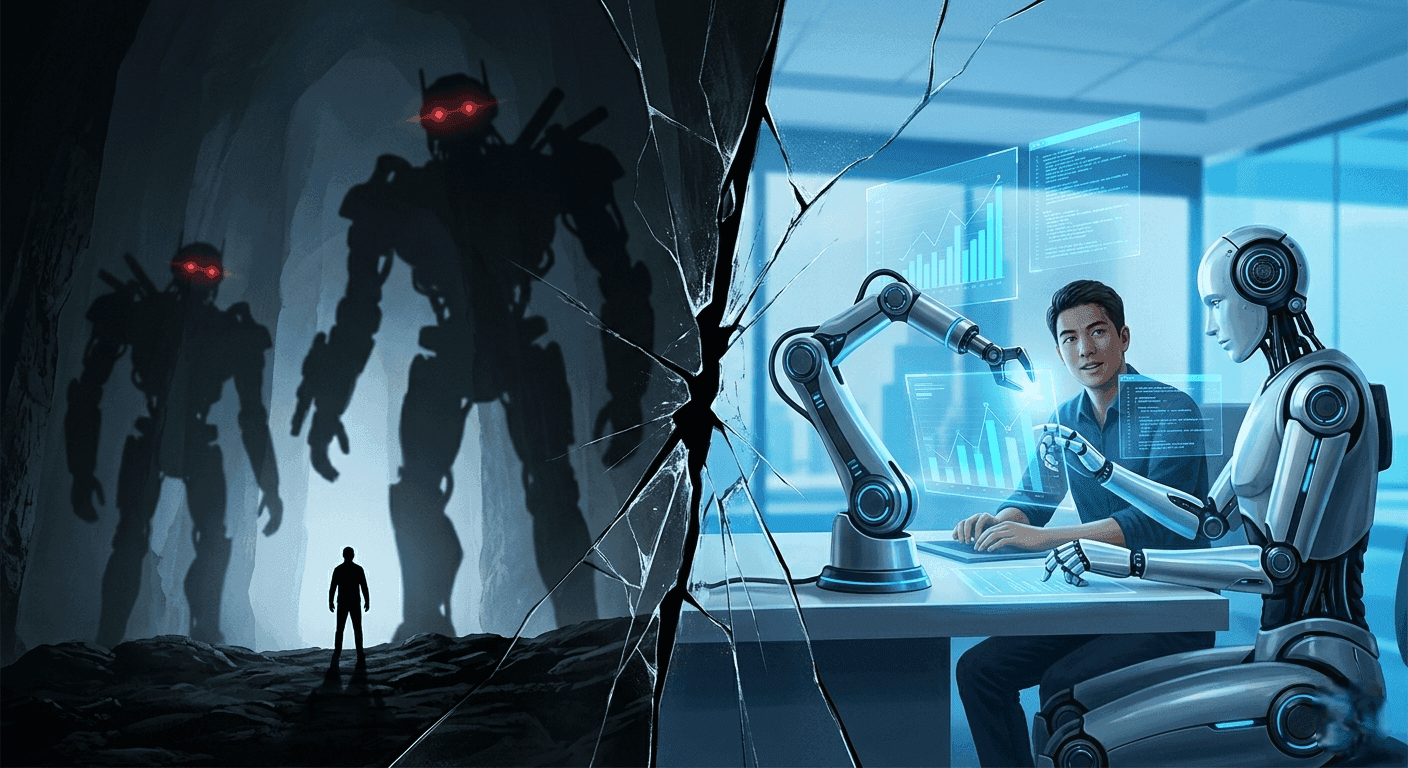
Your boss just used AI to do something that used to take your team three days. Your colleague whispered that the company is "exploring automation." And your LinkedIn feed is full of either panic or blind optimism. You're not sure which to believe and honestly, neither extreme is helping you plan your next career move.
The conversation around AI and jobs is loud, emotional, and more often than not wrong. Not because people are dishonest, but because the myths spread faster than the research. And the research, when you actually read it, tells a far more complex and in many ways more hopeful story than the headlines suggest.
Let's cut through the noise. Here are seven of the most persistent myths about AI replacing jobs and what the verified data actually says.
Table of Contents
Myth #1: AI Is Going to Eliminate Most Jobs
Myth #2: AI Replaces Entire Jobs, Not Just Tasks
Myth #3: No New Jobs Will Be Created to Replace the Lost Ones
Myth #4: White-Collar, Educated Workers Are Safe
Myth #5: AI Replaces Everyone Equally
Myth #6: Creativity and Human Skills Are Already Being Replaced
Myth #7: This Is Happening Too Fast for Anyone to Adapt
So What Should You Actually Do?
Myth #1: AI Is Going to Eliminate Most Jobs
This is the headline version the one that sparks panic. "AI will take all our jobs." It is also the least supported by actual data.
The World Economic Forum's Future of Jobs Report 2025 the most comprehensive study of its kind, drawing on surveys of over 1,000 companies across 55 economies projects that by 2030, AI and information technology will displace 92 million jobs globally. That number sounds enormous. But the same report projects 170 million new roles will be created over the same period, resulting in a net increase of 78 million jobs worldwide.
That is not a story of elimination. That is a story of transformation.
Goldman Sachs has estimated that approximately 300 million full-time jobs globally could be affected by generative AI but "affected" here means significant task changes, not full elimination. The distinction matters enormously. Most jobs will change; far fewer will vanish entirely.
An MIT study found that AI can currently replace tasks equivalent to about 11.7% of U.S. labor meaningful exposure, but a far cry from the apocalyptic scenarios that dominate social media.
The verdict: AI will displace many jobs. It will also create more jobs than it destroys but the timing, geography, and skills required for those new jobs will not automatically align with displaced workers. The challenge is transition, not extinction.
Myth #2: AI Replaces Entire Jobs, Not Just Tasks
This myth treats jobs as monolithic blocks that can be swapped out wholesale. In reality, most jobs are bundles of tasks some of which AI handles well, and many of which it does not.
Research from Harvard Business School analyzed job postings from 2019 through March 2025 and found a telling pattern. After the public launch of ChatGPT in November 2022, job postings for roles involving lots of structured, repetitive tasks decreased by 13%. Meanwhile, employer demand for jobs requiring analytical, technical, or creative work roles that AI can enhance rather than eliminate grew by 20%.
The research conclusion: rather than solely eliminating jobs, generative AI is creating new demand in augmentation-prone roles, with human-AI collaboration as a key driver of labor market transformation.
Think about a radiologist. AI can now scan medical images and flag anomalies with impressive accuracy. But diagnosing a patient, weighing competing risks, explaining a prognosis to a frightened family, and deciding on a treatment path considering that patient's full life context? Those tasks remain deeply human. The radiologist's job changes it does not disappear.
The verdict: AI is automating tasks within jobs, not eliminating most jobs entirely. The jobs most at risk are those where the overwhelming majority of tasks are structured, repetitive, and rule-based and even there, human oversight typically remains valuable.
Myth #3: No New Jobs Will Be Created to Replace the Lost Ones {#myth-3}
History has been here before. The printing press threatened scribes. The tractor displaced farmhands. The spreadsheet was supposed to end accountancy. None of these technologies produced the mass unemployment their critics predicted, because they also created entirely new categories of work that did not exist before.
The data from AI suggests the same pattern is repeating. Goldman Sachs noted that over 85% of U.S. employment growth since 1940 has come from technology-driven job creation. The WEF projects that the fastest-growing new roles between now and 2030 will include AI and machine learning specialists, big data analysts, fintech engineers, sustainability experts, and cybersecurity professionals categories that barely existed a decade ago.
AI engineer roles have seen a demand surge of over 140% year-over-year, making them among the fastest-growing careers in any sector. AI and ML engineer roles grew at 41.8% annually. Workers with demonstrable AI skills earn on average 25% more than peers without them, according to PwC's 2025 AI Jobs Barometer.
Even in non-technical fields, new roles are emerging: AI ethics officers, prompt engineers, AI output auditors, and human oversight specialists are job titles that are appearing in hiring pipelines at major companies.
The verdict: New jobs are being created at a rate that, at the macro level, outpaces displacement. The challenge is not whether jobs will exist it is whether displaced workers can access, afford, and succeed in the training needed to fill them.
Myth #4: White-Collar, Educated Workers Are Safe {#myth-4}
This one is perhaps the most dangerous myth, because it lulls the most economically privileged workers into a false sense of security. For decades, automation hit manufacturing and physical labor hardest. Surely the lawyer, the analyst, the programmer, and the accountant are safe?
The data says otherwise. The MIT study that found AI can replace tasks equivalent to 11.7% of U.S. labor specifically highlighted finance, healthcare, and professional services as high-exposure sectors precisely the domains of educated, white-collar workers.
In banking and finance, 70% of basic operations are projected to be automated. Wall Street banks have publicly stated plans to cut approximately 200,000 roles over the next three to five years, specifically targeting entry-level and back-office positions. In 2025 alone, 77,999 tech jobs were directly tied to AI-driven layoffs in the first six months alone.
Legal document review, financial modeling, basic coding, medical diagnosis support, tax preparation, and content writing all historically well-paid, credential-heavy professions are experiencing measurable AI-driven task automation right now.
The irony is that generative AI is linguistically and analytically sophisticated. It excels precisely in the kinds of tasks that require processing large amounts of information and producing structured outputs the bread and butter of many white-collar roles.
The verdict: No educational level or professional credential makes a worker immune. High-earning roles involving structured information processing are among the most exposed. The assumption of safety based on a university degree is outdated and potentially dangerous for career planning.
Myth #5: AI Replaces Everyone Equally {#myth-5}
The impact of AI on jobs is not evenly distributed. It is concentrated in specific industries, age groups, and demographic categories in ways that the average headline completely misses.
Stanford University's Digital Economy Lab published research in August 2025 that provides some of the most rigorous data yet on who is actually being affected. The findings are striking: workers aged 22–25 experienced a 13% relative employment decline in AI-exposed occupations between late 2022 and July 2025. Workers over 30 in the same occupations, over the same period, saw 6–12% employment growth. For software developers specifically aged 22–25, the employment decline was nearly 20%.
In other words, AI is hitting young, entry-level workers the hardest precisely the people who historically used entry-level positions to build the skills and experience needed to advance. That pipeline is compressing. Some 66% of enterprises are already reducing entry-level hiring due to AI.
Gender exposure is also unequal. Research shows that women's jobs globally are at higher risk, with 9.6% of women's jobs in high-income countries highly exposed to AI automation, compared to 3.2% for men a disparity driven by the concentration of women in administrative, secretarial, and clerical roles.
Geography matters too. Nations with large workforces in manufacturing, customer service, and data entry face steeper near-term displacement than those whose economies are concentrated in relationship-intensive or judgment-heavy sectors.
The verdict: AI does not hit everyone the same way. Young workers, women in clerical roles, and workers in routine-intensive sectors face disproportionate disruption. Policy responses that treat displacement as a uniform problem will miss the populations most at risk.
Myth #6: Creativity and Human Skills Are Already Being Replaced {#myth-6}
This myth usually comes with a screenshot of an AI-generated painting, or a note that "ChatGPT wrote this article in 30 seconds." It implies that if AI can produce a sonnet or draw a portrait, the creative professions are doomed.
The evidence does not support this conclusion at least not in the way the myth suggests.
AI can generate content. It can remix patterns it has seen before. What it demonstrably cannot do is originate meaning, exercise genuine cultural judgment, build earned trust with another human being, or make decisions rooted in lived moral experience. Eighty-three percent of business leaders in a recent survey agreed that AI makes human skills more valuable, not less a reflection of the reality that as AI handles routine cognitive tasks, the distinctly human capabilities become the scarcer, higher-value input.
The Korn Ferry 2025 Leadership Trends Report identified adaptability, authenticity, culture-building, and trust as the key skills for organizational success none of which can be automated. Harvard Business School research found that analytical, technical, and creative job postings grew 20% after generative AI became widely deployed because these are precisely the areas where AI augments human capacity rather than replaces it.
After the public launch of ChatGPT in November 2022, job postings for roles requiring more analytical, technical, or creative work grew 20%, precisely because organizations needed more humans capable of directing, evaluating, and contextualizing AI outputs.
AI produces variations of what already exists. Human creators define what is possible next. That distinction is not trivial it is the entire difference between a tool and an author.
The verdict: AI is a powerful tool for creative production. It is not a replacement for human creativity, cultural judgment, ethical reasoning, emotional intelligence, or genuine relationship-building and the data shows organizations increasingly understand and act on that distinction.
Myth #7: This Is Happening Too Fast for Anyone to Adapt {#myth-7}
Panic is understandable. The pace of AI development since 2022 has been genuinely disorienting. But the claim that adaptation is impossible is not supported by history or by current data.
The WEF Future of Jobs Report 2025 found that the skills gap not the AI technology itself is the most significant barrier to business transformation, cited by 63% of employers. That means organizations want humans to work with AI; they are struggling to find humans who can. That is an opportunity, not a death sentence.
The same report found that employers expect 39% of key skills required in the job market will change by 2030 significant disruption, but down from 44% in 2023, suggesting that reskilling efforts are beginning to work. If the entire global workforce were 100 people, 59 would need reskilling or upskilling by 2030 and 11 of those are unlikely to receive it. That 11 is the crisis. The other 48 are a solvable challenge.
AI exposure is growing at approximately 9% per year fast, but not instantaneous. Workers and institutions have time to respond, provided they take the signal seriously rather than dismissing it or catastrophizing into paralysis.
The data is clear: workers with AI skills earn 25% more than those without. Industries with higher AI adoption have seen productivity growth rates four times higher than less AI-intensive sectors. Adaptation is not only possible it is measurably rewarding for those who pursue it.
The verdict: This is moving fast faster than most workforce transitions in recent history. But fast is not the same as instantaneous. The workers most at risk are those who assume they do not need to adapt. The workers best positioned for the next decade are those who treat AI literacy as a core professional skill, not an optional extra.
So What Should You Actually Do? {#conclusion}
The data tells a story that is neither the utopia AI optimists promise nor the apocalypse doomsayers predict. It is messier, more human, and ultimately more navigable than either extreme.
Jobs will change. Many will disappear. More will be created. The transition will be painful for specific groups especially young workers, women in administrative roles, and anyone whose job is primarily structured, repetitive, and rule-based. But the net trajectory, according to the best available evidence, is not one of mass unemployment. It is one of significant transformation that rewards adaptability and punishes complacency.
The myths are dangerous not because they are entirely wrong, but because they encourage two equally unhelpful responses: panic-driven paralysis, or dismissive denial. Neither will serve you.
What will serve you is treating the evidence seriously, investing in the skills that AI complements rather than replaces critical thinking, ethical judgment, emotional intelligence, creative direction, and human relationship and accepting that the most resilient professional identity in the AI era is not the one that competes with AI, but the one that knows how to work with it.
The machines are getting smarter. So should we.
All statistics in this article are drawn from published reports by the World Economic Forum, Stanford University's Digital Economy Lab, Harvard Business School, Goldman Sachs, MIT, PwC, Korn Ferry, and Challenger, Gray & Christmas, as cited in verified industry analyses current through May 2026.