
The Night the Knicks Brought Rikers to Life
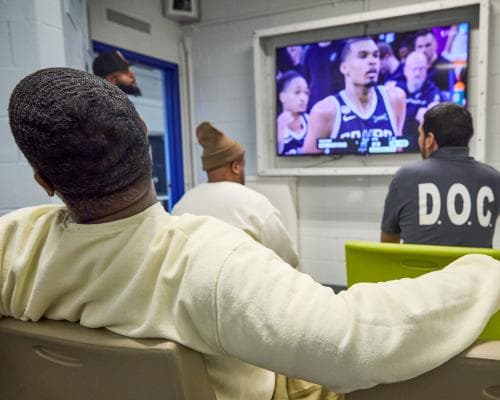
It was a balmy June evening when the sound of a basketball game burst through the concrete walls of a housing unit on Rikers Island. Thirty men in tan uniforms gathered around a folding table piled high with snacks, pulled plastic chairs closer to a flat‑screen TV and let the chant “Knicks in four” fill the air. For a few hours the world’s most infamous jail became a living room for New York City’s biggest basketball moment.
Inside the George R Vierno Center
The George R Verno Center is an 850‑bed facility that sits on a 413‑acre island between Queens and the Bronx. Most of the 6,000 people held there are awaiting trial. The complex functions like a small city with its own power plant, industrial kitchen and dozens of program spaces. On this night, the Beacon Center – a hub that houses classrooms, a recording studio and a barbershop – turned into a makeshift arena for the Knicks.
The Honors House Advantage
Only inmates who have spent at least 120 days without violence or disciplinary infractions are allowed into the “honors house.” Those men earned the privilege of staying out past the usual 9 p.m. lock‑in and receiving a spread that resembled a Super Bowl feast. Bags of chips, cookies, fruit platters, cheese trays, bottled drinks and a large cake emblazoned with “Let’s Go Knicks” set the scene for a night that felt far removed from the usual jail routine.
Voices from the Crowd
Luis Guzman, a 43‑year‑old from the Bronx, described the game as a chance to rally around chemistry and teamwork. “You don’t have a team full of superstar players,” he said, “but this could be the year they finally get it done.”
John Shakespeare, a 44‑year‑old Brooklyn resident, joked about his loyalty to the Liberty after a disappointing first quarter.
Thomas Gregory, a 59‑year‑old awaiting trial for a weapons charge, reminded everyone of the long wait for justice, yet he still shouted with the crowd when a San Antonio player missed a travel call.
These conversations echoed the banter heard in Bronx barbershops, Queens bodegas and Staten Island living rooms.
A Citywide Celebration Behind Bars
Correction officials reported that nearly 2,000 inmates across 44 housing units watched the game in some form. Some gathered in the Peace Center, a basement program space for younger men, while others tuned in from a chapel at the Otis Bantum Correctional Center. The shared experience collapsed the physical distance between the island and the city, uniting strangers under the same hopeful chant.
Reform Leadership on the Court
Stanley Richards, the first formerly incarcerated person to lead New York City’s Department of Correction, watched the game from the sidelines. Having spent time in a tiny Rikers cell three decades ago, Richards believes moments like these remind people in custody that they remain part of the city. “We are not the judge or jury,” he told reporters at halftime. “We can decide how we treat people when they come into our care.”
His appointment comes as the complex remains under federal oversight and the city struggles to meet a 2027 deadline to close Rikers. Small gestures – a cake, a shared chant, a chance to cheer – are part of a larger effort to humanize a system long labeled an “incubator of misery.”
Why Sports Matter Behind Bars
The Knicks’ comeback in the fourth quarter sparked a roar that reverberated through cinder‑block walls. When Jalen Brunson sank a corner three to put New York ahead, the celebration felt like a victory for everyone in the room, not just the team on the screen. The night proved that a shared cultural event can provide hope, conversation and a brief escape from the harsh realities of incarceration.
Closing Thoughts
For the men at Rikers, the Knicks finals were more than a game. They were a reminder that life outside the walls continues, that community can be built in unexpected places, and that dignity can be restored through simple acts of inclusion. As the final buzzer sounded and the crowd filed back to their cells, the echo of “Let’s go Knicks!” lingered, proving that even behind bars, the spirit of New York remains unbroken.