
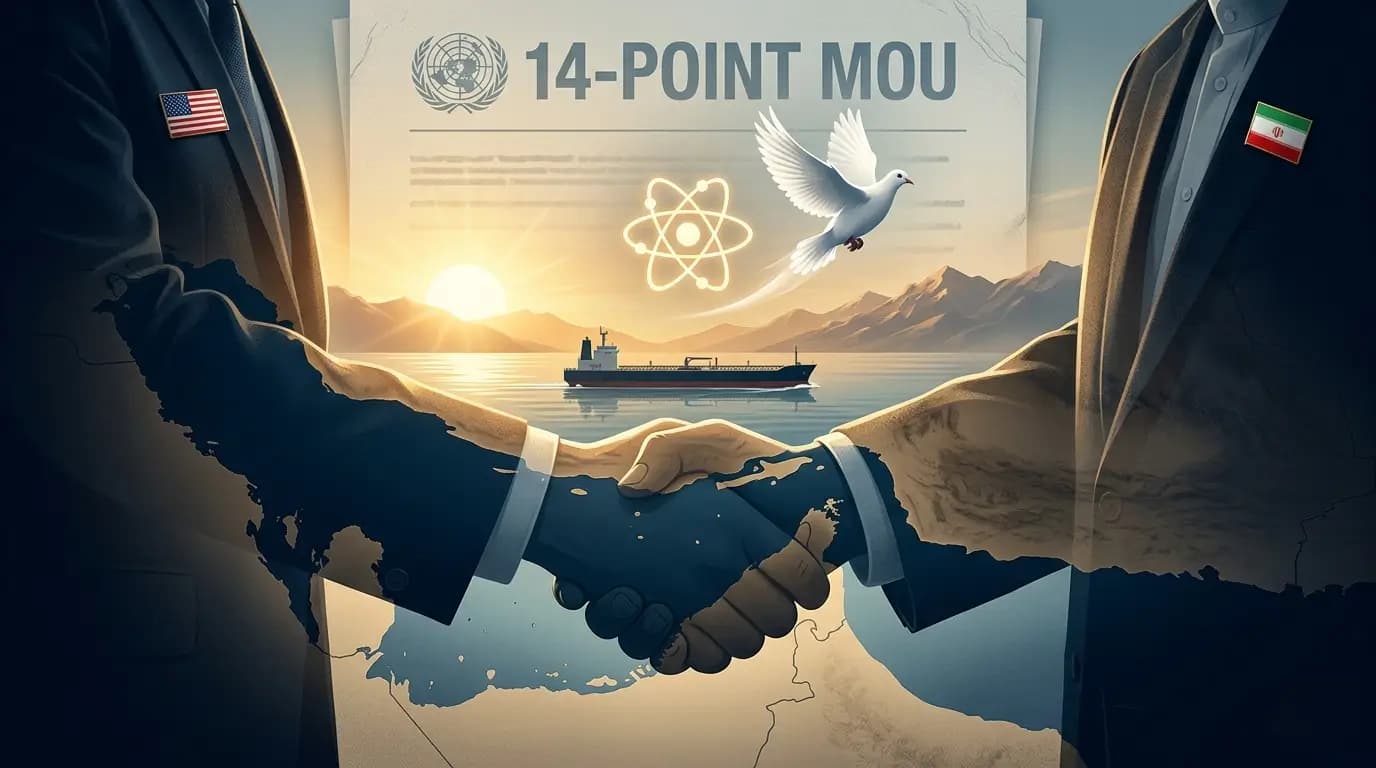
Inside the Deal That Aims to Turn the Page on War
After days of intense speculation and diplomatic secrecy, the United States on Wednesday released the full, official text of its framework agreement with Iran. Titled the “Islamabad Memorandum of Understanding between the United States of America and the Islamic Republic of Iran,” the 14-point document lays the groundwork for ending a brutal conflict, reopening the world’s most critical oil chokepoint, and for the first time binding Iran to a specific method for neutralizing its most sensitive nuclear material. The memorandum is set to be formally signed on Friday, unlocking a frantic 60-day sprint to negotiate a comprehensive final deal.
The unveiling came only hours after CNN published a draft version of the agreement that had been circulating among officials. The White House initially dismissed that draft as inaccurate, but the final released text confirms the core architecture while introducing several critical upgrades most importantly, a concrete “minimum methodology” for addressing Iran’s stockpile of highly enriched uranium. Here, we dissect every point of the MOU, compare the public draft to the official language, and explore what this unprecedented bargain means for the Middle East and beyond.
The 14 Points: What the Memorandum Actually Says
The document, dated [___ date], is short for a state-to-state compact with such staggering scope. It functions as a political roadmap a “dial,” as one senior US official described it where Iranian steps toward de-escalation are met with calibrated American sanctions relief and economic incentives. Let’s walk through each provision.
1. Immediate and Permanent End to War
The United States and Iran, along with their allies, declare an “immediate and permanent termination of military operations on all fronts, including in Lebanon.” Both sides pledge not to initiate any war or military operation against the other and to refrain from the threat or use of force. Crucially, the final deal is tasked with confirming a permanent end to hostilities across all theaters, including Lebanon, turning the MOU’s ceasefire into a durable peace clause.
2. Mutual Respect for Sovereignty
In language that echoes foundational diplomatic norms, Washington and Tehran commit to respecting each other’s sovereignty and territorial integrity and to non-interference in internal affairs. This is a sweeping promise that, if honored, would rule out the kind of covert operations, cyberattacks, and proxy meddling that have defined the adversarial relationship for decades.
3. 60-Day Negotiation Window
The parties have a maximum of 60 days to negotiate and conclude a final deal, extendable if both agree. This clock starts ticking upon Friday’s signing, creating immense pressure to resolve highly technical disputes over sanctions sequencing, nuclear verification, and the staggering $300 billion reconstruction package.
4. US Naval Blockade Lifted Within 30 Days
Immediately upon signing, the United States begins removing its naval blockade and any “disturbances or impediments” against Iran. The blockade must be fully ended within 30 days, with vessel traffic scaling back up proportionally to pre-war levels as Iran restores its own shipping. Furthermore, the US commits to pulling its forces from “the proximity” of Iran within 30 days after the final deal is sealed a significant concession to Tehran’s longstanding demand for a reduced American military footprint in the Gulf.
5. Iran Reopens the Strait of Hormuz - Free of Charge, for 60 Days
Perhaps the most economically urgent article. Iran will use its best efforts to ensure safe passage for commercial vessels between the Persian Gulf and the Sea of Oman, “with no charge, for 60 days only.” Traffic resumes immediately, with demining and removal of technical obstacles to be completed within 30 days. Simultaneously, Iran commits to dialogue with Oman and other Persian Gulf littoral states to define the Strait’s future administration under international law a notable nod to collective maritime governance rather than unilateral Iranian control.
6. A $300 Billion Reconstruction and Development Fund
The United States pledges to work with regional partners to create a “definitive, mutually agreed plan” for Iran’s reconstruction and economic development, with financing of at least $300 billion. The mechanism will be finalized as part of the 60-day talks, and Washington guarantees all necessary licenses, waivers, and permissions for the associated financial transactions. This is not a blank check; it ties Iran’s economic recovery directly to the success of negotiations and ongoing compliance.
7. Full Sanctions Termination
The US commits to terminating all sanctions - UN Security Council resolutions, IAEA Board of Governors resolutions, and all unilateral American primary and secondary sanctions on an agreed schedule within the final deal. The text explicitly acknowledges the “critical importance” of this issue, with both sides promising to tackle it immediately in negotiations. This is Tehran’s crown jewel, and sequencing it against nuclear concessions will be the central battle of the coming weeks.
8. The Nuclear Core: “Minimum Methodology” of Down-Blending
This is the article that distinguishes the official text from the earlier draft. Iran reaffirms it will not procure or develop nuclear weapons. The two sides agree to resolve the disposition of Iran’s stockpiled enriched material via a mutually agreed mechanism, with the minimum methodology being down-blending on site under IAEA supervision. That phrase absent from the leaked draft is a landmark. It means that near-bomb-grade uranium (often referred to as “nuclear dust” by officials) will not simply be shipped out or stored; it must be chemically mixed with lower-grade material to irreversibly reduce its enrichment level, all under the eyes of international inspectors. The deal also commits them to discuss enrichment and “nuclear needs” based on a satisfactory framework in the final agreement. Again, both parties stress the critical importance of these issues and intend to begin addressing them at once.
9. Status Quo Pending Final Deal
During the 60-day negotiation, Iran maintains its nuclear program as it stands, and the US will not impose new sanctions or deploy additional forces in the region. This standstill prevents either side from exploiting the interim period to improve their bargaining position.
10. Immediate Oil Export Waivers
Right after the MOU is signed, the Treasury Department will issue waivers for Iranian crude oil, petroleum products, and all associated services banking, insurance, shipping until sanctions are formally terminated. This jump-starts Iran’s ability to re-enter global energy markets almost overnight.
11. Frozen Funds Released and Fully Usable
Upon implementation of the MOU, frozen or restricted Iranian assets are to be made “fully available for use.” The Central Bank of Iran can designate any ultimate beneficiary, and funds, whether held in original accounts or transferred, must be freely usable. The US undertakes to issue all necessary licenses. This unblocks tens of billions of dollars that have been locked in escrow accounts around the world.
12. Executive Monitoring Mechanism
An executive mechanism will be established to oversee implementation of the MOU and future compliance with the final deal. The details are left to negotiation, but the principle of joint monitoring is now codified.
13. Staggered Implementation Triggers
Negotiations on the final deal will begin only after the MOU is signed and there is confirmed progress on the key immediate steps: the ceasefire (Article 1), lifting the naval blockade (4), reopening the Strait (5), oil waivers (10), and release of frozen funds (11). This sequence ensures that both sides deliver tangible early wins before diving into the hardest political questions.
14. UN Security Council Endorsement
The final deal will be endorsed by a binding UN Security Council resolution. This wraps the bilateral agreement in international law, making any violation a matter of global concern and in theory giving it staying power beyond any single administration in Washington.

Draft vs. Final Text: The Crucial Differences
CNN’s earlier disclosure of a draft agreement, obtained from a US official and confirmed by multiple diplomatic sources, sparked a flurry of denials. The White House claimed it did not reflect the actual MOU, while a senior official told CNN that the real text had been digitally signed by President Trump, Vice President Vance, and Iranian parliamentary speaker Mohammad Bagher Ghalibaf. Comparing the two versions reveals exactly where the language was toughened and where it remained flexible.
1. The “Minimum Methodology” for Uranium
The draft’s Article 8 simply stated that the fate of enriched material would be “adequately addressed in a final agreement.” The official MOU inserts a specific, irreversible process: down-blending on site under IAEA supervision. This is not semantics. Down-blending destroys the weapons potential of the material immediately, precluding any future breakout using existing stockpiles. It is the kind of technical guarantee that arms control advocates have demanded for years, and its inclusion suggests back-channel Iranian concessions that went beyond the initial written language.
2. Strait of Hormuz: Free Passage - But Only for 60 Days
The draft envisioned Iran taking steps to resume merchant shipping to pre-war volume within 30 days. The final text explicitly adds that commercial vessels will pass “with no charge, for 60 days only,” while demining and obstacle removal are completed. This time-limited free passage, combined with the commitment to involve Oman and other littoral states, creates a glide path toward a new maritime governance structure rather than leaving the Strait permanently under a Tehran-controlled toll regime.
3. Language on Hostilities and Allies
The draft’s Article 1 spoke of an end to “hostile action” and a promise not to “launch any hostile action against each other.” The final MOU uses the more definitive “military operations” and explicitly names “the current war” and “all fronts, including in Lebanon.” It also adds the phrase “ensuring the territorial integrity and sovereignty of Lebanon,” which was absent from the draft. This strengthens the ceasefire’s scope and signals a commitment to stabilizing Lebanon as a sovereign state rather than simply silencing the guns.
4. Withdrawal of US Forces
The draft committed the US to withdrawing forces from “the surrounding areas within 30 days after the final agreement.” The final text refines this to “from the proximity of the Islamic Republic of Iran,” a less geographically sweeping but still strategically significant formulation that likely refers to the Persian Gulf and its immediate environs.
5. Reconstruction and Frozen Funds
Both versions contain the $300 billion figure and the release of assets, but the final MOU’s language on frozen funds is slightly more prescriptive, insisting that funds be “fully usable for payment to any ultimate beneficiary designated by the Central Bank.” The draft had similar intent but with less direct phrasing.
Analysis: A Grand Bargain or a Precarious Bet?
The Islamabad Memorandum is, by any measure, the most ambitious US-Iran agreement since the 2015 JCPOA and in many ways it goes much further. It merges a ceasefire to a multi-theater war with a nuclear deal, a maritime security pact, and a mammoth economic reconstruction plan, all under the umbrella of a future UN Security Council resolution. The senior US official’s description of a “dial” captures the operational logic: Iran’s good behavior is rewarded with progressive sanctions relief and investment, while backsliding would presumably freeze or reverse the benefits.
Several elements stand out.
The “Nuclear Dust” Commitment
The inclusion of on-site down-blending is the most consequential technical detail. It not only neutralizes Iran’s existing highly enriched uranium stockpile but does so in a verifiable, practically irreversible manner. This goes well beyond the JCPOA’s requirement to ship out or dilute enriched material and signals that Washington extracted a core nonproliferation win before pen was put to paper on Friday.
The Strait of Hormuz Off-Ramp
The economic shock of a closed Strait has been a nightmare scenario since the war erupted. By securing a commitment to reopen the waterway with no transit fees for two months and to involve Oman and Gulf states in future governance the MOU provides immediate relief to global energy markets while laying a foundation for durable maritime stability. The 60-day clock, however, also gives Iran leverage: if final negotiations falter, the fee-free passage could lapse, reintroducing a pressure point.
A $300 Billion Reconstruction Fund and Sanctions Relief
The economic package is staggering. $300 billion, coupled with a full termination of UN, IAEA, and US sanctions, would transform Iran’s shattered economy. Yet the mechanism for this fund is not detailed; it must be negotiated within 60 days. Who contributes? Under what conditions? What oversight? These unanswered questions will pit the US, Gulf states, and Europe against one another even as they negotiate with Tehran. The promise of full sanctions relief on an “agreed schedule” also sets up a sequencing puzzle: Iran will want maximum upfront relief, while Washington will insist on irreversible nuclear steps first.
Sovereignty and the Lebanon Question
The explicit mention of Lebanon’s territorial integrity is a diplomatic win for those who fear that the war’s end would simply hand Lebanon to one side or the other. By requiring both the US and Iran to respect Lebanese sovereignty, the MOU attempts to freeze the country as a neutral space though how this squares with Iran’s deep ties to Hezbollah and US alliances with Lebanese factions remains to be seen.
The Dangers of a 60-Day Dash
The single biggest risk is the timeline. Sixty days to turn a political MOU into a legally binding, comprehensive final deal that covers nuclear disposition, sanctions termination, reconstruction funding, force withdrawals, and a new Strait of Hormuz regime is almost impossibly compressed. The MOU is loaded with phrases like “critical importance” and “intention to immediately address,” but the real tests will be whether domestic opposition in both Washington and Tehran allows negotiators the space to make hard compromises. In the US, a skeptical Congress may chafe at the rapid unwinding of sanctions; in Iran, hardliners will scrutinize any nuclear transparency measures as a capitulation.
What Comes Next
Friday’s signing ceremony in Switzerland will formally trigger the 60-day countdown. In parallel, the implementation of Articles 1, 4, 5, 10, and 11 -ceasefire, blockade removal, Strait reopening, oil waivers, and asset release is supposed to begin immediately, creating facts on the ground that are difficult to reverse. The world will watch the Strait of Hormuz for the first oil tankers to transit safely, while IAEA inspectors will likely gain rapid access to Iran’s enrichment sites to begin down-blending operations.
If all holds, the coming weeks will see the real diplomatic marathon: detailed technical annexes on nuclear verification, a timeline for UN Security Council resolution repealing prior sanctions, and the intricate design of a $300 billion international fund. The end goal, as the MOU states, is a final deal that permanently ends the war on all fronts, normalizes Iran’s economic reintegration, and guarantees through law and oversight that Iran’s nuclear program remains peaceful.
For now, the Islamabad Memorandum is a statement of intent—a bet that the horrors of war have opened a window for a transformative settlement. Whether that window stays open depends on the 14 points becoming more than words on paper.