
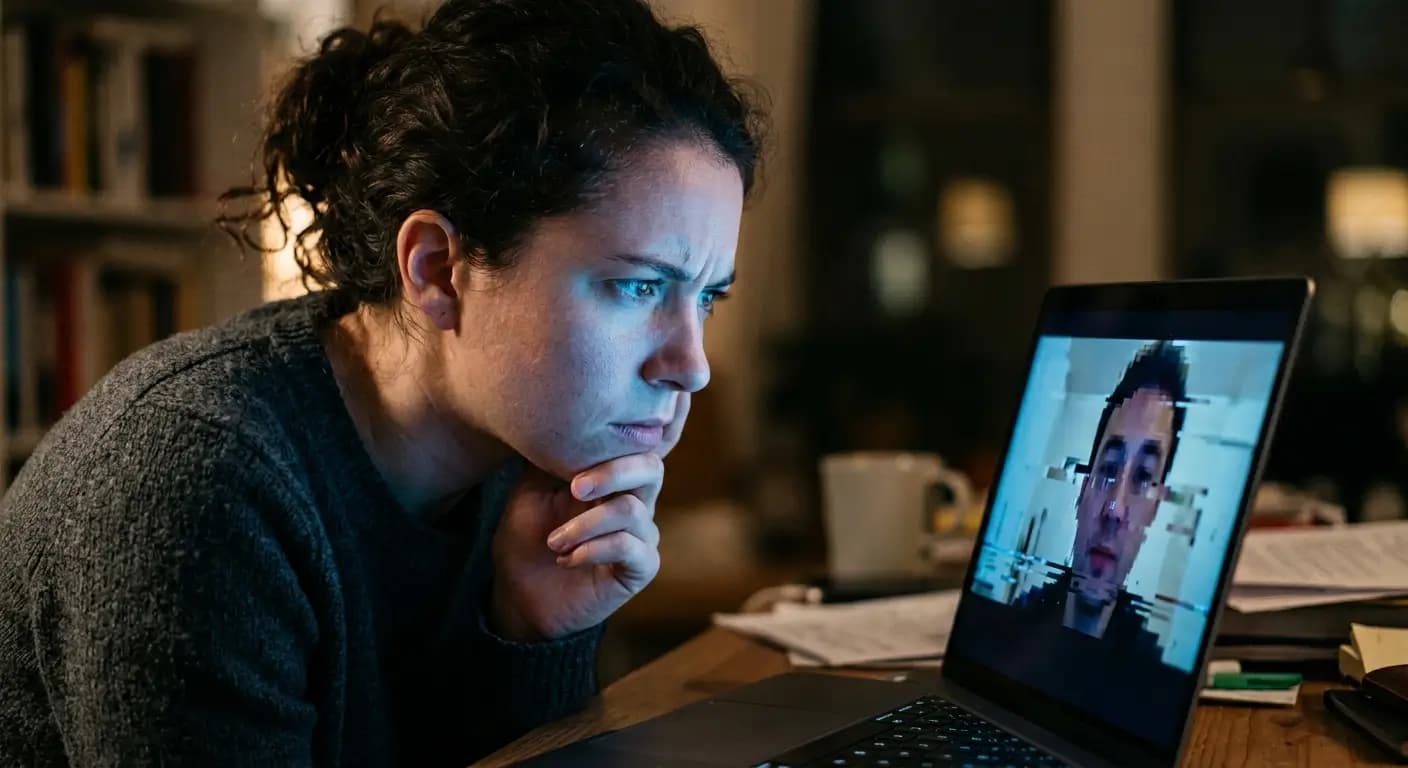
A video starts circulating of a well known business leader calmly explaining a new investment opportunity, urging people to send money before a deadline. The voice sounds right. The face sounds right. Thousands of people share it before anyone realizes the person in the video never said a single word of it. By the time it gets debunked, the damage, both financial and reputational, is already done.
This is not a rare fluke anymore. It is becoming a routine Tuesday on the internet, and the uncomfortable truth is that the advice most people still rely on to spot a fake, like checking for weird teeth or off lighting, stopped working a while ago. The technology moved on. Your detection skills need to move with it.
Why The Old Advice Quietly Stopped Working
For a few years, spotting a deepfake felt almost manageable if you knew the classic tells. Strange blinking patterns. Blurry edges around the face. Teeth that looked like a single white block instead of individual teeth. Lighting that did not quite match the room.
Those tells made sense when deepfake tools were crude. They are far less reliable now. Modern generation models have specifically improved on exactly the flaws that used to give them away, which means a video built on the latest tools can sail right past someone using outdated checklists. The honest starting point for anyone learning this skill in 2026 is accepting that the easy, obvious red flags from a couple of years ago are mostly gone. What is left are subtler failures, the kind that happen at the edges of physics and human behavior rather than in the broad strokes most people were trained to notice.
The Asymmetry You Are Up Against
Before getting into what to actually look for, it helps to understand the uneven playing field you are working with. Producing a convincing fake video now takes minutes and costs almost nothing using freely available tools. Proving conclusively that a video is fake can take hours of careful frame by frame analysis, specialized software, and sometimes expertise most ordinary people simply do not have. That asymmetry is not going away anytime soon, and it means your goal should not be airtight forensic certainty. It should be building enough reasonable suspicion to pause, verify, and avoid acting impulsively on something that turns out to be fabricated.
Watch the Eyes First
Real human blinking follows a natural, slightly irregular rhythm, typically every few seconds, varying based on mood, lighting, and fatigue. Many synthetic videos still struggle to fully replicate this irregularity, either blinking too rarely, too uniformly, or in a way that feels subtly mechanical once you are paying close attention. This is not foolproof on its own, since newer models have improved here too, but unnatural blinking remains one of the more accessible tells for an untrained eye to catch with a bit of practice.
Turn the Head and Watch What Breaks
Most deepfake models are trained heavily on front facing footage, since that is the most commonly available training data. This creates a genuine weakness. When a synthetic face turns toward a profile angle, the rendering often becomes noticeably less stable. Watch the ear closely during a turn. Watch where the jawline meets the neck. Watch whether glasses sit naturally on the face or seem to melt slightly into the skin around them. These transitional moments, where a face moves away from straight on, are still some of the hardest things for current generation models to render convincingly, and they remain one of your most reliable practical checks.
Listen As Carefully As You Watch
Audio carries just as many tells as video, and most people forget to actually listen critically. Real human speech includes natural breathing, and that breathing happens at believable, slightly irregular moments tied to sentence structure and pauses. Synthetic audio sometimes inserts breath sounds at oddly mistimed points, or repeats an identical breath sound more than once, which a human voice never quite does the same way twice.
Pay attention to the acoustic environment too. If someone appears to be speaking outdoors, in a busy office, or in a noisy public space, but the audio sounds unnaturally clean and studio quiet, that mismatch is worth noticing. Real recordings carry the texture of the room they were captured in. A perfectly silent backdrop behind a supposedly real world recording is a meaningful signal that something was generated rather than captured.
Check the Small Physical Details
Some of the most reliable remaining tells live in small, easily overlooked details rather than the face as a whole. Jewelry can flicker, shift, or disappear briefly as a head moves, since accessories are computationally expensive to render consistently across every frame. Hair sometimes moves as a single solid clump rather than individual strands catching light and motion the way real hair does. Skin texture is another giveaway, with some synthetic faces looking unusually smooth and waxy, missing the natural pores, small blemishes, and texture variation visible in genuine high resolution footage.
If you have the ability to pause and step through a video frame by frame, look for flickering inconsistencies between consecutive frames, things like a mole that briefly vanishes, a freckle that shifts position, or skin tone that subtly changes at the boundary where a face meets hair or background. These inconsistencies are often invisible at normal playback speed and become much more obvious once you slow things down.
Think About Light Like a Detective
One of the more advanced but genuinely effective checks involves thinking carefully about how light should behave in a real physical space. In any authentic scene, parallel lines, like the edge of a desk, a hallway, or a window frame, should all converge toward the same vanishing point. Generated video sometimes gets this geometry subtly wrong, producing conflicting vanishing points within a single frame that feel slightly off even if you cannot immediately articulate why.
Shadows deserve the same scrutiny. If a person appears to move closer to a window or light source, the shadows and highlights on their face should shift accordingly. A real, documented deepfake incident involving a sitting head of state showed exactly this flaw, where the lighting on the speaker's face stayed perfectly consistent even as he appeared to move directly in front of a window, which is simply not how light behaves in the real world. If something about a video feels visually correct but emotionally off, mismatched lighting and shadow behavior is often the hidden reason why.
Step Back and Look at the Whole Scene
Sometimes the most obvious failures are not in the face at all. They show up in how a person fits, or fails to fit, into their surroundings. A synthesized speaker can look slightly pasted into a background, with lighting on their body that does not quite match the lighting sources visible in the room around them. Stepping back from the details and asking whether the whole scene feels physically coherent, rather than fixating purely on facial features, often reveals problems that close up analysis alone would miss.
Why This Matters More If You Are in Nigeria or Anywhere in Africa
This is not a distant, hypothetical problem for African audiences. Synthetic audio and video have already been used during recent election cycles across the continent to inflame ethnic and regional tensions, with fabricated clips timed deliberately to spread when emotions were running highest and critical thinking was at its weakest. Prominent Nigerian public figures, including respected business leaders, medical voices, and global officials, have had their likeness used without consent to promote fraudulent investment schemes and fake medical cures. Public figures in entertainment have also been targeted with fabricated footage used for harassment.
The old scam patterns familiar to anyone who has used the internet for more than a decade have not disappeared. They have simply been upgraded, replacing crudely written scam emails with high fidelity video featuring a face you actually recognize and trust. That trust is exactly what makes this version of the scam so much more effective, and exactly why building real detection habits matters more here than almost anywhere else right now.
The One Defense That Actually Works Every Time
Here is the part worth remembering above everything else in this guide. Visual analysis, no matter how sharp you get at it, is always playing catch up against generation technology that keeps improving. The one defense that remains reliable regardless of how convincing a fake becomes is verification through a separate, independent channel.
If a video, voice note, or call appears to be from a family member, employer, or public figure asking for money, sensitive information, or urgent action, do not respond within that same channel. Reach out through a phone number, account, or contact method you already know is genuine, completely separate from wherever the suspicious content arrived. Some families have started agreeing on a private safe word or phrase in advance, something only real family members would know, specifically to verify identity quickly during a suspicious call without needing any technical analysis at all. This kind of low tech, out of band verification remains the single most reliable defense against a convincing real time impersonation, because it does not depend on you catching a subtle visual flaw under pressure.
Should You Rely on Detection Tools
Several tools exist that claim to analyze uploaded video for signs of manipulation, scanning for compression artifacts, pixel level inconsistencies, and metadata irregularities. Some of these tools are genuinely useful as a quick first pass, especially free options that let you upload a clip and get an instant likelihood score.
Treat any single tool's result as one data point rather than a verdict. The same generative models creating convincing fakes are increasingly trained specifically to defeat existing detection algorithms, which means a high confidence real score from one tool is not a guarantee of authenticity. Combining a detection tool's output with your own careful visual and audio review, plus independent verification through a separate channel when anything important is at stake, gives you a far stronger layered defense than relying on any single method alone.
Building the Habit, Not Just the Checklist
The most useful thing you can take from all of this is not a static checklist, because the specific tells will keep shifting as the technology improves. What matters more is building a habit of healthy skepticism toward emotionally charged or urgent content, especially anything asking you to act quickly, send money, or share sensitive information based on a video or voice recording alone.
Slow down before sharing anything that triggered a strong emotional reaction. Ask whether the claim matches what you already know about the person or situation from verified sources. Look closely at edges, transitions, lighting, and small physical details rather than just the overall impression a video gives you at a glance. And whenever something genuinely important is on the line, verify through a channel that has nothing to do with the suspicious content itself.
Deepfake technology is not going to stop improving, and detection will likely always be playing some degree of catch up. But the gap between someone who has never thought critically about this and someone who has built even a basic, practiced sense of skepticism is enormous. You do not need to become a forensic expert. You just need to stop assuming that seeing is the same thing as believing, because in 2026, it genuinely is not anymore.