
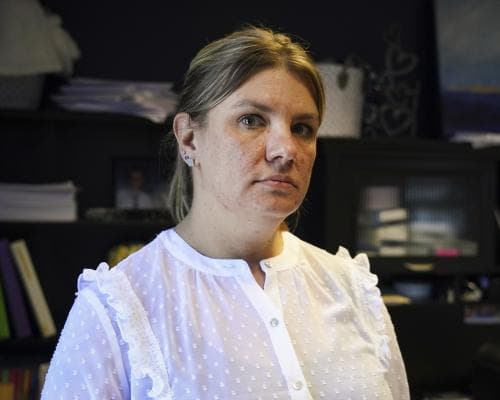
A federal judge has handed down a sentence of nearly 42 years in prison to Aimee Bock, the founder of Feeding Our Future, for masterminding the largest pandemic-related fraud scheme in the United States. The sentencing, which took place on Thursday, follows a complex plot that exploited federal child nutrition programs to the tune of $250 million. This scheme not only had far-reaching consequences but also became a focal point in the immigration crackdown led by former President Donald Trump in Minnesota, resulting in violent protests and the tragic deaths of two Americans, Renee Good and Alex Pretti, at the hands of ICE.
Prosecutors had initially requested a 50-year sentence, emphasizing that Bock's crimes, which included conspiracy, wire fraud, and bribery, had diverted millions of dollars intended to feed children during the Covid-19 pandemic, causing "profound" damage that would resonate far beyond the state of Minnesota. In a statement made in federal court, Bock expressed remorse, stating, "I understand I failed. I failed the public, my family, everyone." She further added, "I don't have the words to express just how horrible I feel... I know I'm responsible. It's never been my goal to shift responsibility. I understand I failed to protect the program I was supposed to protect."
According to prosecutors, Feeding Our Future operated as a "cash pipeline, open to anyone willing to submit fraudulent claims and pay kickbacks." The organization's actions had a ripple effect, causing immeasurable and lasting consequences for both Minnesota and the nation. Bock was convicted last year on multiple counts involving conspiracy, wire fraud, and bribery, despite her initial claims of innocence. In 2022, she told the Minnesota Star Tribune, "I believe that this is an attack on a community... I believe this is punishment for going against the grain. And I think it is punishment for holding a state agency accountable."
Bock's lawyer, Kenneth Udoibok, argued for a significantly shorter sentence, citing his client's cooperation with investigators. Udoibok characterized Bock's actions as a "case of gross negligence," stating, "I'm not saying she's not taking responsibility... What I'm saying is – if I can project the court to what Ms. Bock intended to do for this group of people – in her mind, she thought she was giving them access to being good citizens and being in this program."
The non-profit organization at the center of the scheme was part of a larger fraud network that included a web of partner organizations, fake distribution sites, kickbacks, and fictitious lists of children supposedly being fed. Dozens of individuals, many from Minnesota's sizable Somali community, have been convicted for their roles in a series of overlapping food fraud cases that have been ongoing for years.
During the sentencing, Assistant US Attorney Rebecca Kline stated that Bock "didn't participate in fraud, she orchestrated it, profited from it." Kline further emphasized that Bock "acted as a gatekeeper" and "had an integral role in planning the scheme." Meanwhile, authorities have filed additional charges against other individuals in a sprawling investigation into federal social service spending in Minnesota.
One of the targets of the investigation is Fahima Mahamud, the former CEO of Future Leaders Early Learning Center, a childcare center in Minneapolis. Mahamud's organization was reimbursed approximately $4.6 million for services provided on behalf of individuals who did not make the required copayment, according to prosecutors. Mahamud was charged separately in February with fraud related to meals and has pleaded not guilty.
Two other individuals were charged with conspiring to receive $975,000 in Medicaid subsidies for housing services that were not provided. They are expected to plead guilty in June, according to a court filing. Additionally, two people were accused of receiving $21.1 million by billing Medicaid for autism therapy that was either unnecessary or not provided. Investigators alleged that they paid families as much as $1,500 per child per month to add their names to the program and receive reimbursement.
Speaking at a press conference led by the Justice Department, US Attorney Daniel Rosen stated, "While that fraud in and of itself was breathtaking, the truth is Feeding Our Future is only a start, and we believe it's only a small fraction of the fraud that is actually ongoing here in the state of Minnesota." Addressing the Health Secretary and the Administrator for the Centers for Medicare and Medicaid Services, Rosen pledged to "defuse, to deter future thefts from your department and from your agency to recover as much of the losses as we possibly can and to put the thieves here in Minnesota into prison."
The case has drawn attention from former President Trump, who has long been critical of the Somali community in Minnesota. Last year, Trump blasted the state as "a hub of fraudulent money laundering activity" and criticized the leadership of Governor Tim Walz. Trump also froze Minnesota's childcare funding over alleged fraud within the state's social services program, particularly in Minneapolis's Somali American childcare centers.
The pursuit of fraud cases in Minnesota has been a contentious issue, with Governor Walz accusing Trump of "politicizing the issue" and targeting Somali American communities. The controversy surrounding the case has had significant implications, with Walz announcing his decision to quit his bid for a third term as governor in January. Explaining his decision, Walz stated, "Every minute I spend defending my own political interests would be a minute I can't spend defending the people of Minnesota against the criminals who prey on our generosity and the cynics who prey on our differences."
The sentencing of Aimee Bock and the ongoing investigation into federal social service spending in Minnesota serve as a reminder of the importance of accountability and transparency in government programs. The case highlights the need for robust oversight and enforcement mechanisms to prevent fraud and ensure that public funds are used for their intended purposes. As the investigation continues to unfold, it is likely that more individuals will be held accountable for their roles in the scheme, and the people of Minnesota can expect a more rigorous approach to preventing fraud and protecting public resources.