
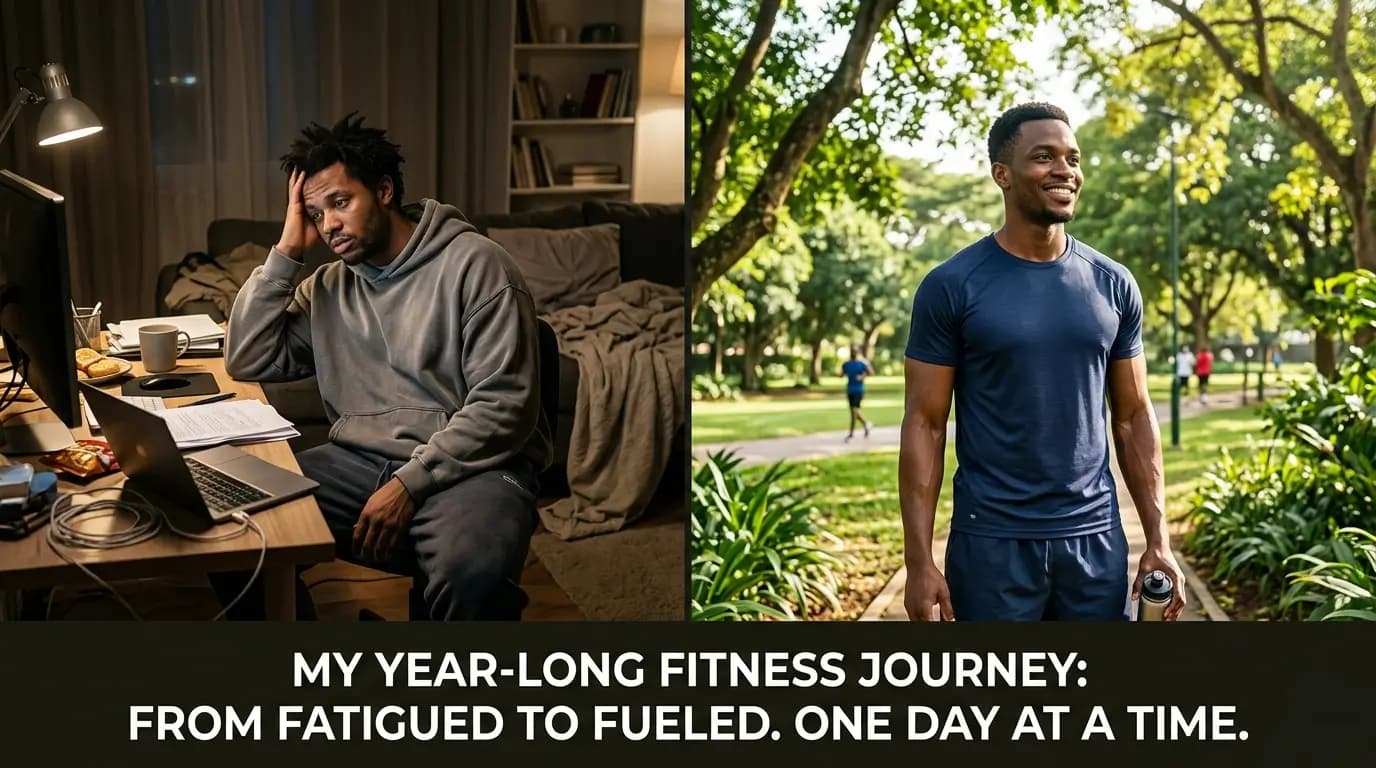
I want you to picture the version of me that existed fourteen months ago.
I am sitting at my desk at 11 PM, surrounded by takeout containers, three empty coffee cups, and a television playing something I stopped paying attention to two hours ago. My back hurts. My knees ache when I climb the single flight of stairs to my apartment. I am thirty-one years old and I feel sixty. My resting heart rate is embarrassingly high. My energy crashes by 2 PM every single day without fail. I have not broken a genuine sweat from physical exertion in somewhere between two and three years.
That was not a rock bottom moment. That is what makes it even more unsettling. That was just a Tuesday.
This is the story of how I went from that Tuesday to running a 5K without stopping, losing twenty-six pounds, gaining muscle I genuinely did not believe my body was capable of building, and more importantly, becoming the kind of person who actually enjoys moving. I am going to tell you everything. The embarrassing stuff. The moments I quit and restarted. The things that worked and the programs that did absolutely nothing for me. And yes, the progress photos that I almost did not take because I was too ashamed of how I looked at the start.
Why I Was So Sedentary in the First Place
Before we get to transformation content, I think it is worth being honest about how sedentary life actually happens, because it rarely comes from laziness. I had a demanding remote job that kept me seated for nine to eleven hours a day. I was in a long period of low mood that made every task feel heavier than it needed to be. I had tried three different gym memberships over five years and abandoned all of them within six weeks each time. The pattern was always the same: start too hard, feel out of place, get injured or exhausted, stop.
I was not unmotivated in other areas of my life. I cooked my own food most of the time. I read consistently. I was good at my job. But fitness felt like a foreign language that everyone else had learned in childhood and I had somehow missed entirely.
The turning point was not a dramatic event. My younger sister visited for a weekend and we tried to take a walk along a nearby trail that she described as easy. I was out of breath within eight minutes. She did not say anything unkind. She did not need to. I felt the gap between who I was and who I wanted to be in a way that landed differently than it ever had before.
I drove home that Sunday evening and made one decision. Not a dramatic resolution. Not a gym membership purchase. Just one decision: I would walk for twenty minutes every day for the next thirty days, and I would not try to do anything else.
Month One and Two: Walking Was Harder Than I Expected
I have read enough fitness content to know that walking gets undersold as a starting point. Influencers move past it quickly to get to the more photogenic workouts. But for someone truly sedentary, walking every single day is a real commitment, and the first two weeks revealed how deconditioned I actually was.
The first week I was sore. Not in the way people get sore from lifting. Just a general fatigue in my legs and hips that told me these muscles had been sleeping for years. My pace was slow. I felt mildly ridiculous walking through my neighborhood at a snail's speed while joggers glided past me.
But I kept the one rule: twenty minutes, every day. No performance metrics. No pace targets. No calorie tracking. Just show up and move.
By week three something shifted. I stopped dreading the walk. I started extending it slightly, not because I forced myself to, but because turning back started to feel like an interruption. By the end of month two I was walking forty to fifty minutes most days, and I had lost four pounds without changing a single thing about my diet.
The photos I took at day one and day sixty do not look dramatically different. But they represent something real: I had broken a years-long streak of complete physical inactivity, and I had not quit.
Month Three: Adding Strength Training Without Hating Myself
I decided in month three to add bodyweight strength training twice a week. I want to be specific here because vague advice is useless: I started with a routine consisting of wall push-ups, chair-assisted squats, standing hip hinges, and a fifteen-second plank hold. That is it. Nothing more.
I chose bodyweight work at home because the gym still felt like a place where I would feel exposed and incompetent. That feeling is real for a lot of people and pretending it does not exist helps no one. My living room was a judgment-free space where I could do four wall push-ups and not feel watched.
By the end of month three I was doing modified knee push-ups. By the end of month four I did my first real push-up. I celebrated that push-up more than most things I have accomplished in my adult life and I refuse to be embarrassed about that.
This is also when I started paying attention to protein. Not obsessively, not with apps or precise calculations, but I began making sure every meal included a meaningful source of protein: eggs, chicken, legumes, Greek yogurt, cottage cheese. This one habit changed my energy, my recovery, and eventually my body composition more than almost anything else I did.
Month Four Through Six: The Plateau That Almost Broke Me
The six-week period between months four and six is the one I almost did not include in this post because it is not flattering. I stopped losing weight. My workouts felt stagnant. I increased my walking distance but my body had adapted and the results had flattened. I skipped strength training four times in a row, which became eight times, and I started wondering if I was just a person who would always struggle with this.
I did not quit entirely. That is the only thing that saved the journey. I maintained the walking habit even when I dropped the strength work, because it had become genuinely automatic by then. And eventually, after about six weeks of this plateau, I made two changes.
First, I joined a beginner group fitness class at a local community center rather than a commercial gym. The environment was completely different: people of all ages and sizes, an instructor who did not make me feel like a burden, and a social component that changed my accountability in ways I had not expected. Second, I hired a nutritionist for a single one-hour consultation. Not ongoing coaching, just one session to look at my eating patterns. She pointed out that I was eating too little on active days, which was suppressing my recovery and likely affecting my results.
Within three weeks of those two changes, the scale started moving again and more importantly my strength began climbing visibly.
Month Seven Through Nine: The Phase Where It Started Feeling Like Mine
This is the section I find hardest to write because the changes became more internal than physical, and those are harder to explain.
Somewhere in month seven I noticed that I was making activity-related choices without deliberating over them. I took the stairs automatically. I suggested walking meetings with a colleague I work with locally. I woke up at 6:30 AM on a Saturday not because I had set an alarm but because my body was no longer comfortable lying still for eleven hours.
I started running during this period. Jogging, really, mixed with walking, using a beginner interval program that alternated ninety seconds of jogging with two minutes of walking. My first jogging interval felt like a near-death experience in the best possible way. Six weeks later I ran for twenty minutes without stopping for the first time in my adult life. I sat on a bench afterward and felt something I can only describe as disbelief at my own body.
My nine-month progress photos are the ones I am most proud of, not because the transformation is the most dramatic in isolation but because I know what those photos represent in terms of consistency, small decisions made under fatigue and low motivation, and a relationship with my body that was beginning to shift from adversarial to collaborative.
Month Ten Through Twelve: Finishing Strong and Redefining the Goal
The final quarter of the year brought the most physical changes but also the most important mindset shift: I stopped treating fitness as a destination.
In month ten I completed my first official 5K race. My time was not impressive by any competitive standard. I do not care even slightly. I crossed a finish line in an event where a year earlier I could not walk for eight minutes on an easy trail without losing my breath.
In months eleven and twelve I began lifting weights at an actual gym. By this point the self-consciousness had largely dissolved, replaced by genuine curiosity about what my body could do. I was not the fittest person in the gym and I was not the least fit person either. I was just someone who showed up.
The final before-and-after photos show a twenty-six pound reduction in body weight, visible muscle development in my arms and shoulders, and what I can only describe as a different posture, not just physically but in the way I carry myself in photographs. People who know me have used words like "transformed," "unrecognizable," and "glowing." I prefer to think of it differently. I just look like someone who believes they deserve to take up space.
What Actually Made the Difference
After a year of trial and error, these are the things that genuinely moved the needle:
Starting absurdly small was the foundation of everything. Every previous attempt failed because I started at a level that was unsustainable. Starting with twenty minutes of walking felt too easy, and that was exactly the point.
Protecting the minimum on hard days was more valuable than performing on good days. There were days I walked for twenty minutes in the rain because I refused to let a bad day become a broken habit. That consistency compounded in ways that nothing else could replicate.
Protein intake transformed my recovery speed and my ability to build muscle in a way that no supplement ever came close to matching.
Community, even in small doses, changed my accountability completely. The group class was more valuable than three months of solo gym sessions.
Progress photos, despite my initial resistance, became one of my most powerful tools. The changes are too gradual to perceive day to day. But comparing month one to month six to month twelve produced a visual record of change that kept me going through every plateau and setback.
What the Next Year Looks Like
I am not done. That is the most important thing I can tell you. There is no finish line I am approaching where I get to stop being active and return to my old life. This year changed what my default setting is. Movement is now something I protect because I understand what my life feels like without it and I am not willing to go back.
If you are reading this from a Tuesday evening that looks like mine did fourteen months ago, I want you to know that the gap between where you are and where you want to be is crossable. Not in a motivational poster way. In a very practical, unglamorous, one-twenty-minute-walk-at-a-time way.
You do not need to overhaul your life this week. You just need to protect one small decision for the next thirty days and trust that the compound interest of that consistency will eventually show up in your body, your energy, and your relationship with yourself in ways you cannot yet imagine.
Start small. Start today. Take the photo you are embarrassed to take.
Twelve months from now, that photo will be the one you are most grateful you have.