
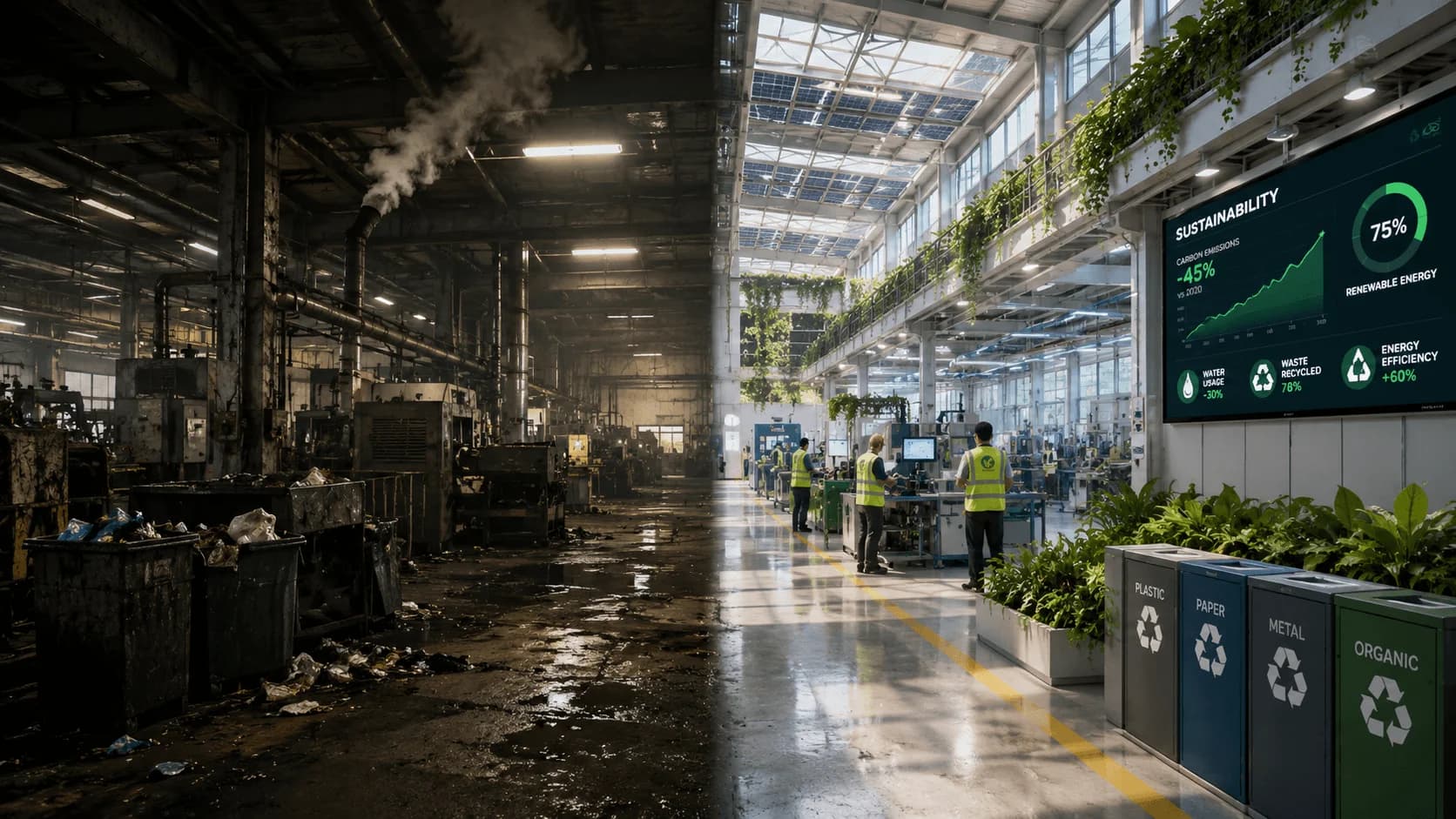
Twelve months ago, Hartwell Industries was hemorrhaging money, poisoning its own future, and had no idea how close it was to becoming irrelevant.
Their energy bills were staggering. Their waste output was embarrassing. Their supply chain was a tangle of inefficiencies that cost them more every quarter. Leadership knew something was fundamentally broken, but the mountain of change in front of them felt impossible to climb.
Then they made one decision that changed everything.
Within 12 months, Hartwell had slashed its carbon emissions by 47 percent, reduced operational waste by 61 percent, cut energy costs by a third, and earned a sustainability certification that opened doors to contracts they had never been able to compete for before. Their story is not a fairy tale. It is a documented, repeatable blueprint that any organization willing to commit can follow.
This is exactly how they did it.
The Wake-Up Call: Why Doing Nothing Was No Longer an Option
For years, Hartwell operated the way most mid-sized manufacturers operate: reactively. They responded to problems as they appeared, patched inefficiencies when they became painful, and treated sustainability as something for the press release rather than the operations floor.
The breaking point arrived in the form of three simultaneous pressures that could not be ignored any longer.
First, energy costs had risen so dramatically that profit margins were visibly shrinking quarter over quarter. Second, a major enterprise client had informed Hartwell that their vendor qualification process would now include environmental impact assessments, and Hartwell would not pass. Third, a newly appointed Chief Operations Officer walked the production floor on her first day and described what she saw in a single word that spread through the entire executive team: unsustainable.
The choice was no longer between changing or staying comfortable. It was between transforming or becoming obsolete.
Phase One: The Sustainability Audit (Months 1 and 2)
You cannot fix what you refuse to measure: This became the internal mantra during the first two months of Hartwell's transformation. Before a single process was changed, the team commissioned a comprehensive operational sustainability audit that examined every corner of the business with unflinching honesty.
The audit covered five critical areas: energy consumption patterns, water usage and waste, supply chain sourcing and transportation emissions, packaging materials and product lifecycle, and employee behavior and workplace culture around sustainability.
What they discovered was sobering but clarifying. Forty-two percent of their energy consumption came from just three pieces of aging equipment that were running inefficiently around the clock. Their packaging supplier was contributing more to their overall carbon footprint than their entire logistics operation. And no one in the building had been given clear guidance on waste sorting, recycling protocols, or energy-conscious behavior.
The audit turned a vague sense of crisis into a precise, actionable roadmap: Every subsequent phase of the transformation was rooted in the specific data the audit revealed. Without this foundation, every effort that followed would have been guesswork.
What This Means for Your Business
Commission a full operational sustainability audit before making a single change. Bring in an independent third-party assessor who will surface problems internal teams are too close to see. The cost of the audit is insignificant compared to the cost of implementing changes in the wrong areas.
Phase Two: Energy Transformation (Months 3 and 4)
Armed with data, Hartwell moved immediately on their single biggest opportunity: energy. The three energy draining machines identified in the audit were replaced with modern, energy efficient alternatives. The initial capital investment was significant, but the financial modeling showed full return on investment within 22 months.
Solar panel installation began on month three: The company's roof space was assessed and a phased solar energy system was installed, beginning with the sections of the facility that consumed the most power during daylight hours. By the end of month four, 28 percent of daytime energy needs were being met by on-site solar generation.
Smart energy management systems were installed throughout the facility. These systems monitored real time consumption, automatically reduced power to idle equipment, and flagged anomalies that indicated inefficiency or equipment malfunction. The operations team could now see exactly where every kilowatt was going.
Lighting across the entire facility was converted to LED with motion sensor controls in low-traffic areas. This single change alone reduced lighting energy costs by 34 percent and required no behavioral change from employees whatsoever.
The results after two months of energy focused transformation: Energy costs had dropped by 19 percent. Carbon emissions from energy consumption had fallen by 23 percent. And crucially, employee morale had measurably improved because leadership had demonstrated that change was not just being discussed but actively implemented.
What This Means for Your Business
Start with energy because it delivers the fastest and most measurable financial return. The cost savings from energy improvements fund subsequent phases of your sustainability transformation and build organizational confidence that the investment is worthwhile.
Phase Three: Supply Chain Revolution (Months 5 through 7)
The audit had revealed an uncomfortable truth about Hartwell's supply chain: many of the company's values were being directly undermined by the partners they chose to work with. Their three largest material suppliers had no environmental certifications, two operated in regions with minimal environmental regulation, and transportation routing had never been optimized for emissions reduction.
Hartwell made a bold and deliberate decision: They would not simply demand sustainability certificates from existing suppliers. They would rebuild supplier relationships from the ground up using environmental performance as a core selection criterion alongside quality and price.
Over three months, the procurement team conducted a thorough review of every supplier relationship. Some suppliers responded enthusiastically and provided detailed environmental performance data. Others could not or would not engage with the process. Those who could not meet the new baseline standards were respectfully transitioned out, and replacements were identified through a new supplier qualification framework that weighted environmental performance at 30 percent of the overall score.
Transportation and logistics were restructured entirely: A logistics specialist was brought in to map every shipment route and identify consolidation opportunities. The result was a 29 percent reduction in total transportation distances, a significant corresponding drop in fuel-related emissions, and cost savings that more than offset the specialist's fees.
Regional suppliers were prioritized wherever quality standards could be maintained. This reduced shipping distances, supported local economies, and gave Hartwell far greater supply chain resilience against global disruptions.
What This Means for Your Business
Your sustainability footprint does not end at your front door. The environmental performance of every supplier and logistics partner you work with is effectively your responsibility in the eyes of increasingly conscious consumers, regulators, and enterprise clients. Build sustainability criteria into every procurement decision you make.
Phase Four: Zero Waste Operations (Months 8 and 9)
Hartwell's waste problem had two dimensions: physical production waste and the cultural assumption that waste was simply a cost of doing business. Phase four targeted both simultaneously.
A waste stream analysis was conducted to categorize every type of waste the facility produced. What emerged was a clear hierarchy of waste types: material offcuts that could be repurposed or sold, packaging waste that could be eliminated through supplier agreement changes, food and organic waste from the staff cafeteria, and genuine residual waste that required responsible disposal.
A circular materials programme was launched immediately: Material offcuts from the production floor, previously sent directly to landfill, were assessed for repurposing potential. Smaller offcuts were sold to a network of local makers and small manufacturers. Larger offcuts were incorporated into an internal product line of sustainability demonstration products used at trade shows and client presentations. The programme generated modest revenue from materials that had previously cost money to dispose of.
Packaging was renegotiated with suppliers to eliminate unnecessary single-use plastics entirely. Where plastic was unavoidable, suppliers were required to use a minimum of 80 percent recycled content. Internal packaging for outgoing products was redesigned by the operations team using less material, with no reduction in protection performance.
The cafeteria became a surprising sustainability win: In partnership with a local composting company, all organic food waste was diverted from landfill and converted to compost, which was then donated to a community urban farm nearby. The story became a powerful piece of internal culture-building content that employees genuinely cared about and shared proudly.
By the end of month nine, total waste to landfill had been reduced by 61 percent. Waste disposal costs had dropped by 44 percent. And for the first time in the company's history, waste was being discussed not as an operational cost but as an operational opportunity.
What This Means for Your Business
Begin with a full waste stream audit before investing in bins, bags, or programmes. Know exactly what waste you produce, in what volumes, and at what cost before designing your zero waste strategy. The data will reveal opportunities invisible to the naked eye.
Phase Five: Building a Sustainability Culture (Months 10 and 11)
Systems and infrastructure can reduce waste and energy use significantly, but the deepest and most durable transformation happens at the level of human behaviour. Hartwell had learned this truth repeatedly throughout the first nine months. The best systems in the world underperform when the people operating them are not invested in the mission behind them.
A Sustainability Champions Programme was launched across every department: Each team nominated one champion who received dedicated training, was given a small budget for departmental sustainability initiatives, and met monthly with the COO and sustainability team to share progress, obstacles, and ideas. The champions became internal influencers and the programme transformed sustainability from a top-down directive into a ground-up identity.
New employee onboarding was redesigned to include a full half-day sustainability orientation. New hires learned the company's environmental commitments, saw the results already achieved, and understood specifically how their role connected to the broader sustainability mission. Research shows that values alignment at the point of hiring is one of the strongest predictors of long-term employee engagement, and Hartwell began seeing this reflected in lower early-stage turnover.
Internal communication became a sustainability storytelling vehicle: Monthly newsletters, digital screens throughout the facility, and team meeting agendas all incorporated sustainability milestones, challenges, and wins. The messaging was deliberately celebratory rather than directive. People were recognized publicly for sustainable behaviours and innovations. The culture shifted from compliance to pride.
A staff led innovation scheme called Green Forward was introduced, inviting employees at every level to submit sustainability improvement ideas. In the first three months of operation, 47 ideas were submitted. Eleven were implemented. Three generated measurable cost savings. One became the foundation of a new product feature.
What This Means for Your Business
Culture is not a soft initiative. It is the operating system on which every sustainability programme runs. Invest in it with the same rigour and budget seriousness you bring to infrastructure and technology.
Phase Six: Measuring, Certifying, and Reporting (Month 12)
The final phase was not about doing more. It was about proving what had already been done and building the systems to ensure the transformation was permanent rather than a single year of effort.
A third-party environmental performance assessment was commissioned: to validate the internal data Hartwell had been collecting throughout the year. The results confirmed and in several areas exceeded internal estimates. The company achieved ISO 14001 certification, an internationally recognized standard for environmental management systems that signalled to clients, investors, and the broader market that Hartwell's sustainability transformation was structural and not cosmetic.
An annual Sustainability Report was produced and published for the first time in company history. The report transparently documented baseline figures, targets set, results achieved, areas where progress fell short of targets, and commitments for the coming year. The honesty of the report, including the sections that acknowledged shortfalls, was specifically praised by enterprise clients who received it.
A sustainability performance scorecard was embedded into quarterly business reviews: at the board level, sitting alongside financial and operational metrics. Sustainability was no longer a special initiative. It was a core business performance dimension measured and reported with the same rigour as revenue and margin.
The 12-Month Results: By the Numbers
When the transformation year concluded, the results were presented to the full executive team and then to the entire company. The numbers told a story that had seemed impossible 12 months earlier.
Carbon emissions: had been reduced by 47 percent against the baseline year.
Energy costs: had fallen by 31 percent, generating annual savings that exceeded the total investment in the sustainability programme.
Waste to landfill: had been cut by 61 percent with associated disposal cost savings of 44 percent.
Supply chain emissions: had been reduced by 29 percent through logistics optimization and supplier transition.
Employee satisfaction scores: had increased by 18 percentage points, with sustainability values alignment cited by employees as a leading factor in their engagement.
Two new enterprise contracts: had been won directly as a result of the ISO 14001 certification, with a combined value that made the entire transformation programme profitable in year one.
Five Lessons Every Business Can Take From Hartwell's Transformation
The specifics of Hartwell's journey are unique to their industry and scale, but the principles behind their transformation apply universally to organizations of every size and sector.
Measure before you move: The audit was the foundation of everything. Without precise data, every subsequent effort would have been directional at best and counterproductive at worst. Invest in knowing your actual baseline before committing to a direction.
Target energy first: Energy improvements generate financial returns quickly, and those returns build both the budget and the organizational confidence to fund more complex transformation phases that take longer to show results.
Hold your supply chain accountable: Your sustainability story is only as credible as the partners you choose to do business with. Supplier standards must evolve alongside internal standards or the progress is an illusion.
Culture is not a bonus phase: Organizations that treat culture as the final item on the sustainability checklist consistently underperform against those that integrate people and values into every phase of the transformation from the very beginning.
Transparency builds trust faster than perfection: Hartwell's honest sustainability report, including the areas where they fell short, earned more credibility with clients and stakeholders than a polished document presenting only successes would ever have done.
Your Transformation Starts With One Decision
Hartwell Industries was not a special case. They were a perfectly ordinary organization that made an extraordinary commitment and backed it with a systematic, phased, data-driven approach over 12 disciplined months.
The challenge of sustainability can feel overwhelming from the outside. It is wide, complex, expensive, and politically charged even within organizations that genuinely want to change. But Hartwell's story proves that the overwhelm dissolves the moment you commit to a structure and take the first step.
You do not need to transform everything at once. You need a plan, the courage to begin, and the discipline to keep moving forward one phase at a time.
The companies that will lead their industries in the next decade are not the ones still debating whether sustainability matters. They are the ones already building the foundation that makes it inevitable.
The only question worth answering now is a simple one: when does your transformation begin?