
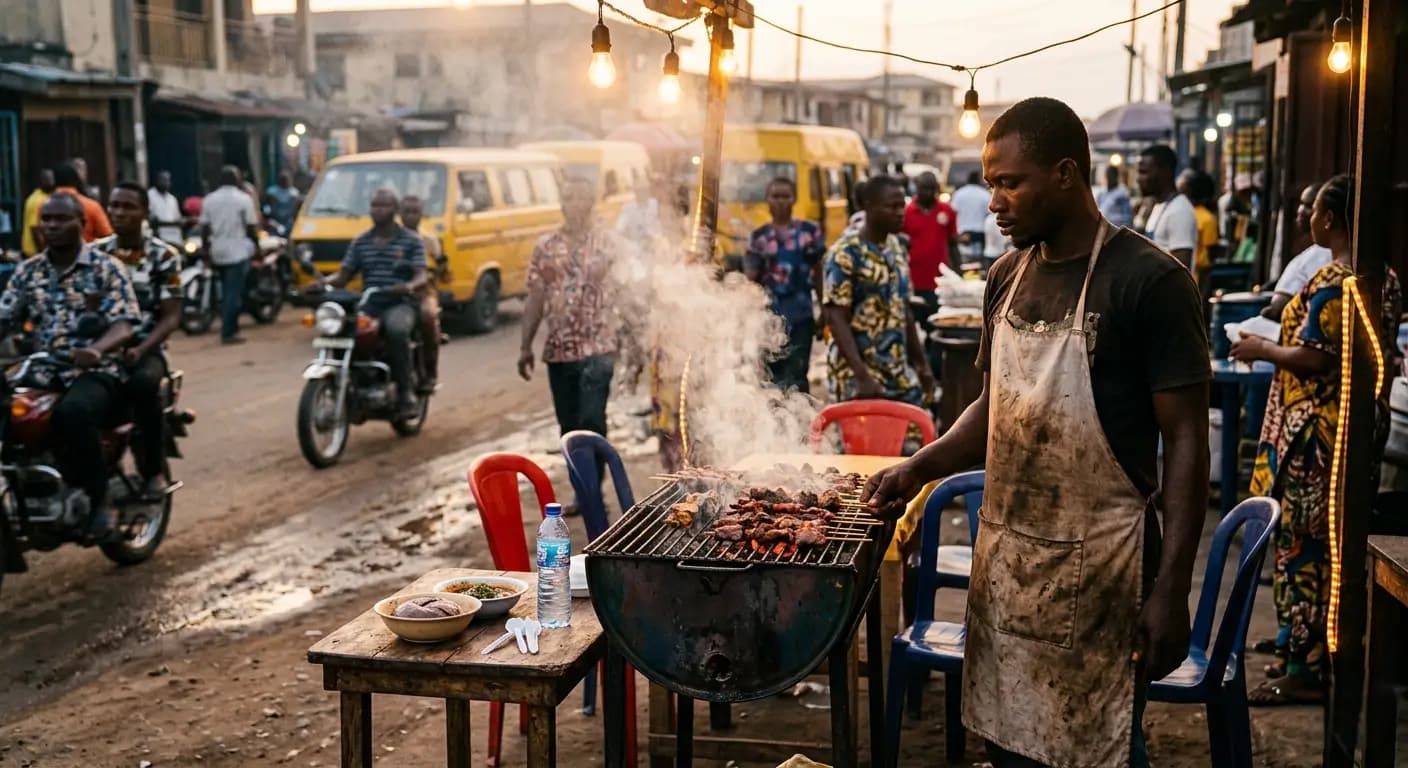
Forget everything the glossy travel blogs told you about eating in Lagos. The real food map of this city was never drawn around chandeliers and valet parking. It was drawn around plastic chairs, smoking grills, and aunties who have been perfecting one dish for thirty years without ever needing a menu printed in two languages.
If you have only eaten where the influencers post their geotags, you have missed the actual heartbeat of Lagos food culture. The dishes that built this city's reputation come from buka kitchens on busy mainland streets, suya stands that only wake up properly after dark, and beans sellers whose pots have fed three generations of the same family. This guide skips the obvious tourist circuit and goes straight to the spots that Lagosians themselves queue for.
Why Locals Eat Differently Than Visitors
Anyone new to Lagos tends to gravitate toward Victoria Island and Lekki because that is where the polished restaurants with English menus and air conditioning live. Locals know better. The food that actually defines Lagos identity often comes from a buka with no signage, a suya grill manned by the same person every single night for two decades, or a beans seller whose pot sells out by mid morning because regulars show up before the sun is properly up.
There is a phrase Lagosians use for this kind of place. They call it a spot, never a restaurant, because calling it a restaurant feels almost disrespectful to how personal and unpolished the experience actually is. A spot is run by someone whose face you will remember long after you forget the street name.
The Amala Circuit Every Lagosian Has an Opinion About
No food argument in Lagos runs hotter than the amala debate. Amala is smooth, slightly bitter yam flour swallow, almost always served with ewedu soup, gbegiri bean soup, and a thick stew loaded with assorted meat, and every Lagosian seems to have a personal favorite they will defend with surprising intensity.
On Lagos Island, Ghana High has been quietly serving its version of local classics since the late nineteen eighties, which in restaurant years makes it practically ancient royalty. Surulere carries serious weight in this conversation too, home to long running favorites like Olaiya Bukka and Amala Shitta, both known for amala so smooth it barely needs chewing, paired with a stew that regulars describe as the actual reason they keep coming back. Iya Eli, also in Surulere, has built its name on consistency rather than spectacle, which in a city this fast moving counts for a lot.
Mainland eaters swear by Ajisafe in Ikeja, a spot that has somehow become the unofficial benchmark for pepper rice, while Buka 99 in the same area handles its swallow and soup combinations with the kind of generous portions that make regulars loyal for years. Up in Agege, Ola Sheu has earned a reputation that travels well beyond its own neighborhood, with people crossing half the city just for a properly made plate of amala and ewedu. Near the university area in Yaba, Iya Moria's Canteen has become something of a tradition for students and staff who need a filling, affordable meal without sacrificing flavor.
What ties all of these spots together is the absence of pretension. Nobody is plating anything for a camera. The food simply works, and word travels through word of mouth in a way that no amount of paid advertising could replicate.
Suya After Dark, The Way It Was Meant To Be Eaten
If there is one food that unites every part of Lagos regardless of class or neighborhood, it is suya. Thin strips of spiced, grilled meat dusted in yaji pepper mix, served with raw onion and tomato, eaten standing up on a dark street while the smoke drifts into your clothes. Suya purists will tell you it should never be eaten before sunset, and most of the legendary spots simply do not bother opening until the evening crowd starts forming.
On Allen Avenue in Ikeja, what locals affectionately call the University of Suya has spent years building a reputation strong enough that people travel across the mainland just to stand in its smoke. Over on the Island, Glover Court Suya in Ikoyi has been running for more than two decades, serving a wide range that goes beyond beef into chicken, kidney, gizzard, and even northern delicacies like masa and kilishi for anyone wanting to round out the meal. Inside the grounds of the Lagos Polo Club, a quieter and more relaxed suya spot serves up chicken and gizzard that regulars rank among the best on the Island, proving that you do not need chaos and a long queue to deliver something exceptional.
Surulere holds its own with Akerele Suya, a grab and go operation with no seating but an organized system that keeps multiple grills working at once to handle the steady stream of customers. Out in Gbagada, a suya spot known locally for opening earlier than most, around ten in the morning rather than the typical evening start, has built a loyal following among residents who do not want to wait until nightfall to get their fix. Even Victoria Island, despite repeated attempts by city authorities to clear roadside kiosks, still has a beloved suya stand operating right across from one of the area's most recognizable hotels, simply because it has earned the kind of local protection that comes from being genuinely excellent for a very long time.
Ewa Agoyin, The Dish That Refuses To Disappear
There is something almost poetic about ewa agoyin. Soft mashed beans paired with a dark, smoky pepper sauce, traditionally eaten with agege bread, the soft pillowy loaf that has become as symbolically Lagos as the yellow danfo buses. The dish traces its roots back to the Agoyin people of Togo and Benin, and somehow it has become one of the few meals in this city that genuinely crosses every economic line. Wealthy executives and street hawkers both end up eating it the exact same way, straight from a wrap of paper, standing on the same corner.
The truest version of ewa agoyin in Lagos has never really lived inside a formal restaurant. It belongs to the itinerant sellers who walk specific routes every morning with their pots, and to small dedicated spots like Beans Palace in the Alagomeji area of Yaba, known for keeping that distinct smoky flavor alive at prices that have barely moved with inflation. For those who want a slightly more structured experience without losing the authenticity, a well known agoyin specialist operating out of the Oniru area has built enough of a following to take orders for delivery, something almost unheard of for a dish this rooted in street culture.
What Makes These Places Hidden Gems And Not Just Cheap Eats
It would be easy to dismiss all of this as simply budget food, but that misses the point entirely. These spots survive because they deliver something that money alone cannot manufacture overnight, which is decades of muscle memory in how a specific stew should taste, how long a specific cut of meat should sit on the grill, and how thick a specific pot of beans should be mashed. A new restaurant with a bigger budget cannot simply copy that. It has to be earned through years of repetition and reputation built one satisfied customer at a time.
This is also why so many of these places have remained physically humble even as their fame has grown. A plastic chair and a smoking grill do not need to evolve when the food itself is already doing all the talking. Locals are not embarrassed to eat standing on a street corner because the experience itself, smoke in your eyes, sauce on your fingers, the particular hum of a busy street at night, is part of what makes the meal memorable in the first place.
Tips Before You Go Hunting For These Spots
Many of these places operate without formal hours posted anywhere, so showing up earlier rather than later is almost always the smarter move, especially for amala and beans spots that frequently sell out before midday. Cash remains the most reliable way to pay at the majority of these locations, since card readers and transfer options are inconsistent even in 2026. Parking can be genuinely chaotic around the most popular suya stands, so arriving on foot or by rideshare drop off often saves a significant amount of frustration. And perhaps most importantly, go in with patience. Part of what makes these places special is that the food is made fresh in real time by people who are not rushing for anyone, and that unhurried rhythm is exactly the experience you came looking for.
The Real Lagos Is Served On A Plastic Plate
The next time someone asks where to eat in Lagos, skip the rooftop lounges and the imported wine lists for at least one meal. Find the smoke, follow the queue, and order whatever the regulars are having. That plate, eaten standing up on a busy street with sauce dripping onto your fingers, will teach you more about this city than any five star dining room ever could.