
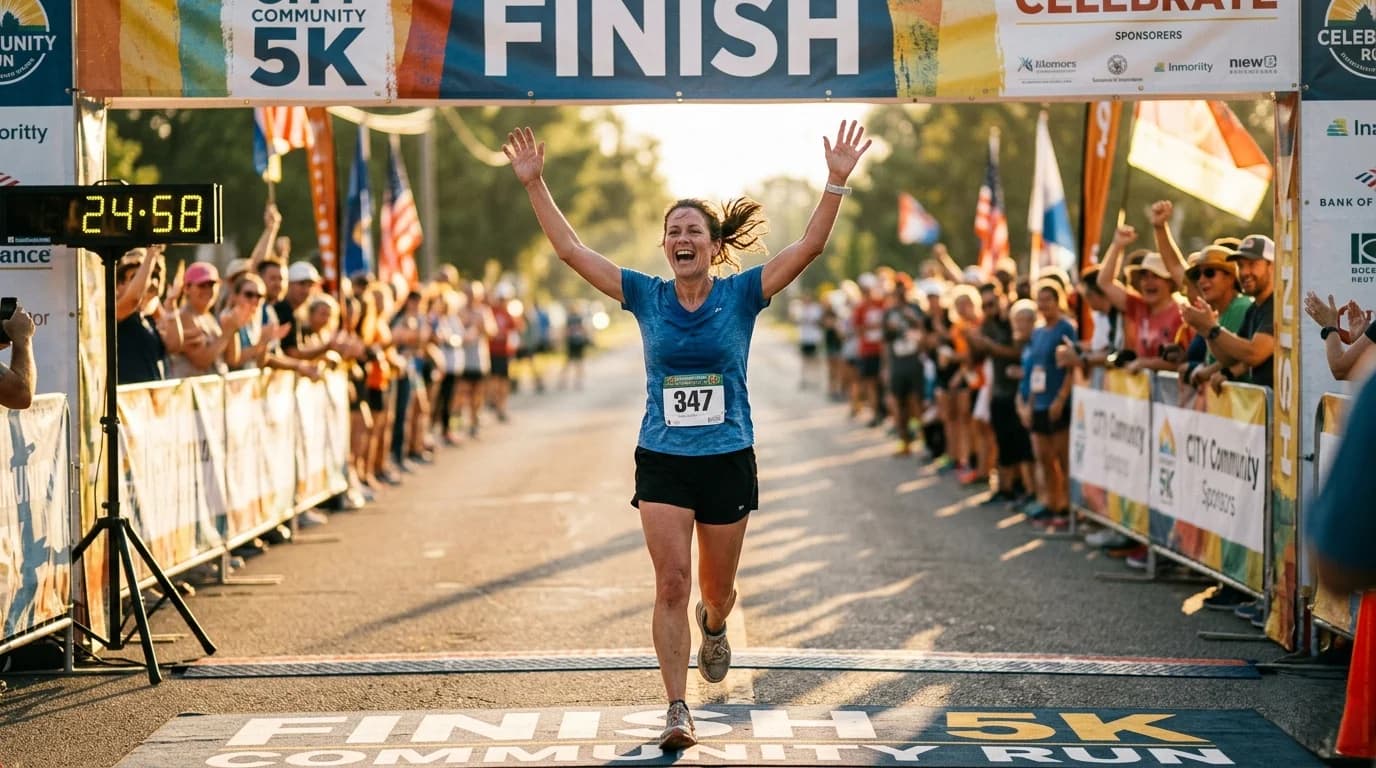
I crossed the finish line ugly. Mouth open, arms barely moving, legs screaming at me to stop. A twelve-year-old passed me in the final hundred meters and I did not care even slightly. Because eight months earlier, I could not run to the end of my street without stopping to catch my breath, and now here I was, 42 years old, completing my first 5K. I cried. An actual, embarrassing, snot-involved cry, right there in front of strangers holding bananas and foil blankets.
This is not a story about becoming a runner in your prime. This is a story about becoming one when everyone including your own knees had serious doubts.
Why 42? Why Now?
There was no dramatic health scare. No doctor delivering a warning across a white desk. It was an ordinary Tuesday afternoon when I watched my nine-year-old run around the park effortlessly for forty minutes while I sat on a bench pretending to check my phone, partly winded from walking up a gentle incline to get there.
Something shifted that afternoon. Not inspiration exactly. It was closer to embarrassment mixed with grief for the physical version of myself I had quietly let go of over the previous decade. I had convinced myself that slowing down was just part of getting older, that the body I had at 32 was simply not available to me anymore.
I signed up for a local 5K that same evening, giving myself eight months to prepare. I told my partner. I told a few friends. I made it public enough that backing out would require more courage than showing up.
Starting from Absolute Zero: The Honest Truth About My Fitness Level
Let me be precise about where I began. I had not run intentionally since my early thirties. My daily movement consisted of walking between my car, my desk, and my sofa. I was not overweight by clinical standards, but I was soft, slow, and breathless at inconvenient moments like stairs and chasing buses.
My first attempt at running lasted four minutes before a sharp stitch in my side convinced me I was dying. My second attempt lasted six minutes. My third attempt produced a blister and a deep personal resentment toward people in those bright technical running jackets who made it look effortless.
I downloaded a beginner running program built around walking and running intervals, starting with ninety seconds of running alternated with ninety seconds of walking. This felt almost insultingly easy when I read it. On the first day, those ninety second running intervals nearly finished me.
The Training Plan That Actually Worked for a Middle-Aged Beginner
I want to share the structure that took me from gasping after one block to completing 3.1 miles, because the approach matters enormously when you are starting late and your body has opinions about everything.
Weeks 1 and 2: Learning to Run Again Without Breaking
Three sessions per week. Each session alternated between sixty to ninety seconds of easy jogging and two minutes of walking, repeated eight times. The word easy is doing heavy lifting in that sentence. Easy meant slow enough to hold a conversation, slow enough that pedestrians could nearly walk at my pace. Speed was not the point. Consistency was.
I also did ten minutes of gentle stretching after every session, which felt unnecessary until the day I skipped it and spent the next morning walking like someone twice my age.
Weeks 3 and 4: Building the Running Intervals
Running intervals extended to three minutes, walking intervals shortened to ninety seconds. Still three sessions per week. I added one longer walk on weekends purely to keep my legs moving without adding impact stress.
By the end of week four, I ran for five consecutive minutes for the first time in years. I know that sounds trivial. It was not. It felt significant in a way that is hard to explain without sounding melodramatic.
Weeks 5 through 8: The Running Takes Over
Intervals shifted progressively toward running eight to ten minutes at a stretch with two minute walking breaks between sets. The sessions started to feel like actual running rather than survival exercises. I bought proper running shoes after developing pain in my right arch that a physio traced directly to my ancient trainers. The shoes cost more than I expected and fixed the problem almost instantly.
Weeks 9 through 14: Running Continuously
This phase was the psychological turning point. The program introduced twenty to twenty-five minute continuous runs at a conversational pace. The first time I ran for twenty minutes without stopping, I genuinely did not believe the timer. I checked it three times.
Weeks 15 through 20: Building to 5K Distance
Longer continuous runs, increasing gradually by no more than ten percent per week in distance. I ran my first unofficial 5K six weeks before race day. It took me forty-one minutes and I was exhausted afterward in a deeply satisfying way. I had proof. I could do it.
Race Minus Two Weeks: Tapering Down
Shorter, lighter sessions. The goal was to arrive at race day with fresh legs rather than proving fitness I had already established. This was harder mentally than physically. Easing back felt like losing ground.
The Setbacks That Almost Ended Everything
I want to be honest about this part because every running article I read while training made the journey sound smoother than mine was.
Setback One: The Knee
Six weeks into training, my left knee began to ache persistently after runs. Not sharply enough to stop me but insistently enough to worry me. I saw a physiotherapist who diagnosed runner's knee, a common overuse injury in new runners, and prescribed strengthening exercises for my hips and glutes, which were apparently doing nothing useful and forcing my knees to compensate for their absence.
I rested for ten days. I felt like I was losing everything I had built. I was not. The body adapts faster than you expect when you return after a short, smart rest.
Setback Two: The Cold That Lasted Three Weeks
Two months before race day I caught a chest infection that wiped me out for ten days and left me with a cough that persisted for a further two weeks. Running while coughing through every breath is not something I recommend, and my physio told me firmly that attempting to train through a respiratory illness was how injuries happened.
I lost almost three weeks of training. I recalculated my schedule, accepted that my finish time would be slower than I had hoped, and got back on the road when my lungs allowed it.
Setback Three: The Mental Wall at Week Twelve
Nobody warned me about this one. Around the three month mark, the initial motivation had faded completely and the event still felt far away. I missed four sessions in two weeks, not due to injury or illness but due to pure resistance. Getting out of the door felt unreasonably difficult. Everything felt harder than it should have.
I told a friend who had run several races. She said what I needed to hear without dressing it up: that every runner hits this wall, that training through it is what separates the people who show up on race day from those who do not, and that the feeling of not wanting to run almost always disappears within the first five minutes of actually running.
She was right. I wrote that reminder on a sticky note and put it on the back of my front door.
The Week Before Race Day
I cannot fully describe the anxiety of race week. It had nothing to do with the competitive aspect and everything to do with the fear of a very public failure. What if my knee went? What if I had to stop? What if I was last?
I laid out my kit three days early. I ate familiar foods and did not try anything new. I went to bed earlier than usual and lay awake longer than usual. I drove the route to the race start twice, which was completely unnecessary and somehow deeply reassuring.
My partner, who had watched me disappear out the door in the dark on cold mornings for eight months, told me the night before that I had already done the hard part.
Race Day: Every Messy, Beautiful Minute of It
The morning was cold and bright. There were several hundred runners at the start, ranging from people with racing bibs and heart rate monitors to children in tutus to elderly men with the calm, weathered expressions of people who had done this a hundred times. I felt simultaneously underprepared and exactly where I was supposed to be.
I started too fast. Everyone does, apparently. The energy of the crowd and the adrenaline in your system override your careful training pace within the first two hundred meters. By the time I noticed, I had gone out nearly a minute per kilometer faster than my training pace and my legs were already complaining about it by kilometer two.
I slowed down. I let people pass me. I talked myself through the middle kilometer the way I had practiced, telling myself I just needed to reach the next lamppost, then the next corner, then the next runner in the orange jacket ahead.
The last kilometer was something I will not forget. It hurt. My lungs were burning, my legs had stopped feeling like legs and started feeling like borrowed equipment I had no business operating. But the crowd along the final stretch was extraordinary. Strangers were cheering by name for people they had never met, reading bib names and calling them out like they knew each person personally.
I ran the final hundred meters faster than I had run anything in years. Not because I had energy reserves. Because I was finishing.
When I crossed the line, a volunteer put a medal around my neck. A plastic medal from a community 5K that cost less than my running socks. I looked at it for a long time.
My finish time was thirty-eight minutes and fifty-two seconds. I placed somewhere in the bottom third of the field. It was one of the best moments of my adult life.
What I Know Now That I Wish I Had Known at the Start
Start slower than you think you need to. The number one mistake new runners make is going out at a pace that feels natural but is actually too fast for building aerobic base. Slow down until it feels almost embarrassingly easy, and then run at that pace for months.
Strength training is not optional. Hip and glute weakness causes the majority of common running injuries in new runners. Two short sessions of bodyweight strength training per week would have prevented my knee issue entirely.
Rest days are training days. This was the hardest mindset shift. Rest is when adaptation happens. Skipping rest days does not make you more prepared. It makes you more injured.
Your pace is valid. Running culture can be oddly intimidating about speed. Thirty-nine minutes for a 5K is a real 5K finish. There is no qualifying pace for being a runner.
Tell people. Accountability is not weakness. It is strategy. The people I told became the people who asked how training was going, which made not training harder to justify to myself.
The forty at the gym said something I never expected. Midway through my training, a man in his mid-sixties at my gym asked if I was training for something. When I told him about the 5K, he said he had run his first marathon at sixty-one. He said the body is remarkably willing when the mind stops assuming the conversation is already over.
I think about that a lot.
For Anyone Who Is 35, or 45, or 55 and Thinking About Starting
You are not behind. There is no timeline you missed. The research on running benefits in adults over forty is genuinely encouraging. Bone density improves. Cardiovascular health improves. Cognitive function improves. Mood regulation improves. The adaptations your body makes are real regardless of the decade in which you start making them.
The finish line is not for a certain type of person or a certain type of body or a certain type of age. The finish line is for anyone willing to show up enough times to reach it.
You already have the most important qualification. You are considering it.
What Comes Next
I signed up for another 5K three days after finishing the first one. The goal this time is thirty-five minutes. Eventually I want to run a 10K. After that, possibly a half marathon, though my knees and I are still negotiating the terms of that conversation.
But more than any specific distance or time, what comes next is something simpler and more valuable than I expected when I sat on that park bench watching my nine-year-old run. What comes next is continuing to be someone who runs.
At 42, I became a runner. I cannot think of a better return on eight months of early mornings and sore legs.