
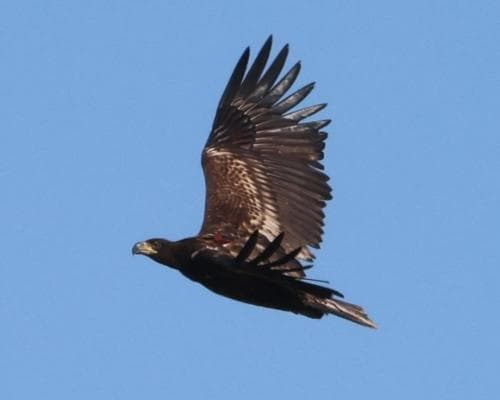
Six officers from the National Wildlife Crime Unit and North Yorkshire Police arrived at the Snilesworth estate in two pickup trucks last week. After consulting with a source, they proceeded to the moors to search for a missing white‑tailed eagle, the United Kingdom’s largest raptor with a wingspan of approximately 2.5 metres.
Snilesworth lies on the western edge of the North York Moors, an area celebrated for grouse, partridge and pheasant shooting and known for attracting affluent visitors from London. This time, however, the focus was a rare bird of prey that has become the centre of a national conservation effort.
The officers were tasked with locating a satellite‑tagged white‑tailed eagle that has been missing since late April. In a press release, North Yorkshire Police described the disappearance as suspicious and confirmed that an investigation is under way.
Since 2019 the Roy Dennis Wildlife Foundation, in partnership with Forestry England, has been re‑introducing white‑tailed eagles to the south coast. Historically the species was driven to extinction in England by human persecution, the last breeding pair disappearing in 1780. To date, 45 juvenile eagles have been released from the project’s base on the Isle of Wight, and in 2025 two birds successfully bred in Dorset – a first for the county in 240 years. The missing bird is a fully grown chick that has been monitored by a satellite tag since hatching.
The cause of the disappearance remains unknown, but the incident occurs against a backdrop of widespread raptor persecution in the United Kingdom. The Royal Society for the Protection of Birds reports 921 confirmed cases of illegal killing, trapping or poisoning of birds of prey between 2015 and 2024, with at least 55 percent occurring on or near land managed for game‑bird shooting. Experts consider the published figures to represent only a fraction of the true scale of the problem.
When the eagle was born last August, a lightweight satellite tag was attached to its back. The device recorded location and body temperature every five minutes and transmitted data twice daily. After a series of migrations that took the bird from the south coast to Scotland and back, the tag indicated that the eagle entered the North York Moors on 30 April. The final transmission, received at 1:20 a.m. on 1 May, showed the bird alive at a roost site. No further signals have been received.
Investigators visited the last known location but found no evidence of the bird. Estate staff assisted the Royal Society for the Protection of Birds in a ground search, which also yielded no trace. Mark Thomas, head of investigations at the RSPB, noted that North Yorkshire consistently records the highest number of bird‑crime incidents in the country. He suggested that the most probable explanation is a night‑time shooting, possibly using thermal‑imaging equipment, because the bird would have been stationary at the roost.
The RSPB’s investigative team recently secured a conviction for a gamekeeper and two accomplices who were recorded coordinating a hen‑harrier shooting on Grassington Moor. Thomas added that similar disappearances have occurred among other eagles released as part of the re‑introduction programme, with three birds reported missing last year in Wales, Scotland and Sussex.
Conservation advocates argue that the pattern of illegal persecution cannot be ignored. Dr Ruth Tingay, director of Wild Justice, called for additional police resources and stronger enforcement powers. Representatives of game‑keeping organisations urged restraint pending the outcome of the investigation. Marnie Lovejoy of the British Association for Shooting and Conservation expressed hope that the eagle is found alive and condemned any illegal killing of raptors. Camilla Swift of the National Gamekeepers Organisation emphasized that white‑tailed eagles have minimal impact on game‑bird populations and that there is no evidence linking a gamekeeper to this case.
Snilesworth estate management declined to comment. Andrew Gilruth, chief executive of the Moorland Association, warned against drawing conclusions from a loss of satellite signal, noting that technical failures, natural death or illness can also interrupt transmission.
The estate’s head gamekeeper, Charlie Woof, was preparing for a charity clay‑pigeon shoot when questioned about the missing eagle. He declined to comment, stating that he did not know anything about the incident. In 2008, while serving as a junior gamekeeper on the same estate, Woof was convicted of illegally trapping birds of prey using live pigeons as bait and was fined £100.
The investigation remains open. Police continue to appeal for information from the public, emphasizing that any knowledge of the eagle’s whereabouts could prove vital to resolving the case.