
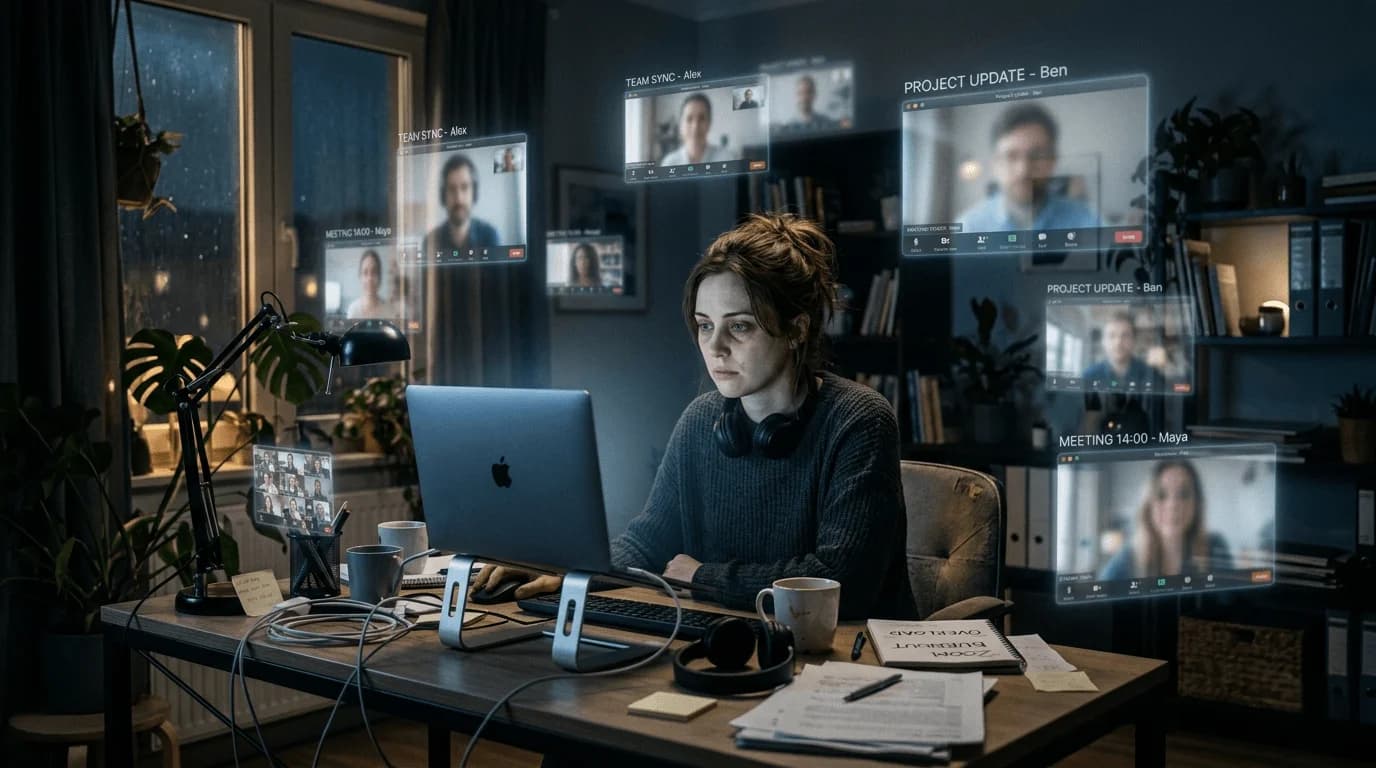
You thought working from home was the dream. No commute. No office politics. No one micromanaging your lunch break. But somewhere between your third video call before 10 a.m. and eating dinner at your desk again, something quietly broke.
It did not happen overnight. It crept in slowly, disguised as flexibility and freedom. And now, millions of remote workers worldwide are waking up to a reality nobody put in the job description: working from home can be deeply, profoundly costly to your mental and physical health.
This is not about being ungrateful for remote work. It is about being honest about what it is doing to people. And it is time we talked about it.
The Loneliness Nobody Warned You About
Loneliness is one of the most underreported and underestimated consequences of remote work. When offices shut down and kitchen tables became workstations, the casual hallway conversation, the quick coffee with a colleague, and the shared groan over a Monday morning disappeared almost overnight.
Research consistently shows that social isolation is not just emotionally painful. It is physiologically dangerous. Chronic loneliness is linked to increased levels of cortisol, weakened immune function, disrupted sleep, and a significantly elevated risk of cardiovascular disease. In fact, health experts have described loneliness as having an impact on physical health comparable to smoking fifteen cigarettes a day.
Remote workers often report feeling invisible. They complete their tasks, send their emails, attend their calls, and yet feel completely disconnected from any sense of team, community, or shared purpose. Unlike the loneliness of being alone on a weekend, workplace loneliness is uniquely painful because it occurs in the middle of constant digital contact. You are technically surrounded by people all day and yet you feel utterly alone.
This is what researchers call the paradox of connected isolation. Technology keeps us technically in touch while stripping away the warmth, spontaneity, and depth of genuine human interaction.
Zoom Fatigue Is Real and It Is Ruining Your Brain
When video calls replaced in-person meetings, most organizations treated them as a seamless substitute. They are not. They are significantly more cognitively demanding, and the science is unambiguous on this point.
Stanford University researchers identified four core reasons why video conferencing exhausts us at a level face-to-face conversation simply does not.
Excessive close-up eye contact. On a video call, every face is positioned at the distance we normally reserve for intense personal confrontation. Maintaining sustained eye contact with multiple faces simultaneously triggers a stress response in the human brain that is normally reserved for high-stakes social situations.
Seeing your own face constantly. No other communication medium forces you to watch yourself in real time for hours on end. This perpetual self-monitoring creates a state of heightened self-evaluation that is mentally exhausting and emotionally corrosive.
Reduced mobility. Normal human conversation involves movement. Walking, gesturing, adjusting posture. Video calls anchor you to a chair and a small rectangle. This physical restriction affects cognitive processing and adds to the sense of mental constriction.
Cognitive processing overload. Reading body language, maintaining eye contact, managing your own background, monitoring your audio quality, and keeping track of who is speaking requires simultaneous processing of far more information than the human brain handles naturally in conversation.
The result is a specific and recognizable form of exhaustion that hits hardest in the afternoons and builds up across the week. People describe it as feeling mentally drained without having done anything obviously strenuous. Their attention fractures, their patience thins, and their motivation evaporates. And then they wonder why they feel so tired when they have barely moved from their chair.
Burnout: When the Home Becomes the Office Becomes Your Whole Life
Burnout in remote workers has reached what many occupational health professionals are now calling a silent epidemic. The World Health Organization classifies burnout as an occupational phenomenon characterized by three dimensions: emotional exhaustion, cynicism and mental distance from one's job, and reduced professional efficacy.
What makes remote burnout uniquely dangerous is its invisibility. In a traditional office environment, there are natural cues that signal the end of the workday. Colleagues packing up, lights being turned off, the physical act of leaving a building. These environmental transitions help the brain shift out of work mode. Working from home removes all of them.
Without those cues, remote workers routinely extend their working hours far beyond what they would in an office. Studies conducted across multiple industries consistently show that remote employees work an average of two to three hours more per day than their office-based counterparts. That is ten to fifteen additional hours per week. Fifty or more additional hours per month. All unpaid. All quietly eroding the boundary between professional life and personal life until there is no boundary left.
The home office becomes the default mental state. Workers report checking email first thing in the morning before getting out of bed, and last thing at night before closing their eyes. The physical space of home, once a place of rest and restoration, becomes permanently colonized by work anxiety. And without physical separation from the workplace, the nervous system never fully disengages.
Over time, this sustained activation of the stress response leads to the hallmark symptoms of burnout: profound exhaustion that sleep does not fix, emotional numbness, creeping cynicism, difficulty concentrating, and a creeping sense that nothing you do at work truly matters.
Who Is Most at Risk?
While remote work affects everyone differently, research identifies several groups that are particularly vulnerable to these hidden costs.
New employees and younger workers suffer disproportionately because they miss the organic mentorship, social bonding, and professional identity formation that happens naturally in shared physical workplaces. Starting a job remotely means beginning your professional life without the informal scaffolding that has historically supported career development.
Caregivers and parents face a compounded burden. Working from home while managing childcare, eldercare, or household responsibilities without clear separation creates a state of perpetual split attention that is exhausting and deeply isolating.
Highly empathetic and socially oriented people often find the emotional thinness of digital communication particularly punishing. They crave depth and texture in their interactions, and video calls rarely deliver either.
High achievers and perfectionists are especially prone to blurring work and personal time because their internal drive removes the social and environmental guardrails that naturally limit working hours for others.
The Signs You Are Already Paying the Hidden Cost
Many people experiencing remote work related burnout, loneliness, or Zoom fatigue do not immediately recognize what is happening to them. Instead, they attribute their symptoms to other causes or simply push through, assuming things will improve.
Watch for these warning signs.
You wake up dreading the day not because of any specific task but because of a pervasive sense of flatness and purposelessness. You feel exhausted even after adequate sleep. Small frustrations provoke reactions that feel disproportionate to their cause. You have stopped engaging fully in video meetings and now largely contribute the minimum required. You have withdrawn from social contact outside work because you feel too depleted to invest in relationships. You cannot clearly remember the last time you felt genuinely excited about your work.
If several of these resonate, you are likely already experiencing the hidden costs of working from home.
What Actually Helps: Evidence-Based Strategies
Protect your transitions. Create rituals that mimic the psychological effect of commuting. A morning walk before sitting down to work, a deliberate shutdown routine at a fixed time each evening, changing out of work clothes as a signal to your brain that the workday has ended. These rituals are not trivial. They are neurologically meaningful.
Redesign your meeting culture. Advocate for asynchronous communication wherever possible. Not every update requires a video call. Not every question requires a real-time response. Reducing the total number of video meetings by even thirty percent produces measurable reductions in fatigue and stress.
Invest in intentional social connection. Schedule unstructured social time with colleagues, not for work purposes, but purely for human connection. Virtual coffee chats, casual non-agenda check-ins, or brief voice calls without video can partially compensate for the spontaneous social contact remote work eliminates.
Set physical boundaries within your home. If possible, designate a specific space exclusively for work and never use it for leisure. If you work on a laptop, close it completely at the end of the workday and put it out of sight. These physical cues carry genuine psychological weight.
Prioritize single-tasking. Multitasking during video calls, checking messages while in meetings, and managing multiple screens simultaneously dramatically amplifies cognitive fatigue. Training yourself to do one thing at a time during focused work periods is one of the most effective ways to reduce burnout over the long term.
Talk to someone. Whether that is a manager, a colleague, a therapist, or a trusted friend, articulating what you are experiencing is clinically proven to reduce its intensity. Isolation thrives in silence.
The Conversation Organizations Need to Have
Much of the discourse around remote work focuses on productivity metrics and real estate savings. It rarely focuses on the human beings sitting in spare bedrooms and kitchen corners, slowly grinding themselves down in the service of organizational efficiency.
Companies that treat employee wellbeing as a priority, not a perk, consistently outperform those that do not. They retain more talent, produce higher quality work, and build cultures that attract the best people. The hidden costs of remote work are not inevitable. They are manageable. But only if organizations choose to take them seriously and give their people the tools, the permission, and the structural support to protect their mental health.
The True Cost of the Home Office
The freedom to work from home is genuinely valuable. For many people, it has opened doors that traditional office culture had firmly closed. But freedom without structure is not liberation. It is a slow erosion of the boundaries that protect human health and happiness.
The loneliness is real. The Zoom fatigue is real. The burnout is real. And pretending otherwise, collectively or individually, only deepens the cost.
You deserve to thrive in your work, wherever that work takes place. Recognizing the hidden costs is not an admission of weakness. It is the first act of genuine professional wisdom.
Start there.