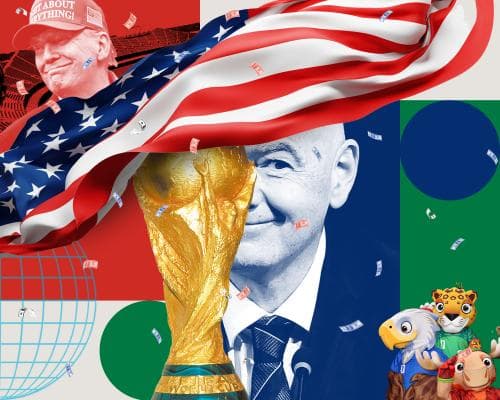
The 2026 FIFA World Cup will commence on 11 June at Mexico City’s Estadio Azteca. Over the next 39 days the tournament will be contested in 16 host cities across the United States, Mexico and Canada. A total of 104 matches will be played over a geographic span of roughly 6 000 miles, extending from Mexico City in the south to Vancouver in the north and Boston in the east. The event represents the culmination of a decade of planning and a century of evolving power dynamics within international sport. By most measures it will be the largest sporting event ever staged, and arguably the largest single event ever organized in North America.
Economic projections estimate that the World Cup will generate approximately $80 billion in global economic output, a figure comparable to the gross domestic product of a small nation. The scale of the tournament underscores the growing intertwining of sport, commerce and geopolitics. At the centre of this convergence is FIFA president Gianni Infantino, whose leadership style and public statements have attracted both admiration and criticism. Infantino’s approach combines a confident public persona with a willingness to engage with governments whose human‑rights records are contested. This juxtaposition raises questions about the ethical responsibilities of sport’s governing bodies.
The 2026 edition arrives at a moment when football is increasingly perceived as a vehicle for political messaging and economic influence. Critics argue that the tournament marks the end of football as a “people’s game,” suggesting that commercial imperatives now dominate the sport’s cultural identity. The experience of the 2022 World Cup in Qatar, which was widely described as a showcase for authoritarian power, reinforces concerns that future tournaments may continue to serve similar purposes.
Several contemporary issues further complicate the outlook for the 2026 World Cup. Recent geopolitical tensions, including the United States’ involvement in the assassination of a foreign leader, have heightened scrutiny of the tournament’s political context. Domestic policies related to immigration and social division in the United States could intersect with the event, potentially affecting fan experiences and security arrangements. Moreover, the high cost of travel and premium ticket pricing estimated at $33 000 for a final‑match seat raises concerns about the accessibility of the competition for ordinary supporters.
From a governance perspective, FIFA’s relationship with controversial regimes has drawn criticism. Infantino’s willingness to maintain close ties with leaders accused of authoritarian practices is viewed by some observers as a departure from the ethical standards expected of a non‑profit sporting organization. Nevertheless, the organization’s financial resources enable it to sustain extensive media campaigns and influencer partnerships, ensuring that the tournament receives extensive coverage regardless of dissenting voices.
Journalistic coverage of the World Cup remains essential despite these controversies. Ignoring the event would not alter the actions of political leaders or the policies of FIFA; rather, it would cede the narrative entirely to those who benefit from unchallenged promotion. Balanced reporting can highlight both the shortcomings of the tournament’s organization and the genuine sporting excitement it generates.
On the field, several national teams are expected to contend for the title. France possesses a deep talent pool and a coaching structure that consistently produces competitive squads. Spain’s cohesive playing style and strong developmental system make them perennial contenders. Portugal combines a talented roster with the enduring popularity of Cristiano Ronaldo, whose presence adds commercial appeal. Brazil and Argentina, the traditional South American powerhouses, remain strong candidates due to their historical success and current player quality. England, currently ranked among the top three favorites by UK betting markets, benefits from a blend of experienced Premier League players and a tactically astute manager in Gareth Southgate, whose approach may suit the tournament’s demanding schedule and climatic conditions.
Potential surprise packages include Morocco, which has demonstrated strong performances in recent international competitions, and Norway, led by a prolific striker with an impressive goal‑scoring record. The tournament’s format, which may involve extended match intervals and frequent video‑assistant‑referee interventions, could favour teams with depth and adaptability.
Beyond the competition itself, the World Cup offers a lens through which to examine broader questions about the United States’ cultural and economic influence. Observers will assess whether the nation continues to serve as a global hub for music, technology and consumer brands, or whether internal divisions and political turbulence diminish its standing. The event also provides an opportunity to evaluate how sport can both reflect and shape societal values in a rapidly changing world.
In summary, the 2026 FIFA World Cup stands as a monumental sporting spectacle with profound economic, political and cultural implications. While the tournament promises memorable athletic achievements, it also compels stakeholders fans, journalists, policymakers and governing bodies to confront the complex interplay between sport, power and responsibility.