
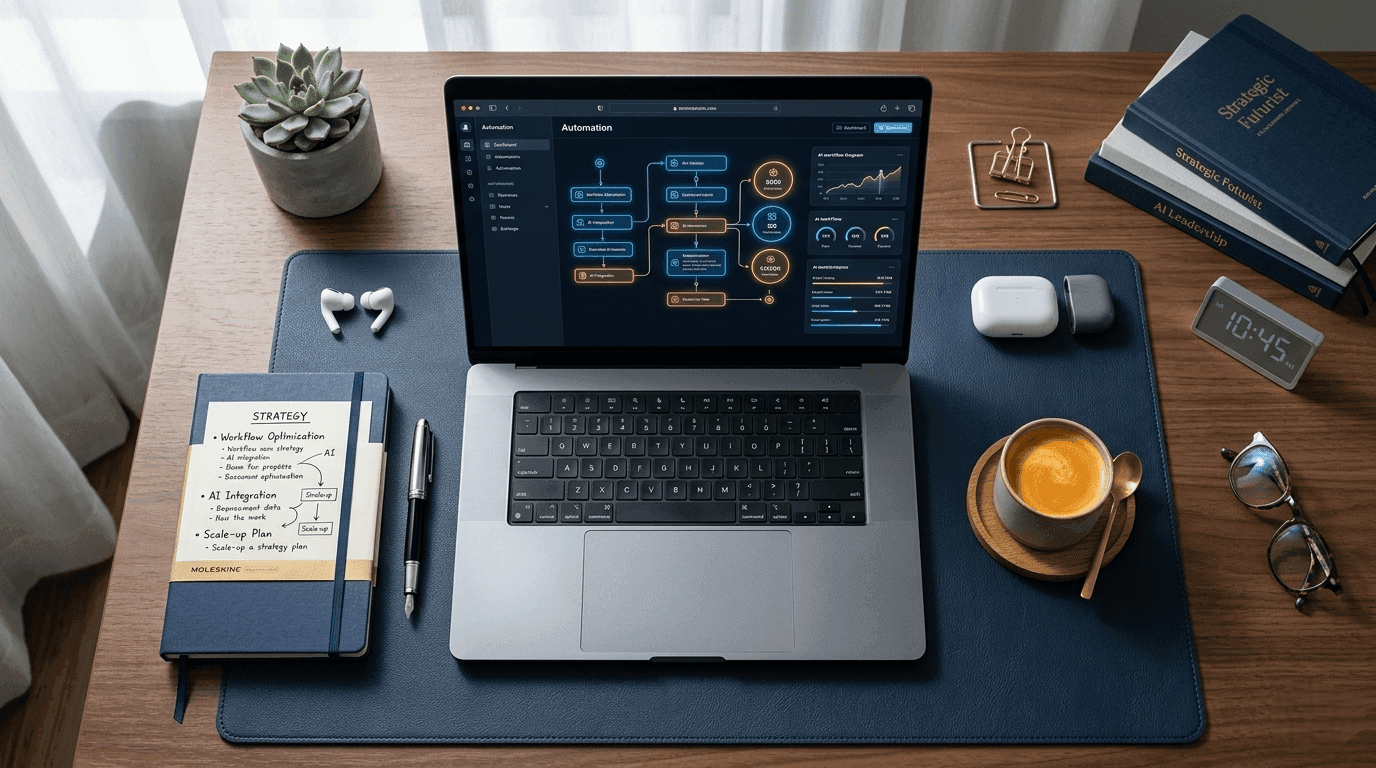
Most businesses don't fail at AI because the technology doesn't work. They fail because they skipped the strategy.
Table of Contents
Why Most AI Integrations Fail (And How to Not Be That Business)
Step 1 — Diagnose Before You Digitize
Step 2 — Start With One Process, Not the Whole Business
Step 3 — Choose Tools That Fit Your Stack, Not Just the Hype
Step 4 — Train Your Team Before You Flip the Switch
Step 5 — Measure, Adjust, and Scale Deliberately
The Hidden Risk Nobody Talks About
Final Thoughts: AI Is a System, Not a Silver Bullet
Why Most AI Integrations Fail (And How to Not Be That Business)
Every week, another business owner announces they're "going all in on AI." Six months later, half of them are quietly walking it back frustrated, over-budget, and running slower than before they started.
This isn't a technology problem. AI automation tools work. The problem is implementation strategy, or rather, the complete absence of one.
The businesses that successfully integrate AI share one thing in common: they treated AI adoption like a surgical operation, not a renovation demo. They went in with a plan, moved methodically, and made decisions based on their specific operations not on what was trending on LinkedIn.
This framework gives you exactly that plan. Five steps. No hype. No shortcuts. Just a proven sequence for bringing AI into your business without blowing up what's already working.
Step 1 — Diagnose Before You Digitize
The single worst thing you can do is buy an AI tool before understanding the problem you're solving. Yet this is exactly what most business owners do. They see a demo, get excited, swipe the card, and figure out the use case later.
Start with a workflow audit.
Spend one full week documenting how work actually moves through your business. Not how it's supposed to move — how it actually does. Talk to your team. Sit in on processes. Look at where time disappears.
You're looking for three categories:
Repetitive and rule-based tasks — Things that follow the same pattern every time: data entry, invoice processing, scheduling, email sorting, report generation. These are your highest-value AI targets because the outcome is predictable and measurable.
High-volume, low-complexity tasks — Customer FAQs, social media scheduling, content reformatting, lead qualification. AI handles volume without fatigue. Your human team doesn't.
Error-prone manual handoffs — Anywhere information moves from one person or system to another by hand is a potential failure point. AI thrives on structured handoffs.
What to document in your audit:
Task name and frequency (daily, weekly, per project)
Average time spent per instance
Who handles it and what their skill level is
Error rate or rework frequency
Downstream impact if it's done wrong or late
Once you have this map, you're not guessing anymore. You're prescribing. The tasks with the highest time cost, highest error rate, and lowest need for human judgment are your Phase 1 automation candidates. Everything else waits.
Step 2 — Start With One Process, Not the Whole Business
This is where discipline separates successful AI integration from expensive chaos. Every business owner wants to automate everything at once. That ambition, left unchecked, is what breaks operations.
The one-process rule is non-negotiable in your first 90 days.
Pick the single process that scored highest in your Step 1 audit the one with the most time drain, the most errors, or the most downstream damage when it fails. That's your pilot process. Your entire AI integration effort focuses here first.
Here's why this works:
Contained risk. If something goes wrong during implementation — and something always does it affects one process, not your entire operation. You can fix it without a crisis.
Measurable results. With one process, you have clear before-and-after data. You know exactly how long it took manually, how many errors occurred, and what the cost was. After AI integration, you can measure improvement precisely. That data becomes the business case for scaling.
Team confidence. A successful small win builds trust in AI across your organization. A botched company-wide rollout destroys it — sometimes permanently.
Operational learning. Your first AI implementation will teach you things no article or course can. How your team adapts. Where the edge cases are. What the tool doesn't handle well. You want to learn those lessons on a small stage, not a big one.
Your 90-day pilot checklist:
Select one process with clear input and output
Set a baseline metric before you start (time, cost, error rate)
Define what "success" looks like in specific, measurable terms
Assign one internal owner for the pilot — not a committee
Set a review date at 30, 60, and 90 days
Keep the manual process running in parallel for the first 30 days
Do not expand to a second process until your pilot process is stable, measurable, and your team is comfortable with it. Patience here pays compounding returns later.
Step 3 — Choose Tools That Fit Your Stack, Not Just the Hype
The AI tool market is loud, crowded, and driven by marketing budgets, not quality rankings. A tool that's featured in every tech newsletter might be completely wrong for your business. Here's how to evaluate without getting played.
Lead with integration, not features.
The most powerful AI tool in the world is useless if it doesn't talk to your existing systems. Before you look at any feature list, ask one question: does this tool integrate natively with the software my business already runs?
If your CRM is HubSpot, your AI tool needs to connect to HubSpot without a complex custom API build. If your accounting runs on QuickBooks, your automation needs to plug in cleanly. Friction at the integration level becomes debt that compounds every single day.
Evaluate tools on these six criteria:
1. Integration compatibility — Does it connect to your existing stack natively, or does it require expensive middleware or developer time?
2. Output control — Can you review, override, and correct AI outputs before they hit the customer or affect downstream systems? Any tool that removes your ability to audit its output is a liability.
3. Data security — Where does your data go? Is it used to train their models? What are their compliance certifications? If you handle customer data, this is non-negotiable to understand upfront.
4. Scalability — Does the pricing model make sense as you grow? Some tools are affordable at 100 tasks per month and brutal at 10,000. Model out your volume growth before committing.
5. Support quality — When something breaks (and it will), how fast can you get a human on the line? AI tool support is notoriously inconsistent. Test it before you buy.
6. Learning curve — How long until your team is independently operational? A tool that requires a developer to maintain is a tool that creates dependency, not efficiency.
A note on "all-in-one" AI platforms:
There is enormous pressure to consolidate onto one AI platform that claims to do everything. Be cautious. Specialized tools often dramatically outperform generalist platforms on specific tasks. Your goal isn't to minimize the number of tools it's to maximize the quality of outcomes while keeping your stack manageable.
Run a two-week free trial of any tool before committing. Use your actual data, your actual processes, and your actual team. Demos use ideal scenarios. Reality doesn't.
Step 4 — Train Your Team Before You Flip the Switch
Technology failure is rarely about the technology. It's almost always about people. The most thoughtfully chosen AI tool will fail if your team doesn't understand it, doesn't trust it, or actively works around it.
This step is where most business owners underinvest — and pay for it later.
Address the fear first, then the function.
Before you train anyone on how to use an AI tool, you need to have an honest conversation about what the tool means for their role. AI automation triggers job security anxiety even when that anxiety isn't warranted. If you skip this conversation, your team will engage with the tool defensively rather than productively.
Be direct and specific: "This tool is taking over the invoice data entry we've been doing manually. That's going to free up about six hours a week on your plate. Here's what we're going to do with that time instead." Specificity kills fear. Vagueness breeds it.
Build your training in three layers:
Layer 1 — Conceptual understanding. What does this tool actually do? What are its limitations? What kinds of errors should they watch for? Your team doesn't need to understand the underlying technology. They need to understand its behavior well enough to catch when it's wrong.
Layer 2 — Operational training. Hands-on, process-specific practice with real scenarios from your business. Not generic demos from the vendor. Run your team through 20 real examples before they go live. Let them make mistakes in a safe environment.
Layer 3 — Exception handling. What do they do when the AI gets it wrong? Who do they escalate to? What's the override process? This is the layer most training programs skip, and it's the one that determines whether your team feels confident or helpless when something unexpected happens.
Designate an internal AI champion.
Every successful AI integration has one internal person who becomes the go-to expert someone who's curious, detail-oriented, and respected by the rest of the team. This person becomes the bridge between the tool and the team. They collect feedback, identify issues before they escalate, and carry the knowledge when vendor support fails.
This role doesn't need to be full-time. It needs to be official. Name someone, give them time to go deep, and make it part of their performance expectations.
Step 5 — Measure, Adjust, and Scale Deliberately
Integrating AI is not a one-time project. It's an ongoing operational practice. The businesses that sustain real competitive advantage from AI are the ones that treat measurement and iteration as permanent fixtures of how they work — not a final checkbox before moving on.
Establish your measurement dashboard from day one.
Before your pilot process goes live, lock in the specific metrics you'll track. These should be tied directly to the business outcomes you identified in Step 1. Generic metrics like "team satisfaction" are nice but insufficient. You need operational data.
Metrics that actually matter:
Time saved per week — Total hours the process consumed before vs. after AI integration
Error rate — Percentage of outputs that required manual correction or rework
Processing volume — How many instances the AI handles per day/week compared to manual capacity
Cost per output — Total tool cost divided by total outputs produced (compare to manual cost)
Downstream impact — Has this improvement affected adjacent processes? Faster invoices, fewer customer complaints, quicker onboarding?
Run a structured review at 30, 60, and 90 days.
At 30 days, you're looking for stability. Is the tool running without frequent failures? Is the team using it correctly? Are outputs meeting your quality threshold?
At 60 days, you're looking for optimization. Where are the edge cases appearing? What manual overrides are happening most often? Those patterns tell you exactly where to configure, adjust, or supplement the AI.
At 90 days, you're making a scaling decision. Does the data justify expanding to a second process? Do you have the team capacity to absorb another pilot without destabilizing the first? Is the tool the right long-term choice, or has the pilot revealed a better alternative?
Scale on evidence, not enthusiasm.
The moment your pilot shows strong results, the temptation to accelerate is powerful. Resist it. Use your 90-day data as the gating mechanism. If the numbers support scaling, scale. If they're ambiguous, run another 30 days. If they're poor, diagnose before you abandon one configuration change often makes the difference between failure and success.
When you do scale, use the same five-step process for every new process you automate. Don't treat scale as permission to skip steps. The framework applies at every size.
The Hidden Risk Nobody Talks About
Every conversation about AI automation focuses on efficiency gains. Almost none of them talk about the risk that scales with those gains: operational brittleness.
When AI handles a process, your team gradually loses hands-on familiarity with that process. That's fine until the AI fails. A vendor goes down, an API breaks, a model update changes output behavior. If your team has completely outsourced their mental model of a process to AI, they can't bridge the gap when the tool stops working.
Build deliberate redundancy into every automated process:
Keep documented manual procedures even for fully automated workflows
Run quarterly manual dry-runs so your team stays operationally literate
Set alerts for output anomalies so failures are caught fast, not discovered weeks later
Never let a single AI tool become a single point of failure for a mission-critical process
This isn't pessimism. It's operational maturity. The businesses that use AI most effectively are the ones that also know exactly how to operate without it if they need to.
Final Thoughts: AI Is a System, Not a Silver Bullet
Every transformative business technology in history has gone through the same cycle: breathless hype, reckless adoption, painful failures, and then for the businesses that approached it with discipline lasting competitive advantage.
AI automation is in the middle of that cycle right now.
The opportunity is real. The tools are powerful. But the businesses that will actually win aren't the fastest adopters or the most aggressive scalers. They're the ones who build clean systems, move with intention, and treat AI as a component of their strategy not a replacement for one.
You now have a framework. Five steps. Audit your workflows. Pilot one process. Choose tools that fit your stack. Train your team properly. Measure and scale on evidence.
The businesses that execute these five steps correctly won't just save time. They'll build an operational advantage that's genuinely hard to compete with.
That's the point. That's the goal. Now go build it.
Found this framework useful? Share it with a business owner who's been burned by a rushed AI rollout or one who's been too afraid to start.