
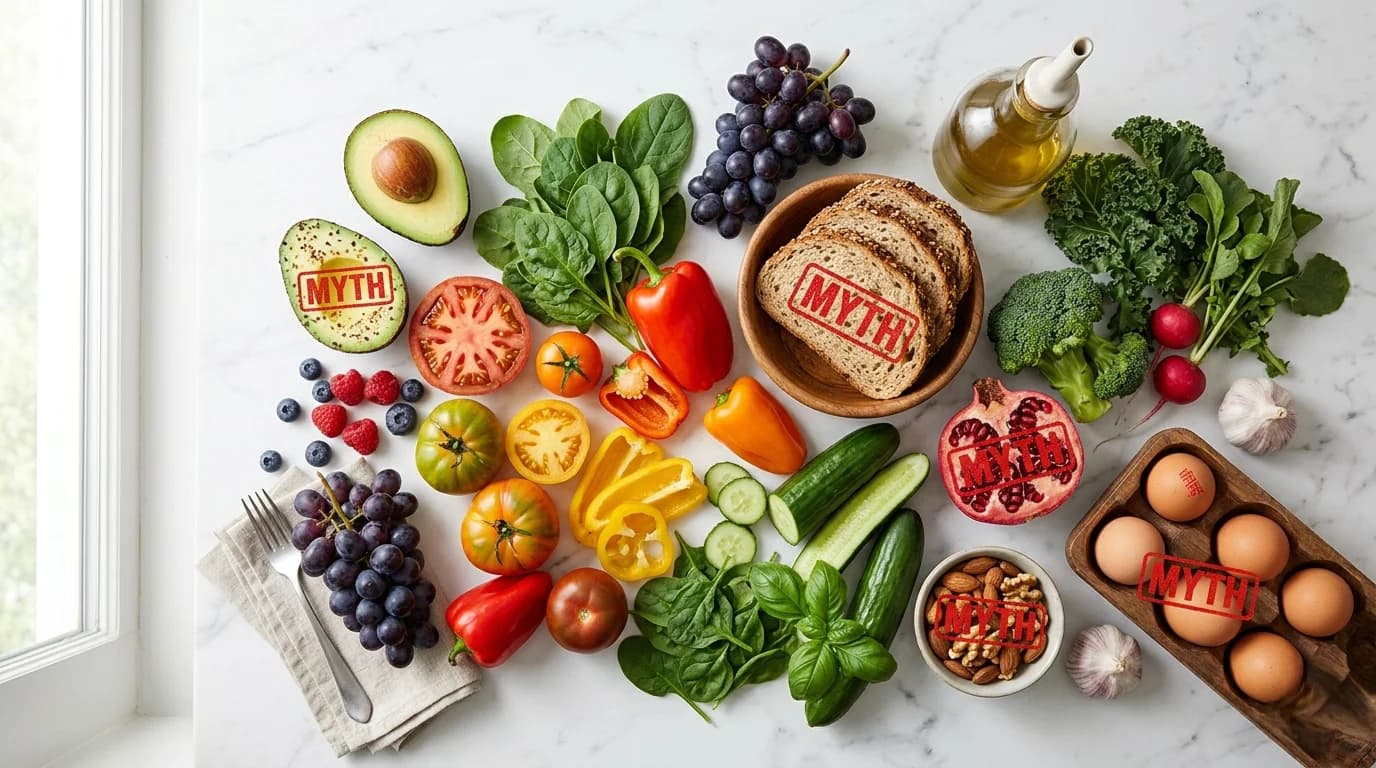
You have been lied to at the dinner table, on social media, and probably by that one friend who swears they know everything about nutrition. Decades of misleading food advice have shaped the way millions of people eat, and most of it is wrong. In 2026, nutritionists are drawing a hard line. The science has never been clearer, the misinformation has never been louder, and your health has never been more at stake.
Here are the biggest diet myths that registered nutritionists and dietitians desperately want you to stop believing right now.
Myth 1: Carbs Are the Enemy of Your Waistline
Carbohydrates have been the most unfairly demonized macronutrient of the last two decades. The low-carb craze convinced millions of people that a slice of bread was more dangerous than a late-night fast food run.
The truth is that not all carbohydrates are created equal. Whole grains, legumes, fruits, and vegetables are carbohydrate-rich foods that nutritionists actively recommend. These foods are loaded with fiber, vitamins, and minerals that support everything from gut health to brain function. The real culprit in most diets is ultra-processed food loaded with refined sugar and artificial additives, not the carbohydrate family as a whole.
Cutting all carbs can actually leave your body starved of quick fuel, slow your thyroid function, and lead to intense cravings that result in overeating later.
Myth 2: Eating Fat Will Make You Fat
Fat has one of the longest and most damaging reputations in the nutrition world. The low-fat food era of the 1990s triggered a wave of products that replaced healthy fats with sugar and starch, and waistlines expanded anyway.
The human body needs dietary fat to absorb fat-soluble vitamins A, D, E, and K. Healthy fats found in avocados, olive oil, nuts, and fatty fish support heart health, reduce inflammation, and keep you feeling full longer.
What actually causes fat storage in the body is a chronic calorie surplus, hormonal imbalances, and metabolic dysfunction. Eating a handful of almonds will not turn into body fat overnight. Nutritionists in 2026 want you to embrace quality fats as a core part of every meal.
Myth 3: Skipping Meals Is a Smart Weight Loss Strategy
Many people believe that eating less frequently means fewer calories and faster weight loss. In practice, the body does not work this way.
When you skip meals, especially breakfast or lunch, your blood sugar crashes. This triggers intense hunger signals, stress hormone spikes, and a near-irresistible urge to overeat at your next meal. Studies consistently show that chronic meal skippers tend to consume more calories overall and make poorer food choices when they finally do eat.
Beyond the calorie math, skipping meals can affect your mood, concentration, muscle retention, and metabolic rate. Regular, balanced eating keeps your blood sugar stable and your metabolism functioning efficiently throughout the day.
Myth 4: Detox Diets Cleanse and Reset Your Body
Juice cleanses, detox teas, and three-day water fasts are sold as miraculous resets for your overworked organs. Nutritionists describe this entire category of products as wellness theater.
Your liver, kidneys, lungs, and skin are sophisticated detoxification systems that run around the clock without any help from a green juice. These organs are extraordinarily efficient at filtering out waste and toxins. No commercially sold cleanse enhances their function in any meaningful way.
What many detox diets actually do is severely restrict calories, strip the body of essential nutrients, and trigger rebound overeating once the cleanse ends. If you want to genuinely support your body's natural detox systems, focus on adequate hydration, fiber-rich vegetables, quality sleep, and regular movement.
Myth 5: Fat-Free Labeled Foods Are Always the Healthier Choice
Walk through any grocery store and you will find shelves lined with fat-free yogurts, fat-free salad dressings, and fat-free snack packs. Food manufacturers discovered decades ago that slapping "fat-free" on a label boosts sales, so they lean into it heavily.
What most consumers do not realize is that when fat is removed from a food product, something has to replace it to maintain flavor and texture. That something is almost always sugar, refined starch, or artificial additives. A fat-free cookie is not a healthy cookie. It is frequently a higher-sugar, lower-satiety version of the original.
Always read the full nutrition label rather than stopping at the front-of-package claim. Whole-food versions with natural fat content are almost always the superior nutritional choice.
Myth 6: Eating After 8 PM Causes Immediate Weight Gain
The idea that food consumed late at night magically converts to fat faster than food eaten at noon is scientifically unsupported. Your metabolism does not suddenly switch into fat-storage mode at a specific hour of the evening.
What matters far more than timing is your total daily calorie intake and the quality of what you eat. The reason late-night eating often correlates with weight gain is behavioral. People who eat late tend to snack on calorie-dense, highly processed foods while watching screens, and they often eat these foods on top of their regular daily intake rather than instead of something else.
If your total nutrition for the day is balanced and within your needs, eating a sensible dinner at 9 PM will not sabotage your health goals.
Myth 7: All Calories Are Exactly the Same
A calorie is a unit of energy, and in a strictly thermodynamic sense, 100 calories of broccoli and 100 calories of gummy bears contain the same energy. However, the idea that these two foods affect your body in identical ways is one of the most oversimplified myths in nutrition.
Different foods trigger vastly different hormonal responses, hunger signals, and metabolic outcomes. Protein, for example, requires more energy to digest than fat or carbohydrates, and it promotes greater satiety per calorie. Fiber-rich foods slow digestion and prevent the blood sugar spikes associated with fat storage.
Ultra-processed foods are specifically engineered to override your body's natural fullness signals, making it nearly impossible to stop eating at a reasonable portion. The source and composition of your calories matter enormously, not just the number on the label.
Myth 8: You Must Eat Six Small Meals a Day to Boost Your Metabolism
The six-meals-a-day advice was based on the idea that frequent eating keeps your metabolic furnace burning at peak efficiency all day long. This became enormously popular in bodybuilding and fitness circles throughout the 2000s and 2010s.
Current research does not support this as a universal truth. Your metabolic rate is primarily determined by your total muscle mass, thyroid function, genetics, and overall activity level. Eating six meals versus three meals of the same total calorie content does not significantly alter how many calories your body burns.
What meal frequency does affect is appetite, energy levels, and practicality. Some people genuinely feel better eating more frequently. Others thrive on three satisfying meals. The best eating schedule is the one that keeps you consistently nourished, satisfied, and able to make good food choices throughout your day.
Myth 9: Going Gluten-Free Automatically Means Eating Healthier
Gluten-free eating became a mainstream wellness trend in the early 2010s and has never fully retreated. Millions of people who have no clinical reason to avoid gluten have adopted gluten-free diets under the assumption that they are making a healthier choice.
Gluten is a protein found in wheat, barley, and rye. For people with celiac disease or diagnosed non-celiac gluten sensitivity, avoiding it is medically necessary and genuinely life-changing. For everyone else, there is no established health benefit to cutting it out.
Gluten-free packaged products often contain more refined starches, more sugar, less fiber, and fewer nutrients than their conventional counterparts. Choosing a gluten-free brownie over a regular brownie is not a meaningful health upgrade for someone without gluten sensitivity.
Myth 10: You Need Protein Shakes and Supplements to Build Muscle
The supplement industry has done a masterful job convincing gym-goers that building muscle requires tubs of protein powder, branched-chain amino acids, and an elaborate stack of capsules taken at precise intervals.
The honest truth from sports nutritionists is that the vast majority of people can meet all of their protein needs through whole food sources. Eggs, chicken, fish, Greek yogurt, legumes, cottage cheese, and tofu are all rich in high-quality protein and come packaged with vitamins, minerals, and other compounds that isolated supplements cannot replicate.
Protein shakes are a convenient tool for people with genuinely high protein requirements who struggle to meet them through food alone. They are not a requirement, and they are not superior to real food. Save your money and build your plate instead.
Myth 11: You Must Drink Exactly Eight Glasses of Water Every Day
"Eight glasses a day" is one of the most universally repeated pieces of nutrition advice in history, and it has very little scientific backing.
Your daily hydration needs are highly individual. They depend on your body size, activity level, climate, overall diet, and health status. Someone eating a diet rich in fruits and vegetables is already consuming significant water through their food. An athlete training in summer heat needs far more fluid than the eight-glass rule suggests.
The most practical guidance from modern nutritionists is to drink enough water that your urine is pale yellow throughout the day, drink more when exercising or in hot weather, and eat plenty of water-rich whole foods. Your body's thirst signals are generally reliable guides when you are healthy and paying attention to them.
Myth 12: Fruit Is Bad for You Because of Its Sugar Content
The idea that an apple is nutritionally comparable to a candy bar because both contain sugar is one of the more alarming oversimplifications to gain mainstream traction in recent years.
Fruit contains fructose, a naturally occurring sugar. It also contains fiber, water, antioxidants, vitamins, and phytonutrients in a complex matrix that your body processes very differently than isolated added sugar. The fiber in whole fruit slows the absorption of sugar into your bloodstream, preventing the spike-and-crash cycle associated with processed sweets.
Whole fruit consumption is associated with lower rates of obesity, type 2 diabetes, heart disease, and several cancers in large-scale nutritional research. No credible nutritionist recommends cutting out whole fruit for a healthy person. Fear of fruit is misplaced fear, and it is actively steering people away from one of the most nutrient-dense food groups on the planet.
The Bottom Line
Nutrition science continues to evolve, but some things are becoming undeniably clear. Your body is not your enemy. Food is not something to fear. Real, whole, minimally processed foods eaten in reasonable amounts are the foundation of lasting health. No cleanse, no restriction spiral, and no supplement stack will outperform that simple truth.
The diet industry profits from your confusion. Nutritionists want you to stop falling for it.
In 2026, the most radical thing you can do for your health is eat real food, trust your body, and stop believing the myths.