
The Fibonacci Sequence: A Deep Dive
1. What It Actually Is
Take two numbers, add them together, and let the result become the next term. That's the whole rule. Start with 0 and 1:
0, 1, 1, 2, 3, 5, 8, 13, 21, 34, 55, 89, 144, 233, 377, 610, 987, 1597, ...Formally:
F(0) = 0
F(1) = 1
F(n) = F(n-1) + F(n-2)   for n >= 2
That's it. And yet this one rule keeps showing up in places that have no business being related to each other number theory, plant growth, algorithm design, even the worst-case behavior of a 2,300-year-old algorithm. The interesting part was never the definition. It's watching where it turns up.
2. Older Than Fibonacci
Fibonacci gets the naming credit, but he wasn't first. Centuries before Liber Abaci, Sanskrit scholars ran into these exact numbers while studying poetic meter specifically, counting how many ways you could build a rhythmic line out of short (one-beat) and long (two-beat) syllables. A line of length n either ends on a short syllable, leaving n-1 beats to fill, or a long one, leaving n-2. Add those two possibilities together and you've got the Fibonacci recurrence, derived from poetry rather than math.
Pingala touched on this around 200 BCE. Virahanka worked it out more explicitly in the 6th century. Gopala and Hemachandra both stated it plainly in the 12th century, decades before Fibonacci's book showed up in Europe. Most historians now treat the Sanskrit prosody work as the real origin point, and the "Fibonacci discovered this" framing as a European-centric shorthand that stuck around mostly because of the name.
3. The Rabbit Problem
Leonardo of Pisa nicknamed Fibonacci, short for filius Bonacci, "son of Bonacci" wrote the numbers into European mathematics in 1202, in a book called Liber Abaci. The book's actual legacy has almost nothing to do with rabbits: it's the reason Hindu-Arabic numerals eventually replaced Roman numerals in European commerce, which was a bigger deal for trade and accounting than any number sequence.
The sequence itself shows up as a throwaway puzzle. One pair of rabbits, breeding once a month starting from their second month, never dying. How many pairs after n months? Run the math and you get the Fibonacci sequence. Fibonacci didn't dwell on it, didn't name it after himself, and didn't dig into its properties. That came later mostly from Édouard Lucas, a 19th-century French mathematician who popularized the name and did a lot of the real algebraic heavy lifting (he's also got his own closely related sequence more on that below).
4. The Actual Math
Where the golden ratio comes from
Because the recurrence is linear, it has a clean closed-form solution. You get there through the characteristic equation:
x² = x + 1which has two roots:
φ = (1 + √5) / 2  ≈ 1.6180339887...
ψ = (1 - √5) / 2  ≈ -0.6180339887...
φ is the golden ratio. ψ is its negative reciprocal (ψ = -1/φ), and both numbers satisfy x² = x + 1 which is exactly why their powers combine to rebuild the Fibonacci recurrence.
Binet's Formula
Combine those roots correctly and you get a genuinely strange result: an integer sequence with a closed form built from an irrational number.
F(n) = (φⁿ - ψⁿ) / √5Since |ψ| is less than 1, ψⁿ collapses toward zero as n grows. So for any reasonably large n, F(n) is just the nearest whole number to φⁿ/√5. No recursion needed, no summing just one formula, one irrational constant, and a rounding step.
As a matrix
The recurrence also has a matrix form:
[1 1]²   [F(n+1)  F(n)  ]
[1 0]   = [F(n)    F(n-1)]
Which is more than a curiosity, it gives you an O(log n) way to compute F(n) using fast exponentiation, and it's the cleanest route to proving several identities below (Cassini's identity, in particular, drops right out if you take the determinant of both sides).
As a generating function
x / (1 - x - x²) = Σ F(n) xⁿOne rational function, the entire infinite sequence encoded inside it. This is the standard tool for proving Fibonacci identities without induction, if you're into that kind of algebra.
5. Identities Worth Sitting With
A few of these are genuinely elegant, not just "interesting if you're into math."
Sum of the first n terms:
F(0) + F(1) + ... + F(n) = F(n+2) - 1Sum of squares:
F(1)² + F(2)² + ... + F(n)² = F(n) * F(n+1)This one has a picture behind it: squares with Fibonacci side lengths, laid out in a spiral, tile a rectangle exactly F(n) by F(n+1). That rectangle is where the popular "Fibonacci spiral" image actually comes from.
Cassini's Identity:
F(n-1) * F(n+1) - F(n)² = (-1)ⁿThis is the identity behind a classic geometric trick cut a Fibonacci-sided square apart and reassemble the pieces into a rectangle that looks like it gained or lost exactly one unit of area. It hasn't. Cassini's identity is where that missing unit hides.
GCD property:
gcd(F(m), F(n)) = F(gcd(m, n))This is the one that surprised me most when I first sat with it. Divisibility relationships between Fibonacci numbers exactly mirror divisibility relationships between their indices. One consequence: F(m) divides F(n) whenever m divides n.
Zeckendorf's Theorem: Every positive integer can be written, uniquely, as a sum of non-consecutive Fibonacci numbers. 100, for instance, is 89 + 8 + 3. This "Fibonacci base" idea underlies Fibonacci coding, a self-delimiting number encoding used in some compression and coding-theory work, the "no two consecutive terms" rule is exactly what makes it self-delimiting.
6. The Golden Ratio, Properly Explained
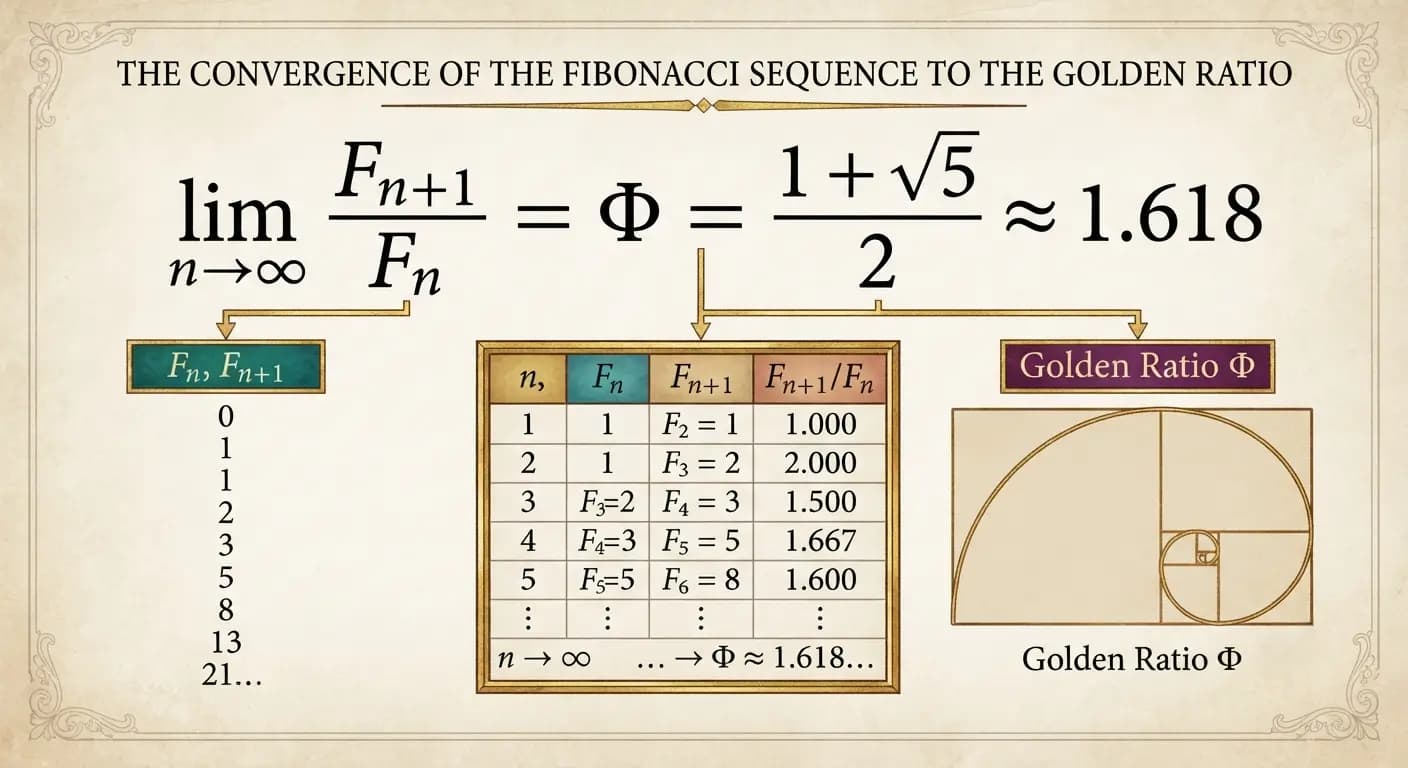
The ratio of consecutive Fibonacci terms drifts toward φ:
lim (n→∞) F(n+1) / F(n) = φBut the more interesting question is how it gets there, and that's where continued fractions come in. φ has the simplest continued fraction there is:
φ = 1 + 1/(1 + 1/(1 + 1/(1 + ...)))Nothing but 1s, forever. The successive convergents of that fraction are exactly the ratios of consecutive Fibonacci numbers - 1/1, 2/1, 3/2, 5/3, 8/5, 13/8, and on. Because that continued fraction uses the smallest possible values at every step, φ turns out to be the irrational number that's hardest to approximate well with rationals (this is formalized in Hurwitz's theorem). Sometimes people call φ "the most irrational number" for exactly this reason and it's not just trivia, it's the actual mechanism behind the plant-packing pattern in Section 10.
7. Pisano Periods
Take the Fibonacci sequence modulo any integer m, and the remainders eventually repeat in fact they repeat from the very start. That repeat length is called the Pisano period, written π(m).
π(2) = 3. π(3) = 8. π(5) = 20. π(10) = 60. This matters practically: if you need F(n) mod m for some huge n, you don't compute the actual (enormous) value of F(n) first. You reduce n modulo π(m), then work from there. Shows up a lot in competitive programming, and in some places in cryptography.
8. Fibonacci Primes and a Real Open Question
A Fibonacci prime is exactly what it sounds like: a Fibonacci number that's also prime. 2, 3, 5, 13, 89, 233, 1597, 28657...
There's a useful (though one-directional) rule here: if F(n) is prime and n is bigger than 4, then n has to be prime too. That follows from the divisibility property in Section 5. The reverse doesn't hold, though F(19) is 4181, which factors as 37 × 113, despite 19 itself being prime.
And here's the honest open question: nobody knows whether there are infinitely many Fibonacci primes. It's unresolved, sitting in the same category as the twin prime conjecture a reminder that "simple sequence" doesn't mean "fully understood sequence."
9. Lucas Numbers and the Family Tree
Lucas numbers use the exact same recurrence, just different starting values:
L(0) = 2, L(1) = 1, L(n) = L(n-1) + L(n-2)Giving: 2, 1, 3, 4, 7, 11, 18, 29, 47, 76, 123...
They're tightly linked to Fibonacci numbers L(n) = F(n-1) + F(n+1), and F(2n) = F(n) × L(n).
The idea generalizes further than that, too. Tribonacci numbers sum the previous three terms instead of two (0, 1, 1, 2, 4, 7, 13, 24...), and their term ratio converges to a different constant, about 1.8393, the real root of x³ = x² + x + 1. Push it further and you land on Lucas sequences generally a two-parameter family that includes both Fibonacci and Lucas numbers as special cases, and which shows up in primality testing methods like the Lucas-Lehmer test.
10. Fibonacci in Nature What Holds Up and What Doesn't
This is the section where I want to slow down, because it's also the section where most popular writing overclaims.
What's actually solid: a lot of plants arrange leaves, seeds, or scales in spirals, and the spiral counts in each direction are very often consecutive Fibonacci numbers. Sunflower seed heads commonly show 34 and 55, or 55 and 89. Pinecones commonly show 8 and 13. Pineapples commonly show 8, 13, and 21 in their scale pattern. This isn't folklore, there's a real mechanism behind it. New growth points on a plant tend to appear at a constant rotational angle from the last one, and the angle that produces the most efficient, least-overlapping packing turns out to be the golden angle about 137.5 degrees, derived directly from φ. Because φ is that "hardest to approximate" number from Section 6, using it as the rotation angle avoids ever lining up into wasteful overlapping rows. The Fibonacci spiral counts you see are basically a visible side effect of a plant using the most efficient packing angle available. That part is real, mechanistic, and testable.
What doesn't hold up: the idea that Fibonacci is some universal law running through all of nature. It isn't. Plenty of plants don't show these spiral counts at all, and even species that "typically" do have documented exceptions. Nautilus shells get held up constantly as a perfect golden spiral they're not, when actually measured; real shell growth ratios vary and don't reliably match φ. Claims about human body proportions being golden-ratio-governed (finger bones, navel placement, facial features) also don't hold up under actual measurement. A few mathematicians have written specifically to push back on this George Markowsky's 1992 piece "Misconceptions About the Golden Ratio" is the classic one, and Keith Devlin has made similar arguments more recently. None of this makes the real phyllotaxis result less interesting. If anything it's more interesting once it's not being stretched into mysticism.
11. Fibonacci in Art and Architecture Same Caution Applies
Claims that the Parthenon, the Great Pyramid of Giza, or various Renaissance paintings were deliberately built around the golden ratio are everywhere. They're also mostly unsupported. There's no surviving documentation that the original builders or artists intended anything of the sort, and getting the ratio to "fit" the actual structures usually requires generous rounding or cherry-picked measurement points.
There is one clean, well-documented exception: some 20th-century designers deliberately built systems around the golden ratio because they'd read about Fibonacci and liked the aesthetic Le Corbusier's "Modulor" system is the clearest case. That's a real, intentional use of the ratio, and it's worth distinguishing from the retroactive claims made about much older buildings that almost certainly weren't designed with φ in mind at all.
12. Fibonacci in Computer Science
The classic recursion example. Naive recursive F(n) runs in exponential time, O(φⁿ), because it keeps recomputing the same subproblems over and over. It's the standard first example for teaching why memoization matters add a cache and it drops to O(n). Use matrix exponentiation from Section 4 and it drops again, to O(log n).
Fibonacci heaps. A priority-queue structure from Fredman and Tarjan (1984), named for the Fibonacci numbers used in bounding tree sizes within its analysis. They offer better amortized time for decrease-key operations than a plain binary heap, which mattered theoretically for speeding up algorithms like Dijkstra's shortest path and Prim's minimum spanning tree though in practice, the constant-factor overhead often makes simpler heaps faster for realistic input sizes.
Fibonacci search. An alternative to binary search that splits the search interval according to Fibonacci numbers instead of exact halves. It mattered more in eras when memory access costs weren't uniform (older tape or disk storage), since it only needs addition and subtraction, not division.
The Euclidean algorithm's worst case. Lamé's theorem shows that the Euclidean algorithm takes the most steps, for a given input size, precisely when you feed it two consecutive Fibonacci numbers. So in a very literal sense, Fibonacci numbers are the hardest possible input for one of the oldest algorithms in existence.
13. Fibonacci in Finance - Read This One Skeptically
Technical analysts use "Fibonacci retracement" levels usually 23.6%, 38.2%, 50%, 61.8%, 78.6% to guess where a price might reverse after a trend, based on Fibonacci-derived ratios.
I'll be direct about this one: there's no established mechanism by which market prices would obey Fibonacci mathematics, and academic attempts to test whether retracement levels actually predict anything have generally come up empty beyond what you'd expect from chance. The more plausible explanation for any effect people do observe is that it's self-fulfilling enough traders watch the same levels and act on them that price sometimes does react nearby, not because of an underlying law of markets, just because of aggregate trader behavior. Worth keeping that distinction in mind before treating this as anything more than a widely-used heuristic with thin evidence behind it.
14. Common Misconceptions About Fibonacci Numbers
The math in Sections 4 through 9 is solid ground. These three claims are the ones that tend to travel furthest past what the evidence supports.
Misconception 1: Everything in nature is Fibonacci. False, and false in a specific way. The phyllotaxis spirals from Section 10 are real and mechanistically explained. But "this one packing phenomenon follows the golden angle" doesn't generalize to "Fibonacci governs biological form." Most tree branching patterns, most animal proportions, most shell geometries when you actually measure them show no meaningful Fibonacci relationship. The honest claim is narrow: certain plant growth patterns, under certain packing pressures, produce Fibonacci spiral counts. The popular claim nature running on Fibonacci as some kind of universal code is the overreach.
Misconception 2: The Golden Ratio guarantees beauty. There's no scientific consensus that people universally prefer golden-ratio proportions. Part of where this idea comes from: 19th-century experiments by Gustav Fechner claimed to find a measurable preference for golden-ratio rectangles. Later attempts to replicate that kind of finding have been inconsistent and heavily dependent on method, and most modern reviews of the aesthetics literature don't support a hardwired universal preference. What actually drives aesthetic judgment is a mix of symmetry, cultural and medium-specific norms, familiarity, and context. A golden-ratio layout can look great. So can a layout that ignores the ratio entirely. "It uses φ" isn't a guarantee of anything on its own.
Misconception 3: Financial markets obey Fibonacci laws. Covered in Section 13, but worth restating plainly: no rigorous evidence shows markets inherently follow Fibonacci mathematics. There's no causal mechanism connecting price action to these ratios, and tests of retracement-level predictive power generally haven't found an edge beyond chance. Some traders swear by the levels; others get nothing from them. Neither experience proves a law exists it just proves that shared attention can move a market, which is a much less exotic claim than "the market obeys Fibonacci."
15. Fascinating Fibonacci Facts
A handful of properties worth knowing on their own several fall directly out of the identities back in Section 5.
Every third Fibonacci number is even. Using standard indexing (F0=0, F1=1, F2=1, F3=2...), the even terms land at F0, F3, F6, F9, and so on a direct consequence of how parity moves through the addition rule.
Every fifth Fibonacci number is divisible by 5. F0=0, F5=5, F10=55, F15=610. This is a specific instance of the general divisibility rule from Section 5: since F5=5, every F(5k) inherits that divisibility.
Consecutive Fibonacci numbers are always relatively prime. gcd(F(n), F(n+1)) = 1, always a direct consequence of the GCD identity in Section 5, since gcd(n, n+1) = 1 for any n.
The ratio of consecutive terms approaches the golden ratio. Covered at length in Section 6 and how fast it converges is governed by how quickly ψ/φ shrinks in Binet's formula.
Fibonacci numbers hide inside Pascal's Triangle. Sum along its "shallow diagonals" entries like C(n-1,0), C(n-2,1), C(n-3,2), and so on and you get the Fibonacci numbers exactly. A genuinely surprising bridge between binomial coefficients and a recurrence relation.
The sequence extends infinitely in both directions. Run the recurrence backward and you get "negafibonacci" numbers: F(-1)=1, F(-2)=-1, F(-3)=2, F(-4)=-3, F(-5)=5, following F(-n) = (-1)^(n+1) F(n). Same numbers as the positive side, just alternating sign.
There are Fibonacci primes covered in Section 8, including the still-open question of whether infinitely many exist.
Fibonacci numbers mark the theoretical worst case for the Euclidean algorithm. Per Lamé's theorem (Section 12), consecutive Fibonacci inputs are, in a precise sense, the hardest possible inputs for one of math's oldest algorithms.
The golden ratio is a consequence of Fibonacci growth, not the cause of it. People often frame it backward φ as some external principle the sequence "obeys." Mathematically it's the other way around: φ falls straight out of solving the recurrence's characteristic equation in Section 4. The ratio is downstream of the recurrence, not upstream of it.
This one recurrence spans an unusual number of unrelated fields. Botany, number theory, algorithm design, combinatorics, and (with heavy caveats) financial technical analysis all draw on some piece of it. That's rare for a single two-term rule, and it's a big part of why the sequence keeps resurfacing in places that seem to have nothing to do with each other.
16. Closing Thoughts
The Fibonacci sequence itself is almost nothing, a one-line rule anyone can state in ten seconds. What earns it this much attention is everything it turns out to connect: a quadratic equation's roots to a plant's packing efficiency, a data structure's runtime analysis to a design philosophy, a poetry-counting problem from ancient India to a primality question nobody's solved yet. The real mathematics here (Sections 4 through 9, mostly) is deep and genuinely settled. The mythology stacked on top of it is a separate thing entirely, and it's worth being able to tell the two apart — the actual result about optimal packing angles in plants is more interesting once it stops being inflated into a claim about the whole universe running on one number.