
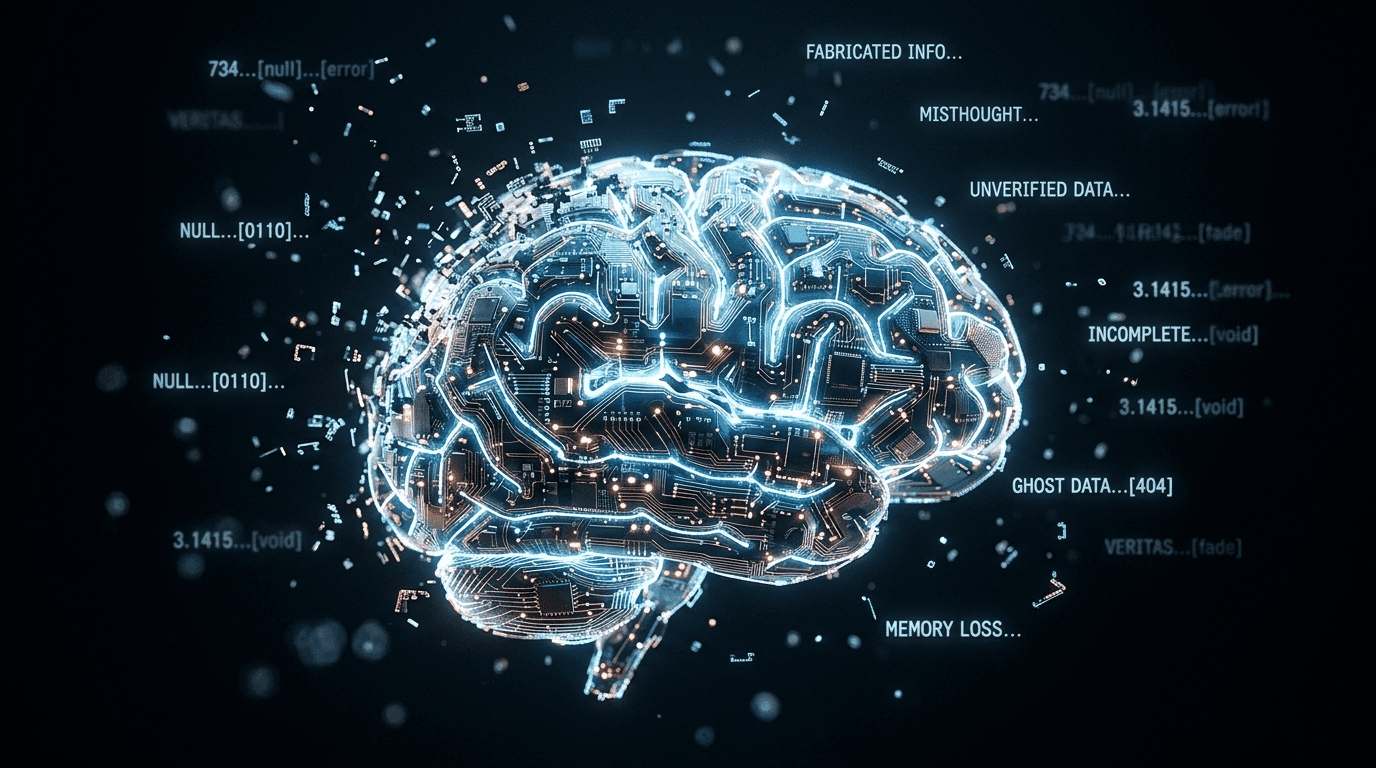
Your AI assistant just confidently told you something completely wrong. It cited a study that does not exist, named a professor who was never born, and referenced a court case that never happened. And it did all of this without a single moment of hesitation.
Welcome to the world of AI hallucinations.
This is not a glitch. It is not a bug being fixed in the next update. It is one of the most fundamental and misunderstood behaviors of modern artificial intelligence, and if you use AI tools in your personal life, your business, or your career, understanding this phenomenon could save you from serious, real-world consequences.
Let us pull back the curtain.
What Exactly Is an AI Hallucination?
An AI hallucination occurs when a large language model (LLM) generates information that sounds completely believable but is factually incorrect, fabricated, or simply does not exist in reality.
The term "hallucination" is borrowed from psychology, where it describes perceiving something that is not there. In AI, it means the model produces outputs that have no grounding in factual reality, yet are delivered with the same confident tone as accurate information.
This is what makes it so dangerous.
An AI hallucination is not the same as a typo or a misquote. It is the AI inventing entire facts from thin air, including:
Names of researchers who do not exist
Scientific studies that were never conducted
Historical events that never took place
Legal cases with fake case numbers and fake outcomes
Product specifications that are completely made up
Medical information that could genuinely harm someone
The model is not lying to you in a human sense. It has no awareness that it is producing false information. That is precisely what makes the problem so difficult to solve.
Why Do AI Hallucinations Happen?
To understand why AI hallucinations occur, you need to understand how large language models actually work.
How LLMs Generate Text
Large language models do not think the way humans do. They do not retrieve facts from a verified database. Instead, they predict the next most statistically likely word, phrase, or sentence based on massive amounts of training data.
In other words, an AI model is essentially an extraordinarily sophisticated pattern machine. It has been trained on billions of words from books, websites, articles, and other text sources. When you ask it a question, it generates a response by predicting what words should logically follow based on patterns it has learned.
The problem is that predicting what sounds right is not the same as knowing what is true.
The Core Reasons Behind Hallucinations
1. Training Data Gaps and Errors
AI models learn from whatever data they are trained on. That data is never perfect. It contains outdated information, biased sources, contradictions, and outright errors. When the training data is incomplete or flawed on a particular topic, the model fills those gaps with statistically plausible but factually wrong content.
2. Overconfidence Without Self-Awareness
Most language models are not designed with a built-in mechanism to say "I do not know." They are optimized to generate fluent, helpful, and coherent responses. This optimization pressure pushes the model toward always producing an answer, even when the honest answer should be uncertainty or silence.
3. No Access to Ground Truth
A language model does not have a fact-checking layer built into its output process. It cannot cross-reference what it is saying against a reliable database of verified facts in real time (unless specifically designed to do so). It generates text and presents it, trusting its own training.
4. Ambiguous or Complex Prompts
When a user asks a vague, complex, or leading question, the model may extrapolate beyond what it actually knows. It tries to satisfy the intent of the question, and in doing so, it invents details that seem logically appropriate but are factually baseless.
5. Rare or Niche Topics
The less a topic appeared in the training data, the higher the risk of hallucination. If you are asking about a very obscure scientific paper, a minor historical figure, or a niche local regulation, the model has very little grounding to work from. It patches the gaps with plausible-sounding fiction.
6. Long Context Degradation
In lengthy conversations or when processing very long documents, AI models can lose track of earlier context and begin generating content that contradicts or drifts away from established facts. This form of hallucination is especially common in professional workflows where people paste large blocks of text for analysis.
Real-World Examples of AI Hallucinations Gone Wrong
Hallucinations are not just a theoretical problem. They have already caused measurable harm in the real world.
The Legal Profession
In one widely reported case, lawyers submitted a legal brief to a federal court that contained citations to multiple court cases that did not exist. The AI tool they used had invented the case names, the docket numbers, and the supposed legal holdings. When the court investigated, none of the cases could be found because they were never real. The attorneys faced serious professional consequences.
Medical Misinformation
Healthcare professionals and patients who rely on AI tools for medical guidance face a unique risk. AI models have been documented producing incorrect drug dosage information, fabricating drug interactions, and inventing non-existent treatment protocols. In a field where accuracy is literally a matter of life and death, this represents an extraordinary level of danger.
Academic and Research Settings
Students, researchers, and academics who use AI tools for literature reviews have discovered references to papers that were never published, authors who never existed, and journals that are entirely fictional. The confident formatting of citations makes them especially easy to miss.
Business and Financial Decisions
Companies that have incorporated AI into their market research, competitive analysis, or financial modeling workflows have encountered hallucinated statistics, fabricated competitor data, and invented regulatory requirements. Decisions made on this information can cost businesses significant money.
How Serious Is the Hallucination Problem?
The honest answer is: more serious than most people realize.
Research from various AI safety organizations has shown that even the most advanced large language models hallucinate regularly. The frequency varies by task, model, and prompt style, but no current AI system is hallucination-free.
Some estimates suggest that general-purpose AI chatbots produce incorrect or fabricated information in a measurable percentage of their responses, with that rate increasing significantly for niche, technical, or highly specific queries.
What makes this statistic particularly challenging is that hallucinated content is often indistinguishable from accurate content at first glance. The writing style is confident, the format is professional, and the information is internally consistent even when it is entirely made up.
How to Detect AI Hallucinations
Detecting hallucinations requires developing a new kind of critical literacy. Here are the key signals to watch for.
Unusually Specific Details
Hallucinations often come packaged with suspiciously precise details. A study published in a specific journal in a specific year by a named researcher with a specific finding is not automatically trustworthy just because it sounds authoritative. Specificity can be a red flag rather than a sign of reliability.
Unverifiable Claims
If you cannot find the source through an independent search, treat it with serious skepticism. This is especially true for statistics, quotes attributed to named individuals, and references to publications or legal documents.
Contradictions Within the Same Response
Sometimes an AI will contradict itself within a single response. This internal inconsistency is a clear sign that the model is generating content without a reliable factual foundation.
Confident Tone on Uncertain Topics
The more confident an AI sounds on a topic that is genuinely uncertain or controversial, the more suspicious you should be. Real expertise acknowledges nuance and uncertainty. Hallucinations often skip past that.
Information That Feels Too Perfect
When an AI gives you an answer that fits your question so cleanly it almost seems designed to please you, that is a moment to pause. The model is optimized to satisfy users. Sometimes it achieves that by inventing what you want to hear.
How to Avoid AI Hallucinations: Proven Strategies
You do not have to avoid AI tools entirely. But you do need to use them with intentional safeguards in place.
1. Always Verify Critical Information Independently
This is the single most important rule. Never use AI-generated information as your final source of truth for anything that matters. Use it as a starting point and verify every significant claim through reliable, independent sources before acting on it.
2. Use AI for Process, Not Just Facts
AI tools are significantly more reliable when used for tasks that do not require perfect factual accuracy. Writing structure, grammar editing, brainstorming, summarizing content you have already verified, formatting, and generating ideas are all lower-risk applications than asking for specific facts, data, or citations.
3. Ask the AI to Express Uncertainty
Prompt the model to tell you when it is unsure. Phrases like "Please tell me if you are not certain about this" or "Indicate your confidence level in this answer" can sometimes encourage more cautious, hedged responses. It is not foolproof, but it can reduce overconfidence.
4. Break Complex Queries into Smaller Steps
Long, complex prompts increase the risk of hallucination. If you are working on a detailed project, break your questions into focused, specific parts rather than asking for everything at once. Simpler inputs tend to produce more reliable outputs.
5. Use AI Tools with Real-Time Web Access Carefully
Some AI tools have access to live web search. While this reduces certain types of hallucination by grounding responses in current sources, it introduces new risks: the model may still misread, misrepresent, or selectively pull from online content. Verify the sources yourself.
6. Cross-Reference Multiple AI Tools
No single AI tool is authoritative. If you receive an important answer from one model, test the same question in a different model. Consistent answers across multiple tools do not guarantee accuracy, but significant contradictions between them are a strong signal to dig deeper.
7. Develop Domain Knowledge First
The best protection against AI hallucinations is your own expertise. When you have foundational knowledge in a subject, you are far more likely to recognize when an AI says something that does not sound right. AI tools are safest in the hands of people who know enough to question the answers.
8. Build Verification Into Your Workflow
For teams and businesses using AI at scale, the answer is not individual vigilance alone. Build verification checkpoints into your processes. Assign human reviewers to AI-generated content before it reaches clients, courts, medical records, or published platforms.
The Future of AI Hallucinations
The good news is that the AI industry is actively working on this problem. Researchers are developing techniques including retrieval-augmented generation (RAG), which grounds AI responses in verified documents rather than relying solely on training data. Other approaches include constitutional AI methods, improved fact-checking pipelines, and better uncertainty quantification.
The sobering news is that hallucinations are unlikely to be eliminated entirely in the near term. They are a fundamental consequence of how current language models work. Even as models become more capable and more accurate overall, the hallucination risk on edge cases, rare topics, and ambiguous queries will persist.
This means the responsibility falls on users as much as developers.
Understanding AI hallucinations is no longer optional knowledge for curious tech enthusiasts. It is essential digital literacy for anyone who uses these tools in a professional, academic, or high-stakes personal context.
What This Means for You
Here is the bottom line.
AI language models are genuinely powerful tools. They can accelerate your work, sharpen your thinking, expand your creativity, and help you do more with less time. These are real, significant benefits that are already transforming industries.
But treating AI output as a trusted oracle rather than a useful but fallible assistant is a mistake that will produce consequences. The organizations and individuals who get the most value from AI in the long run will be those who understand its limitations as clearly as they understand its strengths.
Know what hallucinations are. Know why they happen. Apply the verification habits that protect you from being misled. And share this knowledge with the people around you, because the problem of AI hallucinations does not just affect individuals. It affects every organization, institution, and community that is now integrating these tools into important decisions.
The future belongs to people who can use AI intelligently, and that starts with understanding where it breaks down.
Did this post change how you think about AI tools? Share it with someone who needs to read it.