US Government Orders Anthropic to Shut Down Its Newest AI Models, Fable 5 and Mythos 5
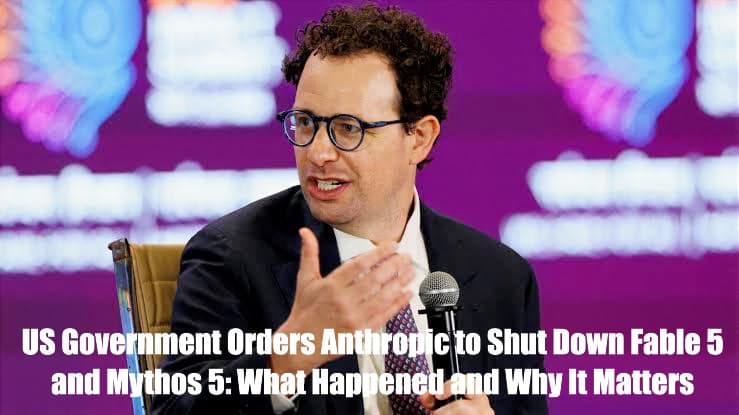
On a Friday evening in June 2026, Anthropic found itself in an unprecedented position. The company behind the widely used Claude chatbot announced that it had been forced to disable access to its two newest and most advanced models, Fable 5 and Mythos 5, after receiving a direct order from the United States government.
This was not a routine product update or a quiet model retirement. It was, by several accounts, the first time a major American AI company has had to pull a publicly available model offline because of a federal directive citing national security.
What Actually Happened
According to Anthropic, the directive arrived at 5:21 pm Eastern Time on Friday, issued under export control authority by the Commerce Department. The order required Anthropic to block any foreign national, whether located inside or outside the United States, from accessing Fable 5 and Mythos 5. That included Anthropic's own employees who are not US citizens.
Because of how broad that restriction was, Anthropic said it had no practical way to comply other than switching the models off entirely for everyone, including paying customers in the United States. Anthropic was quick to clarify that this shutdown did not extend to its other models, including the widely used Claude Opus line, which remained fully available.
Reporting indicates the letter came from Commerce Secretary Howard Lutnick's office, with input from the department's Bureau of Industry and Security. Notably, Anthropic said the directive itself did not spell out the specific national security concern in detail.
The Jailbreak at the Center of the Dispute
Anthropic's understanding, based on verbal explanations from officials, is that the government had become aware of a technique for bypassing Fable 5's safety guardrails, often referred to as a jailbreak.

In its public response, Anthropic pushed back firmly on how serious this actually was. The company said it had reviewed the demonstration in question and found that it involved a small number of previously known, fairly minor vulnerabilities, the kind that other publicly available AI models, including competitors, can also identify. Anthropic also stated that what had been disclosed amounted to either harmless responses or narrow findings that did not provide any meaningful advantage specific to Mythos.
In short, Anthropic's position is that the underlying capability is not unique to its models and is already in everyday use by cybersecurity teams trying to find and fix flaws before attackers do.
Why Fable 5 and Mythos 5 Existed in the First Place
To understand why this matters, it helps to know what these models actually are. Mythos began life as Claude Mythos Preview, a highly capable model built specifically for security research. Rather than releasing it broadly, Anthropic limited access to a small group of partner organizations through an initiative called Project Glasswing.
The results were apparently significant. Participating organizations reported finding and fixing large numbers of real software vulnerabilities with the model's help, including reports that Mozilla alone resolved hundreds of issues this way.
Earlier in the week, before the shutdown, Anthropic had moved to expand access by launching Fable 5 and Mythos 5 as more broadly available products built on that same underlying technology, marketed in part around their advanced cybersecurity capabilities.
A Bigger Pattern of Friction With Washington
This shutdown did not happen in isolation. It follows a period of escalating tension between Anthropic and the current administration.
Separately, the Department of Defense reportedly labeled Anthropic a supply chain risk, a designation that has historically been reserved for foreign adversaries and that can require defense contractors to certify they will not use Anthropic's models in their work. That decision came after talks between Anthropic and the Pentagon broke down, reportedly over Anthropic's refusal to remove certain safeguards related to autonomous weapons and mass surveillance uses of its technology.
In response, Anthropic filed a lawsuit against the administration seeking to overturn that designation, and that litigation is still ongoing.
Taken together, the export control directive and the supply chain risk designation paint a picture of a company that has positioned itself as one of the more safety focused players in AI, now finding that same positioning at the center of a dispute with parts of the federal government.
Why This Moment Matters Beyond One Company
The timing adds another layer. Anthropic had reportedly filed confidentially for a public stock listing earlier in the month, with a recent funding round reportedly valuing the company at around nine hundred and sixty five billion dollars. A government ordered shutdown of its flagship new models, even temporarily, raises obvious questions for investors about how much regulatory risk is now baked into the AI sector, particularly for companies developing models with strong cybersecurity or dual use capabilities.
The episode has also reignited a broader international conversation about AI sovereignty. Commentary from tech leaders outside the United States, including from India's technology sector, has pointed to this kind of sudden access restriction as a reason for other countries to invest in developing their own domestic AI capabilities rather than depending on American providers.
What Happens Next
As of this writing, Anthropic has said it believes the situation reflects a misunderstanding and that it is working to restore access to Fable 5 and Mythos 5 as quickly as possible. The company has also reiterated its broader position, namely that it supports the idea of government oversight over unsafe AI deployments, but argues that any such action should follow a process that is transparent, fair, and grounded in clear technical evidence, criteria it says this directive did not meet.
For now, the rest of Anthropic's model lineup continues to operate normally, and the company's legal challenge over its Pentagon designation remains active. Whether this turns into a brief, resolved misunderstanding or the opening chapter of a much longer regulatory fight over advanced AI is something only the coming weeks will make clear.