
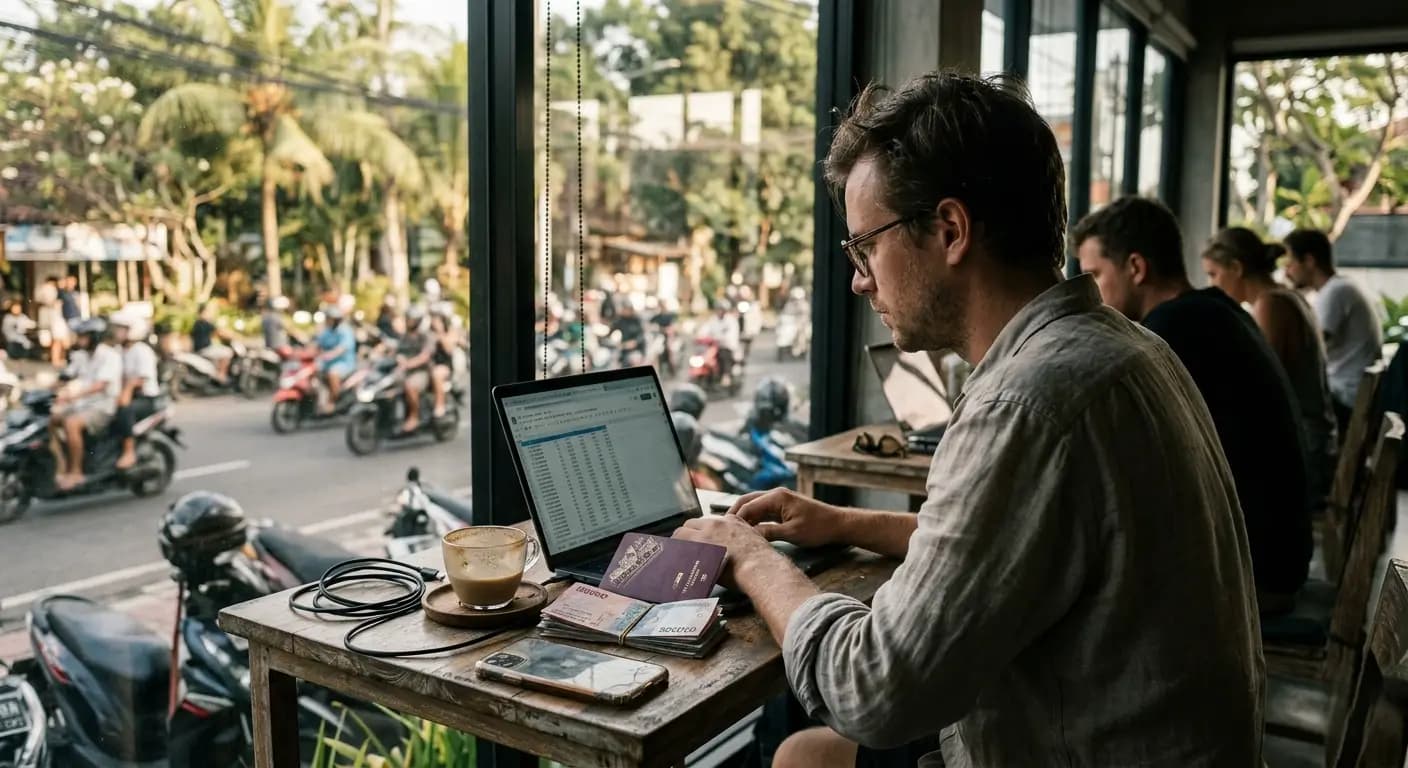
You packed two suitcases, sold your couch, and told everyone you were finally "free." Three months later you're sitting in a co working space in Chiang Mai, staring at a tax form you don't understand, wondering why your bank account looks thinner than it did when you had a "boring" job and a fixed address. Nobody warned you about this part.
The digital nomad dream gets sold to us in tidy little squares on social media. A laptop on a beach. A coconut with a straw. A caption about "living life on your own terms." What rarely makes it into the frame is the quiet financial bleeding that happens behind the scenes, the kind that sneaks up on you slowly until one day you realize the lifestyle that promised freedom is actually costing you more than your old life ever did.
This is not a piece designed to scare you out of the nomad life. It is a piece designed to make sure you walk into it with your eyes open, because the people who actually thrive in this lifestyle are not the ones who romanticized it the hardest. They are the ones who planned for the costs nobody talks about.
The Myth of "Cheap Countries"
Every nomad blog loves to throw around numbers like "live on $800 a month in Bali" or "Vietnam costs nothing." These numbers are technically true if you live like a monk who only eats rice and never leaves their apartment. The reality is that the moment you start wanting a decent gym, a reliable internet connection, occasional restaurant meals, and a social life, those "cheap countries" start looking a lot less cheap.
What actually happens is something economists call lifestyle creep, except for nomads it happens at lightning speed because every new country resets your spending habits. You arrive somewhere new, you don't know which neighborhoods are affordable, you don't know which grocery stores overcharge tourists, and you end up paying a premium just for being unfamiliar with the terrain. By the time you've figured out the local hacks, your visa is expiring and you're moving to the next country to start the learning curve all over again.
Visa Runs Are a Full Time Unpaid Job
If you have never done a visa run, picture this. You fly somewhere just to leave and reenter the country so your tourist visa resets. The flight costs money. The taxi to the airport costs money. The day you lose to travel is a day you are not working, which means it is also costing you money in lost income. Multiply that by every ninety days and suddenly your "cheap" location has an invisible tax attached to it that nobody calculates into their monthly budget spreadsheets.
Some nomads end up spending more on visa logistics across a year than they would have spent on a proper long term visa or residency permit in a country that actually wants long term visitors. The math rarely gets shared publicly because admitting it kind of breaks the fantasy.
Health Insurance Becomes a Maze
Here is something that catches almost everyone off guard. Most domestic health insurance plans either drop you the moment you leave your home country or only cover emergencies abroad with limits so low they are almost decorative. So nomads end up buying special "digital nomad insurance," which sounds great in theory until you actually need to use it and discover the exclusions list is longer than the policy itself.
Dental work, mental health support, chronic condition management, and maternity care are commonly excluded or capped at amounts that would not cover a single decent procedure in many countries. People end up flying home for medical care anyway, which defeats the purpose of having insurance abroad in the first place, and that flight itself becomes another hidden cost layered on top of the medical bill.
The Equipment Graveyard
Laptops do not like humidity, sand, or being shoved into a backpack and dragged across six countries in four months. Phones get stolen. Chargers get left in hostel rooms. Power banks die in altitude. The gear that worked perfectly fine sitting on a desk in a climate controlled apartment back home starts failing at an alarming rate once it becomes your only tool for earning a living while being treated like luggage.
Replacing a laptop is not just an expense, it is a productivity crisis. You lose work hours trying to find a decent electronics store in a country where you don't speak the language, you pay import taxes on parts, and you often pay tourist pricing because shop owners can tell from your accent that you have limited options and limited time.
Loneliness Has a Price Tag Too
This one rarely gets discussed in financial terms but it absolutely belongs in this conversation. Constant relocation makes it incredibly hard to build the kind of stable, deep friendships that protect mental health over the long run. So nomads compensate by spending money on social experiences. Co working memberships that cost triple what a regular desk would cost back home, expensive group retreats marketed specifically at lonely remote workers, and constant eating out because cooking alone in a foreign kitchen feels worse than the price of a restaurant meal.
The loneliness tax is real, and it often shows up disguised as "networking expenses" or "community building costs" on a nomad's monthly spending breakdown.
Banking and Currency Fees Quietly Drain You
Every time money crosses a border, somebody takes a cut. ATM withdrawal fees, currency conversion markups, international transfer charges, and the spread your bank applies when converting your home currency into local cash all add up in ways that feel small individually but devastating when totaled across a year. Some nomads lose the equivalent of an entire month's rent annually just to fees they never properly tracked because each individual charge looked too small to worry about.
Time Zone Chaos Hurts Your Income
If your clients or employer are based in a different time zone than wherever you happen to be that month, you are constantly negotiating against your own body clock. Taking calls at 3am wrecks sleep, which wrecks productivity, which can quietly shrink your earning capacity over time even though nothing about your contract or salary technically changed. The cost here is not a line item on a receipt, it is a slow erosion of the energy you need to actually do the work that pays for this lifestyle in the first place.
The Tax Situation Nobody Prepared You For
Many new nomads assume that because they are not physically present in their home country, taxes somehow stop applying to them. This assumption can be expensive and occasionally disastrous depending on citizenship and the specific countries involved. Tax residency rules, double taxation treaties, and reporting requirements vary wildly, and getting this wrong does not just cost money, it can cost years of stress dealing with penalties and back payments.
Hiring an accountant who actually understands international tax situations is not optional once your income crosses certain thresholds, and that professional help itself becomes another recurring cost that rarely makes it into anyone's glamorous Instagram caption.
So Is It Still Worth It
None of this means the lifestyle is a scam or that people should abandon the dream of working from wherever they want. It means the dream works best when it is funded by realistic planning rather than fantasy budgeting. The nomads who last years instead of months are the ones who built buffers for visa runs, picked insurance plans by actually reading the exclusions, backed up their gear and their income streams, and stopped pretending that loneliness, fees, and tax complexity are problems that only happen to other people.
Freedom is still possible. It just costs more than the postcards suggest, and the people who succeed long term are the ones who budgeted for the version of this lifestyle that actually exists rather than the version that gets filtered for social media.