Germany Nursing Job (Pflegefachkraft) + Visa
Germany Nursing Job (Pflegefachkraft) + Visa: The Complete 2025/2026 Guide for International Nurses
1. Overview
Germany is in a nursing emergency, and the numbers behind that statement are not exaggerations. Over 300,000 foreign-trained nurses currently work in Germany, making up 17.8% of the total nursing workforce, a figure that has quadrupled since 2013. Shortage projections range from 280,000 to 690,000 nurses by 2049, depending on which demographic model you follow. That gap is what makes this opportunity structurally different from most overseas job targets: the demand is legally mandated, institutionally supported, and backed by dedicated government recruitment programmes. SprachschuleSprachschule
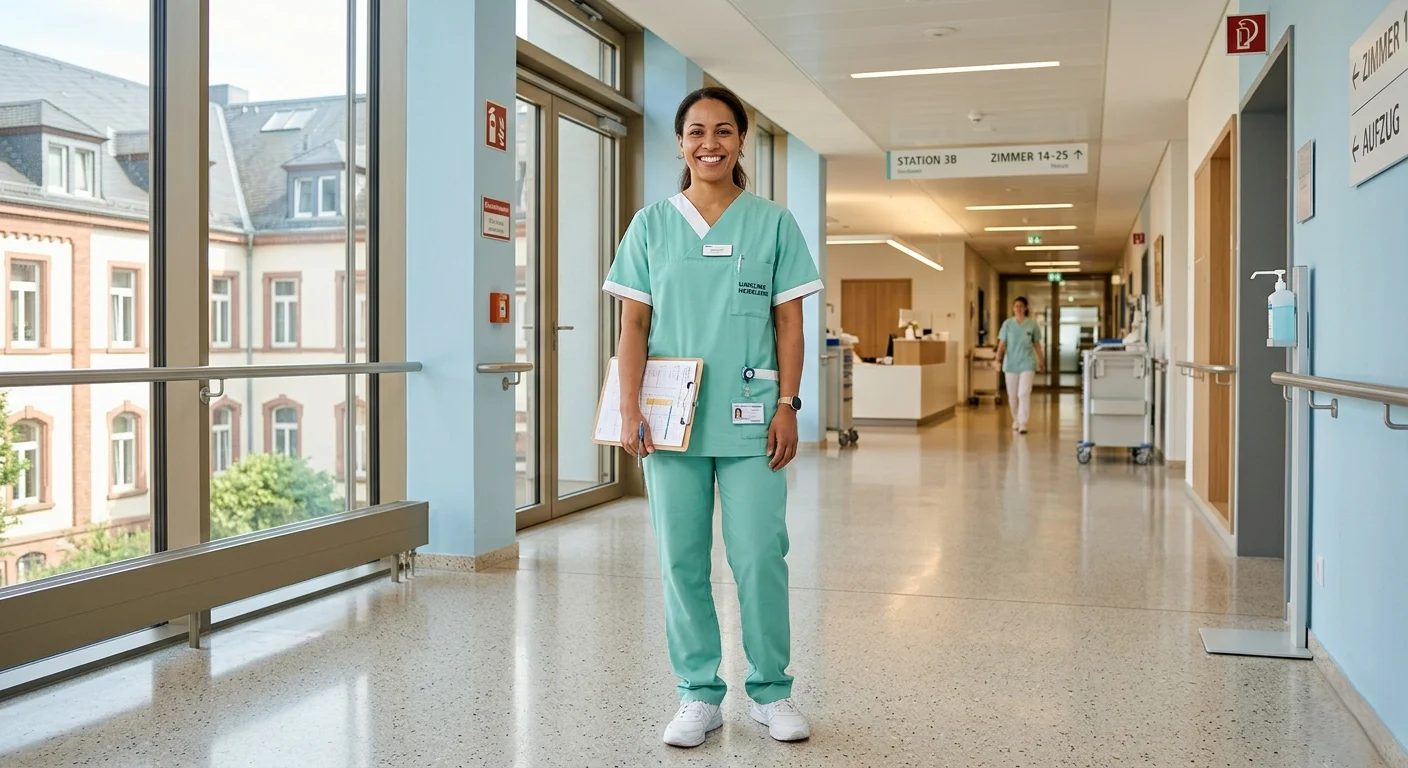
The role you are targeting is called Pflegefachkraft in German. It covers registered general nurses, geriatric nurses, paediatric nurses, and intensive care nurses working in hospitals, rehabilitation centres, and elderly care homes. The title is protected by law, which means you cannot use it or practice at that level without having your foreign qualification formally recognised by German authorities. This recognition process, known as Anerkennung, is the central step in your journey and the one that determines your timeline, your starting salary, and your visa route.
The good news is that the system is built to help you get through it. Most applicants receive at least partial recognition. Employers routinely sponsor the process. The German government subsidises language courses. And since March 2024, you can enter Germany to complete recognition while already earning a salary under an employment contract through the Recognition Partnership visa.
2. Eligibility
Education
You need a nursing qualification equivalent to the German Pflegefachperson standard. This covers Bachelor of Nursing (BSc), General Nursing (GNM), and Master of Nursing (MSc) degrees. The recognition procedure is mandatory for all foreign-trained nurses wishing to work in the profession in Germany. The official Recognition Finder tool on the Anerkennung in Deutschland portal assists applicants in identifying the correct competent authority based on profession, desired work location, and qualification origin. NTL
Language
To work as a recognised nurse (Pflegefachkraft) in Germany, you need B2 German plus a passed Fachsprachprüfung Pflege (specialist language exam). You can start working as a nursing assistant (Pflegehilfskraft) at B1 level. The most widely accepted certificates are from the Goethe-Institut, telc GmbH, TestDaF, and ÖSD. Language certificates should generally not be older than three years at the time of submission. SprachschuleXpolariz
Visa Routes
There are four pathways depending on where you are in the recognition process:
Route A (Recognition Partnership Visa): Since March 2024, the Anerkennungspartnerschaft visa requires only A2 German to apply, a major improvement over the previous B1 or B2 requirement. You sign a contract with a German employer, enter Germany, and complete the recognition process while working under supervision. Sprachschule
Route B (Visa for Recognition under §16d): For applicants who have received partial recognition and need to complete an adaptation programme in Germany. Requires B1 German and a recognition notice showing what gaps remain. Valid for up to 18 months and extendable.
Route C (Skilled Worker Visa under §18a): The standard work permit for nurses with full recognition. Requires full Anerkennung, B2 German, and a concrete job offer. Initially valid for 4 years and leads to permanent residence after 2 to 4 years. Sprachschule
Route D (Opportunity Card / Chancenkarte): A points-based entry visa for job seekers who do not yet have an employer in Germany. Requires A1 German or B2 English.
Important note: The EU Blue Card does not apply to nursing professionals. Make It in Germany
3. Skills Employers Actually Want
Based on a review of more than 15 job descriptions and placement agency requirement lists, the six most repeated requirements are:
German language at B2 level - This is the single most consistent filter. Most employers require proof of B2 before or shortly after arrival, and many will sponsor your B2 courses if you arrive at B1.
Fachsprachprüfung Pflege - The specialist nursing language exam assesses your ability to document patient records, communicate with doctors, and handle clinical scenarios in German. It is required in most federal states before you can practice with full responsibility.
Nursing qualification equivalent to Pflegefachperson - Employers want your BSc or GNM degree, with full transcripts and a curriculum/syllabus submitted to the Anerkennung authority.
Hospital or elderly care experience - Geriatric care experience is especially valued given the highest demand in that sector. Most listings ask for at least two years of post-qualification practice.
Willingness to complete an adaptation period or knowledge test - Around 45 percent of applicants receive partial recognition. Employers who operate recognition partnerships factor this into onboarding. Stating upfront that you are prepared for it makes you a stronger candidate.
Document readiness - Certified translations of your diploma, transcripts, and professional registration are required early. Employers use the completeness of your document file as a proxy for how organised and serious you are.
4. Step-by-Step Path
Step 1: Reach A2 German (Month 1 to 3)
Start German language training immediately in your home country. A2 is the minimum required to apply for the Recognition Partnership visa introduced in March 2024. This is the earliest you can enter Germany with a work contract in hand.
Step 2: Get Your Documents in Order (Month 1 to 2, parallel with language)
Gather your nursing diploma, full academic transcripts, your training programme curriculum/syllabus, and your professional registration certificate if applicable. Have them certified and translated into German by a sworn translator. Each of Germany's 16 federal states administers Anerkennung through designated authorities. Requirements remain consistent nationwide, but processing fees and timelines vary slightly by region. Globeriaglobal
Step 3: Apply for Anerkennung (Month 2 to 4)
Use the Recognition Finder tool at anerkennung-in-deutschland.de to identify the correct authority for the state where you plan to work. Submit your application. Processing time is typically 3 to 6 months of submission. Your employer or recruitment agency will often handle or co-handle this step if you come through a recognition partnership. Globeriaglobal
Step 4: Secure a Job Offer (Month 2 to 5)
Apply through job portals and recruitment agencies simultaneously with your Anerkennung application. You do not need full recognition to receive a job offer. Many employers sign recognition partnership contracts with candidates still in the process.
Step 5: Apply for Your Visa (Month 4 to 6)
With a signed job offer and your Anerkennung reference number, apply at the German consulate in your country. The accelerated skilled worker procedure makes the path from recruitment to the work visa significantly faster and easier to plan. NTL
Step 6: Arrive, Register, and Start (Month 5 to 7)
Register your address (Anmeldung), open a German bank account, and collect your residence permit from the Ausländerbehörde. Enroll in an intensive German course. If you have a BAMF DeuFoV authorisation, the Berufssprachkurse (professional language courses) are completely free, paid for by the German government. Sprachschule
Step 7: Complete Recognition While Earning (Month 6 to 18)
Many nurses arrive in Germany at B1 level and start working immediately as an assistant. They earn real money, gain German-workplace experience, and complete their B2 and recognition process while employed. Their employer often pays for continued language training. Sprachschule
Step 8: Pass the Fachsprachprüfung and Receive Full Recognition (Month 12 to 24)
Once you hold your B2 certificate, sit the Fachsprachprüfung Pflege. After passing, your state authority issues your full professional licence as a Pflegefachkraft. Your salary increases immediately.
Step 9: Build Towards Permanent Residence (Year 3 onward)
Skilled workers with residence permits under §18a AufenthG may now obtain permanent residence after 3 years, provided they hold 36 months of statutory pension insurance contributions. NTL
5. Real-World Challenges
The language wall is real and persistent
Most applicants underestimate how long reaching B2 and then passing the Fachsprachprüfung actually takes. The entire journey from zero German to full recognition takes 18 to 30 months. Nurses who arrive with only A2 or A1 and expect to pass language exams in three months often end up stuck in assistant-level roles longer than planned. Sprachschule
Partial recognition is the norm, not the exception
Around 45 percent of recognition procedures in 2024 resulted in compensatory measures such as a knowledge test or adaptation period. This is not a rejection but it is often treated as one psychologically. Nurses who are not prepared for this outcome sometimes abandon the process or try to change states to reapply, which wastes months. TalentOrbit
Document rejection and incomplete applications
The most widely accepted language certificates are issued by the Goethe-Institut, telc GmbH, TestDaF, and ÖSD. It is important to note that telc certificates from Serbian language schools issued after September 1, 2022 are no longer recognised. Submitting a disqualified certificate restarts the language portion of the application. Xpolariz
Scam agencies are aggressively targeting this route
In a recent fraud case, a Bengaluru-based nurse lost the equivalent of over ₹36.7 lakh after being lured by fraudsters who promised to arrange a German language certificate without an examination and secure her a job in Germany. Scammers have impersonated the Triple Win Project, a legitimate state-backed initiative, to extract fees from Filipino nurses applying for nursing jobs in Germany. Any agency that charges you upfront fees, promises to bypass language exams, or guarantees placement without an interview is operating a scam. News Karnatakagulfnews
State authority processing backlogs
Record figures were set in 2024, with 55,300 new recognition applications and 66,900 procedures decided. Applications from Ukraine alone rose by 143 percent to 3,500. The strongest countries of origin were Turkey, India, and Tunisia. High volumes mean some state authorities are slower than others. Applying in a less congested state or using the accelerated procedure through an employer can significantly reduce wait times. TalentOrbit
6. Where to Apply
Official Government Portals
Bundesagentur für Arbeit (the Federal Employment Agency) at arbeitsagentur.de is the primary official job board with extensive healthcare listings.
Make it in Germany at make-it-in-germany.com is the German government's own international recruitment portal and lists visa-approved employers.
EURES (European Employment Services) at eures.europa.eu connects international job seekers to registered German employers.
The Recognition Finder tool at anerkennung-in-deutschland.de identifies the correct authority for starting your Anerkennung based on your target state.
Job Portals
StepStone Germany, Indeed Germany, and LinkedIn Germany all carry nursing listings, though strong German language skills are recommended for independent applications through these channels.
Recruitment Agencies (with quality seals)
The Fair Recruitment Healthcare Germany quality seal, developed in Germany in 2022, guarantees a transparent recruitment process where all agreements are in writing, your future employer covers all costs associated with the recruitment process, and you join a well-prepared team. Make It in Germany
Agencies that carry this seal or are known for ethical placement include Global Nurse Force, TERN Group, Medicruiter, Dynamic Health Staff, and TPG International.
Government Programmes
The Triple Win programme places nurses from India (Kerala and Telangana), Indonesia, the Philippines, and Tunisia into German healthcare institutions through agreements between the Federal Employment Agency and the partner countries' employment authorities. Make It in Germany
7. Timeline Expectation
3-Month Picture
You are in preparation mode. German language training is underway, ideally toward A2 or B1. Your documents are being collected, certified, and translated. You are beginning to reach out to recruitment agencies and researching which German state you want to target, since state selection affects both the recognition authority and processing speed.
6-Month Picture
Your Anerkennung application is submitted or in process. You have received or are expecting your first recognition notice (Anerkennungsbescheid). If a recognition partnership employer has been found, your visa application is at the German consulate. Some applicants are arriving in Germany at this stage and starting as nursing assistants.
12-Month Picture
A well-prepared applicant with full documents and B2 language can complete the entire process from application to professional certificate in approximately nine months. At the 12-month mark, nurses on the recognition partnership pathway who arrived at B1 are typically approaching their B2 exam and have one to two years of German workplace experience behind them. TalentOrbit
18 to 30-Month Picture
Full recognition is completed, the Fachsprachprüfung is passed, and the standard §18a skilled worker residence permit is in hand. Salary has moved up from assistant level to fully recognised Pflegefachkraft wages. The path to permanent residence after three years is now open and counting.
8. Mistakes to Avoid
Waiting until B2 before applying
This was the old approach. Since March 2024, the Anerkennungspartnerschaft visa lets you enter Germany at just A2 level. Nurses who delay their entire process until they hold a B2 certificate are leaving 12 to 18 months of earning potential and German workplace experience on the table. Sprachschule
Applying to the wrong state authority
The Anerkennung system is decentralised across 16 federal states. Applying to the wrong authority wastes months. Always use the official Recognition Finder tool first.
Using an unverified language certificate
The telc certificates from Serbian language schools issued after September 1, 2022 are no longer recognised. Only certificates from the Goethe-Institut, telc GmbH, TestDaF, or ÖSD are universally accepted. Submitting anything else can trigger a rejection of your entire application. Xpolariz
Treating partial recognition as a dead end
If there are differences between your qualification and the German training, you must complete a compensatory measure such as an adaptation course or a medical knowledge test. Only then can you apply for your professional licence. This is a normal outcome for around half of all applicants. Plan for it rather than panic when it happens. Healthcare-in-germany
Paying fees to recruitment agencies
Legitimate recruitment agencies in Germany do not charge nurses placement fees. The employer pays the agency. Look for agencies that offer full support on documentation, licensing, qualification recognition, and language training at no cost to you. Any agency charging you upfront for visa processing, placement, or language certificates is almost certainly running a scam. Interculturalinsights
Choosing a state based on familiarity rather than processing speed
Some states have notoriously long backlogs for recognition applications. If you have flexibility on where you work, targeting a state with a faster processing authority can shave months off your timeline. Your recruitment agency or the Federal Employment Agency can advise on current wait times.
Letting your language certificate expire
Language certificates should generally not be older than three years at the time of submission. If you passed your B2 exam early in your preparation and then experienced delays, check the date before submitting your Anerkennung application. Xpolariz
9. Next Action
The single most important step you can take right now is to start formal German language training and simultaneously use the Recognition Finder tool at anerkennung-in-deutschland.de to identify the authority in your target state. Do both this week. Language takes the most time of any element in this process, and your Anerkennung clock starts the moment your documents hit the right authority. Every week you delay on either front is a week added to your timeline at the other end.
If you are not yet sure which German state to target, send your CV and qualification summary to a minimum of two agencies that carry the Fair Recruitment Healthcare Germany seal. They can match you with a state and employer simultaneously, and the right agency will begin your Anerkennung application on your behalf at no cost to you.
Travel Essentials
Curated services to help you settle in Germany Nursing Job (Pflegefachkraft) + Visa quickly.
More coming soon
Need help?
Our team can help you find accommodation and coworking spaces in Germany Nursing Job (Pflegefachkraft) + Visa.
Contact Support →