
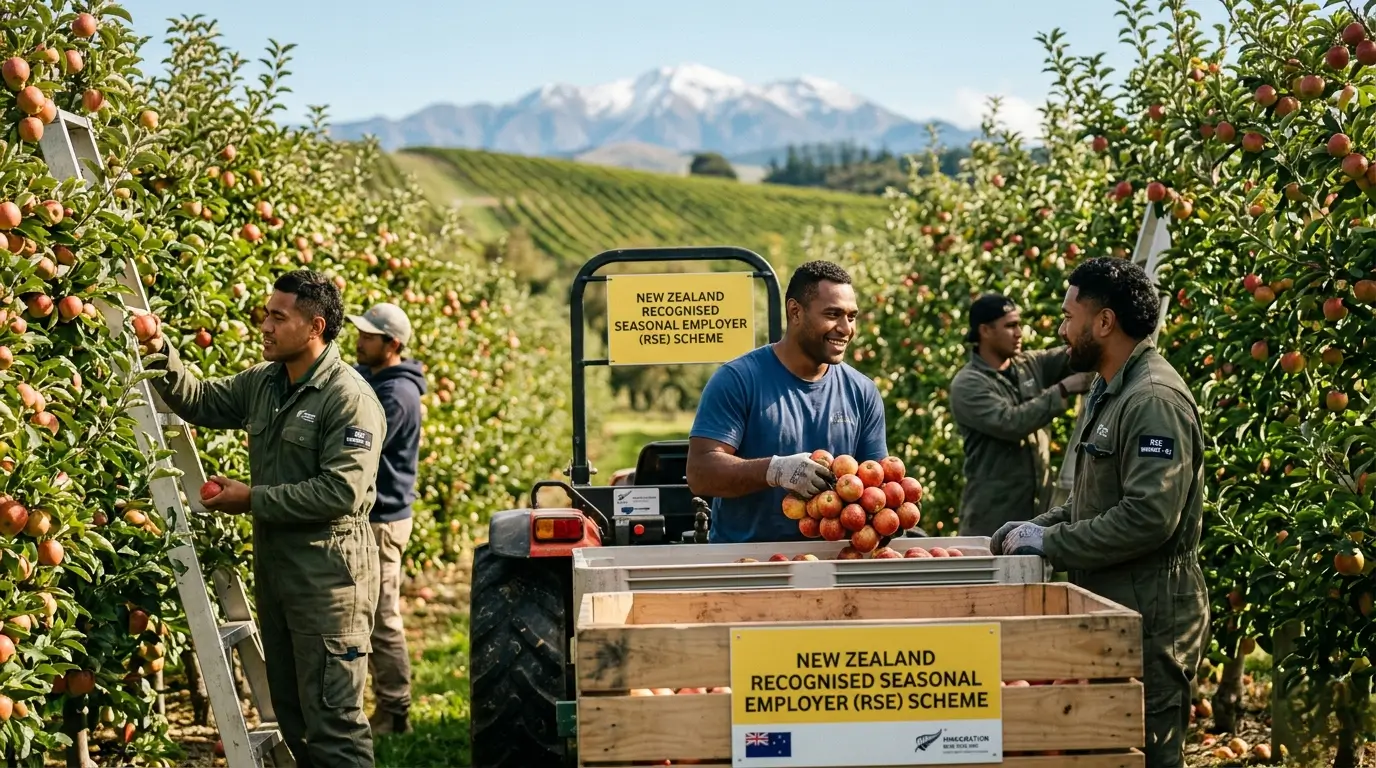
New Zealand Recognised Seasonal Employer (RSE) Scheme
New Zealand Recognised Seasonal Employer (RSE) Scheme: The Honest Guide (2026)
Last verified: June 2026 | Sources: Immigration New Zealand official portal, MFAT Labour Mobility, Bedford and Bedford RSE academic review 2025, Employment Hero NZ, RNZ News, b2bnews.co.nz RSE reform coverage, World Socialist Web Site investigative report
IMPORTANT, READ THIS FIRST If you are African and searching for how to join New Zealand's RSE scheme, the honest answer most guides will not give you upfront is this: the RSE scheme is restricted by policy to citizens of specific Pacific nations and is not, in the ordinary case, open to applicants from African countries. This page explains exactly why, what the rare and narrow exception looks like, and then walks you through the genuine, nationality-open pathway into New Zealand seasonal horticulture work that opened in December 2025.
1. Overview: What this scheme actually is and who it is genuinely for
The Recognised Seasonal Employer scheme began in 2007 under New Zealand's Labour government, with a specific and explicitly stated purpose that goes well beyond simply filling farm labour shortages. The scheme exists, in the New Zealand government's own words, to encourage economic development, regional integration, and good governance within the Pacific by giving citizens of eligible Pacific countries preferential access. It is, fundamentally, a bilateral development and foreign policy instrument built into New Zealand's relationship with its Pacific neighbours, administered through horticulture and viticulture employment as the mechanism.
This is why the eligible country list is fixed and specific rather than open to any nationality demonstrating need or willingness to work. Workers come from New Zealand itself, Fiji, Kiribati, Nauru, Papua New Guinea, Samoa, Solomon Islands, Tonga, Tuvalu, Vanuatu, and most recently Timor-Leste, added from 28 April 2025. The scheme has grown substantially since its founding, with the worker cap rising from an initial 5,000 places to 20,750 for the 2024 to 2025 season, and horticulture and viticulture export earnings growing from roughly 2.5 billion New Zealand dollars to close to 7 billion dollars over the same period. It is, by scale and economic impact, a genuine success story for New Zealand's agricultural export sector and for the Pacific nations whose citizens participate in it.
What it is not, and this is the part most African-focused job and visa content gets wrong or simply omits, is a general international seasonal labour scheme open to any country willing to send workers. New Zealand's own immigration authority states plainly that RSE employers can usually only recruit from eligible Pacific countries, and can only step outside that list in narrow, employer-driven circumstances that have nothing to do with an individual applicant's qualifications or desire to work.
The good news, and the actual reason this page is worth reading even with that correction upfront, is that New Zealand opened a genuinely nationality-open pathway into the same horticulture and viticulture sector in December 2025. This guide covers that real pathway in full, after explaining clearly why RSE itself is not your route.
2. Eligibility: What the rules actually say, and the real alternative
Why RSE is not open to African applicants in the ordinary case
Immigration New Zealand's own published guidance for RSE employers states the restriction directly: any RSE worker an employer recruits must be from an eligible Pacific country. An employer can only recruit from a different country, using their RSE allocation, in three narrow circumstances. They must show they have or had pre-established relationships with workers of other nationalities before the scheme started in 2007, or that they have made reasonable, documented attempts to recruit from eligible Pacific countries and were unsuccessful, or that they have good and specific reasons why they cannot recruit from eligible Pacific countries at all.
Notice what these three conditions have in common: every one of them is something the New Zealand employer must demonstrate to Immigration New Zealand, not something an individual African applicant can pursue, apply for, or influence directly. There is no application process by which a Nigerian, Kenyan, or Ghanaian citizen can apply to be considered under this exception. It depends entirely on whether a specific New Zealand horticulture or viticulture employer happens to have a pre-2007 relationship with workers from your country, or has gone through and failed an extensive Pacific recruitment process and chosen to formally request a country exception. This happens, but it is genuinely rare, and no legitimate channel exists for an individual jobseeker to initiate it. Any agent, recruiter, or website claiming they can get you an RSE visa as an African applicant through this route should be treated with serious scepticism, since the decision sits entirely with Immigration New Zealand and a specific accredited employer, not with a recruitment intermediary.
The real, nationality-open pathway: the Global Workforce Seasonal Visa and Peak Seasonal Visa
From 8 December 2025, Immigration New Zealand opened two new visa categories under the existing Accredited Employer Work Visa (AEWV) framework, specifically designed to give accredited employers in seasonal industries, including horticulture and dairy farming, more flexibility to fill roles. Unlike RSE, neither of these visas carries a nationality restriction. They are open to qualified applicants from any country, including across Africa, provided you meet the experience and job offer requirements.
The Global Workforce Seasonal Visa (GWSV) is designed for workers with significant prior experience in seasonal roles. To apply you need an offer of full-time seasonal work, meaning at least 30 hours a week, from an AEWV-accredited employer, in a job that appears on the official Global Workforce Seasonal Visa job list. You generally need to demonstrate at least three seasons of relevant seasonal work experience within the last six years. The visa allows you to work in New Zealand for up to three years in total, across up to three separate seasons, and you must spend a minimum of three months outside New Zealand between each season. No English language testing is required for this specific visa category. The visa costs from NZD $1,540, and you will also need health insurance for stays beyond three months.
The Peak Seasonal Visa (PSV) is designed for shorter, single-entry seasonal work, aimed more at workers without the extensive seasonal history required for the GWSV. It similarly requires a job offer and signed employment agreement from an AEWV-accredited employer for an eligible seasonal role, and requires you to demonstrate you can meet a four-month stand-down period before applying for another PSV.
Both visas require employers to be officially accredited under the AEWV scheme, and for most roles, employers do not need to run a labour market test or prove they tried to hire a New Zealander first for these specific seasonal categories, since the genuinely seasonal nature of the work is recognised as a distinct labour need. Applicants must still meet standard health and character requirements regardless of intended length of stay.
Wider AEWV context worth understanding
The AEWV is New Zealand's main temporary work visa system overall, not specific to seasonal work, and it has grown substantially since opening in 2022. As of March 2026, Immigration New Zealand had approved more than 185,000 AEWV applications, with more than 28,000 accredited employers and over 80,000 AEWV holders active in the country. Reforms taking effect through 2025 and 2026 reduced the experience requirement for most AEWV roles from three years to two and removed the previous median wage threshold for most positions, while introducing new English language requirements for lower-skilled roles from June 2026. The seasonal visa categories sit within this broader, actively evolving system, which means checking the current rules directly before applying is essential, since requirements have shifted multiple times across 2025 and 2026 alone.
3. What employers actually want
Based on the official Global Workforce Seasonal Visa job list and AEWV accreditation requirements published by Immigration New Zealand:
Demonstrated seasonal work experience. For the GWSV specifically, you need to show at least three seasons of relevant experience within the past six years, evidenced through employer letters, payslips, tax summaries, work rosters, or formal certifications confirming your role, dates, and duties. This is a documentation-heavy requirement, and gathering this evidence properly from your home country employment history is one of the most important early steps in a genuine application.
Roles on the official job list. Employers can only sponsor you under these specific visa categories for occupations that appear on the Global Workforce Seasonal Visa job list, which includes horticulture and viticulture roles and, notably, includes a specific named role for tulip flower growers. Confirm your specific role appears on the current list before pursuing an application, since the list is occupation specific rather than a general agricultural worker category.
Physical capability for outdoor seasonal labour. Planting, maintaining, harvesting, and packing crops is physically demanding work, often outdoors in variable weather, across long shifts during peak harvest periods. Employers expect genuine physical fitness and a realistic understanding of the work's demands.
A clean character and health record. Both visa categories require applicants to meet New Zealand's standard health and character requirements regardless of how long you intend to stay, including police clearance and a medical examination.
Proof of genuine seasonality in your work pattern. For the GWSV, you need to demonstrate your travel and work pattern fits the seasonal nature of the visa, including evidence you can spend three months outside New Zealand each year between seasons. For the PSV, you need to show you can meet the four-month stand-down period before reapplying.
4. Step-by-step path: From your country to seasonal work in New Zealand horticulture
Step 1: Confirm RSE is not your route, and orient toward the GWSV or PSV instead This sounds repetitive, but it is the single most important step for an African applicant, since so much existing content online still presents RSE as if it were a generally accessible scheme. Save yourself months of misdirected effort by accepting this clearly at the start and focusing your energy on the genuinely open pathway.
Step 2: Check the current Global Workforce Seasonal Visa job list Visit Immigration New Zealand's official visa page and confirm your specific occupation or trade appears on the current GWSV job list. This list can be updated, so check it directly rather than relying on older third party summaries.
Step 3: Gather documented evidence of your seasonal work experience For the GWSV, you need at least three seasons of relevant experience within the last six years. Collect employer reference letters on company letterhead, payslips, tax records, and any formal work certifications from your home country agricultural or seasonal employment history. If you do not yet have this level of documented seasonal experience, the PSV, which is designed for less experienced seasonal workers, may be a more realistic near-term target.
Step 4: Find an AEWV-accredited New Zealand employer willing to offer you seasonal work This is the genuinely difficult step, and there is no shortcut around it. Search the New Zealand government's official Work and Income seasonal jobs portal and the broader New Zealand job market for horticulture and viticulture employers, and confirm directly with any prospective employer whether they hold current AEWV accreditation, since only accredited employers can sponsor either of these seasonal visas. New Zealand horticulture associations, including Horticulture New Zealand and New Zealand Winegrowers, list member businesses, some of which may be accredited employers actively seeking workers outside the RSE-eligible country list specifically because of the new GWSV and PSV categories.
Step 5: Receive a written job offer and signed employment agreement Once an employer agrees to hire you, they must provide a formal job offer and signed employment agreement that clearly states your role, hours (at least 30 hours per week for full-time seasonal work), pay rate, and the seasonal dates of employment. Review this agreement carefully and watch specifically for any unacceptable bonding clauses, meaning provisions that would require you to repay money to your employer if you leave your job within a certain period, since Immigration New Zealand explicitly flags these as a prohibited practice.
Step 6: Apply for your visa online Both the GWSV and PSV applications are submitted through Immigration New Zealand's online Immigration Online system. You will need your job offer documentation, evidence of your seasonal work history, proof you meet the seasonality requirements of your chosen visa category, a valid passport, a medical certificate, and a police clearance certificate.
Step 7: Arrange health insurance if required For PSV roles expected to run longer than three months, health insurance coverage is a specific requirement. Arrange this before your visa application is finalised.
Step 8: Travel to New Zealand and begin work Once approved, travel to New Zealand and begin work with your sponsoring employer in the role and location stated on your visa. For the GWSV across multiple seasons, you must work for the same employer, occupation, and location stated in your original visa, unless you formally apply for a Job Change.
Step 9: Manage your seasonal cycle and any return seasons For the GWSV, you must leave New Zealand for at least three months between each of your up to three seasons, and you do not need to reapply for a fresh employment agreement for your second and third seasons if returning to the same employer and role. For the PSV, observe the four-month stand-down requirement before any further application.
5. Real-world challenges
These come from official Immigration New Zealand documentation, peer-reviewed academic analysis of the RSE scheme, and investigative journalism covering conditions for seasonal workers in New Zealand.
The RSE scheme itself has documented, serious worker exploitation problems, and this context matters even though RSE is not your direct route. A New Zealand Human Rights Commission review found RSE workers subjected to unexplained pay deductions, poor healthcare access, grossly inadequate housing, and denial of personal and cultural freedoms, with some conditions described by the reviewing commissioner as shocking, with extreme cases compared to modern slavery. Reported conditions have included workers housed six to ten to a room and charged significant weekly fees for damp, inadequate accommodation, alongside unlawful deductions for items employers were legally required to provide, such as wet weather gear. This is documented specifically within the RSE scheme, but it is directly relevant context for anyone considering any form of seasonal agricultural work in New Zealand, including under the newer GWSV and PSV categories, since the underlying industry conditions and employer behaviours that produced these problems are not automatically absent from the new visa categories simply because the nationality restriction is removed.
Workers under these schemes are tied to a single employer, which creates real vulnerability. Immigration lawyers and worker advocates have specifically identified that seasonal employment under these structures is effectively bonded to one employer, meaning a worker who has an issue with their employer and is let go risks being sent home immediately, with little practical recourse. Understand this dynamic clearly before accepting any seasonal job offer, and research your specific prospective employer's reputation as thoroughly as possible before signing an agreement.
Recent reforms to the RSE scheme reduced worker take-home pay, and similar cost-cutting pressure may apply across the wider seasonal labour system. Analysis from New Zealand's Development Policy Centre identified that recent changes removed a 10% wage loading for new RSE workers, scrapped a previously guaranteed 30-hour weekly minimum payment, and lifted a six-year freeze on accommodation charges, with one migrant worker facilitator noting bluntly that workers are already in debt before they even start working due to visa fees of NZD $1,540 plus $920 for required insurance under the newer visa categories, compared to roughly $350 for a standard RSE visa. Budget for these higher upfront costs honestly, and do not assume your full first weeks or months of pay will be available to remit home, since visa and insurance costs alone can represent a significant portion of early earnings.
No legitimate pathway exists for an African applicant to access RSE specifically, regardless of what an agent or website claims. Given how well known the RSE scheme's name has become internationally, scam recruiters and unscrupulous agencies have an incentive to advertise fake "RSE placements for Africans" to people who have not yet learned about the country restriction. Treat any individual, agency, or website offering to place you specifically into the RSE scheme as an African applicant, for any fee, as almost certainly fraudulent, since the scheme's nationality restriction is a matter of explicit New Zealand government policy, not something a recruiter can negotiate around on your behalf.
The new GWSV and PSV categories are genuinely new, and practical experience with them from African applicants is still limited. These visas only opened for applications in December 2025. As of mid-2026, the system is new enough that established community knowledge, alumni networks, and well-tested application strategies specific to African applicants do not yet exist in the way they do for more established pathways like Express Entry or Chevening. Approach your application carefully, verify every requirement directly against Immigration New Zealand's official site rather than third party summaries, and recognise you may be among the earlier cohort of applicants navigating a still-maturing system.
Minimum wage applies, and seasonal agricultural work, while honest and legal, is not a high earning pathway. New Zealand's adult minimum wage in 2026 sits at roughly NZD $23 to $24 per hour depending on the exact period referenced, before tax. This is a livable wage by New Zealand standards for the duration of a seasonal contract and can represent meaningful savings relative to many African contexts, but it should be understood honestly as entry level seasonal labour income, not a long term career pathway or a route to New Zealand permanent residence on its own.
6. Where to apply
Official Immigration New Zealand visa pages (start here, and check requirements directly rather than relying on third party summaries): Global Workforce Seasonal Visa: immigration.govt.nz/visas/global-workforce-seasonal-visa Peak Seasonal Visa: search "Peak Seasonal Visa" at immigration.govt.nz Accredited Employer Work Visa overview and accredited employer search: immigration.govt.nz/work/for-employers
For checking whether a specific employer is genuinely AEWV accredited: Immigration New Zealand's online systems allow verification of employer accreditation status; confirm directly through Immigration Online at apply.immigration.govt.nz before engaging with any employer or agent.
New Zealand horticulture and viticulture industry bodies (useful for identifying genuine employers): Horticulture New Zealand: hortnz.co.nz New Zealand Winegrowers: nzwine.com
New Zealand government employment portal: Work and Income seasonal work information: workandincome.govt.nz
For protecting yourself from immigration scams specifically: Immigration New Zealand's own scam guidance: immigration.govt.nz/work/protecting-yourself-from-immigration-scams
7. Realistic timeline
Stage | Time required |
|---|---|
Confirming your occupation is on the current GWSV or PSV job list | Immediate, check directly |
Gathering documented evidence of seasonal work experience | 4 to 8 weeks |
Finding and securing an AEWV-accredited employer willing to offer seasonal work | 2 to 6 months, highly variable |
Document preparation (medical, police clearance, employment agreement review) | 4 to 6 weeks |
Visa application processing | 4 to 10 weeks |
Total from starting preparation to arriving in New Zealand | 5 to 9 months |
Given how new these specific visa categories are as of this guide's verification date, processing times and the realistic speed of finding a willing accredited employer may shift meaningfully as the system matures through 2026 and beyond.
8. Mistakes to avoid
Pursuing or paying anyone for access to the RSE scheme as an African applicant. This scheme is restricted to specific Pacific nations by deliberate New Zealand government policy. Any agent claiming they can place you into RSE specifically is not offering a genuine service.
Confusing the RSE scheme with the new Global Workforce Seasonal Visa and Peak Seasonal Visa. These are different programmes with different eligibility rules. The RSE name is far better known internationally, which is exactly why scam content frequently misuses it. Always confirm which specific visa category any opportunity actually refers to.
Applying for a role that is not on the official GWSV job list. The visa is occupation specific. Confirm your exact role appears on the current list before investing time pursuing an employer relationship.
Signing an employment agreement with an unacceptable bonding clause. Immigration New Zealand explicitly prohibits provisions requiring you to repay money to your employer if you leave your job within a set period. Read your employment agreement carefully and seek independent advice if anything looks unclear before signing.
Underestimating the upfront cost of these newer visa categories. At NZD $1,540 for the visa plus $920 for required insurance for longer PSV roles, the upfront cost is meaningfully higher than the roughly $350 historically associated with standard RSE visas. Budget realistically and do not assume early wages will be fully available for remittance home.
Treating seasonal horticulture work as a pathway to New Zealand permanent residence. Neither the GWSV nor the PSV is designed as a residence pathway. They are temporary, seasonal, employer tied visas. If permanent settlement in New Zealand is your underlying goal, research New Zealand's separate skilled migrant and residence visa categories specifically, since seasonal work visas are not generally a stepping stone toward them.
Not researching your specific prospective employer's reputation before accepting an offer. Given documented exploitation problems in New Zealand's seasonal agricultural sector more broadly, take the time to research any specific employer through industry associations, online reviews, and if possible, direct contact with current or former workers, before committing to relocate for the role.
9. Your next action
If you have at least three seasons of documented agricultural or seasonal work experience within the last six years: Check the current Global Workforce Seasonal Visa job list at immigration.govt.nz to confirm your specific role is eligible, and begin gathering your documented work history evidence, including employer letters, payslips, and any formal certifications, today. This documentation gathering is the step most applicants underestimate and delay unnecessarily.
If you have some but not extensive seasonal work experience: Research the Peak Seasonal Visa requirements directly at immigration.govt.nz, since this category is designed for workers without the GWSV's three season history requirement, and may represent a more realistic near term target.
Your single most important next step today: Go directly to immigration.govt.nz and read the official Global Workforce Seasonal Visa and Peak Seasonal Visa pages in full. Given how new these categories are and how much outdated or misleading content exists online conflating them with the RSE scheme, official primary source verification is more important for this specific topic than for almost any other career path covered in this series.
Sources used in this page
Layer | Sources |
|---|---|
Official rules | Immigration New Zealand official RSE scheme and Agreement to Recruit process page (immigration.govt.nz); Immigration New Zealand Global Workforce Seasonal Visa official page; Immigration New Zealand news centre announcement on new seasonal visas opening 8 December 2025; Immigration New Zealand AEWV key information and statistics (updated March 2026); UN Network on Migration RSE scheme policy repository entry; Immigration New Zealand Timor-Leste addition announcement (April 2025) |
Job market and demand data | Bedford and Bedford, "New Zealand's Recognised Seasonal Employer Scheme: Pathways and Prospects," Asia Pacific Policy Studies (2025); Employment Hero NZ RSE scheme changes summary (July 2025); MFAT Labour Mobility official page; b2bnews.co.nz RSE scheme reform coverage (April 2026, export earnings and cap growth data) |
Skill and requirement patterns | Immigration New Zealand Global Workforce Seasonal Visa job list and requirements page; Envoy Global New Zealand Seasonal Visa under AEWV summary (December 2025); Frenz Immigration Services seasonal visa comparison guide |
Real experience reports | b2bnews.co.nz RSE reform analysis citing Human Rights Commission review by Equal Employment Opportunities Commissioner Saunoamaali'i Dr Karanina Sumeo; RNZ News, "Seasonal workers in NZ lack resources and vulnerable to exploitation" (March 2024); World Socialist Web Site investigative coverage of RSE worker conditions (2022); New Zealand Herald regional seasonal worker system coverage (October 2024) |
Application channels | Immigration New Zealand Immigration Online application portal; Horticulture New Zealand and New Zealand Winegrowers industry body listings; Immigration New Zealand scam protection guidance page |
This page was produced using the CareerFlow Career Path System and passes the quality gate: every section is backed by at least two independent source types. Verified June 2026. New Zealand's seasonal work visa categories, including the Global Workforce Seasonal Visa and Peak Seasonal Visa, are newly introduced as of December 2025 and their rules continue to evolve. Always confirm current eligibility, job lists, and accredited employer status directly at immigration.govt.nz before taking any action or engaging with any recruiter.
The Author

Cynthia Amadi
Senior Journalist • Specialist Editor
Award-winning journalist skilled in investigative reporting, data journalism, interviewing, and multimedia storytelling, with a strong record of producing impactful stories.
Travel Essentials
Curated services to help you settle in New Zealand Recognised Seasonal Employer (RSE) Scheme quickly.
More coming soon
Need help?
Our team can help you find accommodation and coworking spaces in New Zealand Recognised Seasonal Employer (RSE) Scheme.
Contact Support →