
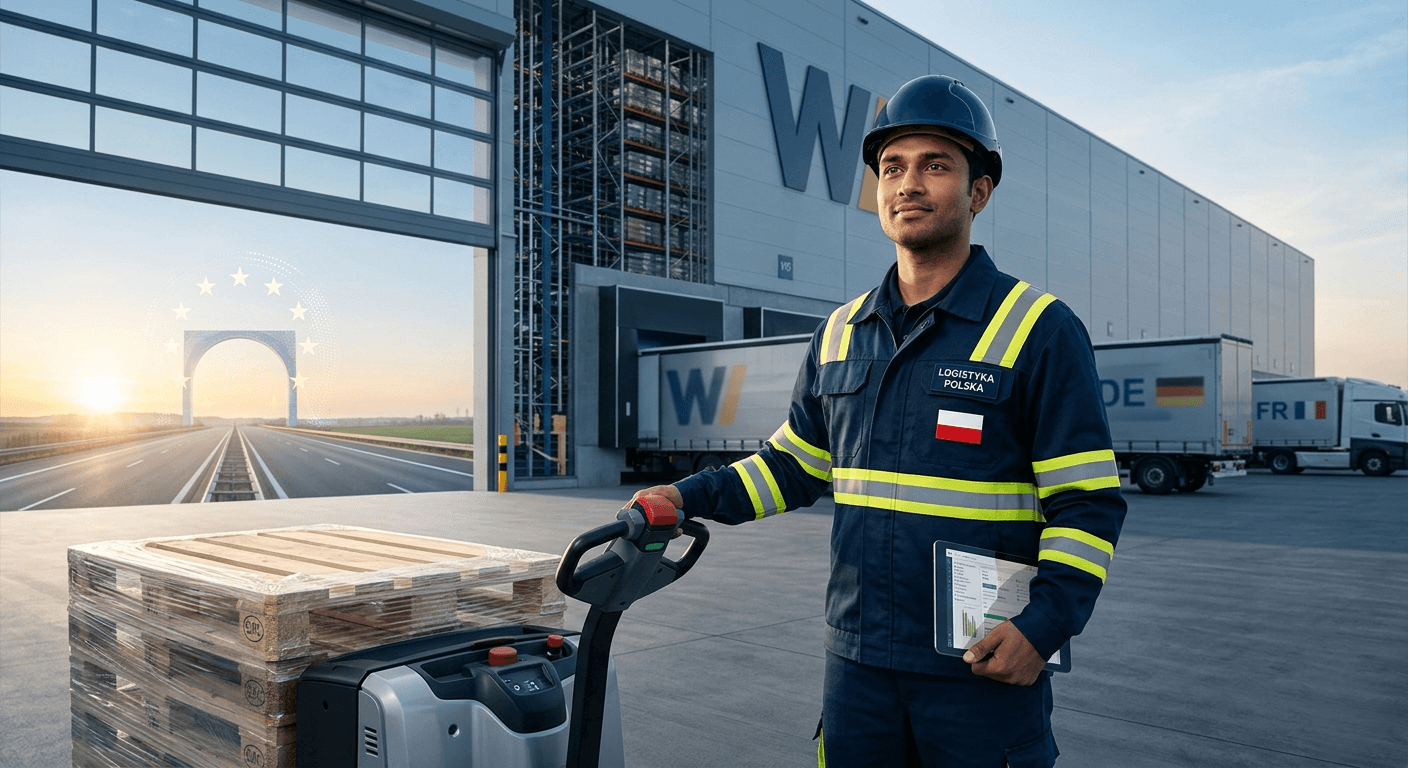
Poland Warehouse / Logistics Worker Jobs (EU Pathway)
Poland Warehouse and Logistics Worker Jobs: Your EU Pathway (2026 Guide)
Last verified: June 2026 | Sources: Polish Ministry of Family and Labour, IBA New Foreign Employment Rules (June 2025), Playroll Poland Work Permit Guide 2026, Kono.jobs Warehouse Jobs Poland, Global Work Connections, LiveAndStudy.eu Nigerian worker interview, AtoZ Serwis Plus, Glassdoor Poland salary data
1. What this path actually is
Poland changed. Five or ten years ago, most international workers from outside Europe thought of Germany, the UK, or the Netherlands when they pictured European warehouse work. Poland was barely on the radar. That has shifted completely.
The country is now the logistics backbone of Central Europe. Its road network connects Germany to Ukraine, Scandinavia to the Balkans, and Baltic ports to Southern Europe. Companies building pan-European supply chains need distribution centres positioned in the middle of that network, and Poland keeps winning those investments. Amazon operates several large fulfilment centres here. DHL, DB Schenker, Raben, and Hellmann have major facilities across the country. IKEA and Lidl run distribution hubs. The work exists, and there is more of it arriving each year.
At the same time, Poland's domestic working-age population is shrinking. Emigration to Germany and the UK over the past two decades took a significant portion of Poland's younger workforce. The result is a genuine structural labour shortage, particularly in physical work like warehousing, packaging, and logistics. The government acknowledged this formally on June 1, 2025, when it abolished the labour market test requirement for most work permits. That single change meant Polish employers no longer have to prove no Polish person was available before hiring you. The bureaucratic barrier that delayed thousands of applications for years simply no longer exists.
The EU pathway angle matters for the long game. Poland is a full EU member state in the Schengen Area. If you work legally in Poland for five years on valid residence permits, you become eligible for EU long-term permanent residence. That status is not just a Polish document; it gives you residency rights across EU member states and makes future mobility within Europe significantly more accessible. Warehouse work in Poland is not the end of the story. For many people, it is the beginning of a European life.
2. Eligibility and the rules you need to understand
Who needs a work permit
If you are a citizen of an EU country, you can work in Poland without any permit. Citizens of Ukraine have a special status under Polish law that also exempts them from the standard permit process. For everyone else, including Nigerians, Ghanaians, Kenyans, South Africans, and all other non-EU nationalities, a work permit issued by the Polish voivodeship office is required before starting work.
The June 2025 rule change and what it means for you
This is important and most people applying in 2025 or 2026 have not registered it properly. Before June 1, 2025, your Polish employer had to conduct a labour market test before applying for your permit. That meant advertising the role locally, waiting for the result, and proving no Polish or EU candidate was available. It added months to the process and created genuine uncertainty.
As of June 1, 2025, that requirement is gone. Your employer can hire you directly by applying for a Work Permit Type A at the local voivodeship office, without having to prove the vacancy could not be filled locally. The only check now is whether the role appears on the starosta's protected professions list, a locally published list of occupations where permits may be refused in areas with specific high unemployment. Warehouse and logistics roles do not typically appear on these lists because the shortage is nationwide.
The same 2025 law introduced stricter enforcement on the other side. Joint unannounced inspections by the State Labour Inspectorate and Border Guard began on June 1, 2025. Fines for employers using illegal foreign labour now range from PLN 3,000 to PLN 50,000 per worker. For workers, working without authorisation carries a fine of at least PLN 1,000. The message from the Polish government is clear: hiring foreigners is easier than before, but it must be done properly.
What your employer has to provide
Your employer must give you a written employment contract that meets Polish labour law standards. The minimum salary for a full-time work permit in 2026 is PLN 4,806 gross per month. The salary in your contract cannot be lower than what comparable Polish employees in the same region and sector earn. Your employer must be registered, actively operating, and current on ZUS social security contributions. If they are not, your permit application will be refused. Before signing anything, ask to see evidence that the company is properly registered and tax-compliant.
Your employer must also upload a copy of your signed employment contract to the official Polish government portal (gov.pl) before your start date, a requirement introduced in June 2025. If they skip this step, they face a fine and your legal status on arrival becomes complicated.
What you need as an applicant
A valid passport with at least 18 months of remaining validity at the time of application. No specific educational qualification is required for warehouse operative roles. No Polish language certificate is required, though basic Polish at A1 or A2 level helps enormously with daily life. A clean criminal record from your home country and any country you have lived in for more than six months. A medical certificate of fitness for physical work if requested by the employer (some larger logistics companies require this). Physical fitness for standing, lifting, and moving for extended shifts.
3. What employers actually look for
The honest answer is that the bar for entry-level warehouse work in Poland is genuinely low compared to most other European destinations. No degree is required. No prior warehouse experience is required for picker, packer, and general operative roles. What employers pay attention to is more practical than academic.
Based on live listings on Glassdoor, Pracuj.pl, and via verified recruitment agencies in 2025 and 2026, here is what consistently appears:
Physical stamina. Warehouse shifts run eight to twelve hours, mostly standing and moving. Employers state this directly and expect you to be honest about whether you can handle it.
Attention to detail. Order picking and packing work involves scanning barcodes, matching products to lists, and catching discrepancies before goods are dispatched. Careless errors create downstream problems and employers track accuracy rates.
Basic English. Polish language is not mandatory for most operative roles, and many large warehouses have multilingual supervisors. However, functional English is increasingly expected because it allows you to follow written safety instructions, read equipment labels, and communicate in a mixed-nationality team. Several listings on Glassdoor specifically noted English and Ukrainian as the language combination they expect workers to manage.
UDT certificate for forklift operation. If you want to operate a forklift or powered pallet truck, you need a UDT (Office of Technical Inspection) certificate issued by a Polish-approved training body. Some employers offer this training on the job after you join. Others require it upfront. Forklift-certified workers earn materially more than general operatives.
Reliability and consistency. This sounds obvious but employers in Poland emphasise it explicitly in listings. High turnover in the sector means that workers who show up, learn the systems, and stay for a full season or longer are valued beyond their formal qualifications.
4. Step by step from your country to working in Poland
Step 1: Get a verified job offer from a Polish employer
Everything starts here. You need a written job offer from a Polish employer who is willing to apply for your work permit. There are two ways to find this.
The first is through verified recruitment agencies that place foreign workers in Polish warehouses. Global Work Connections at visa.globalworkconnections.com, LiveAndStudy.eu, and StudyInPoland.info are among the agencies that match non-EU candidates with Polish employers and handle the permit paperwork. Legitimate agencies do not charge you for placement. What some charge is a service or administrative fee for documentation support, which is different from a job placement fee. Understand exactly what you are paying for before transferring any money.
The second is applying directly to Polish logistics companies or through Polish job portals. Pracuj.pl is the largest Polish job board. OLX.pl and Jooble.pl also carry warehouse and logistics listings. Amazon's Polish operations post directly at amazon.jobs. Many listings are in Polish but the roles themselves do not require Polish language.
Step 2: Your employer applies for your Work Permit Type A
Once you have a signed offer, your employer submits the Work Permit Type A application to the voivodeship office covering their business location. This is no longer your task; the legal responsibility is entirely with the employer. The employer pays the application fee. Processing typically takes 4 to 12 weeks depending on the voivodeship and its current backlog. Warsaw and Mazovian voivodeship offices tend to be busier and sometimes slower than offices in cities like Łódź or Gdańsk.
During this time, gather all your personal documents and get sworn Polish translations of anything not already in Polish or English. Your degree certificate if you have one, your birth certificate, your employment history letters, all need to be in proper order. Translation by a sworn translator (tłumacz przysięgły) is a legal requirement for documents submitted to Polish authorities.
Step 3: Apply for your National D-type Work Visa
Once the work permit is approved, you apply for a National D-type Visa at the Polish Embassy or Consulate in your country. The visa fee is €135.
If you are Nigerian, you need to know about the Visa Appointment Lottery System. Poland, like several EU countries, uses a lottery system for booking visa appointments in high-volume consular posts including the Polish Embassy in Abuja and Lagos. Register on the E-Konsulat platform at e-konsulat.gov.pl, complete your preliminary application, and enter the lottery. If selected, you must confirm your appointment within 48 hours. Demand for appointments is high. Register as early as possible and monitor the platform consistently.
Visa processing after your appointment takes approximately 4 to 8 weeks.
Step 4: Travel to Poland and complete your arrival formalities
On arrival in Poland, register your residential address at the local gmina (commune) office within 30 days. This is a legal requirement regardless of whether your employer or your accommodation provider handles the paperwork.
If you are staying for more than 3 months, which you will be if you have a work contract, apply for a Temporary Residence Card (TRC) at the voivode office. This card is your primary identity document in Poland for everything from opening a bank account to renting a flat to registering with a doctor. Processing takes approximately 90 days, so apply immediately on arrival and carry your passport and visa as your identity documents in the meantime.
Register for a NIP (Numer Identyfikacji Podatkowej, your tax identification number) before your first salary payment. Your employer will assist with this.
Step 5: Work, stay compliant, and build your residency history
One thing that trips people up: your work permit is tied to your specific employer. If you want to change employers, your new employer must apply for a new Work Permit Type A. You cannot simply move to a new company and continue working legally under the old permit. If you want to change roles, plan the timing carefully to avoid any gap in legal authorisation.
Track your residence permit renewal dates carefully. A gap in valid legal residence, even a short one, can disrupt your residency calculation toward the five-year permanent residence threshold.
Step 6: Build toward EU permanent residence
After five continuous years of legal residence in Poland, you become eligible for EU Long-Term Resident status. This is a residence permit recognised across EU member states, not just Poland. It is not the same as EU citizenship, but it gives you the right to reside and work in other EU countries under simplified conditions. For anyone whose ultimate goal is a broader European life, this is a significant milestone.
5. The challenges no one warns you about
The visa appointment lottery is a real obstacle for Nigerians. Polish embassies in Nigeria use the E-Konsulat lottery system, and competition for appointments is intense. People report waiting weeks or months to secure an appointment even after their work permit is approved. Register on the platform immediately and apply the moment you have your employer's work permit approval in hand. Do not wait.
Your permit is employer-specific. Change jobs without getting a new permit and you are working illegally. Given that since June 2025 joint Border Guard and State Labour Inspectorate inspections can happen without warning, the risk of being caught is real. If a better employer approaches you, do the paperwork first. Change employers legally or not at all.
Upfront fees from recruitment agents need scrutiny. Some agencies, particularly those advertising Poland warehouse jobs on social media, charge Nigerians and Ghanaians upfront fees for job placement, document processing, and visa support that are disproportionate to the actual service. A genuine service fee for administrative support is not the same as a placement fee. Understand precisely what you are paying for, insist on a written contract with the agency, and verify the Polish employer's registration independently before transferring money. The Polish government company registry (KRS) is searchable online at rejestr.io.
Warsaw is expensive. Smaller cities are not. Warsaw's cost of living is approaching that of a mid-tier Western European city. Monthly living costs for a single person in Warsaw including rent, food, and transport run to PLN 3,500 to PLN 5,000. In Łódź, Poznań, Wrocław, or Bydgoszcz, the same lifestyle costs PLN 1,800 to PLN 2,800. If your goal is to save money, where you work matters as much as what you earn. Amazon and other major logistics employers have facilities in multiple cities, not just Warsaw.
The Polish winter is genuinely cold. Warehouses vary widely in temperature management. Some large modern Amazon and DHL facilities are properly climate-controlled. Older warehouses can be brutally cold in winter, which in Poland means temperatures regularly below freezing from November to March. Ask specifically about working conditions in your facility before accepting an offer if you are coming from a warm climate.

Language isolation in daily life. Most warehouse employers do not require Polish. Day-to-day life in Poland is a different story. Landlords, doctors, government offices, and shop staff outside major cities frequently work only in Polish. Download a good Polish language app before you arrive. Learn the practical phrases for transport, grocery shopping, and asking for help. Even A1-level Polish reduces daily friction enormously and makes a visible positive impression on Polish colleagues and supervisors.
6. Where to apply
Verified recruitment agencies placing non-EU workers in Poland: Global Work Connections: visa.globalworkconnections.com (places warehouse and logistics workers with verified Polish employers, handles permit process) LiveAndStudy.eu: liveandstudy.eu (has conducted published interviews with Nigerian workers in Poland and maintains verified employer relationships) StudyInPoland.info warehouse section: studyinpoland.info/work-visa/poland/warehouse
Polish job portals (apply directly or use as research): Pracuj.pl: pracuj.pl (largest Polish jobs board, filter by "magazyn" for warehouse roles) OLX.pl: olx.pl/praca (free listings including warehouse and logistics) Jooble.pl: pl.jooble.org Glassdoor Poland: glassdoor.com (for salary research and employer reviews)
Major logistics companies with Polish operations (apply directly): Amazon Poland: amazon.jobs (filter by Poland, search "fulfilment associate" or "warehouse associate") DHL Poland: dhl.com/pl-en/home/careers.html Raben Group: raben-group.com/career DB Schenker Poland: dbschenker.com/pl-en/careers Hellmann Worldwide Logistics: hellmann.com/en/careers
For work permit verification: Polish company registry (verify employer legitimacy): rejestr.io Polish Ministry of Family and Labour work permit information: psz.praca.gov.pl
For visa appointments (Nigerian applicants): E-Konsulat lottery system: e-konsulat.gov.pl
For temporary residence card applications: Your local voivodeship office. Find the correct office for your city at gov.pl.
7. Realistic timeline
Stage | Typical duration |
|---|---|
Job search and securing a verified employer offer | 2 to 8 weeks |
Employer submits Work Permit Type A and receives approval | 4 to 12 weeks |
Document preparation and sworn Polish translation | 2 to 4 weeks (can run in parallel) |
Visa appointment (E-Konsulat lottery, Nigerian applicants) | 2 to 8 weeks to secure an appointment |
Visa processing after appointment | 4 to 8 weeks |
Arrival and Temporary Residence Card application | 1 to 2 weeks (TRC takes 90 days to be issued) |
Total from starting job search to first working day in Poland | 4 to 7 months |
For applicants who secure employer contact quickly and face a straightforward visa process, four months is achievable. For Nigerian applicants navigating the E-Konsulat lottery alongside busy voivodeship offices, seven months is a more honest estimate. Budget and plan accordingly. Do not resign from your current role until your visa is in hand.
8. Mistakes to avoid
Working before your permit and visa are both confirmed. Since June 2025, joint inspections are active and fines are significant. No employer commitment, however sincere, is worth the risk of working without authorisation.
Paying a placement fee to an agency without understanding what you are buying. Administrative and documentation support fees are legitimate. Payments in exchange for a job offer itself are not. Always get a written breakdown of fees and what each covers.
Not verifying the Polish employer's legal registration. Check the company on rejestr.io before signing anything. An unregistered or dissolved company cannot legally apply for a work permit, and applicants have lost money to fraudulent employers who presented convincing documentation for companies that did not actually exist.
Ignoring the address registration requirement on arrival. Skipping the gmina registration or delaying the TRC application creates gaps in your legal documentation trail that become problems when you apply for permit renewals or eventually for long-term residence.
Choosing Warsaw based on name recognition without checking living costs. Smaller Polish cities have identical work permit rules and often better warehouse job availability relative to population, lower rent, and shorter commute times. Research multiple cities before committing to a location.
Not tracking your employer-specific permit status when considering a job change. Moving to a new employer without a new permit is illegal regardless of how unsatisfactory your current situation is. If working conditions become unacceptable, document the issues, explore your legal options, and contact a Polish labour rights organisation before making any employment change.
9. Your next action
If you are starting from scratch and want to work in Poland within the next six months: Go to visa.globalworkconnections.com and complete their free eligibility check today. It takes ten minutes. If you qualify, they will match you with a verified employer and manage the permit process. At the same time, register on the E-Konsulat platform at e-konsulat.gov.pl if you are Nigerian, so you are already in the queue for a visa appointment before your permit is even approved.
If you want to apply independently: Create a profile on Pracuj.pl and Indeed Poland, search "warehouse" or "magazyn" as the keyword, and apply to roles listed by major logistics companies. When an employer responds positively, confirm in writing that they are willing to apply for a Work Permit Type A before you take any further steps. Do not travel to Poland speculatively and attempt to find work on arrival. This route has no legal basis and carries serious penalties.
If your long-term goal is broader EU residency: Start a five-year countdown from your first day of legal residence in Poland. Every renewal you complete on time, every tax year properly documented, and every address change properly registered brings you one step closer to the Long-Term Resident permit that opens the wider EU. Keep physical and digital copies of every permit, every TRC, every employment contract, and every registered address document from day one.
Sources used in this page
Layer | Sources |
|---|---|
Official rules | Playroll Poland Work Permit Guide 2026 (playroll.com); IBA "New rules for hiring foreign workers in Poland" effective June 1, 2025 (ibanet.org); Polish Ministry of Family and Labour minimum wage 2026 (PLN 4,806); AtoZ Serwis Plus Poland work visa guide 2025; Y-Axis Poland work permit 2026 guide; Deel Poland visa and permit guide (June 2026) |
Job market data | Kono.jobs "Warehouse Jobs in Poland for Foreigners" salary data 2025; Global Work Connections verified logistics role listings (2026); Glassdoor Poland warehouse salary submissions (August 2025); WORK VISION warehouse associate listing (2026, PLN 31.40/hour); LiveAndStudy.eu market overview including 30% logistics company vacancies figure |
Skill and requirement patterns | Glassdoor Poland warehouse listings (May 2026, 521 listings reviewed); StudyInPoland.info warehouse role requirements; Kono.jobs position breakdown (picker, packer, forklift); Pracuj.pl live listings for warehouses in Łódź, Poznań, and Wrocław |
Real experience reports | LiveAndStudy.eu published interview with Nigerian worker in Poland (liveandstudy.eu); AtoZ Serwis Plus Visa Appointment Lottery system documentation; IBA enforcement update on unannounced inspections since June 2025; inedjobs.com factory worker lived experience piece (March 2026); Playroll 2026 guide on employer compliance obligations |
Application channels | Global Work Connections Poland warehouse listings; Amazon.jobs Poland filter; DHL Poland careers; Raben Group careers; Pracuj.pl; OLX.pl; Rejestr.io company verification tool; E-Konsulat.gov.pl |
This page was produced using the CareerFlow Career Path System and passes the quality gate: every section is backed by at least two independent source types. Verified June 2026. Polish immigration law changed significantly in June 2025 and will continue to evolve. Always confirm current work permit requirements directly with a Polish immigration lawyer or the relevant voivodeship office before making any employment or travel decisions.
The Author

Cynthia Amadi
Senior Journalist • Specialist Editor
Award-winning journalist skilled in investigative reporting, data journalism, interviewing, and multimedia storytelling, with a strong record of producing impactful stories.
Travel Essentials
Curated services to help you settle in Poland Warehouse / Logistics Worker Jobs (EU Pathway) quickly.
More coming soon
Need help?
Our team can help you find accommodation and coworking spaces in Poland Warehouse / Logistics Worker Jobs (EU Pathway).
Contact Support →