
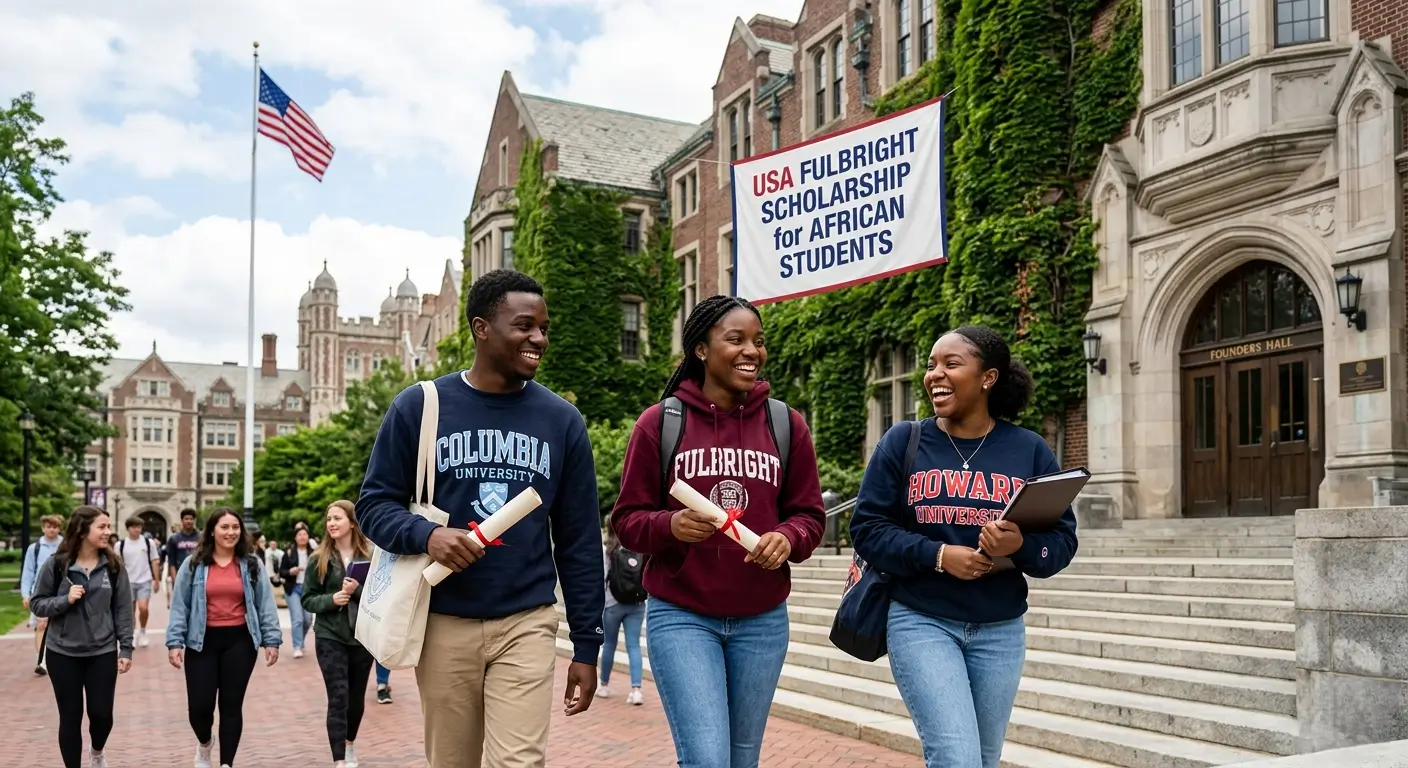
USA Fulbright Scholarship for African Students
USA Fulbright Scholarship for African Students (2026 Complete Guide)
Last verified: June 2026 | Sources: US Department of State Fulbright Program, IIE (Institute of International Education), US Embassy Nigeria, US Embassy Kenya, South Africa DHET Fulbright Programme, ProFellow Statistics 2024 to 2026, Global Admissions Fulbright Guide 2027 to 2028, Fulbright Scholar Program official completing guide
1. Overview: What this opportunity actually is
The Fulbright Programme was established by an Act of the United States Congress in 1946, proposed by Senator J. William Fulbright of Arkansas, with the specific goal of promoting mutual understanding between the people of the United States and the people of other nations through educational and cultural exchange. Since then, the programme has awarded over 400,000 grants to students, scholars, teachers, and professionals across more than 160 countries. Fulbright alumni include 63 Nobel Prize laureates, 93 Pulitzer Prize winners, and 46 current or former heads of state or government.
For African students, the relevant programme is the Fulbright Foreign Student Programme (FFSP), which brings international graduate students, young professionals, and artists to the United States to pursue Master's degrees, doctoral study, or independent research at accredited US universities and academic institutions.
There is also a separate programme worth knowing about: the Fulbright African Research Scholars Programme (FARSP), which specifically targets junior and mid-career African academics and researchers who want to conduct research at a US institution without necessarily pursuing a full degree. This programme is available in selected countries including Ethiopia, and applications for the 2026 to 2027 cycle closed through the IIE portal on July 31, 2025.
The scholarship is administered locally. Every African country has either a binational Fulbright Commission or a US Embassy Public Diplomacy Section that manages the country's programme, sets country-specific requirements, runs the selection process, and determines deadlines. This means that eligibility requirements, application documents, and deadlines are not the same across Africa. A Fulbright application in Nigeria looks different from one in Kenya, which looks different again from one in South Africa. The starting point for every applicant is the US Embassy or Fulbright Commission website specific to their country.
What all these programmes share is the same core financial package: full tuition, a living stipend, round-trip airfare, health insurance, and the Fulbright name on your CV for the rest of your career.
2. Eligibility: What the rules say
Universal requirements across all African countries
You must hold a bachelor's degree or its equivalent by the time the grant period begins. You must be a citizen of your home country and not hold US citizenship or permanent residency. You must demonstrate strong academic performance, which in practice means a GPA equivalent of approximately 3.0 on a 4.0 scale or above, or the equivalent designation in your national system such as Second Class Upper or above in Nigeria, First Class Honours in Kenya, or the equivalent in francophone African countries. You must demonstrate leadership potential, community engagement, and a genuine commitment to returning to your home country and contributing to its development after completing your programme.
The Fulbright programme explicitly prefers applicants who have not previously held a Fulbright grant. Repeat applicants are eligible but are at a competitive disadvantage.
Country-specific requirements for major African countries
Nigeria: The FFSP in Nigeria specifically targets young and promising academic staff members who want to conduct doctoral research in the United States. Applicants must be at least two years into a doctoral programme at a Nigerian university or research institute at the time of application. The TOEFL iBT minimum score is 90. Strong research proposals are required, outlining research objectives, methodology, timeframe, and justification for conducting the research in the US specifically. Only applicants with strong proposals are shortlisted for interviews. The 2026 to 2027 cycle deadline was June 1, 2025. For the 2027 to 2028 cycle, check ng.usembassy.gov for the updated deadline.
Kenya: The FFSP in Kenya requires at least four years of university education and the equivalent of a US bachelor's degree. Applicants must submit three letters of reference, standardised test scores including TOEFL or IELTS and GRE or GMAT depending on the field, and digital copies of official transcripts for all previous and current academic coursework. The 2026 to 2027 application cycle ran from January 13 to April 18, 2025. Check ke.usembassy.gov for the current cycle's opening and closing dates.
South Africa: South Africa's FFSP offers two tracks. The first is a Master's or PhD scholarship awarded for a maximum of two years toward one degree, covering all fields except MBA and studies requiring patient contact. The second is a Visiting Student Researcher track for South African PhD students enrolled at a South African university who want to conduct one year of research at a US institution, currently supported by the National Research Foundation. Applicants must be South African citizens or permanent residents with at least five years of permanent residency. The 2026 to 2027 deadline was April 13, 2025. Check za.usembassy.gov and the DHET scholarships portal for the 2027 to 2028 cycle.
Ethiopia, Ghana, Senegal, and others: These countries apply through their respective US Embassy Public Diplomacy Sections. The FARSP is available in Ethiopia specifically. For all other West and East African countries, search your US Embassy's official website for the current Fulbright programme page and confirm the deadline directly. Deadlines across Africa range from February through October depending on the country.
The J-1 visa two-year home residency requirement: what most guides do not tell you
Every Fulbright grantee enters the United States on a J-1 Exchange Visitor visa. Because Fulbright is funded directly by the US government, all Fulbright grantees are subject to the 212(e) two-year home country physical presence requirement. This is the most consequential legal condition attached to the scholarship, and it is the one most guides for African applicants fail to explain plainly.
Here is what it means in practice: after completing your Fulbright programme and leaving the United States, you must return to your home country and be physically present there for a combined total of two years before you become eligible to apply for certain US immigration benefits. Specifically, during this two-year period you cannot apply for an H-1B work visa, an L-1 intracompany transfer visa, or a US green card. You also cannot change your immigration status from J-1 to these categories while still inside the United States.
You can return to the United States during the two-year period on a tourist B-1/B-2 visa, a student F-1 visa, or an O-1 extraordinary ability visa, but you cannot pursue employment-based immigration pathways until the two-year requirement is fulfilled. Waivers of this requirement exist but are described by the Fulbright Scholar Program itself as very rarely granted to Fulbright scholars.
In December 2024, the US Department of State updated its Exchange Visitor Skills List, removing several countries including Brazil, China, India, South Korea, and Turkey from the list for certain fields. Most African countries remain on the Skills List, meaning most Fulbright grantees from Africa remain subject to the two-year home requirement regardless of field of study.
The spirit of this requirement is central to the Fulbright mission: the programme is designed for exchange, meaning you go to the US, learn, and bring that knowledge back home. If your intention is to use the Fulbright grant as a pathway to remain permanently in the United States, the programme is not designed for that purpose and the two-year requirement exists specifically to ensure the exchange is genuine.
3. What successful applicants actually look like
Based on official Fulbright selection criteria documentation, selection committee guidance, and application tips from former Fulbright winners and university fellowship advisers:
Academic profile: A strong and consistently improving academic record at the upper level of your institution's grading system. Reviewers consider your institution's reputation, the rigour of your coursework, and upward trends in your performance, not just your final GPA in isolation. An upward trajectory from a mediocre start often reads better than a flat strong performance throughout.
Three reference letters: These must come from people who know your academic or professional work closely, typically university professors who supervised your research, academic heads of department, or senior professional supervisors. Letters that simply confirm you are a good person or a reliable student are insufficient. Reviewers want to see letters that speak specifically to your intellectual capacity, your research potential or professional achievement, and your suitability for the specific programme you are proposing. All letters should be on official institutional headed paper.
Language test scores: TOEFL iBT minimum 90 is required in Nigeria and many other African country programmes. Kenya requires TOEFL or IELTS. Some countries provide GRE fee waivers for semi-finalists rather than requiring the GRE upfront. Confirm the specific test requirements for your country on your US Embassy's Fulbright page before sitting any exam.
The Statement of Grant Purpose: This is the most important document in your entire application. It is a two-page statement that answers the who, what, when, where, why, and how of what you propose to study or research during your Fulbright year. It should not be a general essay about your academic interests. It should be a specific, feasible, well-reasoned proposal that explains what you will do, at which US institution or with which supervisor, using what methodology, over what timeframe, and why the United States specifically is the right place to conduct this work. Reviewers treat this as a business case. If the proposal is vague, it will not advance.
The Personal Statement: This is a one-page statement that answers not what you propose to do but why you are the right person to do it. The distinction matters. Your personal statement is where you explain how your life experiences, your motivations, your setbacks, and your commitments brought you to this specific proposal. It is your character statement, not your CV in prose form.
Leadership and community engagement: Fulbright explicitly evaluates leadership potential alongside academic achievement. This means involvement in community organisations, professional associations, academic mentoring, civic initiatives, or any other evidence that you exercise influence and responsibility beyond your individual academic or professional role.
The cultural ambassadorship dimension: This is the element that separates Fulbright from every other scholarship programme and the element most African applicants underweight. Fulbright is not simply a funding mechanism. It is a diplomatic and cultural exchange programme. Selection committees look for evidence that you will actively engage with American culture, communities, and people during your grant period, and that you will represent your home country and continent authentically and generously. Your Statement of Grant Purpose and Personal Statement should reflect this orientation explicitly.
4. Step-by-step path: From application to completing your Fulbright year in the USA
Step 1: Identify the correct programme for your country and level of study (start 12 to 18 months before your intended programme start) Go to the US Embassy website for your country and navigate to the Fulbright page. Confirm which programme is available: FFSP for degree study or research, or FARSP for research scholars. Read the full eligibility requirements and confirm you meet every criterion before investing time in the application.
Step 2: Define your study or research proposal with precision Before touching the application form, define your project. If you are applying for a degree programme, research US universities that offer the specific programme of study you need, identify potential advisers or departments whose work aligns with yours, and be ready to name them in your application. If you are applying for an independent research grant, develop a research question, identify your methodology, and explain why a US institution or archive is essential for this work specifically. Fulbright selection committees consistently identify vague or unfeasible proposals as the primary reason for rejection. Be specific about what you will do, where you will do it, and why.
Step 3: Prepare and sit your standardised tests Confirm whether your country's programme requires TOEFL, IELTS, GRE, or GMAT. Book your tests with enough lead time to receive results before your application deadline. TOEFL results take approximately 4 to 6 days. GRE results for score recipients take 10 to 15 days. If you do not achieve the required score on the first attempt, most programmes allow you to retest and submit updated scores by the document submission deadline.
Step 4: Request your reference letters early Contact your referees at least 8 weeks before the application deadline. Brief them thoroughly on the specific programme you are applying for, your proposed project, and what specific aspects of your work you would like them to address. Give them a deadline two weeks before the actual deadline to allow time for delays, revisions, and technical issues with submission portals. Most country programmes require letters to be submitted through the IIE online application portal directly by the referee.
Step 5: Write and revise your Statement of Grant Purpose Begin drafting this document at least 8 weeks before the deadline. Your first draft is never your final draft. Share it with a university professor, a former Fulbright scholar in your country, or a trusted mentor who can assess whether the project is feasible and clearly described. The proposal must answer what you will do, how you will do it, why this project matters, and what the potential benefits are for your field and your home country. Avoid discipline-specific jargon; write for an informed non-specialist reader.
Step 6: Write your Personal Statement Write this separately from the Statement of Grant Purpose. It is not a summary of your project. It is the story of why you are doing this work and why you are the right person to do it. Show, do not tell. Instead of writing "I am passionate about public health," describe a specific moment when you saw something in your community or professional context that made you understand why your proposed research matters. Make your lived experience visible and relevant.
Step 7: Submit your complete application through the correct portal Most African country applications are submitted through the IIE online application portal. Some countries have their own national portals. Confirm the submission route on your US Embassy's Fulbright page. Ensure every document is uploaded, every section is complete, and your application is submitted before the deadline. Late submissions are not accepted under any circumstances.
Step 8: Prepare for and attend your interview Shortlisted candidates are contacted for interviews, typically conducted virtually. Some country programmes, including South Africa, include preparatory workshops for semi-finalists covering the GRE and TOEFL. Know your proposal thoroughly and be ready to discuss it clearly and confidently. Be ready to explain your post-programme plans for contributing to your home country or institution.
Step 9: Receive your nomination and begin IIE placement A nomination by your country's selection committee does not guarantee placement at a specific US university. Nominated candidates are passed to IIE for university placement. IIE manages the placement process. Applicants can indicate preferred US universities and their reasons. Final placement is confirmed by the Fulbright Foreign Scholarship Board (FFSB).
Step 10: Complete your J-1 visa application and travel to the USA Visa application fees are covered by the Fulbright programme. IIE provides your DS-2019 form, which is the document you use to apply for the J-1 visa at the nearest US Embassy. Processing time is typically 4 to 6 weeks. You will travel to the US on economy-class airfare arranged or reimbursed by IIE. On arrival you will receive a settlement allowance to cover your initial costs.
Step 11: Complete your programme and return home When your grant period ends, return to your home country. Your two-year home residency period under the J-1 212(e) requirement begins from the date of your departure from the United States. You may travel internationally during this period but must accumulate a combined total of two physical years in your home country before the two-year requirement is considered fulfilled.
5. Real-world challenges
These come from official Fulbright selection committee guidance, university fellowship adviser commentary, former Fulbright scholar accounts, and immigration lawyer documentation of the J-1 requirement.
The Statement of Grant Purpose is the document that determines most outcomes. Joy Campbell, MSU's Fulbright Programme adviser, described the application process as equivalent to "a one-credit class in terms of the mental energy required." The most consistent feedback from selection committees is that rejected applications had proposals that were too vague, too broad, or insufficiently tied to a specific US institution or set of resources. Approval of your proposal in concept by a potential US adviser before submission strengthens it significantly. Reach out to professors at your target US university before submitting. A positive reply does not guarantee Fulbright funding but it confirms your project is academically credible.
The two-year home residency requirement surprises grantees who did not research it beforehand. Immigration lawyers working with former Fulbright scholars document cases where grantees completed their programme and attempted to transition directly to H-1B employment or to change status to an immigrant visa, only to discover they were legally barred from doing so for two years. Fulbright itself states plainly that "Fulbright students and scholars very rarely receive waivers." Understanding this requirement before you apply is essential, particularly if you have career plans in the United States in the short term after your programme. The Fulbright is designed for people who will return home and contribute. If that is not your intention, that misalignment will likely show in your application and in your experience as a grantee.
Plagiarism disqualifies your application permanently. Fulbright takes plagiarism seriously enough to state it explicitly in application guidelines, noting that plagiarised content in any part of the application will result in immediate disqualification. AI-generated content that is unedited, impersonal, and reads as produced rather than authored carries the same risk. Your proposal and personal statement must be your own words, your own ideas, and your own experiences. Committees read thousands of applications. Generic, formulaic, or impersonal writing is identifiable immediately.
Country-level acceptance rates vary significantly and strategy matters. Nigeria's award rate is approximately 27%, which is above average for the Sub-Saharan Africa region and meaningfully higher than Kenya at 9% or South Africa at approximately 6%. Zimbabwe, Sierra Leone, and several smaller countries have acceptance rates of 32% and above, largely because fewer people apply. This does not mean applying to a smaller country you have no connection to is a viable strategy. The application asks you to demonstrate genuine connection to your host country. Fabricated connections are apparent and counterproductive.
The application timeline is longer than most candidates expect. Applications for programmes starting in September or October of one year close in the spring or early summer of the previous year. This means applications for a September 2027 start are due in spring 2026 in most African countries and decisions are typically announced by November 2026. The total lead time from starting your application to beginning your programme in the US is 12 to 18 months. Do not begin your application the month the portal opens. Begin your research and proposal development at least a year before your target programme start date.
Re-application is normal and encouraged. Fulbright explicitly states that unsuccessful applicants should revise their proposals, update their CVs, and obtain new letters of reference before reapplying. Being rejected in one cycle does not close the door for future cycles. Many Fulbright scholars were rejected once or more before receiving their grant. The programme prefers applicants who have not previously held a Fulbright grant but does not penalise those who applied and were not selected. The message is simple: strengthen your proposal and try again.
6. Where to apply
The central Fulbright Foreign Student Programme information hub: foreign.fulbrightonline.org (find your country-specific programme page from here)
IIE online application portal: apply.iie.org (used by most African country programmes for application submission)
FARSP application (for qualifying African research scholars): apply.iie.org/fvsp2026 (confirm whether your country is included before applying)
Country-specific programme pages (essential first stop): Nigeria: ng.usembassy.gov/the-fulbright-foreign-student-program Kenya: ke.usembassy.gov South Africa: za.usembassy.gov and internationalscholarships.dhet.gov.za Ethiopia: et.usembassy.gov Ghana: gh.usembassy.gov Other countries: find your US Embassy at usembassy.gov and navigate to the education or Fulbright section
For application statistics and country-by-country acceptance rates: ProFellow: profellow.com (search "Fulbright statistics" for the most current country-level award rate analysis)
For enrichment and tips from alumni: Opportunities for Africans: opportunitiesforafricans.com (publishes Fulbright cycle openings with country-specific details) Global Admissions: globaladmissions.com (comprehensive Fulbright guide including benefits breakdown and application timeline)
For J-1 visa and two-year requirement guidance: US Department of State J-1 waiver information: travel.state.gov (search "waiver of the exchange visitor two-year home country physical presence requirement")
7. Realistic timeline
Stage | Time required |
|---|---|
Research programmes, identify target US university and potential adviser | 1 to 3 months |
Standardised test preparation and sitting (TOEFL, GRE or GMAT if required) | 6 to 12 weeks |
Statement of Grant Purpose and Personal Statement drafting and revision | 6 to 10 weeks |
Reference letter requests and submission | 6 to 8 weeks lead time before deadline |
Application window (varies by country; most close between February and July) | Submit within this window |
Selection committee review and shortlisting | 2 to 4 months after deadline |
Interview stage | March to May typically |
Notification of nomination | June to August typically |
IIE university placement process | August to January following year |
J-1 visa processing | 4 to 6 weeks |
Programme start (most common) | September of the following year |
Two-year home residency period after programme completion | 2 years from departure from USA |
Total from starting preparation to first day in the USA | 12 to 18 months |
8. Mistakes to avoid
Submitting a vague or unfocused Statement of Grant Purpose. This is the single leading reason for rejection according to selection committee guidance across multiple country programmes. Specificity about what you will study, at which institution, with which academic resources, over what timeframe, and to what end is the standard. A general statement of interest in American academic culture is not a proposal.
Failing to research the two-year home residency requirement before applying. Every Fulbright grantee is subject to this requirement. Understanding it before you apply, not after you arrive, allows you to plan your career and your life around it honestly. If your near-term plans require staying in the US or pursuing US employment immediately after graduation, the Fulbright is not the right grant for that goal.
Treating the Personal Statement as a second Statement of Grant Purpose. These are two distinct documents. The Statement of Grant Purpose describes your project. The Personal Statement describes you and why this project connects to your life, values, and development goals. Submitting two slightly different versions of the same project description is one of the more common and easily avoidable mistakes.
Requesting reference letters too late. Eight weeks is the minimum lead time for reference letters. University professors carry administrative loads that make last-minute requests genuinely difficult to fulfil well. A referee who is rushed produces a weaker letter than one who has time to write thoughtfully. Give your referees enough time to do you justice.
Applying to a country without a genuine connection to it or its culture. Fulbright applications are evaluated in part on your ability to serve as a cultural ambassador and to engage meaningfully with your US host community. If you have no genuine connection to or knowledge of the specific US region, university, or research community you are proposing to join, this shows in your application. Your host country research matters as much as your academic proposal.
Assuming a nomination from your country's committee guarantees a US university placement. It does not. The nomination process and the university placement process are separate. IIE manages placement. Final confirmation by the FFSB can take additional months. Account for this in your planning and do not make irreversible decisions about your current employment or academic position until placement is confirmed.
9. Your next action
If your target programme start is September 2027: Application deadlines for the 2027 to 2028 cycle across most African countries fall between February and July 2026. Most have already closed. The cycle opening for programmes starting in September 2028 will begin between August and November 2026 in most countries. Use the current period to develop your research proposal, sit your standardised tests, and identify potential US university supervisors. Contact potential supervisors now, before the application portal opens.
If your target programme start is September 2028: The 2027 to 2028 application cycle for most African countries will open between August and November 2026. Begin sitting your TOEFL or IELTS now. Use the rest of 2026 to develop a specific research proposal, identify US universities and advisers, and start drafting your Statement of Grant Purpose with input from a professor or mentor. The earlier you start the writing process, the more revision cycles you can complete before the deadline.
Your single most important next step today: Go to the US Embassy website for your country and find the Fulbright Foreign Student Programme page. Read it in full. Note the specific eligibility requirements, required documents, and deadline for your country's next cycle. Then confirm whether you currently meet every one of the eligibility requirements. If you do, begin working on your research proposal today. If you do not, identify which requirement needs to be met first and make that your priority for the next three to six months.
Sources used in this page
Layer | Sources |
|---|---|
Official rules | US Embassy Nigeria Fulbright FFSP page (ng.usembassy.gov); US Embassy Kenya FFSP 2026 to 2027 page (ke.usembassy.gov); South Africa DHET Fulbright 2026 to 2027 programme (internationalscholarships.dhet.gov.za); South Africa FFSP Application Guidelines 2026 to 2027 (za.usembassy.gov); Fulbright FARSP 2026 to 2027 Ethiopia call for applications (et.usembassy.gov); Fulbright Scholar Program completing guide 212(e) requirement (fulbrightscholars.org) |
Demand and availability data | Scholars4Dev FFSP overview (approximately 4,000 awards/year); ProFellow 2024 to 2025 Sub-Saharan Africa award rate data (26% regional average); ProFellow Nigeria 27% and Kenya 9% award rates; World Population Review Fulbright acceptance rates by country (2026); Global Admissions FFSP guide 2027 to 2028 (grant value $20,000 to $70,000+); Fulbright alumni statistics (63 Nobel laureates, 93 Pulitzer winners) |
Skill and requirement patterns | Fulbright US Student Programme Academic Components page (Statement of Grant Purpose structure); USC Fulbright application tips and guidelines (personal statement vs grant purpose distinction); ProFellow winning Fulbright Statement of Grant Purpose guide; Global Admissions Fulbright stipend details ($1,200 to $2,500/month by city); Global South Opportunities FFSP 2027 to 2028 benefits breakdown |
Real experience reports | University of Iowa Fulbright application tips from winners and advisers (2024); MSU Fulbright adviser Joy Campbell "one-credit class" description; Fulbright programme plagiarism disqualification warning; ProFellow repeat applicant guidance; Rokas Law Office J-1 Fulbright visa two-year requirement analysis; Johns Hopkins OIS 212(e) requirement guide (December 2024 Skills List update) |
Application channels | IIE application portal (apply.iie.org); FARSP application portal (apply.iie.org/fvsp2026); Opportunities for Africans Fulbright listings; US Embassy country-specific pages; travel.state.gov waiver guidance; ProFellow statistics database |
This page was produced using the CareerFlow Career Path System and passes the quality gate: every section is backed by at least two independent source types. Verified June 2026. Fulbright programme requirements, deadlines, and country-specific conditions are updated annually. Always confirm current requirements directly with the Fulbright programme page at your country's US Embassy website before beginning your application.
The Author

Cynthia Amadi
Senior Journalist • Specialist Editor
Award-winning journalist skilled in investigative reporting, data journalism, interviewing, and multimedia storytelling, with a strong record of producing impactful stories.
Travel Essentials
Curated services to help you settle in USA Fulbright Scholarship for African Students quickly.
More coming soon
Need help?
Our team can help you find accommodation and coworking spaces in USA Fulbright Scholarship for African Students.
Contact Support →