

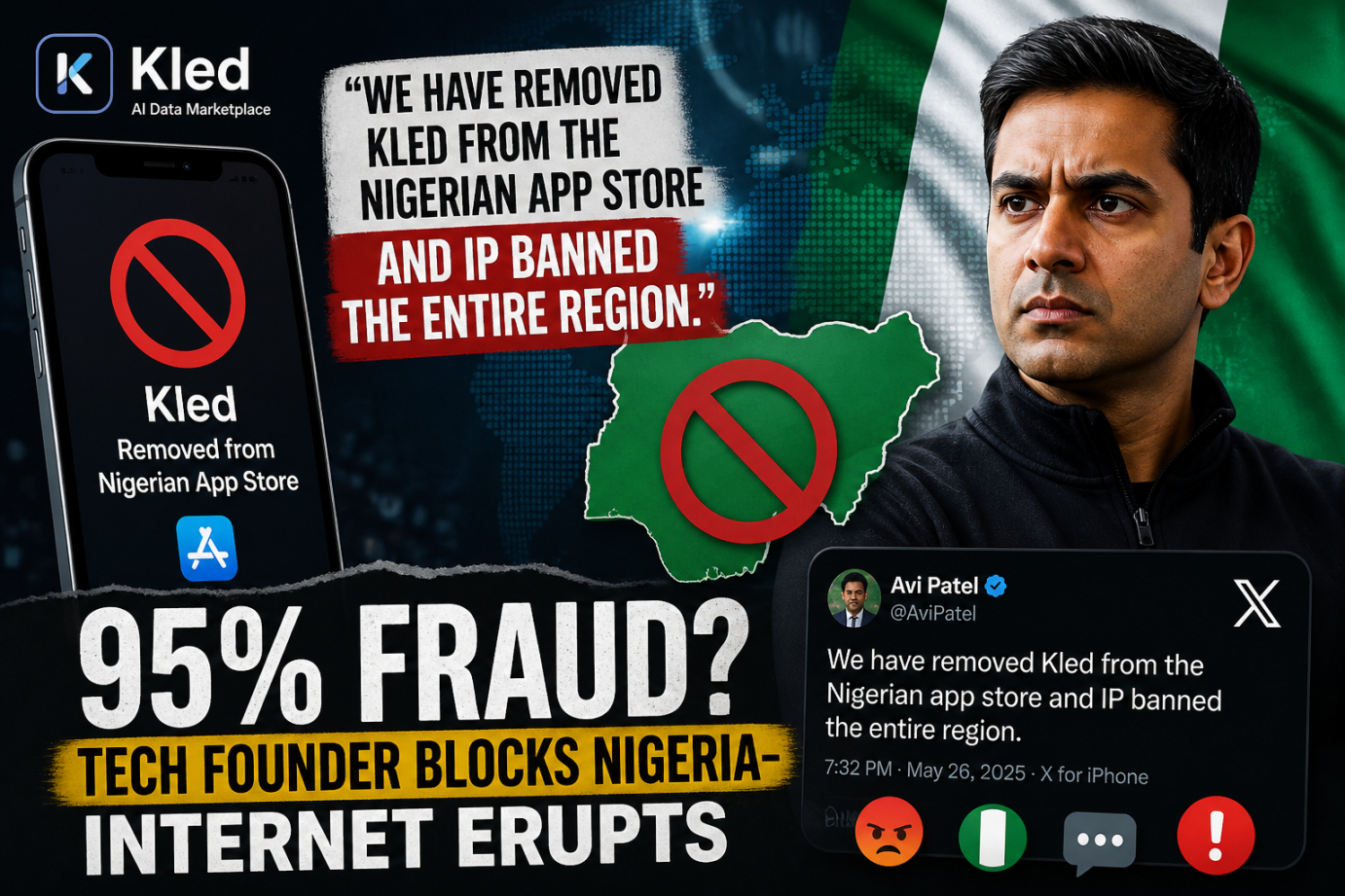
95% Fraud? Tech Founder Blocks Nigeria—Internet Erupts
A foreign tech entrepreneur, Avi Patel, has stirred widespread outrage and conversation across Nigeria after revealing that his company has pulled its app, Kled, from the Nigerian App Store and blocked access from the region, citing extremely high levels of fraud.
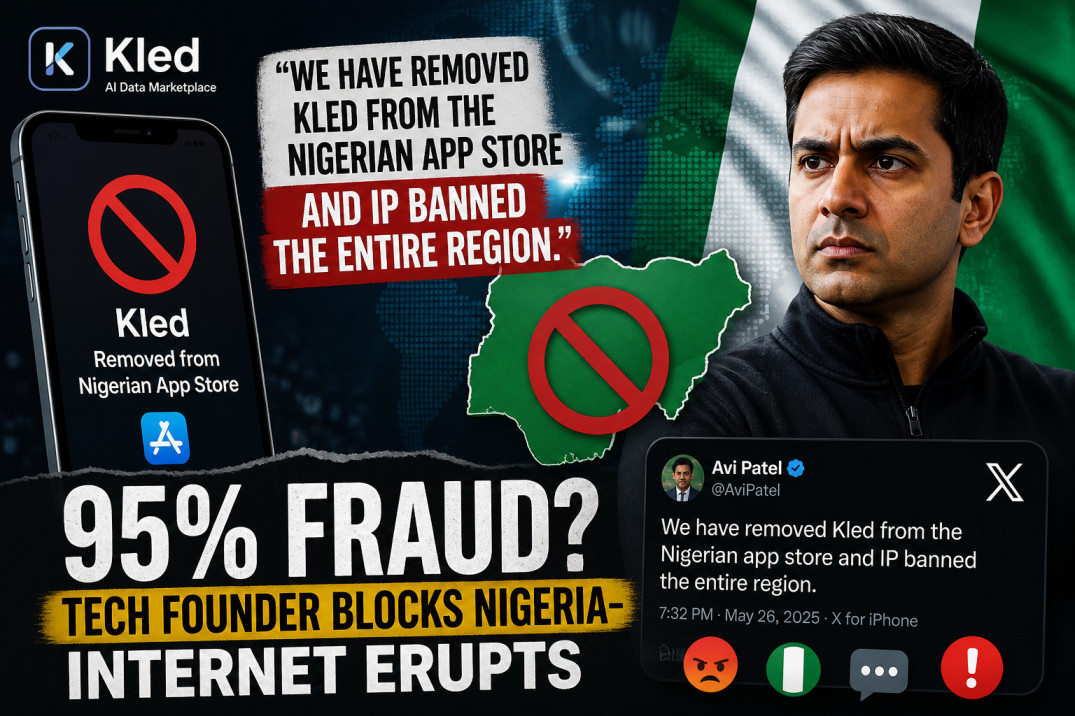
In a detailed post shared on X, Patel stated plainly, “We’ve taken Kled off the Nigerian App Store and implemented an IP ban across the entire region.”
He tried to clarify that the move was not personal, saying Nigeria was actually among the app’s earliest and most supportive user bases. “I have nothing against Nigeria… you were some of our first adopters, and we truly appreciate the support,” he noted.
Kled, a platform that rewards users for submitting digital content—such as images, videos, and documents—for AI training, has only been around for about four months. Within that short time, Patel claimed the app achieved impressive traction worldwide, with over a billion uploads and payouts to hundreds of thousands of contributors.
However, he alleged that Nigeria became a major concern.
According to Patel, nearly 95% of submissions from Nigeria were fraudulent or unusable. He claimed users frequently uploaded blank images, duplicates, AI-generated content, or materials sourced from the internet at an overwhelming scale.
He compared this with other countries like Malaysia, Indonesia, and the Philippines, where fraud levels reportedly remained below 10% despite having significantly larger user bases.
The situation reportedly escalated when the platform’s identity verification system (KYC) was flooded with fake documents. Patel described a surge of forged Japanese passports and IDs that had been altered with Nigerian photos, calling it the “final straw.”
While he maintained that Kled’s fraud detection system was effective, he admitted it was being pushed beyond its limits due to the increasing sophistication of these activities.
Patel emphasized that the decision was purely business-driven. According to him, the startup could not sustain the financial burden caused by handling large volumes of invalid data. He added that the ban may not be permanent and hinted at a possible return in the future.
As criticism grew online, Patel insisted the move was not a publicity stunt, questioning why the company would block a region it intended to market to. He also clarified that Kled is currently available only on iOS and warned users about fake versions circulating elsewhere.
Sharing more data, he claimed the platform had over 25,000 Nigerian users and that analysis of around 10 million uploads showed a fraud rate of 94.2%. He noted that even a 50% fraud level might have been manageable, but the current figures were too extreme to ignore.
He further pointed out that Nigeria is the only country affected by the ban, stating that Kled remains accessible in other African nations.
The announcement quickly triggered strong reactions across Nigerian social media. Many users accused Patel of stereotyping, exaggeration, and racism.
Some dismissed the claims entirely, suggesting the situation might be a marketing tactic. Others expressed anger, arguing that the decision unfairly targeted Nigerians and reinforced negative global perceptions.
There were also concerns about user privacy, with critics questioning why internal data and statistics were being publicly disclosed.
On the other hand, a few voices within the discussion acknowledged that the issue might reflect deeper systemic problems. Some commenters suggested that the incident highlights broader concerns about fraud and accountability beyond politics.
Others, including some Nigerian users of the app, expressed disappointment rather than anger, saying they valued the platform and were saddened by the outcome.
Despite the backlash, Patel stood firm, describing the reaction as overly emotional and reiterating that the decision was based solely on business realities, not racial bias. He concluded by urging critics to respect the company’s position.




(0) Comment