
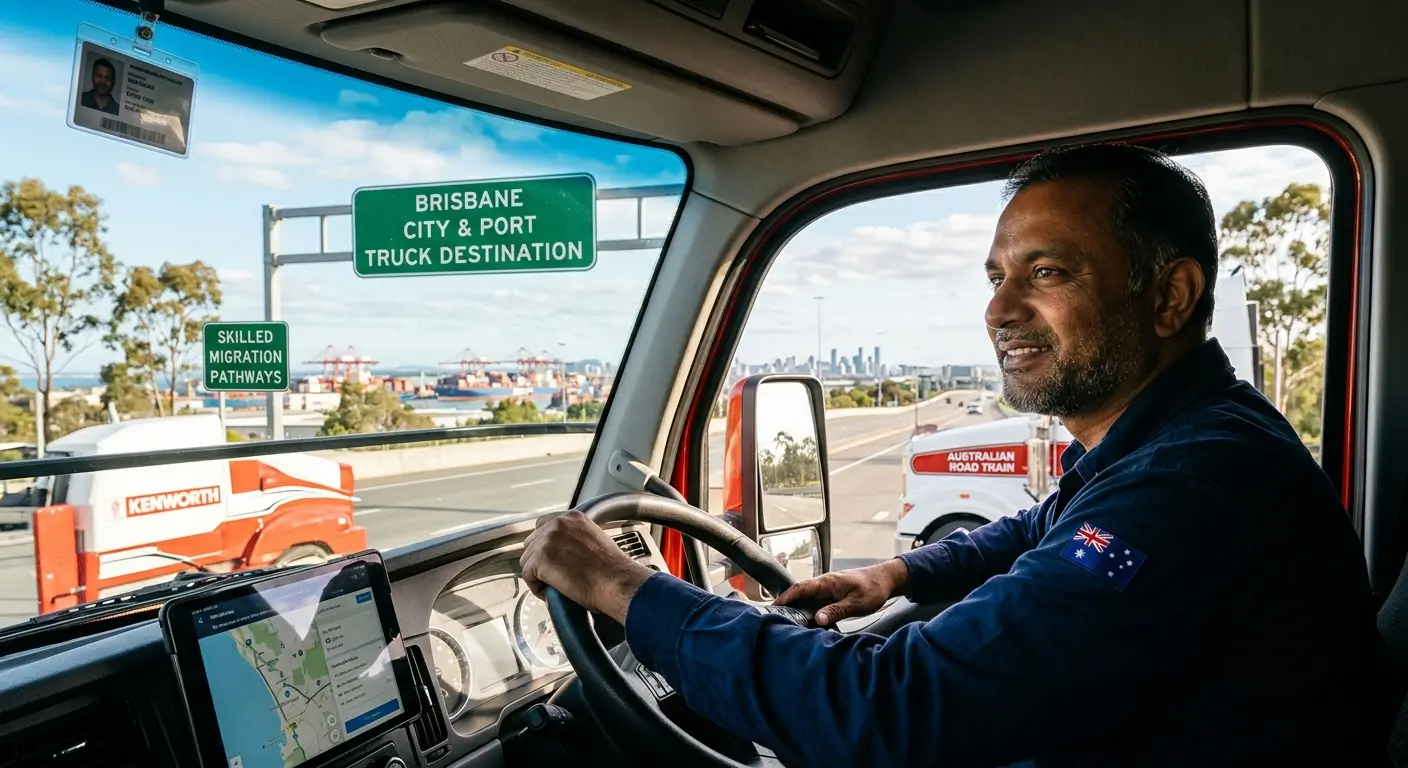
Australia Truck Driver Skilled Migration
SEO Excerpt
Before you read further: four corrections that change your strategy
Truck drivers cannot access standard employer-sponsored migration directly. The Truck Driver (General) occupation under ANZSCO code 733111 is not listed on the Core Skills Occupation List in a way that allows most employers to sponsor internationally using the standard Skills in Demand 482 visa. The primary legal migration route for overseas truck drivers is the Designated Area Migration Agreement, a specialised regional framework that requires both the employer and the region to have signed off before any nomination can proceed. Searching for "482 visa truck driver" and applying through agencies that do not operate within DAMA arrangements is not a viable pathway.
Your overseas heavy vehicle licence does not automatically convert to an Australian one. Australia's heavy vehicle licence classes are specific to Australian road regulations, the Heavy Vehicle National Law, and fatigue management requirements that differ from those in any African country. Every overseas-trained driver must go through a licence conversion process in their target state, which involves a knowledge test at minimum and in many cases a practical driving assessment. You cannot legally drive a heavy vehicle in Australia on your home country licence beyond a short initial period.
The employer must hold an active DAMA labour agreement, not merely an intention to sponsor you. Many drivers secure expressions of interest from Australian trucking companies only to discover the employer has not yet completed the DAMA labour agreement process. Without a signed individual labour agreement between the employer and the Australian Department of Home Affairs, the employer cannot nominate you for a visa. Finding an employer who is already endorsed under DAMA is significantly faster than finding one who is willing but not yet set up.
Permanent residency under DAMA is real but conditional. The pathway to a subclass 186 ENS permanent visa or a subclass 191 regional permanent visa exists and is one of DAMA's genuine advantages over other temporary work arrangements. But it requires meeting continuous employment conditions, English language requirements, and health standards across the full work period before PR can be lodged. It is a multi-year commitment with specific checkpoints, not a guaranteed outcome of simply arriving and working.
1. Overview
Australia is a continent-sized country entirely dependent on road freight. Every product that reaches a supermarket shelf in Perth, a mining site in the Pilbara, a grain terminal in South Australia, or a construction project in the Northern Territory has passed through the hands of a truck driver at some point in its journey. The National Road Transport Association has described Australia's truck driver shortage as an urgent economic crisis, with over 26,000 unfilled positions as of 2025 and road freight demand projected to increase 77 per cent between 2020 and 2050. The workforce is ageing, with a large proportion of current drivers approaching retirement, and domestic training pipelines are not producing enough new drivers to replace them.
The response has included the deliberate expansion of DAMA arrangements to include truck drivers as an eligible occupation across multiple regional agreements covering Western Australia, the Northern Territory, South Australia, parts of Victoria, New South Wales, and Queensland. These agreements allow regional employers facing genuine shortages to sponsor overseas truck drivers with concessions that are not available under standard skilled migration, including lower English requirements, age concessions up to 55, and the ability to sponsor drivers with relevant experience rather than formal qualifications.
For drivers from South Africa, Kenya, Zimbabwe, Ghana, Tanzania, Uganda, Cameroon, Zambia, and other African countries with well-established commercial driver training systems and strong safety records, this pathway offers something most international migration routes do not: a genuine entry point based on a practical trade qualification rather than a university degree, combined with a structured route to permanent residency. The salary is tax-free of income tax at the same rates as Australian residents (income tax does apply but there is no additional migration levy), superannuation is paid by the employer at 12 per cent on top of your wage from July 2025, and the occupation carries one of the clearest long-term demand profiles of any trade in the country.
2. Eligibility
Experience and qualification requirements
For DAMA sponsorship, you must hold either an AQF Certificate II in Transport and Logistics (Road Transport) or equivalent, or two years of relevant heavy vehicle driving experience in lieu of a formal qualification. For the ENS 186 permanent residency application at the end of your DAMA period, three years of relevant experience is required. The experience must be in the specific vehicle class you are being sponsored to drive, meaning experience solely on rigid trucks does not satisfy a sponsorship for heavy combination driving.
Licence class
Australia uses five heavy vehicle licence classes: Light Rigid (LR), Medium Rigid (MR), Heavy Rigid (HR), Heavy Combination (HC), and Multi-Combination (MC). The sponsorship category and the salary attached to it depend on which class you hold. MC-class drivers, which covers B-double and road train operators, command the highest wages and are in the most acute shortage in remote Western Australia, the Northern Territory, and outback Queensland. HC-class drivers covering articulated semi-trailers and B-doubles are the most commonly sought category across the DAMA regions. HR-class drivers are sponsored in some regions but the sponsorship market is smaller at this level.
English language
Under most DAMA arrangements, truck drivers must achieve IELTS 5.0 overall with no individual band below 4.0 for TSS 482 and SESR 494 visa applications. For the ENS 186 permanent residency application, the requirement increases to IELTS 5.0 with no band below 4.5. These are significantly lower thresholds than standard professional migration and are one of DAMA's key concessions for trade and semi-skilled occupations.
Age
The standard Australian permanent residency age limit of 45 does not apply under DAMA. Workers can be up to 55 years old at the time of applying for permanent residency under most DAMA arrangements. This is a critical advantage for experienced drivers in their late forties or early fifties who would be excluded from the standard pathway.
Skills assessment
A skills assessment is required before a DAMA visa nomination can proceed for most DAMA regions. VETASSESS is the assessing authority for truck driver occupations under several DAMA agreements. You must have a formal employer offer or sponsorship in place before applying for the VETASSESS assessment. The Northern Territory DAMA uses its own assessment process separate from VETASSESS. Processing for skills assessments typically takes six to twelve weeks and costs approximately AUD 500 to 1,500.
Health and character
All applicants must pass a medical examination from an approved Australian panel physician and provide police clearance certificates from every country in which they have lived for twelve or more months in the past ten years. Police clearances from African country authorities must be apostilled or otherwise officially authenticated before submission.
3. Skills Employers Actually Want
A review of truck driver job postings and DAMA employer specifications across Western Australia, South Australia, the Northern Territory, and regional New South Wales consistently shows the following requirements.
Heavy vehicle licence class matching the role being advertised is the primary filter. Employers specify HC or MC in the majority of DAMA-eligible postings. HR-class sponsorships do exist but are concentrated in specific industries like civil construction and agricultural freight. Applying for a role requiring HC or MC experience without that specific licence class experience documented in your history will not proceed.
Documented clean safety record is a non-negotiable expectation. Australian heavy vehicle employers operate under strict National Heavy Vehicle Regulator fatigue management requirements and Chain of Responsibility legislation that makes employers legally liable for their drivers' compliance. A history of safety incidents, major traffic infringements, or licence suspensions will significantly affect both the employer's willingness to sponsor and the visa application itself.
Compliance with Australian fatigue management rules, while something you will need to learn in Australia, is a topic employers expect prospective drivers to understand conceptually. Heavy vehicle drivers in Australia operate under regulated work and rest schedules under the Heavy Vehicle National Law. Demonstrating awareness of this framework in an interview signals professional competence.
Experience across industry types is valued differently depending on the DAMA region. Western Australia's mining sector, particularly Pilbara and Goldfields, values drivers with FIFO (fly-in fly-out) logistics or bulk materials haulage experience. South Australian and Victorian DAMA regions value agricultural and food-freight experience. The Northern Territory favours remote-area driving competency and self-sufficiency. Understanding which industry type matches your background and targeting your applications to the relevant DAMA region improves your sponsorship conversion rate considerably.
Basic mechanical awareness and pre-trip vehicle inspection competency are expected across all categories. Australian heavy vehicle legislation requires drivers to conduct formal daily pre-trip inspections and to report defects. Drivers who have operated in environments where this was not standard practice should be prepared to demonstrate this competency during the assessment phase.
4. Step-by-Step Path
Step 1: Confirm your vehicle class and obtain documentation of your experience
Before anything else, identify which Australian heavy vehicle licence class corresponds to the vehicles you have been driving. Heavy rigid trucks with three or more axles carrying general freight map to HR. Articulated semi-trailers and B-doubles map to HC. Road trains and multi-combination vehicles map to MC. Gather employment reference letters from every employer you have worked for as a commercial driver, specifying the vehicle types, tonnage class, years of service, and types of freight. These letters must be on company letterhead, signed by an authorised representative, and ideally notarised. VETASSESS and the DAR endorsement process both require verifiable employment evidence.
Step 2: Identify your target DAMA region and find an endorsed employer
Each DAMA is administered by a Designated Area Representative for a specific geographic area. The active DAMA regions that include truck driving in their occupation lists include the Western Australia state-wide DAMA (covering all areas outside Perth, active since 1 July 2024), the Western Australia Pilbara, Goldfields, East Kimberley, and South West sub-regions, the Northern Territory DAMA III (active since March 2025, 325 eligible occupations and 1,500 annual places), the South Australia Regional DAMA (active to June 2026 and expected to be renewed), the Goulburn Valley DAMA in Victoria, the Great South Coast DAMA in Victoria, the Orana DAMA in New South Wales, the Far North Queensland DAMA, and the Townsville North Queensland DAMA.
Finding an employer who is already DAMA-endorsed in your target region is the critical step. SEEK Australia allows you to filter by "DAMA sponsorship" in the visa sponsorship category. Major Australian logistics companies with DAMA agreements include Centurion Transport in Western Australia, which is known for its remote and mining logistics operations and has DAMA endorsement. Linfox, Toll Group, and Qube Holdings are large national logistics operators who hire internationally in shortage regions. Smaller regional trucking companies in WA, the NT, and SA often have active DAMA arrangements that are not publicly advertised. Direct outreach to trucking companies operating in DAMA regions, with your vehicle class experience documented clearly, is a productive approach alongside job board applications.
Step 3: Employer obtains DAMA endorsement and you apply for skills assessment
Once an employer in a DAMA region is willing to hire you, they must first approach the Designated Area Representative for their region to obtain endorsement for your position. The endorsement confirms that the role is a genuine shortage and that the employer has attempted to recruit locally first. This employer-side process takes several weeks. In parallel, once you have a formal offer or expression of intent from the employer, apply for your skills assessment through VETASSESS (for most regions) or through the NT government process (for the Northern Territory). Prepare your employment letters, licence copies, and any certificate documentation before starting this application.
Step 4: Employer applies for DAMA labour agreement and lodges nomination
With DAMA endorsement from the DAR, the employer applies to the Department of Home Affairs to sign an individual DAMA labour agreement. Once this agreement is in place, the employer lodges a formal nomination for you under the relevant visa subclass: SID 482, SESR 494, or ENS 186 depending on the pathway agreed. The SID 482 and SESR 494 pathways are the most common entry points, with the 186 ENS permanent visa used after the required period of employment has been completed.
Step 5: Lodge your visa application
Once the employer nomination is approved, you lodge your visa application through ImmiAccount. The application requires your completed skills assessment, English language test results, police clearances, health examination from an approved panel physician, passport photographs, and supporting financial and employment documentation. Processing times for SID 482 under DAMA have been approximately two months for priority roles. The SESR 494 takes somewhat longer on average.
Step 6: Convert your licence and comply with Australian fatigue regulations on arrival
Upon arriving in Australia, you must convert your home country licence to an Australian heavy vehicle licence in your target state. In Western Australia, the Department of Transport assesses overseas licences and requires knowledge testing and typically a practical assessment. In South Australia, the Department for Infrastructure and Transport manages licence conversion. In the Northern Territory, the Motor Vehicle Registry handles this process. The conversion does not start from scratch, but it does require passing state-specific tests. Begin the conversion process as soon as you arrive. Without the Australian licence, you cannot legally drive commercially even with a visa.
Step 7: Work toward permanent residency
After completing the required employment period under your DAMA arrangement (two years under some 482 arrangements, three years under 494), your employer nominates you for the ENS 186 permanent visa. Meeting the English threshold of IELTS 5.0 with minimum 4.5 in each band, passing a health examination, maintaining a clear character record, and holding continuous employment with your sponsoring employer are all required conditions. The 191 permanent visa is an alternative pathway for holders of the 494 regional visa who meet the income and regional residence requirements.
5. Real-World Challenges
Finding an employer who is already DAMA-endorsed
The most consistent obstacle for overseas drivers targeting this pathway is that employers who are interested in sponsoring often have not yet signed a DAMA labour agreement. The endorsement and labour agreement process is employer-driven, takes weeks to months, and requires the employer to demonstrate genuine shortage and prior local recruitment attempts. Drivers who receive expressions of interest from employers who say they are "looking into" DAMA should treat this as a preliminary signal rather than a sponsorship commitment. Target employers who are already endorsed and have previously sponsored overseas workers.
Licence conversion timelines
Licence conversion is not completed before you arrive and is not done remotely. You need to be in Australia, in your target state, to attend the knowledge test and practical assessment. In some cases, state transport authorities have backlogs for practical assessments of several weeks. During this period you cannot legally drive commercially. Plan your financial buffer to cover at least four to six weeks of living costs while you complete the licence conversion before beginning paid work.
Regional living realities
DAMA placements are by definition in regional and remote areas. Western Australia's Pilbara and Goldfields are extremely remote, with very limited services, extreme heat for six months of the year, and limited cultural and community infrastructure. South Australia's regional areas are more accessible but still rural. The Northern Territory's distances and road conditions are among the most challenging in the world. Drivers who arrive expecting the social environment of a large city will find regional placements a significant lifestyle adjustment. The financial benefits, particularly in WA mining and remote logistics roles, are real, but they come with a cost-of-living and isolation trade-off that must be understood before committing.
The genuine PR versus the promise
Some migration content implies DAMA automatically leads to permanent residency after two years. It does not. PR under the 186 pathway requires meeting health, character, English, and employment conditions at the time of application, not simply completing a work period. A driver who changes employers without transferring their DAMA sponsorship correctly, or who has a gap in employment, may find their PR pathway disrupted. Maintaining continuous sponsored employment and seeking legal advice from a MARA-registered migration agent before making any employment change is important.
Fatigue law compliance
Australia's Chain of Responsibility legislation holds employers, managers, and drivers jointly liable for fatigue-related compliance breaches. The National Heavy Vehicle Regulator enforces work and rest hour requirements strictly. Drivers from countries where fatigue management enforcement is less formalised sometimes find the Australian system demanding. Non-compliance can result in significant penalties and, in serious cases, visa implications. Study the work and rest requirements before you arrive.
6. Where to Apply
DAMA regional portals and DAR contact pages
Each DAMA region has a Designated Area Representative with a public-facing portal that confirms which occupations are eligible and provides contact information for endorsed employers. Western Australia's DAMA information is at migration.wa.gov.au. The Northern Territory DAMA is at dtbar.nt.gov.au. South Australia's DAMA occupation lists are at migration.sa.gov.au. The Goulburn Valley DAMA in Victoria is at gvdama.com.au. The Far North Queensland DAMA is through the Cairns Chamber of Commerce at cairnschamber.com.au. The Orana NSW DAMA is at oranadama.org.au.
SEEK Australia
SEEK (seek.com.au) carries the highest volume of truck driver job postings in Australia. Filter by "visa sponsorship" and "DAMA" in the location and keywords. Western Australian listings in Karratha, Port Hedland, Kalgoorlie, and Darwin are consistently active for HC and MC class positions.
Major logistics and freight companies with DAMA track records
Centurion Transport (centurion.com.au) operates across Western Australia's mining and remote regions and has an established international recruitment history under DAMA arrangements. Toll Group (tollgroup.com), Linfox (linfox.com), and Qube Holdings (qubelogistics.com.au) are the three largest Australian logistics companies and all operate in DAMA-eligible regions. Direct applications to their recruitment teams, specifying your licence class and DAMA target region, are a productive approach alongside job board applications.
VETASSESS
VETASSESS (vetassess.com.au) handles skills assessments for truck driver occupations under most DAMA arrangements. Their website specifies which DAMA regions they assess and what documentation is required. Begin the assessment process once you have a formal offer in hand.
MARA-registered migration agents
The DAMA framework involves multiple government agencies, two employer-side steps, individual regional rules, and occupation-specific concessions that vary across all thirteen DAMA regions. Navigating this independently is possible but significantly more time-consuming and error-prone than working with a MARA-registered migration agent who specialises in regional employer-sponsored migration. The MARA register is at mara.gov.au.
7. Timeline Expectation
Months 1 to 3: Document your experience by gathering all employment reference letters, licence copies, and personal statements. Research the five most relevant DAMA regions for your licence class and experience type. Begin applying to employers in those regions and making direct contact with logistics companies in DAMA areas.
Months 3 to 5: Receive expressions of interest from employers. Confirm which employers are already DAMA-endorsed. Accept a formal offer from an endorsed employer. Apply to VETASSESS for your skills assessment in parallel with the employer's endorsement confirmation. Sit your English language test.
Months 5 to 7: Skills assessment completed. Employer obtains DAR endorsement and submits DAMA labour agreement request to Home Affairs. Nomination is lodged once the labour agreement is signed.
Months 7 to 9: Visa application lodged. Medical examination completed. Police clearances obtained from home country and any other countries of prior residence. Visa granted.
Month 9 to 10: Arrive in Australia. Begin state transport authority licence conversion process. Complete knowledge test and practical assessment. Australian heavy vehicle licence issued. Begin paid employment.
Years 2 to 4: Complete required employment period under your DAMA arrangement. Maintain sponsored employment continuously. At the required milestone, employer lodges ENS 186 nomination for permanent residency. Health examination and updated character clearances submitted. Permanent residency granted.
The above assumes a straightforward application with documented experience, an already-endorsed employer, and no complications in police or health clearances. Applications involving employers who need to set up their DAMA labour agreement from scratch add three to six months to the employer-side steps before nomination can proceed.
8. Mistakes to Avoid
Applying for standard SID 482 truck driver sponsorship outside DAMA. Truck Driver (ANZSCO 733111) is not on the Core Skills Occupation List as a standard employer-sponsored occupation. If an agent or employer is proposing a standard 482 sponsorship outside a DAMA framework, confirm the legal basis before proceeding. Outside DAMA, very few employer-sponsored migration routes exist for this occupation.
Accepting an informal job offer without verifying the employer's DAMA labour agreement status. An employer who says they want to sponsor you under DAMA and an employer who has an active signed DAMA labour agreement are two different things. Only the latter can nominate you for a visa. Before investing time and money in a skills assessment or relocation planning, ask the employer to confirm their DAMA labour agreement status with the Department of Home Affairs.
Assuming your home country licence is sufficient to begin work on arrival. It is not. Every state in Australia requires overseas-trained heavy vehicle drivers to complete a licence conversion process, and you cannot begin commercial driving until the Australian licence is issued. Build the conversion timeline and cost into your financial planning before departure.
Targeting DAMA regions without researching the regional lifestyle. The DAMA regions with the most active truck driver sponsorship are also among the most remote and climatically challenging places in Australia. Western Australia's Pilbara operates in temperatures exceeding 45 degrees Celsius for months at a time. Darwin and the Northern Territory have a tropical wet season with significant infrastructure and logistics disruptions. These conditions are manageable, but they are not comparable to urban employment environments. Drivers who are not genuinely prepared for remote regional living consistently find the adjustment harder than the professional transition.
Changing employers without understanding visa implications. On a SID 482 or SESR 494 visa under a DAMA labour agreement, your visa conditions tie you to your sponsoring employer's agreement. Changing employers without correctly transferring your sponsorship can jeopardise your residency status and your PR pathway. Always seek advice from your migration agent before accepting a role with a different employer, even within the same DAMA region.
Misunderstanding owner-driver advertising. Some Australian trucking job advertisements display annual figures of AUD 90,000 to AUD 130,000 that represent gross contract revenue for owner-drivers, not employed wages. Owner-drivers operate as small businesses covering their own fuel, maintenance, insurance, and downtime costs. Sponsored employees operate on wages under the Road Transport Award, which is a very different financial arrangement. Compare like with like when evaluating offers.
9. Next Action
Identify your vehicle class today and then go to the SEEK Australia website and search for "DAMA truck driver" in Western Australia, South Australia, and Northern Territory. Read at least five current job advertisements from employers specifically offering DAMA sponsorship. Note which of those employers are named logistics companies with an online presence and which appear to be agencies or unverifiable operators. Then go to the DAMA regional portal for the region with the most active postings and confirm that the Truck Driver occupation is still on their current live occupation list. That combination of an active employer and a confirmed occupation list is your starting point. Everything after it, the skills assessment, the English test, the visa application, runs in sequence from that foundation.
Sources
Layer | Source | Used in sections |
|---|---|---|
Official rules | Department of Home Affairs: Designated Area Migration Agreements, homeaffairs.gov.au | 2, 4, 6 |
Official rules | DAMA complete guide 2026 (visalounge.com.au), June 2025 | 1, 2, 4, 5 |
Official rules | Green Wings Migration: truck driver DAMA pathway Australia, March 2026 | 1, 2, 4 |
Official rules | Nationwide Migration: truck driver DAMA permanent residency pathway | 2, 4, 7 |
Official rules | Aussizz Group: DAMA visa Australia eligibility benefits PR pathway, October 2025 | 2, 4, 5 |
Official rules | VETASSESS: DAMA skills assessment for truck drivers, vetassess.com.au | 2, 6 |
Official rules | Australian skilled migration 2026 visa routes and rules, VisaVerge, April 2026 | 2, 4 |
Official rules | DAMA Australia guide: DAMA regions and updated TSMIT July 2025 (sscs.com.au), April 2026 | 2, 4, 6 |
Official rules | DAMA for tradies Australia 2026, Aussizz Group, March 2026 | 2, 4, 6 |
Official rules | Getting Down Under: DAMA regions covering truck driving (WA, SA, NT) | 2, 4, 6 |
Job market data | Green Wings Migration: Australia truck driver shortage 26,000 unfilled positions and 77% freight growth | 1 |
Job market data | Skill shortage list Australia 2026 and CSOL framework, PSS Removals, April 2026 | 2 |
Job market data | Onederland: DAMA Australia 2026 complete guide, March 2026 | 4, 5, 7 |
Job market data | DAMA Australia 2025 updates: NT DAMA III, WA statewide DAMA, SA expansion | 1, 4, 6 |
Skill patterns | SEEK Australia: truck driver job postings review June 2026 | 3 |
Skill patterns | Delta Immigration: Truck Driver General ANZSCO 733111 visa eligibility | 2 |
Salary data | How much do truck drivers earn in Australia 2026: full salary guide (inedjobs.com), May 2026 | 5, 7 |
Salary data | How much do truck drivers earn in Australia 2026 (tokhidrivingsolutions.com.au), May 2026 | 5, 7 |
Salary data | SEEK: truck driver salary Australia June 2026 | 5, 7 |
Salary data | Indeed Australia: truck driver salary AUD 38.26/hour, June 2026 | 5, 7 |
Salary data | ERI: heavy truck driver salary Australia 2026 (erieri.com) | 5 |
Salary data | PayScale: heavy truck driver hourly pay Australia 2026 | 5 |
Salary data | Transport Driver Training: truck driver salaries and career progression, March 2026 | 5, 8 |
Real experience | Getting Down Under: DAMA employer endorsement and labour agreement process | 5, 8 |
Real experience | Onederland DAMA: DAMA does not guarantee PR, employer-side setup requirements | 5, 8 |
Application channels | Centurion Transport: centurion.com.au, WA DAMA regional logistics | 6 |
Application channels | Toll Group: tollgroup.com, national logistics with DAMA-eligible regional operations | 6 |
Application channels | Linfox: linfox.com, national logistics employer | 6 |
Application channels | Qube Holdings: qubelogistics.com.au, national logistics employer | 6 |
Application channels | DAMA regional portals: migration.wa.gov.au, dtbar.nt.gov.au, migration.sa.gov.au, gvdama.com.au, oranadama.org.au | 6 |
The Author

Cynthia Amadi
Senior Journalist • Specialist Editor
Award-winning journalist skilled in investigative reporting, data journalism, interviewing, and multimedia storytelling, with a strong record of producing impactful stories.
Travel Essentials
Curated services to help you settle in Australia Truck Driver Skilled Migration quickly.
More coming soon
Need help?
Our team can help you find accommodation and coworking spaces in Australia Truck Driver Skilled Migration.
Contact Support →