
Germany Hospitality Worker Visa (Ausbildung)
Before you read further: four corrections that shape your preparation
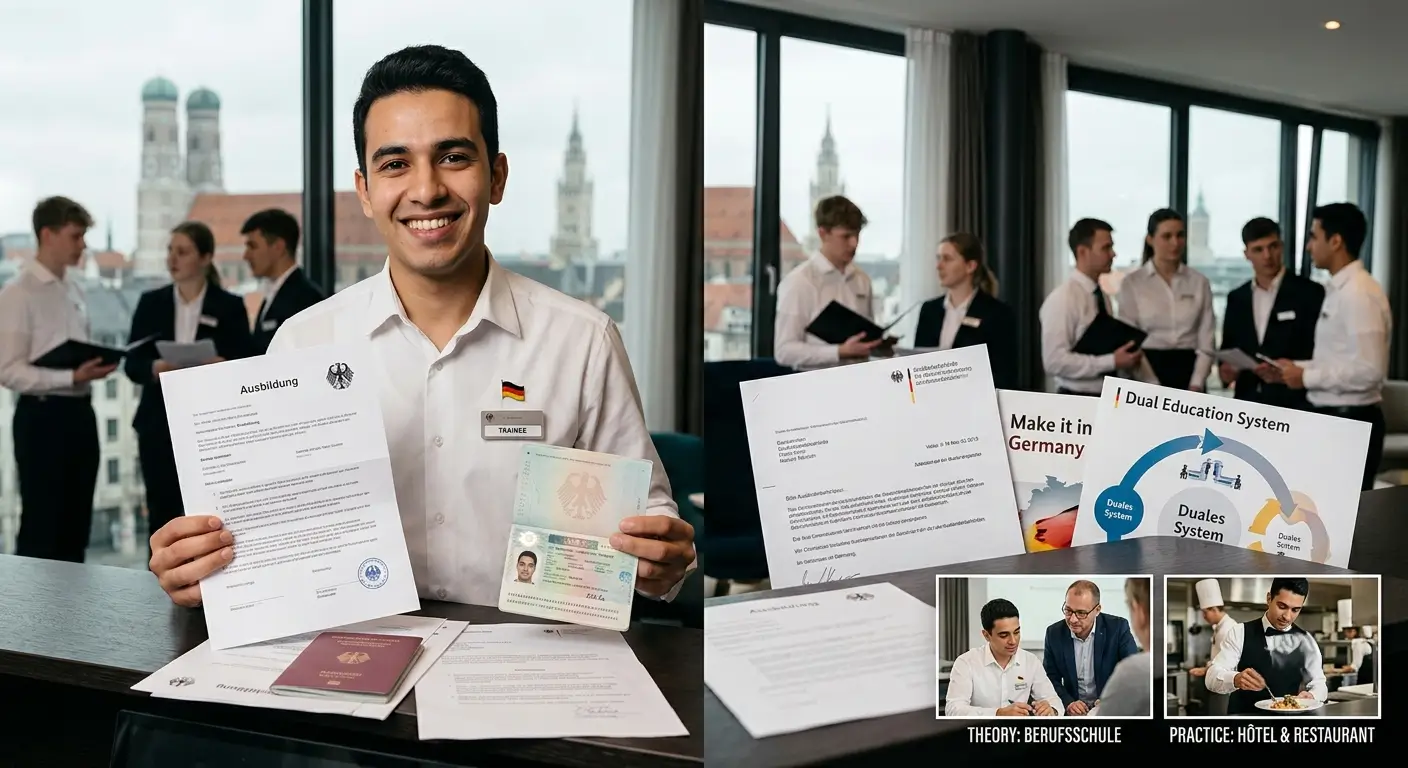
The Ausbildung is not a job offer. It is a paid training programme. From day one you are both a learner and an employee, spending roughly 70 per cent of your time at the training company and 30 per cent at a vocational school. You do not arrive as a qualified hospitality professional being hired for a role. You arrive as a trainee who earns a training allowance while gaining the qualification. The distinction matters because your rights, your income level, and your daily reality for the first two to three years are governed by training law, not employment law.
The legal German language minimum of B1 is not enough for comfortable functioning in the programme. The vocational school portion of the Ausbildung is taught entirely in German, including specialist terminology around food hygiene, hospitality law, service technique, and accounting. Trainees who arrive at exactly B1 consistently report struggling in Berufsschule classes during the first year. Reaching B2 before arrival is a practical target, not a bonus. Applications to employers are also expected in German and a weak motivation letter in German signals poor preparation.
Hospitality is one of the lower-paying sectors within the Ausbildung system. The statutory minimum training allowance in 2026 is €724 per month in the first year, and while hospitality Ausbildung positions typically pay above this at €800 to €1,200 per month, this is significantly below what Ausbildung trainees in metalworking, banking, IT, or healthcare earn. In cities like Munich, Hamburg, and Frankfurt, where many major hospitality employers are based, rent for a single room in a shared flat typically costs €700 to €1,000 per month. Planning a realistic budget before you apply, rather than after you arrive, determines whether you can sustain the programme.
You do not need a signed training contract before you can come to Germany to look for one. The Ausbildung-seeker visa under Section 17 of the German Residence Act allows applicants under 35 to enter Germany for up to nine months to search for an Ausbildung position on the ground. You can work up to 20 hours per week during this period. This is a significant and underused route for applicants who want to secure a training place from within Germany rather than relying entirely on remote applications.
1. Overview
Germany's dual vocational training system is the model on which most European apprenticeship frameworks are built, and it has been producing internationally recognised skilled workers since the nineteenth century. Over 320 recognised training occupations are covered by the system, and as of 2025 approximately 213,000 foreign nationals were already training in Germany under this framework, making up roughly 13.2 per cent of all Ausbildung trainees. The hospitality sector alone has more than 65,000 unfilled positions according to DEHOGA, the German Hotel and Restaurant Association, with turnover in restaurants and hotels running at 70 to 80 per cent annually. Germany's hospitality sector projects a need for 112,000 internationally trained workers to meet projected visitor demand. International recruitment is not a side strategy for German hospitality employers. It is a central operational response.
The broader German immigration framework reformed significantly between 2023 and 2024, with the Skilled Immigration Act expanding access, creating an experience-based pathway for workers without German-recognised degrees, and introducing the Chancenkarte, a points-based job-search visa. These reforms affect multiple routes into Germany. Applicants with technology or engineering qualifications and relevant work experience may find the EU Blue Card direct employment pathway more appropriate for their situation than the Ausbildung. A separate pathway overview covering that route is available at zuqolab.com/travel/germany-software-engineer-job-eu-blue-card.
For applicants without higher education qualifications or for those whose existing hospitality experience is not formally recognised in Germany, the Ausbildung is the primary structured entry point. It offers something rare in international labour migration: a qualification earned while working, paid for by the training employer, with no tuition fees, recognised across the entire European Union after completion, and connected directly to a permanent residency pathway that can be activated within five years of starting the programme.
2. Eligibility
Educational qualification
Most Ausbildung programmes require the equivalent of a German Mittlere Reife, broadly comparable to a completed secondary school education of around twelve years. Secondary school leaving certificates from across Africa, including the WAEC/WASSCE from Ghana, Côte d'Ivoire, and West African countries, the KCSE from Kenya, the ZIMSEC O and A Level from Zimbabwe, the NSC from South Africa, the KCPE/KCSE progression from Uganda and Tanzania, the BECE from Ghana, the Baccalauréat from Francophone African countries, and the WASSCE from Sierra Leone, Liberia, and the Gambia, are generally accepted. Qualification recognition is assessed case by case and can be checked through the ANABIN database maintained by the Federal Foreign Office, or through the Central Office for Foreign Education (ZAB).
German language proficiency
A minimum of B1 level on the Common European Framework of Reference, certified by the Goethe Institut or telc, is required for the vocational training visa. As noted above, B2 is the realistic functional target. Cooking programmes at some training companies accept A2 to B1 because the kitchen environment requires less verbal communication than front-of-house roles. The Goethe Institut operates examination centres in South Africa, Kenya, Ghana, Nigeria, Ethiopia, Tanzania, Senegal, Cameroon, Côte d'Ivoire, Morocco, Egypt, and other African countries, making German language certification accessible across the continent.
Age
There is no upper age limit for the Ausbildung training visa (§16a AufenthG). However, German embassies may ask additional questions of applicants over 35 about their motivation and career plan, and some training companies target younger applicants. The Ausbildung-seeker visa (§17 AufenthG) is restricted to applicants under 35. Applicants over 35 must have a signed training contract before applying for a visa.
Financial proof
If your training allowance will be at least €1,048 gross per month, it counts as sufficient financial proof and you do not need a blocked account. Most hospitality Ausbildung positions pay €800 to €1,200 gross, which means the blocked account is commonly required in the first training year when allowances are lowest. The blocked account requirement for the vocational training visa is €1,091 per month as of 2026, equating to approximately €13,092 per year. This money is not spent before you leave. It sits in a blocked account in Germany and you draw it down by €1,091 each month after arrival. Opening a Sperrkonto through providers such as Fintiba, Expatrio, or Deutsche Bank is the standard process and takes approximately one to two weeks.
Health insurance
All trainees are covered by statutory health insurance (gesetzliche Krankenversicherung) from the first day of training, with contributions shared between you and your training employer. You do not need to arrange private health insurance for the duration of your Ausbildung.
3. Skills Employers Actually Want
A review of Ausbildung hospitality job postings across ausbildung.de, azubiyo.com, and the IHK and DEHOGA regional portals shows the following consistent requirements across all programme types.
German language ability is the single most important factor for employer selection. Applications submitted in German are expected across all programmes. A motivation letter written by the applicant themselves, demonstrating genuine interest in the specific company or region, consistently outperforms generic form letters. Employers in Germany's hospitality sector deal with Berufsschule enrolment, written assessments, and daily operational communication in German, and they assess language ability as a proxy for whether a trainee will be able to function independently within the first six months.
Customer service orientation and genuine interest in working with people are assessed through the application letter and in interviews. German hotel and restaurant employers use Ausbildung recruitment interviews that include practical scenarios: how would you handle a guest complaint, how would you greet a table of four, what do you know about service standards. Applicants who can demonstrate prior service experience, whether in hotel work, retail, or community service settings, have a practical advantage.
Reliability, punctuality, and structured work habits are stated requirements in almost every posting. German workplace culture places substantial weight on these qualities. Applicants who can demonstrate a consistent work or study record, and who show clear sequential planning in how they describe their journey toward the Ausbildung, present better than those with gaps or vague explanations.
Flexibility regarding location is a practical differentiator. Many of the best-funded Ausbildung positions in hospitality are outside the major cities, in Bavaria, Baden-Württemberg, the Rhine-Main region, and along the North Sea and Baltic coasts, where hotel and resort groups run large training cohorts. Applicants who are willing to relocate to smaller cities or regional towns find significantly more openings than those who restrict their search to Berlin or Munich.
A secondary language beyond German, particularly English, is viewed very positively in an industry that serves international guests. Applicants from anglophone African countries who speak English fluently and are developing German have a double language asset that training companies in tourist-facing hospitality genuinely value.
4. Step-by-Step Path
Step 1: Reach B1 German, then target B2
Begin German language study as early as possible using Goethe Institut programmes in your country, online platforms such as Deutsche Welle's DW Learn German, or language schools that prepare candidates for telc certification. Aim to reach B1 by the time you begin searching for an Ausbildung position, and continue studying toward B2 while your application is in progress. The Goethe Institut has examination centres in South Africa, Kenya, Ghana, Nigeria, Ethiopia, Tanzania, Cameroon, Senegal, Morocco, and Egypt, so certification is achievable without international travel in most African countries.
Step 2: Identify your programme and begin searching for training companies
The five main hospitality Ausbildung programmes for international applicants to consider are: Hotelfachmann/frau, which covers all hotel departments including reception, F&B, and housekeeping over three years and is the most versatile entry point; Koch/Köchin, a three-year culinary training programme for kitchen and cooking roles; Restaurantfachmann/frau, a three-year front-of-house and service programme; Fachkraft im Gastgewerbe, a shorter two-year programme covering gastronomy basics; and Hotelkaufmann/frau, a three-year programme focused on hotel administration and business management.
Search for training positions on ausbildung.de, azubiyo.com, and the Bundesagentur für Arbeit's Jobbörse (jobboerse.arbeitsagentur.de). DEHOGA regional associations list member employers who take on trainees. IHK (Industrie und Handelskammer) regional portals for Bavaria, Hamburg, Berlin, and Baden-Württemberg carry employer-specific postings. GoAusbildung (goausbildung.com) aggregates listings specifically for international applicants. Apply to a minimum of ten to fifteen companies spread across different states, prioritising companies in tourist regions where demand is highest.
Step 3: Prepare and submit your application
Your application package must include a Europass-format CV in German, a motivation letter in German written in your own words, certified copies of your secondary school certificate with a German translation if the original is not in English or German, your German language certificate, and a copy of your passport. Letters should be addressed to the specific employer, mention their specific hotel or restaurant chain, and explain why you want to train in hospitality in Germany specifically and what you plan to do after qualifying. Generic letters are identified immediately and discarded.
Applications should be submitted nine to twelve months before the Ausbildung start date. Hospitality Ausbildung programmes almost universally begin in August or September. This means applications submitted between October of the prior year and February of the start year are in the strongest window. Positions do become available later, but the highest-quality employers and the best-funded programmes fill early.
Step 4: Receive and sign your training contract, then apply for the visa
When a training company accepts you, they issue a signed Ausbildungsvertrag. This is your core document for the visa application. Contact the German Embassy in your country as soon as you have this contract. In Nigeria, the German Embassy is in Lagos and Abuja. In Kenya, it is in Nairobi. In Ghana, it is in Accra. In South Africa, the German Embassy operates in Pretoria and Cape Town. In Ethiopia, it is in Addis Ababa. In Tanzania, it is in Dar es Salaam.
Your visa application documents include: a valid passport, the signed training contract, your B1 German language certificate, proof of financial means (your training allowance payslip or blocked account confirmation), proof of health insurance, a criminal record certificate from your home country, two recent passport photographs, and a completed visa application form. The visa fee is €75. Processing typically takes four to twelve weeks and the application should be submitted at least three to six months before your programme start date.
Step 5: Arrive, register, and begin
Upon arrival, you must register at the residents' registration office (Einwohnermeldeamt) in your city within two weeks. Your training company will handle your Berufsschule enrolment and your formal registration with the IHK or HWK, the chamber that administers the final examination at the end of your training. Your statutory health insurance begins from the first day of training. Your tax identification number (Steueridentifikationsnummer) is issued automatically by the tax authorities once you are registered.
Step 6: Complete your Ausbildung, obtain your IHK certificate, and build toward permanent residency
At the end of your programme you sit the Abschlussprüfung, the final examination administered by the IHK or HWK, which tests both theoretical knowledge and practical competency. Passing this examination earns you the nationally and EU-wide recognised vocational qualification in your chosen field.
After passing, you receive an automatic 18-month residence permit to search for qualified employment matching your new qualification. During this period you can work in any job. Once you have a position matching your qualification, you switch to the skilled worker permit under §18a of the Residence Act. After completing your Ausbildung plus two years of qualified employment, you are eligible to apply for the Niederlassungserlaubnis, Germany's permanent settlement permit. This is significantly faster than the eight years required for naturalisation in most cases and is one of the strongest outcomes available through any international labour migration route in Europe.
5. Real-World Challenges
The language gap between the certificate and the classroom
Trainees who arrive at B1 consistently report that the Berufsschule is harder than they expected. Hospitality Ausbildung school curricula include written German, specialist vocabulary for food hygiene (HACCP), German commercial law, accounting, and menu composition. The vocabulary is domain-specific and not covered in standard B1 language courses. The most effective preparation is to begin reading German hospitality textbooks and watching German YouTube content about Hotelfachmann programmes before you arrive, not after. Many Berufsschulen in Germany have begun offering language support programmes for international trainees, and choosing a training company that has an established international trainee cohort often means better informal peer support is available.
The budget reality in major cities
A hospitality Ausbildung trainee earning €900 to €1,100 gross per month in Munich pays approximately €140 to €200 per month in social security contributions, leaving a net of €700 to €960. A room in a shared flat in Munich costs €800 to €1,100. This means living in Munich on a hospitality training allowance without additional savings or the blocked account drawdown is extremely tight. Trainees who target smaller cities such as Düsseldorf, Leipzig, Nuremberg, Hannover, or regional resort towns find significantly more financial headroom on the same training allowance. The qualification earned is identical regardless of city.
Changing training companies
If your relationship with your training company breaks down, changing to a new employer during the Ausbildung period requires a permit amendment from the Ausländerbehörde. The new training contract must cover the remaining training period, and a gap in coverage can affect your visa status. If a training company closes or terminates your contract, the Federal Employment Agency and your Berufsschule will support you in finding a new placement, but there is a time window within which this must be resolved. Understanding this before you begin means you are not caught off guard if your first employer does not work out.
Working additional hours
Under the §16a training visa, trainees can take an additional job of up to 20 hours per week in an unrelated field. Many hospitality trainees supplement their income this way. However, working additional hours on top of a demanding training schedule and Berufsschule attendance affects study time and recovery time. The trainees who perform best in their final IHK examinations are those who manage their supplementary work carefully and maintain a clear study schedule throughout the programme. The final examination failure rate is not negligible, and failing means either resitting or extending the programme.
Integration and social life
Germany is a more reserved social culture than most African cultures, and the initial period of building friendships and community can feel isolating, particularly in smaller cities. The international trainee community across Germany has grown substantially in recent years and African trainee networks exist in most major cities, particularly in Berlin, Frankfurt, Munich, Hamburg, and Düsseldorf. Connecting with these networks through social media and community platforms before you arrive significantly accelerates the social integration process.
6. Where to Apply
Make It in Germany
The official German federal government portal for international skilled workers and trainees, at make-it-in-germany.com, carries a full explanation of the Ausbildung process, a hospitality sector profile with training allowance ranges, and a searchable database of training positions. It is the most reliable single source for checking current visa requirements and employer listings.
Ausbildung.de and Azubiyo.com
These are the two dominant Ausbildung job boards in Germany. Both allow filtering by sector, location, and availability for international applicants. Ausbildung.de lists positions from IHK-registered training companies across all sixteen German states. Azubiyo.com targets younger applicants with a mobile-first interface. Both carry live hospitality Ausbildung postings.
Bundesagentur für Arbeit Jobbörse
The Federal Employment Agency's official job board at jobboerse.arbeitsagentur.de carries Ausbildung listings with employer contact details and training allowance information. Filtering by Ausbildungsberuf and selecting hospitality categories surfaces positions from all regions.
IHK and DEHOGA regional portals
Regional chambers of commerce and the hotel and restaurant association both maintain employer-facing portals. The IHK Munich, IHK Berlin, IHK Frankfurt, and DEHOGA Bavaria and Baden-Württemberg all list training positions. These are direct employer contacts and often carry positions that do not appear on general boards.
GoAusbildung and international-focused platforms
GoAusbildung (goausbildung.com) and similar platforms aggregate listings specifically for non-German speakers and offer guidance in English for African, Asian, and other international applicants. They sometimes partner directly with training companies that have established international trainee pipelines.
The Goethe Institut in your country
The Goethe Institut provides German language courses and examinations in South Africa, Kenya, Ghana, Nigeria, Ethiopia, Tanzania, Cameroon, Senegal, Morocco, Egypt, and other African countries. Their websites in each country often carry information on DAAD scholarships, Ausbildung information evenings, and contacts with German employers active in their region. The German Embassy in your country may also conduct information sessions on vocational training opportunities.
7. Timeline Expectation
12 to 18 months before intended start (August/September): Begin German language study toward B1, then B2. Research programme types and target training companies.
9 to 12 months before start: Sit your B1 or B2 German language examination. Begin submitting applications to training companies in Germany. Prepare your Europass CV, motivation letter in German, and attested educational documents.
6 to 9 months before start: Receive offers from training companies. Evaluate and accept one offer. Sign the training contract (Ausbildungsvertrag).
4 to 6 months before start: Open your blocked account (Sperrkonto) if required. Book your German Embassy appointment. Submit your full visa application. Wait for processing, which takes four to twelve weeks.
1 to 2 months before start: Visa granted. Book flights. Arrange initial accommodation. The training company may assist with accommodation; confirm this with them before departure.
Month of arrival: Register at Einwohnermeldeamt within two weeks. Receive tax identification number. Begin training. Enrol at the Berufsschule through your training company.
Year 1 to 2.5 or 3: Complete training programme, attend Berufsschule, build practical skills. Prepare for intermediate examination (Zwischenprüfung) at the halfway point and final IHK examination at the end of the programme.
After completing Ausbildung: Receive 18-month job-search permit. Secure qualified employment. Switch to §18a skilled worker permit. After two years of qualified employment, apply for the Niederlassungserlaubnis permanent settlement permit.
8. Mistakes to Avoid
Applying with a motivation letter that is not in German. German hospitality employers recruiting trainees expect all application documents in German. An application in English, regardless of how strong the candidate is, sends an immediate signal that the applicant has not prepared seriously. Write your letter in German, have it reviewed by a native speaker or language teacher, and personalise it for each specific employer.
Underestimating the blocked account cost. The blocked account requirement of approximately €13,092 for the year must be funded before you can travel. This is not a fee you pay to Germany. It is your own money deposited in a German account that you draw down monthly. But it must be available before departure and many applicants who begin the visa process without this amount ready are delayed by months while they save it. Start saving early and factor this into your application timeline.
Targeting only Munich, Berlin, or Hamburg. These are the most expensive cities in Germany and carry the most competitive trainee markets in hospitality. Training allowances are the same or similar to smaller cities, but living costs are substantially higher. Cities like Nuremberg, Dresden, Hannover, Freiburg, Mannheim, and resort areas in Bavaria, the Black Forest, and the Baltic Coast offer the same IHK qualification with far more sustainable budgets and often faster employer responses to international applicants.
Confusing the Ausbildung-seeker visa with the training visa. The §17 Ausbildung-seeker visa allows you to enter Germany to look for a training place if you are under 35. The §16a training visa requires a signed contract before you apply. These are different instruments. Applicants over 35 cannot use the seeker visa and must secure a contract remotely before applying for any visa. Applicants under 35 have the additional option of entering Germany to search in person, which substantially expands their employer contacts.
Failing to prepare for the Berufsschule vocabulary. The school portion of the Ausbildung tests specialist written German that most standard language courses do not cover. Hospitality-specific German vocabulary for menu writing, hygiene protocols, booking systems, and service standards should be introduced into your language study at least six months before you begin. Free resources from Deutsche Welle, YouTube Ausbildung preparation channels, and German hospitality textbooks are all available online.
Changing employers without notifying the Ausländerbehörde. Any change of training company during your Ausbildung period requires a formal amendment to your residence permit. Working with a new training company without updating your permit constitutes unlawful employment and can affect your ability to apply for permanent residency later. If your training situation changes for any reason, contact the Ausländerbehörde and your Berufsschule immediately.
9. Next Action
Register with the Goethe Institut in your country today and enquire about the next available B1 examination date. If you have not yet begun studying German, start this week using Deutsche Welle's free DW Learn German platform, which is structured specifically for absolute beginners and runs to B1 level. In parallel, open ausbildung.de and filter the search to hotel and gastronomy, with no location restriction. Read twenty job postings across different German states. Note which cities appear most frequently, what training allowances are listed, and what each employer says about language requirements. Those two actions, registering for the language path and reading the actual market, will tell you within an hour whether this pathway fits your situation and how long your preparation period realistically needs to be.
Sources
Layer | Source | Used in sections |
|---|---|---|
Official rules | Make It in Germany: visa for vocational training, make-it-in-germany.com (2026) | 2, 4, 6 |
Official rules | Make It in Germany: hotel and gastronomy industry training profile | 3, 5, 7 |
Official rules | German Residence Act §16a (vocational training visa) and §17 (Ausbildung-seeker visa), Federal Foreign Office | 2, 4, 8 |
Official rules | German Embassy Harare: apprenticeship (Ausbildung) visa requirements | 2, 4 |
Official rules | Germany Ausbildung visa 2026 guide: blocked account, processing time, documents (migaku.com), May 2026 | 2, 4, 7 |
Official rules | Ausbildung requirements 2026: age, education, German level (goausbildung.com) | 2, 4 |
Official rules | Germany Ausbildung visa requirements 2026 guide (ausbildungway.com), May 2026 | 2, 4 |
Official rules | Germany skilled worker visa Fachkräfteeinwanderungsgesetz reforms 2023 to 2024 (workpermitguide.com) | 1 |
Official rules | Ausbildung in Germany 2025 complete guide (jaberilawyers.com) | 2, 4, 7 |
Official rules | Jobbatical: Germany Ausbildung visa for employers 2026 | 4, 5 |
Job market data | GoAusbildung: ultimate Ausbildung guide 2026, 54,400 unfilled positions (September 2025) | 1 |
Job market data | GoAusbildung: hospitality and tourism Ausbildung jobs Germany, programme overviews | 1, 3 |
Job market data | Ausbildungmarkt: hospitality and gastronomy Ausbildung Germany | 3, 7 |
Job market data | MyBusinessFuture: skills shortage top German industries 2026 (June 2026) | 1, 5 |
Job market data | MyBusinessFuture: gastronomy skills shortage 2026, DEHOGA 65,000 missing employees | 1, 5 |
Job market data | Dynamic Staffing Services: hotel jobs Germany, 112,000 workers needed | 1, 6 |
Job market data | RoomPriceGenie: 7 trends and challenges German hospitality industry 2026 | 1, 5 |
Skill patterns | GoAusbildung: hospitality sector skills requirements and programme descriptions | 3, 4 |
Skill patterns | Terratern: hospitality and tourism Ausbildung in Germany 2026 | 3, 4 |
Salary data | Make It in Germany: hospitality Ausbildung training allowance ranges by programme (2026) | 5, 7 |
Salary data | GoAusbildung: statutory minimum training allowance 2026 (€724/month) and sector ranges | 5, 7 |
Salary data | Germany Ausbildung visa 2026: statutory minimum Ausbildungsvergütung (migaku.com) | 2, 5 |
Salary data | Terratern: hotel management Ausbildung in Germany salary complete guide | 5, 7 |
Salary data | Entri Blog: Ausbildung salary in Germany by sector and region | 5 |
Salary data | GoAusbildung: post-Ausbildung starting salary €2,200-€2,800/month for hospitality graduates | 7 |
Application channels | Ausbildung.de: main Ausbildung job board | 6 |
Application channels | Azubiyo.com: trainee-focused Ausbildung job board | 6 |
Application channels | Bundesagentur für Arbeit Jobbörse: jobboerse.arbeitsagentur.de | 6 |
Application channels | GoAusbildung (goausbildung.com): international applicant-focused platform | 6 |
Application channels | Goethe Institut Africa: language examination centres in South Africa, Kenya, Ghana, Nigeria, Ethiopia, Cameroon, Tanzania, Senegal | 2, 6, 9 |
Real experience | Next-Work study: solutions to existential staff shortage hospitality Germany (life-in-germany.de), June 2026 | 5 |
Real experience | KiTalent: Lübeck hospitality workforce gap analysis (April 2026) | 1, 5 |
Real experience | KTCHN Rebel: measures to fight staff shortage in German hospitality | 1, 5 |
The Author

Amel Walter
Registered Dietitian-Nutritionist • Gerontological Nutritionists
RDN with 3+ yrs clinical exp: assess patient needs, manage disease, create therapeutic meal plans in hospital teams. Turns nutrition science into realistic, patient-centric diets to improve outcomes.
Travel Essentials
Curated services to help you settle in Germany Hospitality Worker Visa (Ausbildung) quickly.
More coming soon
Need help?
Our team can help you find accommodation and coworking spaces in Germany Hospitality Worker Visa (Ausbildung).
Contact Support →