
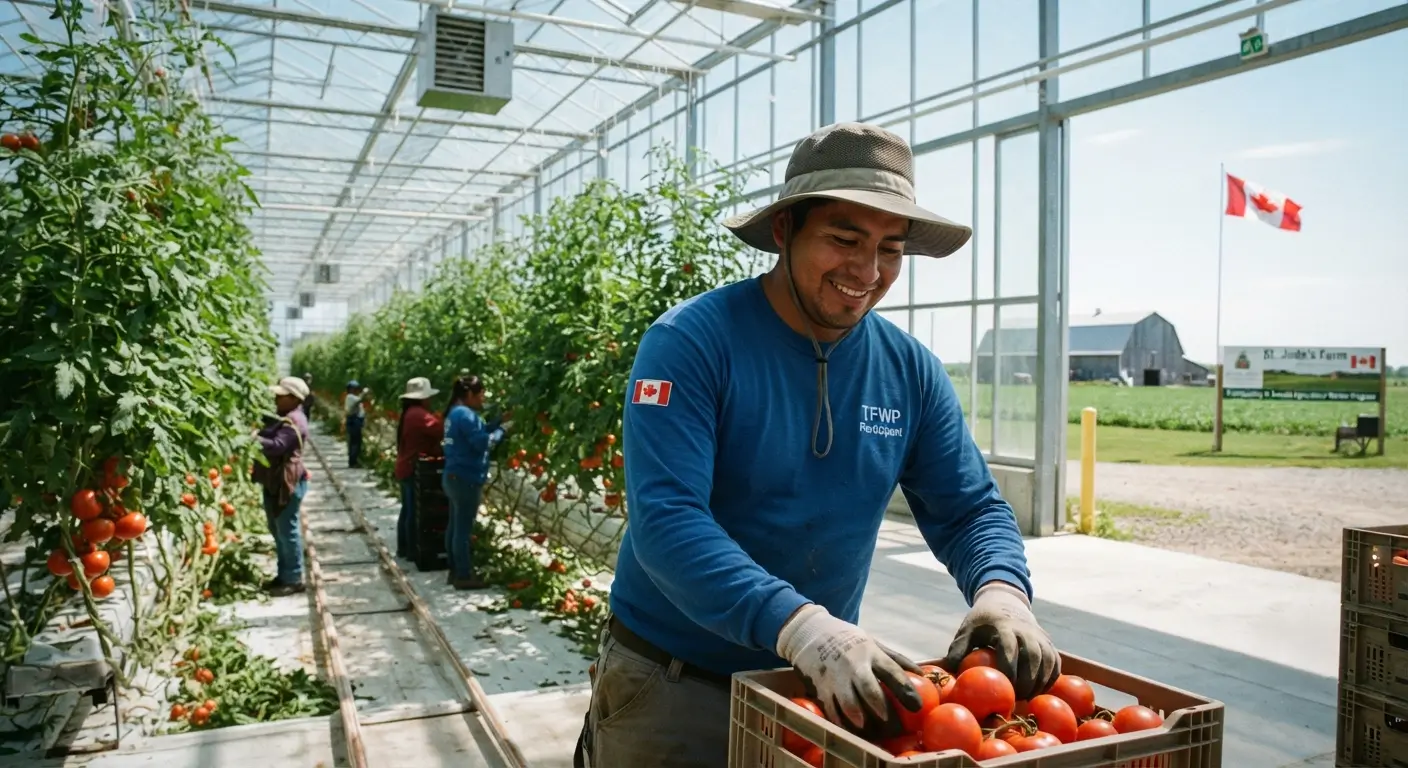
Canada Agricultural Worker Program (TFWP)
Before you read further: four corrections that determine your entire approach
SAWP is not a general agricultural migration programme. The Seasonal Agricultural Worker Program was established through bilateral government-to-government agreements and is only open to citizens of Mexico, Jamaica, Trinidad and Tobago, Barbados, Anguilla, Antigua and Barbuda, Dominica, Grenada, Montserrat, St. Kitts and Nevis, St. Lucia, and St. Vincent and the Grenadines. Citizens of any other country, including countries across Africa, Asia, most of Latin America, the Pacific, and Europe outside of specific agreement countries, are ineligible for SAWP. They must use the Agricultural Stream of the TFWP instead. The two programs are governed differently, process differently, and have meaningfully different implications for workers.
You cannot apply for SAWP yourself. Under the bilateral agreement model, SAWP workers are selected and sent by their home country government. The government matches workers to Canadian employers, not the workers themselves. An individual cannot independently submit a SAWP application to IRCC or to a Canadian employer. If someone is charging you a fee to apply for a SAWP position, they are either running a fraudulent scheme or they do not understand how the programme works.
The TFWP has been significantly tightened since 2024, and the 2026 targets reflect deliberate volume reduction. Canada's 2026 Immigration Levels Plan sets a TFWP target of 60,000 new arrivals, a 27% reduction from the previous year's target of 82,000. Low-wage LMIA applications are no longer being processed in 30 census metropolitan areas where unemployment is 6% or higher. Primary agriculture is exempt from this freeze, but the broader policy direction is toward reduction, not expansion. Understanding the programme as it exists in 2026, rather than as it operated in 2021 or 2022 when TFWP volumes surged, is essential for realistic planning.
The closed work permit structure creates documented structural risk of exploitation. The closed, employer-specific work permit that governs all TFWP agricultural positions means that your immigration status and your employment status are controlled by the same person. Amnesty International's January 2025 report concluded that exploitation is not incidental to the TFWP but a structural consequence of this design. A UN special rapporteur described the programme in July 2024 as a breeding ground for contemporary forms of slavery. Between April and October 2024, federal inspections found 11% of employers to be non-compliant. This does not mean the programme cannot be used safely and beneficially. It means going in with full awareness of your legal rights, reporting mechanisms, and support resources is not optional preparation.
1. Overview
Canada's agricultural sector is structurally dependent on temporary foreign workers. Temporary foreign workers accounted for approximately 20% of Canada's agricultural workforce in 2024, rising to significantly higher proportions in commodity sectors like fruit, vegetables, greenhouse, and nursery production. This dependency is not a short-term emergency response. It reflects decades of domestic labour supply shortfalls in physically demanding seasonal and year-round farm work that Canadian and permanent resident workers have consistently not filled in sufficient numbers.
The two agricultural programmes under the TFWP represent different historical and structural responses to this dependency. SAWP, launched in 1966 as a bilateral agreement with Jamaica and expanded over the following decades, is the oldest and most institutionalised stream. It is also the most restricted by nationality. The Agricultural Stream, which opened the programme to workers from any country not covered by SAWP, addresses a broader set of agricultural labour needs including non-seasonal roles, positions on the National Commodity List, and work that SAWP's eight-month seasonal constraint cannot accommodate.
For workers from countries not covered by SAWP, the Agricultural Stream is the operative mechanism. It requires an employer to obtain a Labour Market Impact Assessment, a process that confirms no Canadian or permanent resident worker is available for the position, before a work permit application can be submitted. This makes the Agricultural Stream fundamentally employer-initiated. A worker cannot trigger the process alone. Finding an employer willing and able to go through the LMIA process is the primary challenge for prospective agricultural workers from non-SAWP countries.
Both streams are genuinely temporary in nature. SAWP positions are capped at eight months and workers must return home each year. Agricultural Stream positions can run up to two years for low-wage roles and three years for high-wage roles, but they are time-limited and employer-specific. Both streams carry a closed work permit, meaning you are authorised to work only for the specific employer named on your permit. The implications of this are significant and are described in detail in Section 5 of this page.
2. Eligibility
For the Seasonal Agricultural Worker Program (SAWP)
You must be a citizen of one of the twelve participating countries: Mexico, Jamaica, Trinidad and Tobago, Barbados, Anguilla, Antigua and Barbuda, Dominica, Grenada, Montserrat, St. Kitts and Nevis, St. Lucia, or St. Vincent and the Grenadines. Your home country government must select and send you through the bilateral agreement process. You must be physically able to perform agricultural work in outdoor and sometimes harsh conditions. The work must be in an eligible commodity sector on Canada's National Commodity List, which includes apiary products, fruits, vegetables, mushrooms, flowers, nursery-grown trees, pedigreed canola seed, seed corn, grains, oil seeds, maple syrup, sod, tobacco, and livestock including bovine. The work must be on-farm primary agriculture.
Work permits under SAWP are issued for a maximum of eight months between January 1 and December 15 of any given year. A minimum of 240 hours of work must be offered within a period of six weeks or less. Workers can return to Canada under SAWP season after season, building long-term relationships with Canadian farm employers who return them through their home government.
For the Agricultural Stream (for all other nationalities)
You can be a citizen of any country. The Agricultural Stream covers on-farm primary agriculture positions in eligible commodity sectors and occupation codes. The relevant NOC codes are 80020 (Farm supervisors and specialized livestock workers), 80021 (General farm workers), 82030 (Agricultural service contractors), 82031 (Agricultural and related occupations, not elsewhere classified), 84120 (Nursery and greenhouse workers), 85100 (Harvesting labourers), 85101 (Fruit, vegetable and related workers), and 85103 (Other seasonal agricultural workers).
Low-wage Agricultural Stream positions (those paying below the provincial median hourly wage) can be authorised for up to two years. High-wage positions can be authorised for up to three years. Employers must provide free or cost-included housing that meets federal housing inspection standards, and must arrange and cover the cost of round-trip international airfare. Day-to-day transportation between employer-provided housing and the workplace must also be provided free of charge. These employer obligations are not optional perks. They are legal requirements of the Agricultural Stream.
Programme restrictions in metropolitan areas
As of April 10, 2026, low-wage LMIA applications are not being processed in 30 census metropolitan areas where unemployment is 6% or higher. This includes major cities like Vancouver, Toronto, Montreal, Calgary, Edmonton, Winnipeg, and Halifax. Agricultural positions are specifically exempt from this freeze, meaning LMIA applications for on-farm primary agriculture continue to be processed regardless of the urban unemployment rate. Farm work is genuinely excluded from the urban employment restrictions that affect most other TFWP streams.
SAWP contract amendments in 2026
The 2026 SAWP contract amendments raised the recognition payment to CAD $4.69 per week (with a maximum of CAD $149.94 over a contract period) and updated airfare and accommodation deduction rules province by province. SAWP liaison officers from each sending country are present in Canada to assist workers and administer contracts.
3. Skills Employers Actually Want
A review of agricultural job postings and LMIA-linked positions posted on Job Bank Canada and through Farm Management Canada, the Ontario Federation of Agriculture, and provincial agricultural employer associations shows the following consistent patterns.
Physical fitness and tolerance for outdoor, repetitive, and sometimes harsh-condition work is the baseline requirement across virtually all farm positions. Canadian agricultural employers are explicit about this in their job postings, and the SAWP agreement guidelines themselves state that workers must be physically able to work in harsh conditions and conduct repetitive labour. This is not performative language. Fruit picking, greenhouse planting, livestock handling, and field vegetable harvesting are physically intensive roles conducted in Canadian weather extremes that range from extreme summer heat in Ontario and British Columbia to cold snap exposure during early and late season harvesting.
Experience in the specific commodity is consistently preferred. A worker with documented experience in greenhouse operations, specifically tomato or flower growing, is more immediately deployable than a general labourer in a greenhouse context. Similarly, livestock workers with verifiable experience in bovine operations are preferred over general farm hands for dairy or beef farming positions. Applicants who can name specific crops, animals, equipment types, and techniques in their application documents are shortlisted faster.
Machinery and equipment operation is a differentiating factor in many LMIA applications, particularly for NOC 80020 and 82030 roles. Tractor operation, irrigation system management, greenhouse climate system operation, and basic mechanical maintenance all represent skills that command higher wages and attract employer LMIA applications at the supervisory rather than labourer level.
Basic English communication is expected even in physically oriented roles. Safety briefings, equipment instructions, chemical handling requirements, and emergency procedures are all communicated in English on Canadian farms. Workers who cannot follow basic verbal instructions in English create liability for the employer and safety risks for the workplace.
Reliability and multi-season availability are valued highly by SAWP employers specifically. Canadian farms that have used SAWP for years track returning workers and specifically request them back by name in each new season's LMIA. A first-season worker who performs reliably is almost always requested to return, which transforms a temporary seasonal arrangement into a long-term annual income source. For Agricultural Stream workers, a demonstrated willingness to commit to the full contract duration including the end-of-season harvest, which is often the most physically demanding period, is important to communicate clearly in applications.
4. Step-by-Step Path
Step 1: Confirm which stream applies to your nationality
If you are a citizen of Mexico, Jamaica, Trinidad and Tobago, Barbados, or one of the eight OECS member states (Anguilla, Antigua and Barbuda, Dominica, Grenada, Montserrat, St. Kitts and Nevis, St. Lucia, St. Vincent and the Grenadines), SAWP is your programme. Contact your home country's Ministry of Labour or equivalent government body that administers the bilateral agreement and register your interest in the programme. The Canadian employer and your government handle the matching process.
If you are a citizen of any other country, you must use the Agricultural Stream. Proceed to Step 2.
Step 2: Find a Canadian agricultural employer willing to obtain an LMIA
The Agricultural Stream is employer-initiated. The employer must apply to Employment and Social Development Canada for a Labour Market Impact Assessment, pay the $1,000 LMIA application fee, demonstrate that the position is a genuine agricultural role in an eligible NOC code and commodity, and confirm they have attempted to recruit domestically first. The advertising requirements as of April 1, 2026 include posting for a minimum of eight consecutive weeks on Job Bank (including the youth section) and at least two additional recruitment methods targeting underrepresented groups.
The most realistic approaches for non-SAWP international workers are to contact Canadian farms directly through their own websites and farm association directories, to work with registered Canadian immigration consultants who have established relationships with Agricultural Stream employers, and to apply through Job Bank Canada (jobbank.gc.ca) which lists LMIA-approved positions from employers already set up to hire internationally. Not every farm posting on Job Bank is LMIA-approved, so filter specifically for positions marked as eligible for foreign workers.
Step 3: Receive and review your job offer and LMIA confirmation
Once an employer obtains a positive LMIA for your position, they provide you with an employment contract and LMIA confirmation letter. Read the employment contract in full before signing. The contract must specify your wage (which must be at or above the prevailing wage for the occupation and province), your duties, your work location, your hours, your accommodation arrangements, and your transportation provisions. Confirm that the housing described in the contract is free or within the cost terms specified in the programme, that return airfare is covered, and that daily transportation to the work site is provided.
If anything in the written contract differs from what was described verbally or in the initial job offer, resolve the discrepancy before signing. Once signed, the contract governs your employment. Provincial employment standards also apply and provide a legal floor below which no contract term can go, regardless of what you have signed.
Step 4: Apply for your work permit
With your signed employment contract and positive LMIA letter, apply for a Canadian work permit through IRCC's online application system. Documents required include your valid passport, the LMIA number and confirmation letter, your signed employment contract, two passport photographs, and evidence of your intent to return home at the end of the permit period. The work permit will name your specific employer, the specific occupation, and the specific location. You are authorised to work only within those parameters.
IRCC's processing standard is 80% of SAWP applications within 60 days from outside Canada. Between April 2024 and March 2025, 72% met that standard. Agricultural Stream processing times vary. Budget a minimum of two to three months between LMIA approval and work permit issuance for financial and logistical planning purposes.
Step 5: Arrive, work, and document your experience
Upon arrival, your employer should provide orientation covering your rights as a temporary foreign worker, your accommodation arrangements, and your workplace safety protocols. Employers are legally required to give every worker a copy of the federal document "Your Rights Are Protected" before or on their first day of work. If this is not provided, request it. Keep copies of all your pay stubs, your employment contract, and any written communications with your employer throughout your stay. This documentation serves multiple purposes including supporting any future PR application and providing evidence if a labour dispute arises.
Step 6: Explore PR pathways in parallel with your first season
For Agricultural Stream workers accumulating Canadian work experience, the Canadian Experience Class under Express Entry is the most common onward pathway. CEC requires at least 12 months of full-time skilled work experience in Canada at NOC TEER 0, 1, 2, or 3. Most general farm worker roles sit at TEER 4 or 5, which means they do not qualify for CEC directly. However, supervisory and specialist agricultural roles at NOC 80020 sit at TEER 2 and do qualify. Workers who move into supervisory roles or who document responsibilities that qualify at a higher NOC level should track this carefully.
For workers seeking a more direct agricultural PR route, the Rural and Northern Immigration Pilot programme in some communities specifically includes agricultural labour needs. For those whose work is in food processing rather than on-farm primary agriculture, the Agri-Food Immigration Pilot was a targeted pathway worth researching for current status, as programme renewals and eligibility changes in this space occur periodically.
Workers from non-SAWP countries who want to understand how their Canadian agricultural experience compares to PR pathways available through skilled worker routes should also review our guides to Canada Personal Support Worker Pathway, which covers a comparable care-sector route with clearer PR outcomes, and Canada Construction Project Manager Job and Express Entry, which illustrates how skilled trade and management experience translates into Express Entry eligibility for workers considering longer-term Canadian settlement through a different occupational lens.
5. Real-World Challenges
The closed work permit is the single largest structural risk
Your TFWP work permit names one employer. You cannot transfer to a different employer without obtaining a new work permit for the new employer, which requires a new LMIA and takes time. During that gap, you have no authorisation to work. This structure gives the employer asymmetric power over your livelihood and your immigration status simultaneously. Amnesty International's January 2025 report, based on interviews with 44 migrant workers from 14 countries across a 16-month research period, documented workers being subjected to 60 to 80 hour weeks, wage theft, physical and psychological abuse, confiscation of passports, surveillance in accommodation, and threats of deportation when they raised complaints. The January 2025 report's central conclusion was that exploitation is not a byproduct of a few bad actors but a structural consequence of the closed permit design.
A UN special rapporteur who visited Canada in 2023 and published findings in 2024 described the TFWP as a breeding ground for contemporary forms of slavery. A Senate committee and a House committee both issued reports in 2024 recommending the phase-out of employer-specific permits. Federal inspections between April and October 2024 found 11% of inspected employers non-compliant. In the same period, $2.1 million in fines were issued and 20 employers were banned from the programme.
The government has responded with increased inspections and penalties, and ESDC operates a 24-hour reporting line at 1-866-602-9448. More than 2,700 open work permits were granted to vulnerable foreign workers in the first eight months of 2024, the highest annual figure to that point. These are genuine improvements, but they operate within a structural framework that critics argue makes vulnerability inherent rather than exceptional.
Illegal recruitment fees remain widespread despite being prohibited
No worker should pay any fee to any intermediary for placement in a TFWP agricultural position. The employer pays the LMIA fee and all legitimate recruitment costs. A Cameroonian worker documented by both Amnesty International and CBC News paid CAD $10,000 in recruitment fees to an agency promising Canadian farm work, then experienced abuse from her employer with no avenue for recourse. Fraudulent agencies, particularly those operating internationally and targeting workers in regions with limited information about Canadian immigration law, charge placement fees, housing fees, training registration fees, and document processing fees. None of these charges are legal under the TFWP. Any intermediary asking for money before or during a TFWP agricultural placement is either operating fraudulently or facilitating a violation of programme rules.
Housing quality varies significantly
Employers are required to provide free housing that meets provincial and municipal standards. In practice, housing ranges from well-maintained on-farm worker cottages to significantly substandard bunkhouse arrangements with overcrowding and inadequate sanitation. Federal housing inspections exist but are not exhaustive. Workers who arrive to find their accommodation materially different from what was described in their contract have the right to raise this with ESDC and with their provincial labour ministry. SAWP liaison officers from sending countries can also assist in resolving housing disputes for SAWP-eligible workers.
Limited PR pathways for most agricultural roles
The most commonly filled TFWP agricultural positions, NOC 85100 and 85101 at TEER 4 and 5, do not qualify for the Canadian Experience Class, which requires TEER 0 through 3. This means a worker who completes two or three years of general farm labour under the Agricultural Stream has built Canadian work experience that does not directly count toward the most common PR programme. Workers who are targeting Canadian PR should understand this before committing to the Agricultural Stream as a PR strategy, and should explore whether their specific role or supervisory responsibilities qualify at a higher TEER level, or whether provincial nominee programmes in their target province have agricultural streams with different occupational criteria.
The 2026 volume reduction context
The broader TFWP policy environment in 2026 is one of deliberate reduction. The government's 2026 target of 60,000 new arrivals is 27% below the 2025 target. Rural employer measures introduced in April 2026 provide some protection for farms outside census metropolitan areas, and primary agriculture remains exempt from the urban LMIA freeze. But workers who experienced relatively accessible TFWP volumes in 2021 to 2023 and are planning based on that memory should update their understanding. Employer LMIA processing has become more demanding, and some smaller farms that previously recruited internationally have found the administrative burden of the updated process prohibitive.
6. Where to Apply
Job Bank Canada
Job Bank at jobbank.gc.ca is the official federal government jobs portal and the primary listing point for LMIA-approved agricultural positions. Employers seeking to hire through the Agricultural Stream are required to advertise their positions on Job Bank. Filtering for agricultural roles that are explicitly marked as suitable for temporary foreign workers surfaces positions from employers who are already set up in the system.
Farm Management Canada and provincial agricultural associations
Farm Management Canada (farmmanagementcanada.ca) and provincial bodies including the Ontario Federation of Agriculture (ofa.on.ca), BC Agriculture (bcagri.ca), and similar associations in Alberta, Saskatchewan, Manitoba, and Quebec all maintain employer directories and sometimes carry employment listings. Some provincial associations run their own international agricultural worker matching services in partnership with ESDC.
F.A.R.M.S. (Foreign Agricultural Resource Management Services)
F.A.R.M.S. (farmsontario.ca) is an employer-funded non-profit that administers SAWP placements specifically for Ontario employers and workers from the twelve SAWP-eligible countries. Their website provides detailed programme information for eligible workers and is the primary operational body for SAWP in Ontario. Workers from SAWP-eligible countries should engage with their home country ministry of labour first, since the bilateral agreement process runs government-to-government, and then confirm how FARMS functions in their destination province.
WALI (West Alternatives to Labour Imports)
WALI (walicanada.ca) is the BC equivalent of FARMS, supporting agricultural employers in British Columbia in accessing SAWP and Agricultural Stream workers. Their website covers both programmes with employer-facing detail that helps workers understand what BC farm employers specifically require.
Support and rights organisations for workers already in Canada
The United Food and Commercial Workers union (UFCW Canada at ufcw.ca) represents and advocates for agricultural workers across Canada and runs the Agricultural Workers Alliance, which operates support centres in agricultural communities in Ontario, British Columbia, Alberta, and Quebec. For workers who experience difficulties with their employer, these centres provide legal information, referrals, and practical support. ESDC's TFW abuse reporting line at 1-866-602-9448 operates 24 hours a day, seven days a week, in over 200 languages.
7. Timeline Expectation
For SAWP-eligible country citizens:
Contact your home country's Ministry of Labour or equivalent government body responsible for the bilateral agreement and register your interest in SAWP. Government matching processes vary by country. Mexico processes through the Secretaría del Trabajo y Previsión Social. Caribbean countries process through their respective National Employment Services or Ministries of Labour. Workers who are selected by their government are then matched to Canadian employers who have submitted LMIA applications and specified the number of workers needed. Work permits are processed by IRCC, with a target of 80% processed within 60 days. Most SAWP workers arrive in Canada for the spring planting season in April and May, or for late summer and fall harvest in July through October depending on the commodity.
For Agricultural Stream applicants (all other countries):
Months 1 to 3: Identify employers through Job Bank, provincial agricultural associations, and immigration consultants with agricultural sector relationships. Apply for positions and await employer interest.
Months 3 to 5: Employer submits LMIA application to ESDC. LMIA processing for agricultural positions typically takes four to six weeks for straightforward applications. Employer obtains positive LMIA, sends you the confirmation letter and employment contract.
Months 5 to 7: Review and sign employment contract. Apply for work permit with IRCC. Processing time ranges from four to twelve weeks depending on your country of application.
Months 7 to 9: Arrive in Canada. Begin work with your sponsoring employer. Document all pay stubs, hours worked, and employer-provided benefits from day one.
Months 9 onward: If targeting PR, assess your NOC code level and begin evaluating CEC eligibility, provincial nominee programme options, or other pathways based on your accumulated Canadian experience.
8. Mistakes to Avoid
Assuming SAWP is available to your nationality when it is not. SAWP operates exclusively under bilateral agreements with twelve specific countries. Citizens of all other countries cannot access SAWP regardless of their agricultural experience, language ability, or any other factor. Applicants who are told by an agent or online guide that they can apply for SAWP without being a citizen of one of the twelve eligible countries are either being misled or are dealing with a fraudulent intermediary.
Paying any fee to any intermediary for agricultural placement. The employer bears all recruitment costs under the TFWP. No legitimate placement service charges the worker for an agricultural TFWP position. Fees paid to agents for job placement, visa processing, housing deposits, or document preparation for a TFWP agricultural role are almost always either illegal under programme rules or fraudulent. The Cameroonian worker mentioned in Section 5 paid CAD $10,000 before arriving and experienced severe abuse on arrival. The fee payment created an additional layer of vulnerability. Do not pay.
Signing a contract without reading it carefully. The contract governs your employment and accommodation terms. Discrepancies between what was promised verbally and what is in the contract are most easily resolved before you sign rather than after you are in a remote rural location dependent on the employer for housing and transportation.
Expecting TFWP agricultural experience to directly qualify for the Canadian Experience Class. Most general farm worker NOC codes sit at TEER 4 or 5, below the TEER 3 minimum for CEC. Workers who are targeting Canadian PR should research whether their specific role qualifies at a higher TEER level before committing to the Agricultural Stream as a PR strategy, or should explore provincial nominee pathways that specifically include lower-TEER agricultural occupations.
Not knowing your rights before you arrive. You have the right to receive your employment contract before departing your home country. You have the right to free or specified-cost housing. You have the right to employer-covered transportation. You have the right to report abuse to ESDC at 1-866-602-9448 without your employer being notified first. You have the right to apply for an open work permit if you are experiencing abuse. Your employer cannot legally confiscate your passport, restrict your movement outside working hours, penalise you for seeking to change employers, or reduce your pay below the prevailing wage stated in your LMIA. Knowing these rights before you arrive, rather than discovering them after a problem begins, is your most important preparation.
Treating a TFWP agricultural position as the beginning of Canadian settlement if you have dependants. The closed permit structure, limited PR pathways from TEER 4 and 5 agricultural roles, and the absence of a dependant visa mechanism within most agricultural TFWP placements mean that this programme functions as an income-generating arrangement rather than a family settlement pathway for most participants. Workers with families who want to settle in Canada permanently should consider whether a skilled worker route with clearer PR outcomes and the right to bring dependants from the outset better serves their long-term goals.
9. Next Action
The first action is to identify definitively which stream applies to your nationality. If you are a citizen of one of the twelve SAWP-eligible countries, contact your country's Ministry of Labour or National Employment Service this week and ask how the bilateral agreement with Canada is administered, when the next recruitment round opens, and what the government selection criteria are. Do not use private agents for SAWP. The government channel is the only legitimate one.
If you are a citizen of any other country, go to jobbank.gc.ca today, set the location filter to rural provinces including Ontario, British Columbia, Alberta, and Quebec, and search agricultural roles. Look specifically for positions that indicate LMIA approval or explicitly state they are open to temporary foreign workers. Read three to five complete postings carefully. Note which employers are named, what commodity they produce, and whether housing and transportation are specified. That baseline reading tells you what an active Agricultural Stream employer looks like, which equips you to distinguish genuine opportunities from misrepresented or fraudulent ones as your search develops.
Sources
Layer | Source | Used in sections |
|---|---|---|
Official rules | Canada.ca: Hire a temporary worker through the Seasonal Agricultural Worker Program, Overview (updated June 2026) | 1, 2, 4, 6 |
Official rules | Canada.ca: Hire a temporary foreign worker through the Agricultural Stream, Overview | 2, 4 |
Official rules | Canada.ca: Program requirements for low-wage positions, April 1 2026 update | 2, 4 |
Official rules | Canada.ca: IRCC – Seasonal Agricultural Worker Program, worker-facing information | 2, 4, 9 |
Official rules | Canada.ca: How to report abuse of temporary foreign workers, Service Canada | 5, 6, 8 |
Official rules | Canada.ca: IRCC Minister Transition Binder 2025-05, Temporary Workers policy | 1, 5 |
Official rules | F.A.R.M.S. Ontario: General Principles for SAWP, updated 2025 | 2, 4, 6 |
Official rules | Cooper Institute: Guide for Seasonal Agricultural Workers, status and work permits | 2, 4, 5 |
Official rules | UFCW Canada: Canadian Foreign Worker Streams, TFWP Primary Agriculture overview | 2, 4 |
Official rules | LegalClarity.org: Canada's TFWP Explained, 2026 volume targets and restrictions | 1, 2, 5, 7 |
Official rules | OnTheMoveCanada.com: 2026 LMIA Guide, SAWP contract amendments and CMA freeze | 2, 4, 7 |
Official rules | CFIB: TFWP Recent Program Changes, 2024-2026 restrictions overview | 1, 2, 5 |
Job market data | WelcomeAide: Agricultural Worker in Canada 2026, Farm Work and SAWP Guide | 1, 2, 3, 7 |
Job market data | Global Skill Partnerships: SAWP overview, 20% agricultural workforce share | 1 |
Job market data | Mercan Canada: SAWP TFWP program, LMIA process and GCMS details | 2, 4 |
Job market data | JustForCanada.com: SAWP program guide, work permit conditions and CAQ requirements | 2, 4 |
Skill patterns | Job Bank Canada: agricultural worker postings review June 2026 | 3 |
Skill patterns | Farm Management Canada and provincial agricultural employer associations | 3, 6 |
Real experience | Amnesty International: Canada Has Destroyed Me, Labour Exploitation of Migrant Workers (January 2025) | 1, 5, 8 |
Real experience | CBC News: I did not expect to be a slave, Amnesty TFWP report (January 2025) | 5 |
Real experience | Al Jazeera: Canada's temporary foreign worker scheme inherently exploitative (January 2025) | 5 |
Real experience | Canadian Occupational Safety: Abuse is systemic in Canada's TFWP, Amnesty International | 5, 8 |
Real experience | Policy Options: How Canada can better protect migrant workers (April 2026) | 5 |
Real experience | Immigration.ca: Canadians Increasingly Critical of TFWP, Angus Reid poll 2025 | 5 |
Real experience | CFIB: Temporary Foreign Workers Myths vs Realities, November 2025 | 5 |
Application channels | Job Bank Canada (jobbank.gc.ca): LMIA-approved agricultural positions | 6, 9 |
Application channels | F.A.R.M.S. Ontario (farmsontario.ca): SAWP Ontario administration | 6 |
Application channels | WALI Canada (walicanada.ca): BC agricultural worker access programmes | 6 |
Application channels | UFCW Canada Agricultural Workers Alliance: worker support centres | 6, 8 |
Application channels | Canada By Choice: TFWP consultation and Agricultural Stream guide | 4 |
The Author

Cynthia Amadi
Senior Journalist • Specialist Editor
Award-winning journalist skilled in investigative reporting, data journalism, interviewing, and multimedia storytelling, with a strong record of producing impactful stories.
Travel Essentials
Curated services to help you settle in Canada Agricultural Worker Program (TFWP) quickly.
More coming soon
Need help?
Our team can help you find accommodation and coworking spaces in Canada Agricultural Worker Program (TFWP).
Contact Support →