
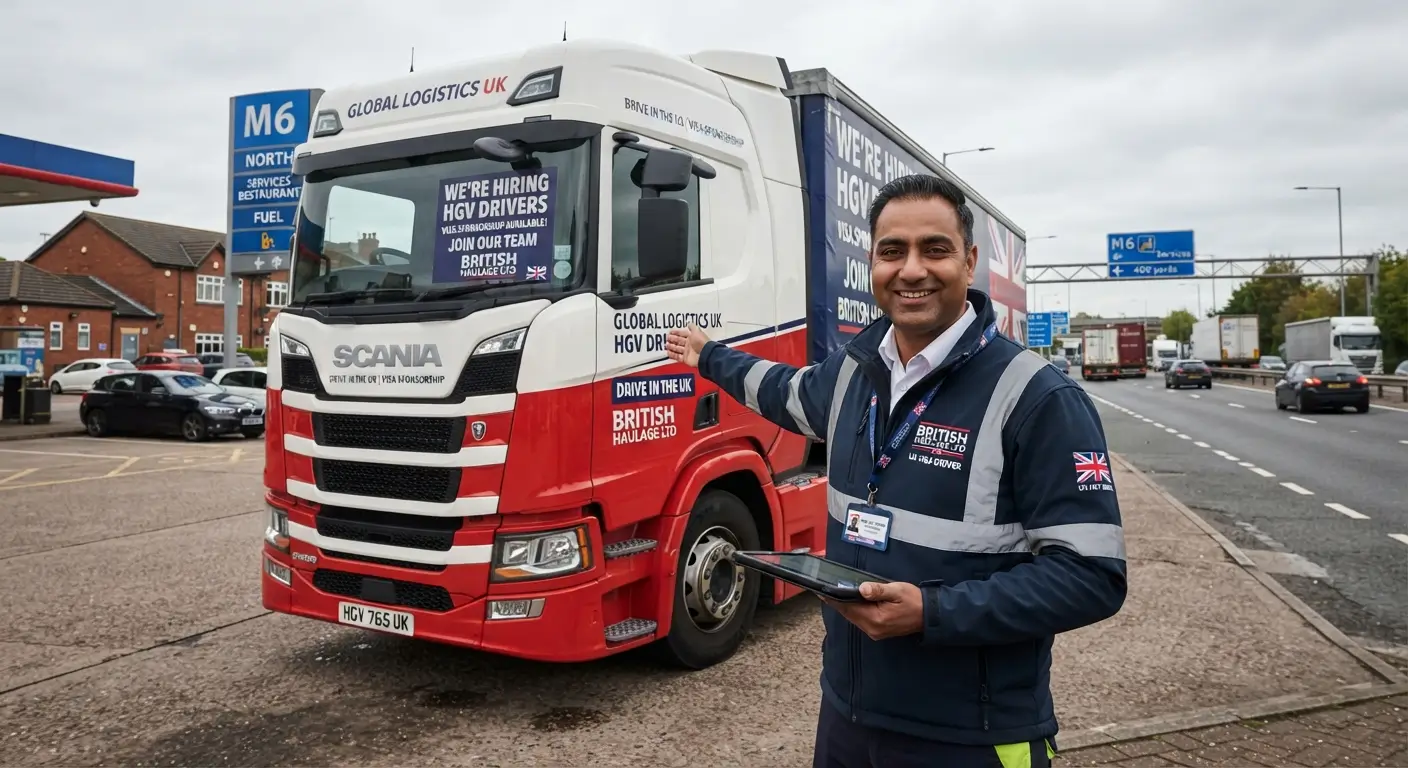
UK HGV / Lorry Driver Job + Visa Sponsorship
Before you read further: four facts that change how you plan
HGV driver sponsorship sits on a time-limited mechanism that expires at the end of 2026. Large Goods Vehicle Drivers under SOC 2020 code 8214 are classified as a sub-degree occupation at RQF Level 3 to 5. Under the rules introduced on 22 July 2025, sub-degree roles can only be sponsored if they appear on the Immigration Salary List or the Temporary Shortage List. Both of those mechanisms are currently scheduled to expire on 31 December 2026, unless the Migration Advisory Committee recommends their continuation before that date, with a final report expected in July 2026. A driver whose Certificate of Sponsorship is assigned after 31 December 2026 under an expired mechanism cannot proceed. Getting your CoS assigned with meaningful margin before that date is not a bureaucratic detail. It is a structural condition of the route.
The salary you must be paid is not the going rate for the occupation. The published going rate for SOC 8214 is £28,200 per year. But because this is below the general Skilled Worker salary threshold of £41,700, and because the ISL reduces that general floor rather than the going rate itself, you must be paid whichever is higher between the ISL-reduced general threshold and the full going rate. In practical terms this means sponsored HGV drivers must generally be paid at least £33,400 per year as a minimum floor, not the £28,200 going rate. This is achievable for experienced Class 1 articulated truck drivers, whose market salaries typically reach £38,000 to £55,000, but is tight or impossible to justify for entry-level or Class 2 positions where actual market pay sits at £28,000 to £36,000. Always confirm the specific salary requirement with an OISC-registered immigration adviser before any application proceeds.
Your overseas lorry licence does not transfer automatically. Drivers from EU and EEA countries, and a small number of other designated countries including Switzerland and Japan, can exchange their licence for a UK equivalent at the DVLA without retaking tests. Drivers from the vast majority of other countries, including most countries outside Europe, must pass UK theory and practical tests for each licence category they wish to hold. This is not an administrative formality. Category C and Category C+E theory and practical tests take weeks of study and practice to pass, cost between £1,800 and £3,250 per category in training fees, and must be completed after arrival in the UK. Planning your finances to cover a period of no commercial driving income while completing licence conversion is essential.
Workers newly sponsored into sub-degree roles after 22 July 2025 cannot bring dependants. If you have a spouse, partner, or children who you intend to bring to the UK, the current HGV driver sponsorship route does not permit this. Existing dependants of workers who held Skilled Worker status before July 2025 are protected and can extend their visas. But a driver arriving new to the UK in 2026 under this route arrives without the right to bring family members. This is a firm policy design of the sub-degree sponsorship framework, not an employer-by-employer variation.
1. Overview
Road freight moves approximately 89% of all domestic goods in the United Kingdom. Every supermarket shelf replenishment, construction site delivery, fuel depot top-up, and online order fulfilment depends on a qualified driver at the wheel of an HGV. The structural shortage of those drivers has been a defining feature of UK logistics since Brexit, when freedom of movement ended and the pipeline of EU drivers, who had made up a significant share of the UK workforce, largely closed.
The shortage peaked at over 100,000 drivers in 2021 and has since narrowed, with government training bootcamps and licensing reforms helping to add new domestic drivers. Estimates for 2025 to 2026 put the remaining gap at between 30,000 and 45,000 qualified drivers. The ageing profile of the existing workforce is the structural engine of this shortage: approximately 55% of UK HGV drivers are aged between 50 and 65, the average driver age is 51, and fewer than 1% of current drivers are under 25. Retirements will continue to outpace new entrants for years regardless of what short-term government programmes achieve. The sector's own representatives acknowledge that the structural demand for qualified drivers will not self-correct quickly.
This creates a genuine employment opportunity for internationally trained drivers who hold the relevant licence classes and experience, and who are willing to navigate the licence conversion process on arrival. Class 1 drivers holding Category C+E, which covers articulated lorries, road trains, and tractor-trailer combinations, are at the top of the demand curve and at the highest end of the salary range. Class 2 drivers holding Category C for rigid lorries are also in active demand, though at a lower market rate that intersects more tightly with the minimum salary threshold required for sponsorship.
The route requires careful planning, precise timing against the December 2026 deadline, and a realistic understanding of the first few months on the ground while licence conversion and employer onboarding are completed. For drivers who plan well, the financial outcome is genuinely strong. Average HGV driver salaries rose from roughly £32,500 in 2020 to around £44,000 in 2025, a 35% increase driven directly by the supply shortage, and experienced Class 1 drivers are consistently among the better-compensated non-degree trade workers in the UK.
2. Eligibility
Visa eligibility and occupation code
Large Goods Vehicle Drivers are classified under SOC 2020 code 8214. This code is currently eligible for Skilled Worker visa sponsorship through the sub-degree mechanism described above. Eligibility must be confirmed against the live GOV.UK Appendix Skilled Occupations and the current ISL or TSL at the exact point a Certificate of Sponsorship is assigned, since both lists can change. Never confirm eligibility from a secondary source alone when the CoS assignment is imminent.
Licence class
UK heavy vehicle licences use the DVLA category system. Category C covers rigid lorries with a gross vehicle weight of more than 3,500kg and is broadly equivalent to what the industry calls Class 2. Category C+E covers articulated and other combination vehicles including tractor-trailer units and is broadly equivalent to Class 1. Sponsored employment requires the driver to hold, or to obtain on arrival, the UK licence category corresponding to the vehicle class they will operate. A driver sponsored into a Category C+E role but holding only a Category C equivalent from their home country must pass the Category C+E test in the UK before operating articulated vehicles.
Salary requirement
Sponsored drivers must be paid at least the applicable minimum, which as described above is generally £33,400 at the ISL floor for this occupation, provided the ISL remains active, or the full general threshold of £41,700 if it does not. The going rate of £28,200 is the occupational benchmark but is not itself the floor. Only guaranteed gross basic salary counts. Overtime, allowances, night premiums, and subsistence payments are all excluded from the salary calculation for visa purposes.
English language
CEFR B2 English is required for all new Skilled Worker visa applicants from 8 January 2026. This can be demonstrated through an approved Secure English Language Test, through a degree taught in English from an approved institution, or by nationality where the Home Office classifies the country as majority English-speaking. Drivers from countries with English as an official language and English-medium education systems should check whether their qualification satisfies the Home Office's specific list before assuming no test is required.
Health and character
A D4 medical examination from a DVLA-approved doctor is required to hold a UK HGV licence. This covers vision, hearing, cardiovascular health, diabetes status, and several other conditions. The D4 medical must be completed on arrival and renewed every five years under 45 and every year from 45 onwards. A criminal record certificate from every country in which you have lived for twelve or more months in the past ten years is required for the visa application.
3. Skills Employers Actually Want
A review of UK HGV driver job postings from logistics companies, hauliers, and freight operators, alongside sponsor licence holder recruitment patterns, shows the following consistent requirements.
Category C+E experience is the most in-demand qualifier in the market. Employers recruiting under sponsorship consistently specify articulated truck experience because the Category C+E driving pool is narrower and the salary justification for the sponsorship investment is stronger. Class 2 rigid truck experience alone is less frequently the basis for sponsorship, partly because the Class 2 salary range aligns poorly with the minimum sponsorship threshold.
Specialist load experience commands a premium and strengthens sponsorship business cases. Tanker driving, ADR certification for the carriage of dangerous goods, temperature-controlled freight, flatbed and abnormal load experience, and curtainsider operation are all sectors where documented specialist experience produces both higher salary offers and stronger employer motivation to complete the sponsorship process.
A clean driving record and documented safe operation history are non-negotiable. UK transport operators are regulated through operator licensing held by the company, not the driver alone, and serious driving convictions or patterns of infringements on any driver's record create licence risk for the employing company. Employers scrutinise overseas driving histories carefully.
Tachograph knowledge and compliance awareness are expected. UK commercial drivers operate under EU-derived working time and driver hours regulations enforced by the Driver and Vehicle Standards Agency. Drivers from regulatory environments with less formalised enforcement sometimes require structured orientation to UK compliance requirements. Demonstrating awareness of these requirements in application and interview is a positive signal.
A valid Driver CPC is required by law for all professional lorry, bus, and coach drivers in the UK. Internationally trained drivers who do not hold an equivalent qualification must complete an initial qualification before driving commercially. For most international drivers this involves either passing the Driver CPC test or completing an approved initial qualification course. The CPC must then be maintained by completing 35 hours of approved periodic training every five years. Employers typically cover the cost of periodic training but may require an initial qualification to be completed before or shortly after start.
4. Step-by-Step Path
Step 1: Confirm your eligibility and verify the current ISL or TSL status of SOC 8214
Go directly to the GOV.UK Appendix Skilled Occupations page and the live ISL or TSL page and confirm that SOC 8214 is currently listed. Do this as a starting point and again before any Certificate of Sponsorship is assigned. Given the December 2026 expiry timeline, the status of this code is subject to review and should not be assumed from any secondary source to remain unchanged indefinitely. If you are working with an OISC-registered immigration adviser, ask them to confirm current eligibility at the outset of your engagement.
Step 2: Identify your UK licence class target and understand the conversion process
If you hold a Category C equivalent from your home country, confirm whether your country is on the DVLA's direct exchange list. EU and EEA licence holders can generally exchange directly. Most other countries require full UK testing in each category. For Category C, full training typically costs between £1,800 and £2,300 from UK approved training providers. For Category C+E, the additional training runs from £2,650 to £3,250. Budget for these costs and for the income gap during the weeks you are training and cannot yet drive commercially. Some UK employers fund licence training for the right candidates in exchange for a minimum service commitment. This arrangement is worth discussing in the hiring process as it can significantly reduce upfront out-of-pocket costs.
Step 3: Find a sponsor-licensed employer
UK hauliers, logistics companies, and distribution businesses that want to hire internationally must hold a Home Office sponsor licence. The public register of licensed sponsors on GOV.UK allows you to verify whether a specific employer is licensed before investing time in an application. Major UK logistics employers including DHL Supply Chain, DHL Express, Tesco distribution, Amazon Logistics, Eddie Stobart, XPO Logistics, and Wincanton all recruit at significant scale and some have established international recruitment pipelines for experienced Class 1 drivers. Specialist driver recruitment agencies with documented sponsor-licensed employer relationships are a practical alternative route, particularly for international applicants who have not yet built a UK employer network.
Construction and civil engineering logistics hauliers also recruit HGV drivers at higher salary bands. Our guide to UK Construction Worker Job and Skilled Worker Visa covers how the construction sector connects to logistics demand, since many sponsored construction employers also require qualified HGV drivers for plant and materials movement. For scaffolding-related transport specifically, which bridges both the construction and haulage sectors, our UK Scaffolder Job and Visa Sponsorship guide covers the relevant overlap.
Step 4: Confirm the salary offered meets the threshold at point of offer
Before accepting any offer and before the employer assigns a Certificate of Sponsorship, confirm in writing that the guaranteed basic salary meets the applicable minimum threshold for SOC 8214 at that date. Do not rely on the going rate figure of £28,200. The binding threshold depends on whether the ISL or TSL is active for this code and what the relevant floor is at the time of CoS assignment. Only gross guaranteed basic salary counts. Confirm this calculation with an OISC-registered adviser rather than relying on the employer's HR team alone, since employers sometimes apply the wrong threshold.
Step 5: Complete your visa application
With your signed employment contract and Certificate of Sponsorship reference number in hand, submit your Skilled Worker visa application online. Documents required include your passport, English language evidence, criminal record certificates from all relevant countries, your D4 medical (or confirmation of appointment), your overseas driving licence, and any relevant CPC or specialist certification. Processing takes approximately three to eight weeks depending on where you apply. You can apply up to three months before your intended start date.
Step 6: Arrive, complete licence conversion, and begin employment
Upon arrival, complete your DVLA licence conversion process in the category or categories required. For categories requiring UK tests, schedule your theory test promptly and book your practical test as soon as theory is passed. Complete your D4 medical if not already done. Register with the DVLA. Once you hold the appropriate UK licence and your CPC is in order, you can begin commercial driving. Your employer should have a structured induction that covers UK tachograph requirements, Working Time Regulations for transport, and operator licence obligations.
5. Real-World Challenges
The December 2026 deadline is not theoretical
The ISL and TSL are both scheduled to expire on 31 December 2026. The MAC will publish its Stage 2 recommendations in July 2026 and the government will then decide whether to retain, amend, or allow the lists to lapse. Road haulage associations have been active in making the case for continued access, and the scale of the driver shortage provides genuine evidence of labour market need. However, the government's broader direction has been toward reducing sub-degree migration, and no continuation is guaranteed. Applicants who are partway through the process in late 2026 with a Certificate of Sponsorship not yet assigned are at real risk if the mechanism expires before their CoS is issued. Prioritise getting your employer to assign the CoS as early as possible once you have a confirmed offer.
The experienced driver preference problem
Despite a genuine structural shortage, the majority of sponsored HGV vacancies target experienced Class 1 drivers with UK or Western European references. Surveys and driver forums show that more than 70% of professional drivers do not believe the shortage translates into job offers for newly qualified or newly arrived drivers. The demand is real but it concentrates on drivers who can be put in a vehicle on day one, which means internationally trained drivers without UK employer references face a more difficult initial job search than headline shortage figures suggest. Leveraging recruitment agencies with established relationships with sponsor-licensed employers is more effective than cold job board applications for international drivers without a UK track record.
The no-dependants restriction
This is one of the most significant practical constraints for drivers with families. New HGV driver sponsorships under the sub-degree route from July 2025 onwards cannot include dependant visa applications for a spouse, partner, or children. This is a deliberate policy restriction that reflects the government's tiered approach to sub-degree versus graduate-level migration. Drivers who need their family to join them in the UK should either seek legal advice on whether any transitional provision or alternative route applies to their specific situation, or should weigh whether the financial and personal trade-off of a period of solo UK employment is acceptable in their circumstances.
Salary threshold versus actual market pay for Class 2
The minimum sponsorship salary of approximately £33,400 is achievable for Class 1 drivers, whose market rate typically runs well above that figure. For Class 2 drivers, the market rate of £28,000 to £36,000 means the minimum threshold exceeds what many Class 2 roles naturally pay. Employers who genuinely want to sponsor a Class 2 driver must offer a salary above the natural Class 2 market rate to meet the sponsorship floor, which some are willing to do in acute shortage situations but many are not. This salary floor is a genuine structural filter that reduces the pool of available Class 2 sponsored roles.
Tachograph and working hours compliance
New international drivers unfamiliar with UK and EU-derived driver hours regulations occasionally find the tachograph compliance system demanding in their first months. UK enforcement of working time and driving hours through the DVSA is rigorous, and the consequences of non-compliance extend to the employer's operator licence, meaning companies are highly motivated to ensure their drivers operate within the rules. A driver who is caught in a serious hours infringement can expose their employer to licence jeopardy, which creates real employment risk. Study the Working Time Regulations for Road Transport and the driver hours rules before arrival, not after.
6. Where to Apply
Major logistics companies with sponsor licences
DHL Supply Chain and DHL Express represent the largest single HGV employer grouping in the UK and recruit drivers at significant scale. Tesco Distribution, Asda Distribution, and Sainsbury's Logistics all operate large private fleet operations. Amazon Logistics, XPO Logistics, Eddie Stobart, Wincanton, and Culina Group are among the major operators whose scale means they have or can obtain sponsor licences for suitably qualified international drivers. Each maintains a career portal with live vacancies.
Driver-specialist recruitment agencies
Transport and logistics recruitment agencies with sponsor-licensed employer relationships are the most practical channel for internationally based drivers. Agencies including Driving Solutions, Driver Hire, and specialist transport divisions within larger recruiters maintain networks of sponsor-licensed operators and can identify which employers are currently willing and set up to sponsor. Confirm the agency's knowledge of current ISL and TSL rules before engaging, since some agencies continue to operate from pre-July 2025 assumptions.
Indeed UK, Totaljobs, and Logistics job boards
Indeed UK, Totaljobs, and specialist transport boards including Road Haulage Association job listings carry live HGV driver vacancies. Filter specifically for roles that mention visa sponsorship or Skilled Worker sponsorship in the advertisement text. Verify the employer's sponsor licence status on the GOV.UK register before submitting any application or personal documents.
GOV.UK licence exchange and DVLA resources
The DVLA's official guidance on exchanging non-GB driving licences confirms which countries qualify for direct exchange and which require UK testing. This information is updated periodically and should be checked directly on GOV.UK rather than from third-party guides, since the exchange list changes.
HGV training providers for licence conversion
UK training providers including HGV Training Network, Multi Recruit, Global Drivers, and National Driving Centre offer Category C and C+E training courses with theory preparation, practical training, and test booking support. Some providers can confirm availability timelines for practical tests in specific regions, which matters for planning your income gap period after arrival.
7. Timeline Expectation
Weeks 1 to 6: Confirm SOC 8214 eligibility against the live GOV.UK lists. Contact OISC-registered adviser to confirm current salary thresholds. Gather driving licence documentation, employment references from previous haulage employers, criminal record certificates, and English language evidence. Research and approach sponsor-licensed UK employers or specialist transport recruitment agencies.
Weeks 6 to 12: Interview with sponsoring employer. Confirm salary offer meets current minimum threshold for this occupation code. Receive signed employment contract. Employer assigns Certificate of Sponsorship.
Weeks 12 to 16: Submit Skilled Worker visa application with all required documents. Book D4 medical if not completed. Await visa decision, typically three to eight weeks.
Weeks 16 to 20: Visa granted. Travel to UK. Begin DVLA licence conversion process immediately on arrival. Complete Category C and C+E theory tests and practical tests as required. The income gap period is typically four to eight weeks depending on test waiting times in your region and your preparation level.
Weeks 20 to 24: UK licence obtained. Driver CPC status confirmed or initial qualification completed. Begin paid commercial driving employment with sponsoring employer.
For all TSL/ISL applicants in 2026: The Certificate of Sponsorship must be assigned before 31 December 2026 for the sub-degree eligibility mechanism to apply. Do not allow any stage of the process to drift into Q4 2026 without confirming your CoS has been assigned.
ILR pathway: After five years of continuous residence on a Skilled Worker visa, assuming the route has a continuing ILR pathway at that point, you may be eligible to apply for Indefinite Leave to Remain. Given the government's stated intention to potentially extend the ILR qualifying period to ten years, and given that sub-degree route workers on TSL sponsorship have less settled long-term legal status than RQF 6+ route workers, taking qualified immigration advice about your long-term settlement options is recommended before and during your time in the UK.
8. Mistakes to Avoid
Treating the December 2026 deadline as someone else's problem to manage. The employer assigns the Certificate of Sponsorship, but you are the one whose immigration outcome depends on it. Ask your employer explicitly when they intend to assign your CoS and confirm the date. Do not leave this to a passive assumption that it will be completed in time.
Assuming the going rate is what you need to be paid. The going rate of £28,200 for SOC 8214 is a published benchmark. The minimum salary for sponsorship purposes is determined by the applicable threshold at the time of CoS assignment, which is currently higher. Accepting an offer of £28,200 and proceeding to a visa application will result in a refusal. Confirm the specific current minimum with an OISC-registered adviser before agreeing to any salary figure.
Arriving without planning for the licence conversion income gap. You cannot drive commercially in the UK on a non-exchangeable overseas licence while awaiting your UK tests. The gap between arrival and first legal commercial shift can be four to eight weeks or longer depending on test waiting times. Budget specifically for this period and discuss with your employer whether they will cover any training costs or whether any administrative role is available to you in the interim.
Assuming all logistics employers can sponsor you. Employer willingness and employer legal capacity are different things. An employer must hold an active sponsor licence to issue a Certificate of Sponsorship. Verify sponsor licence status on the Home Office public register before investing time in any application process.
Ignoring the no-dependants restriction in your family planning. The restriction is real, current, and not subject to employer-level variation. If bringing your family to the UK is a medium-term goal, seek immigration advice about what timeline and pathway might make that possible before committing to the route based on an assumption that family reunification will follow automatically.
Not studying UK driving hours rules before arrival. UK tachograph compliance is enforced seriously. A serious hours violation in your first months of employment creates employment risk, operator licence risk for your employer, and reputational risk in a sector where driver references travel quickly. Arrive knowing the basics of the UK Working Time Regulations for transport and the driver hours rules, not planning to learn them on the job.
9. Next Action
Open the GOV.UK Appendix Skilled Occupations page today and search for SOC code 8214. Confirm it is listed and note which mechanism (ISL or TSL) covers it. Then open the corresponding list (ISL or TSL) and note both the current salary floor and the expiry date. With those two confirmed figures in front of you, you will know whether any employer offer you receive is above the minimum threshold and how much time remains before the current eligibility mechanism expires. That twenty-minute exercise gives you the factual foundation for every other decision in this process, including whether to proceed now, which employers to target, and at what salary to negotiate.
Sources
Layer | Source | Used in sections |
|---|---|---|
Official rules | GOV.UK: Skilled Worker visa eligible occupations, Appendix Skilled Occupations (updated April 2026) | 1, 2, 4, 9 |
Official rules | GOV.UK: Skilled Worker visa your job (bricklayers/labourers example, SOC code matching) | 2, 4 |
Official rules | GOV.UK: Skilled Worker visa Immigration Salary List (November 2025 update) | 1, 2, 4 |
Official rules | GOV.UK: Skilled Worker visa Temporary Shortage List (July 2025) | 1, 2, 7 |
Official rules | Home Office: Sponsor a Skilled Worker guidance, version 04/26 (April 2026) | 2, 4 |
Official rules | DavidsonMorris: SOC Codes UK 2026 guide, Tables 1A/2A/3A sub-degree rules | 1, 2 |
Official rules | DavidsonMorris: Immigration Salary List 2026, ISL going rate and salary floor mechanics | 2, 5 |
Official rules | DavidsonMorris: Temporary Shortage List Guide 2026, December 2026 expiry | 1, 2, 5, 7 |
Official rules | Visahelpuk.com: Immigration Salary List 2026, ISL/TSL structure explained | 1, 2 |
Official rules | RSW Law: Temporary Shortage List Skilled Worker applications, no-dependants rule | 2, 5 |
Official rules | Garth Coates: TSL review what UK employers should prepare for before July 2026 | 1, 5, 7 |
Official rules | Gulbenkian: Skilled Worker visa UK list 2026, ISL/TSL salary thresholds | 2, 4 |
Official rules | Rove Legal: Temporary Shortage List guide 2026, logistics sector included | 1, 2 |
Official rules | Recruitroo: how to sponsor HGV drivers UK 2026, SOC 8214 going rate £28,200 | 2, 4 |
Official rules | DVLA: overseas licence exchange and conversion, UK GOV.UK | 4, 6, 8 |
Job market data | All Truck Info: HGV driver shortage 2025, 30,000-45,000 gap, ageing workforce | 1, 5 |
Job market data | MHF Trucks: UK HGV driver shortage causes and workforce analysis 2026 | 1, 5 |
Job market data | Logistics UK / logisticsuk.org: HGV driver shortage UK 2026, operational impacts | 1, 5 |
Job market data | PfP Thrive / CITB: HGV driver age profile, under-25 share below 1% | 1, 5 |
Skill patterns | NaijOnline Abroad: HGV driver jobs UK 2026, employer requirements and CPC overview | 3, 4, 6 |
Skill patterns | Trans.info: new HGV driver wages and employer priorities for experienced drivers | 3, 5 |
Salary data | Aspion: HGV driver salary guide 2026, Class 1 vs Class 2 pay breakdown | 2, 5, 7 |
Salary data | Salary After Tax UK: HGV driver salary UK 2026, Class 1 £38k-£55k, Class 2 £28k-£36k | 2, 5, 7 |
Salary data | HGVT.co.uk: average HGV driver salary 2026, Cat C and Cat C+E ranges | 5, 7 |
Salary data | Jobleap.co.uk: HGV driver salary UK 2026, shortage impact on wages | 1, 5 |
Salary data | Trans.info: training costs Cat C £1,800-£2,300, Cat C+E £2,650-£3,250 | 4, 5 |
Application channels | DHL, Tesco Distribution, Amazon Logistics, Eddie Stobart, XPO, Wincanton career portals | 6 |
Application channels | Road Haulage Association: job listings and sector advocacy | 6 |
Application channels | AYJ Solicitors: SOC codes UK 2026, how to choose correct code | 4 |
Real experience | Trans.info: truth behind HGV driver shortage, experienced driver bias, entry-level reality | 5 |
Real experience | MGBe Legal: UK Temporary Shortage List 2026 which roles still qualify, logistics included | 1, 5 |
The Author

Cynthia Amadi
Senior Journalist • Specialist Editor
Award-winning journalist skilled in investigative reporting, data journalism, interviewing, and multimedia storytelling, with a strong record of producing impactful stories.
Travel Essentials
Curated services to help you settle in UK HGV / Lorry Driver Job + Visa Sponsorship quickly.
More coming soon
Need help?
Our team can help you find accommodation and coworking spaces in UK HGV / Lorry Driver Job + Visa Sponsorship.
Contact Support →