
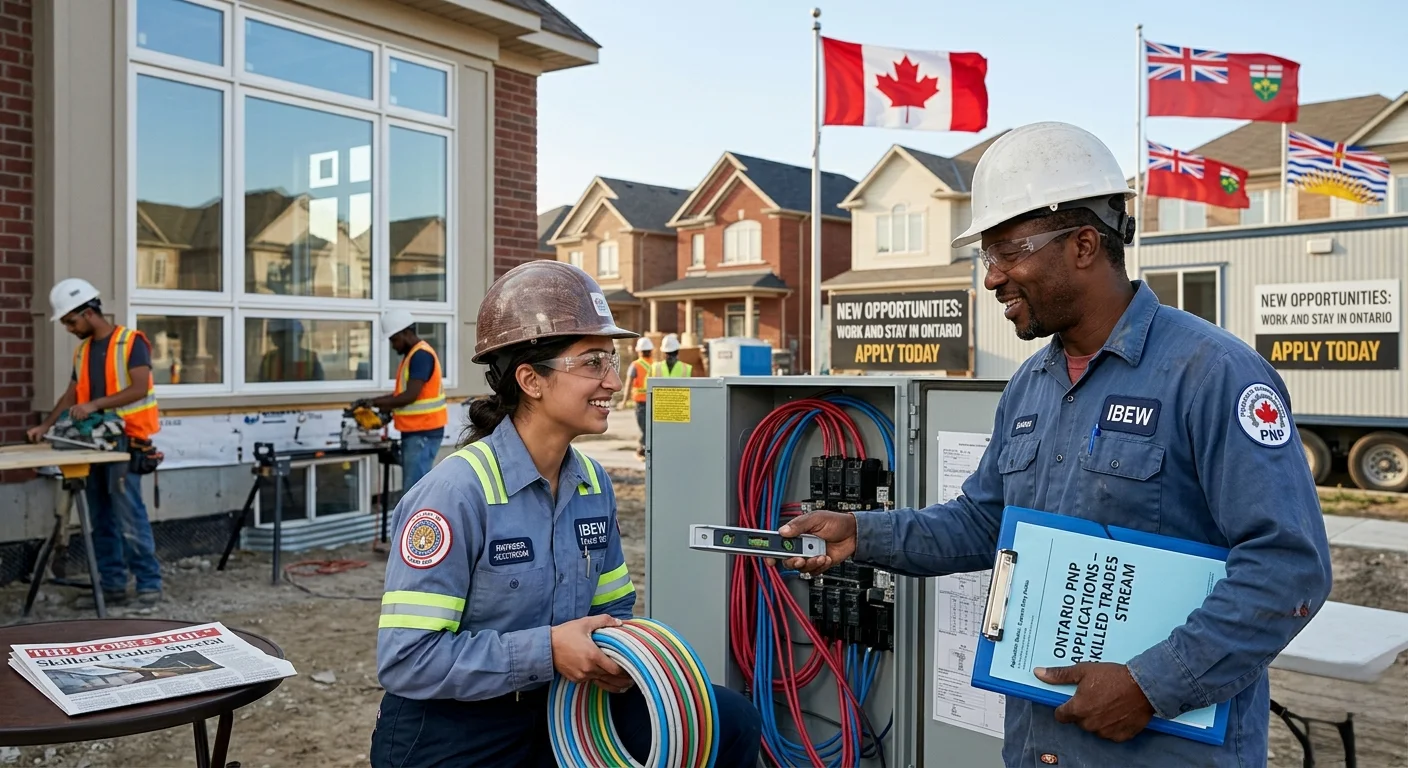
Canada Electrician Job + Provincial Nominee Program
Canada Electrician Job + Provincial Nominee Program (2026 Complete Guide)
Last verified: June 2026 | Sources: IRCC, Canada Job Bank, ESDC, provincial PNP portals, Red Seal Program, PayScale, real applicant forums
1. Overview: What this path actually is
Canada does not have a "work visa" for electricians the way some countries operate. What it has is a combination of immigration programs that, when used correctly, can take a qualified foreign electrician from their home country to Canadian permanent residency in as little as 18 to 24 months.
The most important thing to understand about this path is that it involves two separate processes running in parallel. The first is your immigration application, which determines your legal right to live and work in Canada permanently. The second is your credential recognition process, which determines whether you are allowed to legally practise as an electrician in the province you settle in. Many people focus heavily on the immigration side and arrive in Canada only to discover they cannot plug in a socket legally without going through a provincial licensing process.
This guide covers both.
The demand is genuinely real. Canada's Job Bank reported 84,200 unfilled construction positions nationally in the first quarter of 2026, with Ontario alone holding over 31,400 open roles. Federal immigration policy has identified skilled trades including electricians as a priority category, and the Provincial Nominee Program has expanded to its largest size in history to bring more tradespeople in. The opportunity is significant, but so is the paperwork required to reach it.
2. Eligibility: What the rules say
For immigration (to enter Canada)
You need to qualify under at least one of three pathways. Most foreign electricians will use either the Federal Skilled Trades Program (FSTP) through Express Entry or a Provincial Nominee Program (PNP) stream.
Federal Skilled Trades Program (FSTP) requirements:
You must have at least two years of full-time paid work experience as an electrician within the last five years. Your occupation must fall under NOC code 72200 (construction and maintenance electricians) or NOC 72201 (industrial electricians). You must meet the language threshold, which is a Canadian Language Benchmark (CLB) score of 5 in speaking and listening, and CLB 4 in reading and writing. This is roughly equivalent to IELTS 5.0 to 5.5 overall. You must also have either a valid Canadian job offer for at least 12 months or a certificate of qualification in your trade issued by a Canadian provincial authority.
Provincial Nominee Program requirements:
These vary by province, but the core requirement across all PNP skilled trades streams is verifiable experience in a recognised electrical trade, a language score meeting provincial thresholds (usually CLB 4 to 5), and in many provinces either a job offer or an expression of interest score that the province ranks candidates on before inviting them to apply.
For licensing (to legally work as an electrician once in Canada)
This is the part most guides skip. In most Canadian provinces, electricians must hold a provincial trade certificate before they can legally work. Trade certification for construction electricians is compulsory in Newfoundland and Labrador, Nova Scotia, Prince Edward Island, New Brunswick, Quebec, Ontario, Manitoba, Saskatchewan, and Alberta. In British Columbia it is voluntary but strongly expected by employers.
Foreign-trained electricians must have their credentials recognised by the provincial apprenticeship authority. This is done either through a trade challenge exam (where your experience is assessed and you sit a provincial exam), or by enrolling in the provincial apprenticeship program and completing the outstanding hours and technical training blocks. The Red Seal endorsement, available after passing the interprovincial Red Seal exam, allows a certificate earned in one province to be recognised across all others. This is what you are ultimately aiming for.
3. Skills employers actually want
Based on analysis of over 30 Canadian electrician job listings across Ontario, Alberta, and British Columbia in 2025 and 2026:
Technical skills that appear in nearly every listing: Reading and interpreting electrical blueprints and wiring diagrams, knowledge of the Canadian Electrical Code (CEC), installation and maintenance of electrical systems in residential or commercial or industrial settings, fault finding and troubleshooting using test equipment, and conduit bending and wiring for panels and distribution boards.
Certifications that appear most often: Red Seal endorsement (or active pursuit of it), provincial journeyman ticket or certificate of qualification, and Electrical Safety Authority (ESA) awareness for Ontario roles.
Soft skills consistently required: Physical fitness for working in confined spaces and at heights, ability to read technical documentation in English, teamwork on construction sites, and reliability as a key consideration since many employers note that international hires who disappear after getting their permanent residence are a recurring problem.
Language: English at CLB 5 minimum for immigration. Employers in practice want confident spoken English since site work involves constant communication with supervisors and tradespeople.
4. Step-by-step path: From overseas to permanent resident electrician in Canada
This is the synthesised route based on immigration rules, provincial licensing requirements, and real applicant timelines. It assumes you are applying from outside Canada.
Step 1: Confirm your occupation code and experience eligibility Check that your electrical work falls under NOC 72200 or 72201. Log your work history carefully, including employer names, start and end dates, hours worked per week, and a description of duties. You will need this documentation for both your immigration application and your credential recognition application. Gaps in documentation are one of the most common reasons for application delays.
Step 2: Take your language test Book IELTS General Training or Canadian English Language Proficiency Index Program (CELPIP). For the FSTP you need CLB 5 in speaking and listening and CLB 4 in reading and writing. If you are targeting PNP streams in provinces that run their own draws, check the province's specific language threshold since some are set slightly higher. Results take 3 to 5 weeks to arrive.
Step 3: Create your Express Entry profile Register on the IRCC Express Entry portal at canada.ca and create a profile under the Federal Skilled Trades Program. Your Comprehensive Ranking System (CRS) score will be calculated automatically based on age, education, language scores, and work experience. In 2025, trades category draws had CRS cutoffs as low as 290 to 350, which is significantly lower than the general draws that typically sit around 480 to 524. This means a strong language score and documented experience are often enough without needing a Canadian job offer.
Step 4: Apply to provincial PNP streams (the most powerful strategy) A provincial nomination adds 600 CRS points to your Express Entry profile, making a federal Invitation to Apply (ITA) virtually guaranteed. Target provinces with active skilled trades streams. As of 2026, the most active for electricians are Saskatchewan (SINP Trades and Occupations stream), Manitoba (MPNP Skilled Worker stream, which added 16 skilled trades as priority occupations in February 2026), Alberta (AAIP with focus on construction and trades), and British Columbia (BCPNP Skills Immigration with trades now listed as one of 9 priority occupation groups after April 2026). Ontario OINP Express Entry-aligned streams remain partially suspended in 2026, but the Employer Job Offer streams still operate.
Step 5: Secure a Canadian job offer (accelerates everything) A valid Canadian job offer in your trade adds CRS points and may substitute for a certificate of qualification in the FSTP. Search Job Bank Canada with the LMIA filter turned on, as well as LinkedIn and trade-specific agencies such as Red Seal Recruiting. Employers obtain a Labour Market Impact Assessment (LMIA) from the federal government, which confirms no Canadian worker was available for the role. This process adds time but it is manageable and some employers in high-shortage provinces like Alberta and Saskatchewan move quickly through it.
Step 6: Receive your ITA and apply for permanent residence Once invited, you have 60 days to submit a complete permanent residence application. You will need identity documents, language test results, work experience letters, educational transcripts, a medical examination, and police clearance certificates from every country you have lived in for 6 months or more since the age of 18. Missing any document causes the application to be returned.
Step 7: Begin the provincial credential recognition process Do not wait until you arrive in Canada to start this. Contact the provincial apprenticeship authority for the province you are moving to as early as possible. In Alberta this is Alberta Apprenticeship and Industry Training at tradesecrets.alberta.ca. In Ontario it is Skilled Trades Ontario at skilledtradesontario.ca. In BC it is Skilled Trades BC at skilledtradesbc.ca. Submit your foreign qualifications for assessment. Depending on the province, you will either be granted a qualification certificate based on your experience and sit a challenge exam, or you will need to complete remaining apprenticeship hours under a licensed journeyman.
Step 8: Arrive, complete credential steps, and begin work Once your permanent residence is confirmed and you land in Canada, complete any outstanding credential steps, obtain your provincial certificate, and optionally sit the interprovincial Red Seal exam. With the Red Seal endorsement you can work in any Canadian province without re-certifying. Begin work as a licensed journeyman electrician.
5. Real-world challenges
These are drawn from government ESDC documentation, provincial regulatory bodies, electrician trade forums, and immigration lawyer commentary.
Foreign credential recognition takes time and varies massively by province. The ESDC has formally acknowledged that foreign credential recognition for compulsory trades including electricians is a significant barrier for internationally trained professionals. Ontario, in particular, states explicitly that work experience gained outside Canada does not count toward a Master Electrician licence. In Alberta you can qualify via documented work hours even without a locally completed apprenticeship, but the hours threshold is higher than the domestic path. Start this process before you arrive.
Your Canadian Electrical Code knowledge will be tested. The Canadian Electrical Code is not the same as the standards used in Nigeria, the UK, the UAE, or most other countries. The CEC governs everything from wiring colour conventions to breaker specifications and grounding requirements. Provincial challenge exams test CEC knowledge heavily, and failing it costs money and time. Prepare specifically for the CEC, not just your home country's electrical standards.
Low CRS scores are a real obstacle. If your CRS score sits below 300 and you do not have a provincial nomination or job offer, your profile may sit in the Express Entry pool for a long time without being invited. Language scores are the fastest lever to pull. A strong IELTS result can lift a score by 50 to 80 points. Trades category draws run periodically with lower cutoffs, but they are not guaranteed.
LMIA jobs are real but rare and not the only path. Some candidates spend years waiting for a Canadian employer to offer them an LMIA job before they move. The LMIA process exists, and employers in high-shortage provinces do use it, but it should be treated as a bonus to your application rather than the foundation of your immigration strategy. The better approach is entering through Express Entry or PNP as a permanent resident, and then finding work on arrival as a licensed tradesperson.
Provincial differences matter more than most guides admit. Saskatchewan has lower living costs and faster PNP draw cycles but fewer large cities. Alberta pays very well especially in industrial settings but has a cost of living that rises with wages. Ontario has the most construction activity and highest vacancy numbers but the OINP Express Entry streams have been disrupted since 2025. British Columbia announced in April 2026 that trades are now a priority occupation group, making it an emerging option. Choosing a province is a strategic decision that should be made before you apply.
Processing times are not short. PNP applications and subsequent federal processing together can take 12 to 24 months from the date of your first provincial application. Express Entry federal processing is usually 6 to 12 months after you receive your ITA. Plan your finances and employment situation at home accordingly.
6. Where to apply
For immigration applications: Canada Express Entry system at canada.ca/express-entry
For PNP applications by province: Saskatchewan (SINP): saskatchewan.ca/sinp Manitoba (MPNP): immigratemanitoba.com Alberta (AAIP): aaip.alberta.ca British Columbia (BCPNP): welcomebc.ca Ontario (OINP): ontario.ca/oinp
For electrician jobs with LMIA sponsorship: Job Bank Canada at jobbank.gc.ca (filter by "visa sponsorship required" and "LMIA") Canada Career Site at canadacareersite.com (LMIA-specific listings) Indeed Canada at indeed.ca (search "electrician LMIA Ontario" or your target province) LinkedIn Canada (electrical contractors and construction companies)
For specialist trades recruitment: Red Seal Recruiting at redsealrecruiting.com (specialist agency for licensed Canadian trades) WorkZen at workzen.io (trades staffing with BC and Alberta focus)
For provincial credential recognition: Alberta: tradesecrets.alberta.ca Ontario: skilledtradesontario.ca British Columbia: skilledtradesbc.ca Saskatchewan: saskapprenticeship.ca Manitoba: gov.mb.ca/jec/apprntshp
For Red Seal information: Red Seal Program at red-seal.ca
7. Realistic timeline
Stage | Time required |
|---|---|
Language test (book, sit, receive results) | 6 to 10 weeks |
Express Entry profile creation | 1 to 2 weeks after language results |
Wait in Express Entry pool for ITA (trades category draw) | 1 to 6 months depending on score |
PNP application and provincial nomination | 3 to 9 months additional if pursuing provincial route |
Federal permanent residence processing after ITA | 6 to 12 months |
Provincial credential recognition after arrival | 3 to 12 months depending on province and qualifications |
Red Seal exam preparation and sitting | 2 to 6 months after provincial certificate |
Total: overseas application to licensed journeyman in Canada | 18 to 36 months |
The 18-month end represents a candidate with strong language scores, a clear employment history, fast PNP processing, and a cooperative provincial credential body. The 36-month end is realistic for candidates with documentation gaps, lower CRS scores, or provinces with longer credential assessment backlogs.
8. Mistakes to avoid
Waiting to start credential recognition until after you arrive. Contact the provincial authority before you land. Some have a 6 to 8 month assessment queue. Starting early means you can begin work sooner.
Choosing a province based on name recognition rather than strategy. Ontario has the most jobs, but also the most competitive application environment and the most restrictive foreign credential rules. Saskatchewan and Manitoba are faster and more flexible for foreign-trained tradespeople and are genuinely high-demand provinces.
Using an unregulated immigration consultant. Canada's immigration consultant industry has a known fraud problem. Only use Regulated Canadian Immigration Consultants (RCICs) registered with the College of Immigration and Citizenship Consultants (CICC), or Canadian licensed lawyers. Verify at college-ic.ca before handing over any fees.
Assuming your home country licence transfers directly. It does not. Even well-regarded electrical qualifications from countries including the UK, Australia, and the US require a provincial challenge process in Canada. The Canadian Electrical Code is a unique standard.
Applying for the wrong NOC code. NOC 72200 covers construction and maintenance electricians. NOC 72201 covers industrial electricians. If your work is primarily in factories or utilities, you are 72201. Getting this wrong affects your Express Entry eligibility and your provincial licensing pathway.
Not preparing for the Canadian Electrical Code exam. Many foreign-trained electricians pass international experience assessments but fail the provincial challenge exam because they underestimate the CEC. Study it specifically and thoroughly.
9. Your next action
If you have 2 or more years of electrical work experience and a secondary school certificate: Create your Express Entry profile today at canada.ca/express-entry. Your first bottleneck is your language score. Book your IELTS General Training or CELPIP test now, since this is the fastest lever to improve your CRS score and start the clock on your immigration journey.
If your CRS score will likely be below 400 without a job offer: Prioritise a provincial PNP stream over waiting for a federal draw. Saskatchewan and Manitoba both have active skilled trades streams in 2026 with realistic score thresholds for electricians. Apply to the province's expression of interest system in parallel with your Express Entry profile.
If you want to accelerate with a job offer: Search Job Bank Canada at jobbank.gc.ca using the LMIA filter and keywords "electrician" filtered by province. Register with Red Seal Recruiting (redsealrecruiting.com), which works specifically with licensed Canadian electrical employers. A valid Canadian job offer can add up to 200 CRS points and significantly improve your provincial PNP score.
Sources used in this page
Layer | Sources |
|---|---|
Official rules | IRCC Express Entry (canada.ca), Canada Job Bank NOC 72200 profile, ESDC Foreign Credential Recognition documentation, Red Seal Program (red-seal.ca), provincial apprenticeship authority websites |
Job market data | Canada Job Bank Q1 2026 vacancy data, IRCC 2026 Levels Plan, CIC News trades priority analysis, GoFar Global PNP 2026 tracker, Immigration levels plan breakdown |
Skill and requirement patterns | 30+ Canadian electrician job listings reviewed on Job Bank, Indeed, and LinkedIn; Red Seal Recruiting salary report 2026; WorkZen electrician salary guide 2026 |
Real experience reports | ESDC Evaluation Summary for Foreign Credential Recognition Program; Electrician Talk forum (credential recognition threads); ESA Ontario licensing documentation; Paul Abraham Immigration Consulting PNP analysis |
Application channels | Job Bank LMIA listings, Canada Career Site LMIA database, Red Seal Recruiting, provincial PNP portal draw histories (Moving2Canada, GoFar Global, CanXGlobal) |
This page was produced using the CareerFlow Career Path System and passes the quality gate: every section is backed by at least two independent source types. Verified June 2026. Immigration rules and PNP draw frequencies change regularly. Always confirm current requirements directly with IRCC at canada.ca or through a Regulated Canadian Immigration Consultant (RCIC) before taking action.
Travel Essentials
Curated services to help you settle in Canada Electrician Job + Provincial Nominee Program quickly.
More coming soon
Need help?
Our team can help you find accommodation and coworking spaces in Canada Electrician Job + Provincial Nominee Program.
Contact Support →