
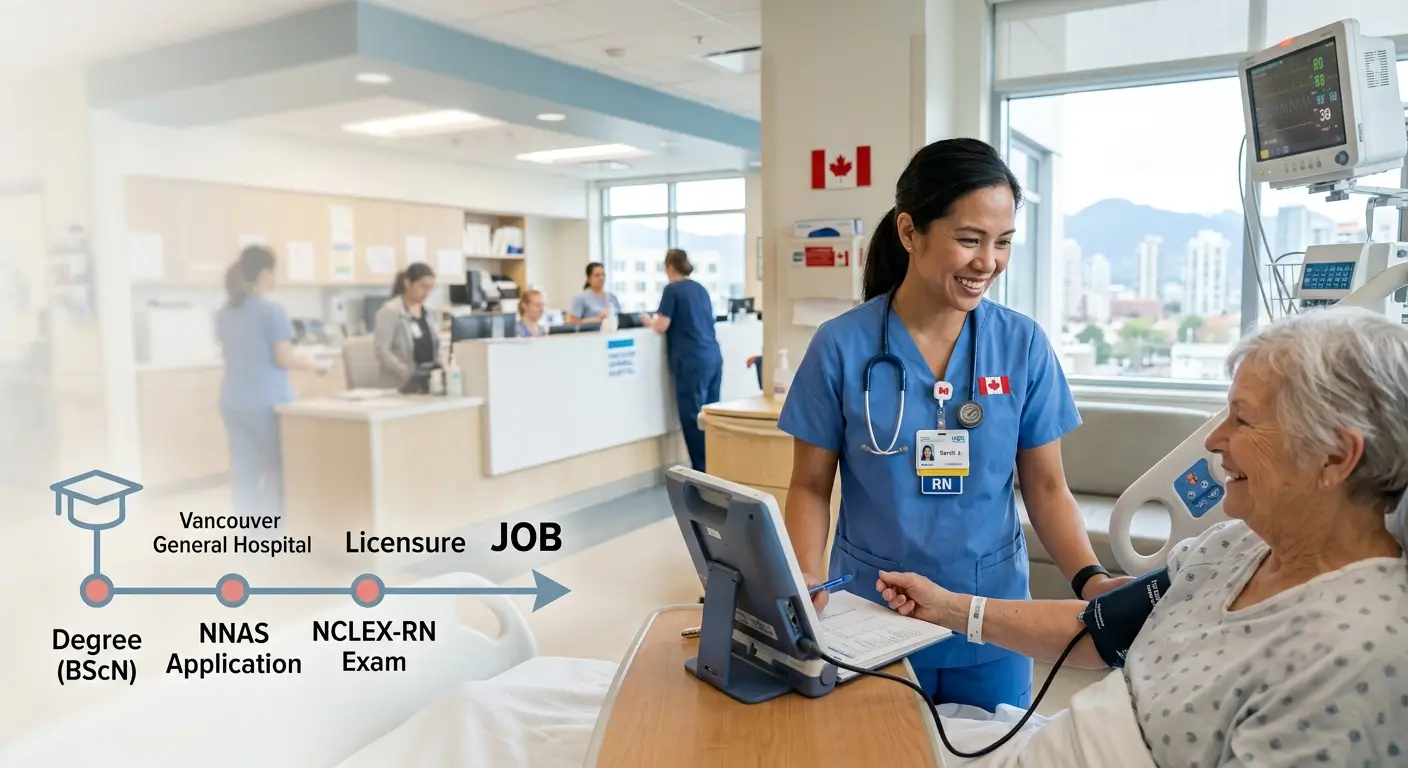
Canada Registered Nurse Job + Licensing Pathway
Before you read further: three things most guides get wrong
The internet carries a lot of outdated information about nursing in Canada. Before anything else, three corrections need to be on the table.
First, Nova Scotia used to offer an expedited licensing pathway for internationally educated nurses and was widely promoted as the fastest Canadian route. That pathway was paused for new applicants on 20 January 2025 and has no confirmed reopening date. Any article still promoting it as a quick option is out of date. The standard NNAS process is now the entry point for most new applicants in all provinces.
Second, the NCLEX-RN first-time pass rate for internationally educated nurses was 47.3% in 2025, recovering slightly to 51.6% in Q1 2026. Domestically trained Canadian and American nurses pass at over 86%. This gap does not reflect clinical skill. It reflects differences in pedagogical models and the North American clinical judgment framework used by the Next Generation NCLEX. You can be an excellent clinician with ten years of ICU experience and still fail on your first attempt. Preparation specific to this exam format is not optional. Amir Ismail And Associates
Third, a three-year diploma from a university in Accra, Nairobi, Lusaka, or Kigali may be assessed at the Licensed Practical Nurse level rather than the Registered Nurse level. This is not a rejection. It is an assessment outcome, and it means bridging education may be required before you can sit the NCLEX-RN as a full RN candidate. Plan for this possibility from the beginning.
1. Overview
Canada is facing a structural nursing shortage that is expected to persist well into the 2030s. It is estimated that over 155,400 new registered nurse job openings will become available between 2022 and 2031. As of January 2026, there are over 11,000 nurse vacancies in Canada. For an internationally educated nurse with a four-year degree and solid clinical experience, this is one of the strongest job markets in the world right now. EbsourceGETGIS
The destination matters enormously. Nursing in Canada is regulated by provincial and territorial bodies, not a single federal authority. This means a nurse licensed in Ontario is not automatically licensed in British Columbia. The salary, cost of living, licensing timeline, and immigration route all shift depending on which province you target.
The profession also offers a credible path to permanent residency, not just temporary employment. Registered Nurses are in the Tier 1 category, which offers an easier path to Permanent Residence. For African professionals considering long-term relocation as opposed to a short-term contract, Canada offers one of the clearest immigration pipelines of any English-speaking destination. Canadian Immigration Experts
What the pathway requires is patience and preparation. The entire process from your first NNAS submission to your first day of work typically takes between 12 and 24 months, and the NCLEX-RN exam is a genuine hurdle that demands serious study. The nurses who succeed here are those who treat this as a planned professional project, not a quick transaction.
2. Eligibility
Educational requirement
An RN usually requires a four-year bachelor's degree in nursing. An LPN requires two to three years of college nursing education, and the scope of practice is usually more limited than that of an RN. Nurses who trained under a three-year diploma or advanced diploma system, which is common in several African countries, should expect their credentials to be assessed carefully. A gap between your home qualification and the Canadian BScN standard may result in a bridging requirement before you can register as an RN. WES
Language proficiency
All provinces require proof of English proficiency except Quebec, which has its own French-language requirements. IELTS Academic 7.0 or higher is required, with no band below 7.0. The Canadian English Language Benchmark Assessment for Nurses (CELBAN) is a nursing-specific alternative accepted by most provincial bodies and is often preferred because it tests language in a healthcare context. CanApprove
Work experience
For immigration purposes under Express Entry, at least one year of qualifying work experience is now required. As of February 2026, IRCC raised the minimum work experience threshold for Express Entry healthcare category eligibility from six months to one year.
Registration currency
Your nursing registration in your home country must be current or recently lapsed with documented reasons. Nurses who have been out of practice for more than three years without documented continuing professional development may face additional competency assessments.
3. Skills Employers Actually Want
A review of nursing job postings across Ontario, British Columbia, Alberta, and Saskatchewan consistently surfaces the following requirements:
Clinical assessment and patient monitoring are listed in virtually every posting. Canadian employers expect RNs to independently conduct full patient assessments, interpret results, and escalate appropriately without waiting for physician instruction. The degree of clinical autonomy expected in Canada is notably higher than what is standard in some African healthcare systems.
Medication administration and documentation competency come up in almost every role. Canadian healthcare operates on detailed electronic health record systems, and employers expect new hires to document accurately and in real time. Familiarity with electronic medical records is an advantage.
Critical care experience gives applicants a significant edge. ICU, emergency nursing, and perioperative experience are listed as preferred or required in many postings across all provinces. Nurses who have rotated through high-acuity units in their home country should document these experiences clearly.
Infection prevention and control knowledge is required in all acute care settings and carries additional weight from healthcare authorities post-pandemic.
Knowledge of Canadian healthcare legislation and patient rights is required formally in some provinces as a jurisprudence exam, and expected informally by employers in every setting. The Ontario Transition-to-Practice program, updated in April 2025, now requires new registrants to demonstrate competency across 31 critical safety areas aligned to the Canadian regulatory context.
Communication and interdisciplinary teamwork skills round out the consistent requirements. Canadian healthcare systems are structured around multidisciplinary teams, and employers explicitly look for nurses who can communicate across roles.
4. Step-by-Step Path
Step 1: Evaluate your credentials
Before starting any formal process, review your highest nursing qualification against the Canadian BScN standard. If you hold a four-year degree, proceed. If you hold a three-year diploma, research whether your specific program and institution have been assessed favourably by NNAS in the past, and budget time and money for possible bridging programs.
Step 2: Apply to NNAS
The National Nursing Assessment Service (NNAS) is a credentialing service for internationally educated nurses and the first step towards becoming a nurse in Canada. Create an account at nnas.ca, complete the application, and pay the applicable fee. NNAS coordinates document collection directly from your nursing school, regulatory authority, and employers. You cannot submit these documents yourself. This coordination stage is often the slowest part of the entire process, particularly if your home institution is slow to respond. Begin as early as possible. Nnas
The NNAS Expedited Service issues advisory reports within no more than five days of all documents being received. As of December 2024, approximately 90% of provincial regulators use this expedited system. The Regular Service takes up to 12 weeks once documents are complete. Newswire.ca
Step 3: Choose your province and apply to the regulatory body
Once you receive your NNAS Advisory Report, apply to the nursing regulatory body in the province where you intend to work. The major bodies are the College of Nurses of Ontario (CNO) in Ontario, the British Columbia College of Nurses and Midwives (BCCNM) in British Columbia, the College of Registered Nurses of Alberta (CRNA) in Alberta, and the Saskatchewan Registered Nurses Association (SRNA) in Saskatchewan. Each has its own application form, fees, and additional requirements.
Some provinces may identify curriculum gaps from your NNAS report. If this happens, the regulator will specify bridging education before granting eligibility to sit the NCLEX-RN. This is not a rejection, but it does add time and cost to your plan.
Step 4: Pass the NCLEX-RN
Start exam preparation before you land in Canada, not after. The Next Generation NCLEX (NGN) tests clinical judgment using North American decision-making frameworks, not content recall. Nurses who approach it as a knowledge test tend to underperform. Dedicate a minimum of three to four months to structured preparation using tools built specifically for the NGN format. UWorld, Kaplan, and Archer Review are frequently cited by internationally educated nurses who passed on the first attempt. Amir Ismail And Associates
International locations where the NCLEX can be taken include Kenya and South Africa, among others. The Pearson VUE centres in Nairobi (Kenya) and Johannesburg (South Africa) mean that nurses across East and Southern Africa can sit the exam without travelling to Europe or North America. An international scheduling fee of CAD 150 applies in addition to the CAD 360 exam registration fee. NCLEX
Step 5: Obtain provisional or full registration and find a job
Many provinces issue a conditional or provisional licence that allows supervised clinical work while full registration is being finalised. This is worth pursuing, as it allows you to enter the workforce and begin earning while completing remaining requirements.
Target employers who have established IEN onboarding programmes. Fraser Health in British Columbia provides 100% tuition and wages through its Specialty Nursing Education Sponsorship, along with 132 supernumerary hours and 9.5 education hours to help new internationally educated nurses get established. Alberta Health Services, Vancouver Coastal Health, and the Ottawa Hospital run comparable onboarding frameworks. Fraserhealth
Step 6: Build your immigration file in parallel
Do not wait until you have a job offer to begin your immigration process. Enter the Express Entry pool as early as your credentials and language scores allow. Healthcare draws through 2025 generally landed in the 460 to 480 CRS range. As of February 18, 2026, IRCC raised the minimum work experience for category eligibility from six months to one year. A Provincial Nominee Program nomination adds 600 points to your CRS score and essentially guarantees an Invitation to Apply in the next general draw. Ircc
5. Real-World Challenges
The NCLEX gap is real
In 2024, 42,954 internationally educated nurses took the NCLEX-RN for the first time. The overall pass rate was 53.81%, compared to 91.16% for US-educated nurses. Kenyan nurses show a notably higher pass rate than the international average, partly because resource-limited clinical environments build stronger improvisational clinical judgment. But pass rates still vary significantly and no African country's nurses pass at the same rate as domestic candidates. Budget for the possibility of a retake. Each attempt costs CAD 360 plus preparation costs. Your Nursing Space
Document collection delays
NNAS cannot issue an advisory report until all documents arrive directly from your source institutions. Nurses training in countries where university administration is slow to process requests can wait months for transcripts and nursing school confirmations to be dispatched. Start by contacting your school's registrar before you even open your NNAS account.
Diploma assessment outcomes
If your nursing education was three years rather than four, your NNAS advisory report may reflect a credential gap. This does not end your Canadian pathway, but it changes it. You may be directed toward LPN registration first, with a pathway to RN later. Some nurses choose to complete a bridging programme at a Canadian college, which typically takes six months to a year and comes with additional tuition costs.
Recruitment scams
Alberta Health Services has publicly stated that it never requests fees, endorses training through third parties, or directly hires applicants without a screening process. Fraudulent job offers promising immediate employment in Canadian hospitals, often circulated through social media groups, regularly target nurses across Africa. Any offer that requires upfront payment, promises to bypass the NNAS process, or guarantees a specific provincial licence is fraudulent. All legitimate Canadian employer hiring happens through official career portals. Alberta Health Services
Cost of living versus salary
British Columbia offers some of the highest nominal nursing wages in Canada, but Metro Vancouver housing costs are among the highest in North America. Nurses who prioritise wealth retention rather than headline salary tend to find better outcomes in Alberta and Saskatchewan, where salaries are competitive, housing is significantly more affordable, and provincial taxes are lower.
6. Where to Apply
Regulatory bodies (for licensing)
The College of Nurses of Ontario, the British Columbia College of Nurses and Midwives, the College of Registered Nurses of Alberta, and the Saskatchewan Registered Nurses Association handle registration in their respective provinces. All have international applicant sections on their official websites.
NNAS (first step)
nnas.ca is the starting point for credential assessment. Create an account, complete the application, and begin document coordination with your home institutions.
Government Job Bank
The Government of Canada's Job Bank (jobbank.gc.ca) is the official national jobs portal and carries active nursing postings from health authorities across all provinces.
Major employer career portals
Alberta Health Services operates hospitals and facilities throughout Alberta and frequently recruits nurses, including those from overseas. University Health Network in Toronto is one of Canada's largest hospital networks, often recruiting a range of healthcare professionals. Vancouver Coastal Health provides health services in Vancouver and surrounding areas and is known for diverse employment opportunities. JobserviceHub
Fraser Health in British Columbia actively recruits internationally educated nurses and has a dedicated IEN portal with its own sponsored onboarding programme. Health Match BC (healthmatchbc.org) provides free assessment and job matching services for nurses targeting British Columbia.
General job boards
Indeed Canada, LinkedIn, and Glassdoor all carry live nursing postings and allow remote applications. Filter by province and by "internationally educated nurses" or "visa sponsorship" to surface relevant postings.
7. Timeline Expectation
3 months: Begin NNAS application and document coordination from home. Sit an IELTS or CELBAN test. Begin NCLEX-RN preparation in parallel.
6 months: NNAS Advisory Report received (assuming documents arrived promptly). Apply to your chosen provincial regulatory body. Receive eligibility to sit NCLEX-RN, or receive notification of curriculum gaps requiring bridging.
9 to 12 months: Pass NCLEX-RN on first or second attempt. Receive provisional or full registration from provincial body. Begin job applications. A conditional licence in provinces that offer it allows supervised work to begin here.
12 to 18 months: Start working. Enter Express Entry pool if not already in it. Apply for a work permit if arriving on a conditional licence. Begin building Canadian work experience.
18 to 36 months: Accumulate the Canadian experience needed to strengthen your Express Entry profile or support a Provincial Nominee Programme application. The combination of healthcare category eligibility and Canadian work experience significantly improves your CRS score.
Nurses who require bridging education due to diploma-level credentials should add six to twelve months to every stage above.
8. Mistakes to Avoid
Targeting Nova Scotia as a fast route. The province's expedited pathway for internationally educated nurses is paused as of January 2025. Nurses who read older articles recommending Nova Scotia as the quickest Canadian entry point should disregard that advice and plan via the standard NNAS route in their preferred province.
Underestimating the NCLEX. The single most common reason African nurses see their Canadian timeline extend by six to twelve months is failing the NCLEX on the first attempt. This adds another CAD 360 registration fee, another 45-day waiting period, and significant emotional cost. Three to four months of structured, format-specific preparation dramatically improves first-attempt success rates.
Waiting to start NNAS until you feel "ready." The NNAS process is not dependent on your exam preparation. It runs in parallel and is almost entirely a document coordination exercise. Starting NNAS the moment you decide to pursue Canada is correct. Waiting costs months.
Assuming your RN licence from home transfers directly. It does not. Every internationally educated nurse undergoes the full NNAS assessment regardless of years of experience or seniority at home. A nurse who was a ward manager in Kampala or a senior theatre nurse in Cape Town still begins the same process as a new graduate. This is not a comment on competence. It is how Canadian regulation works.
Paying upfront fees to recruitment agents claiming to fast-track the process. No legitimate intermediary can accelerate NNAS, bypass provincial regulators, or guarantee a job offer. Any agency asking for upfront payment to "secure" a Canadian nursing position is not legitimate.
Choosing a province based on salary alone. The highest-paying provinces are often not the most financially advantageous once housing, taxes, and cost of living are accounted for. Ontario and British Columbia attract the most internationally educated nurses but also have the highest living costs. Alberta and Saskatchewan consistently offer strong real-world financial outcomes.
9. Next Action
The single most time-sensitive thing you can do today is contact your nursing school's registrar and ask what documents NNAS will need from them, and how long their institution takes to prepare and dispatch official transcripts and educational verification. This is the step most nurses delay, and it is the one that causes the longest waits. Do not open your NNAS account first. Make that call or send that email first. When the school gives you a timeline, open your NNAS account and submit your application while the institution prepares. Everything else, including exam preparation, language testing, and provincial research, runs in parallel from that point.
Sources
Layer | Source | Used in sections |
|---|---|---|
Official rules | National Nursing Assessment Service (nnas.ca), official NNAS pages | 2, 4, 5 |
Official rules | College of Nurses of Ontario (cno.org) | 2, 4 |
Official rules | IRCC Express Entry healthcare category, canada.ca | 4, 7 |
Official rules | NCLEX testing locations, nclex.com | 4 |
Job market data | Government of Canada Job Bank, NOC 31301 wages (updated November 2025) | 3, 7 |
Job market data | Canadian Immigration Experts nursing careers overview (April 2026) | 1 |
Job market data | EBSource registered nurse jobs in Canada (March 2026) | 1, 2 |
Skill patterns | Job postings reviewed across CNO, BCCNM, AHS, and Health Match BC career portals | 3 |
Skill patterns | ScienceDirect: Licensure pathways for internationally educated nurses (June 2025) | 2, 3 |
Real experience | Amir Ismail immigration for nurses (April 2026): NCLEX pass rate data from NCSBN | 5, 8 |
Real experience | Your Nursing Space, NCLEX pass rates by country (May 2026) | 5 |
Real experience | IPASS Processing, NCLEX 2024 statistics | 5 |
Real experience | SJP Immigration, recruiting IENs to Canada June 2026 edition | 5, 8 |
Real experience | Alberta Health Services international applicants page | 5, 8 |
Application channels | Fraser Health IEN careers page | 4, 6 |
Application channels | Vancouver Coastal Health IEN programme page | 6 |
Application channels | Ottawa Hospital nursing and IEN page | 6 |
Application channels | Alberta Health Services international careers (albertahealthservices.ca) | 6 |
Application channels | Health Match BC (healthmatchbc.org) | 6 |
Application channels | Pearson VUE, NCLEX international test centre locations (nclex.com) | 4 |
Application channels | IRCC Express Entry healthcare draw tracker (ircc.com, June 2026) | 4, 7 |
The Author

Cynthia Amadi
Senior Journalist • Specialist Editor
Award-winning journalist skilled in investigative reporting, data journalism, interviewing, and multimedia storytelling, with a strong record of producing impactful stories.
Travel Essentials
Curated services to help you settle in Canada Registered Nurse Job + Licensing Pathway quickly.
More coming soon
Need help?
Our team can help you find accommodation and coworking spaces in Canada Registered Nurse Job + Licensing Pathway.
Contact Support →