
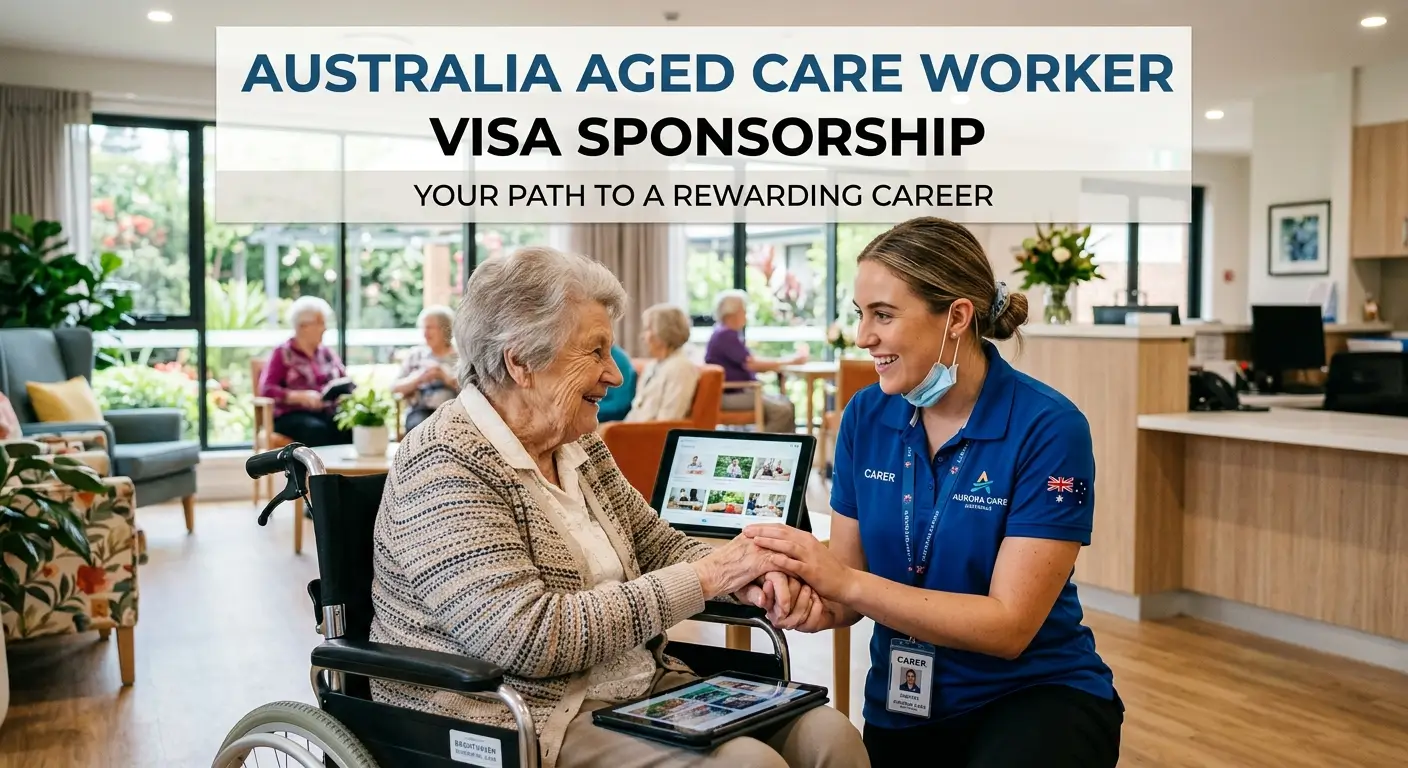
Australia Aged Care Worker Visa Sponsorship
Before you read further: four things most guides get wrong
A large volume of information circulating online about working in Australian aged care is either out of date or misleading about how accessible the pathway is. Four corrections come first.
The Temporary Skill Shortage (TSS) visa no longer exists. The TSS visa was replaced by the Skills in Demand (SID) visa on 7 December 2024. Streams, salary thresholds, and the PR pathway all changed. The subclass number remained 482, but almost everything underneath it is different. Any guide that discusses the "TSS visa" without noting this change is describing a closed product.
Standard care worker salaries fall below the threshold for the main visa stream. The current Temporary Skilled Migration Income Threshold for standard 482 applications is AUD 76,515. The salary floor under the Aged Care Industry Labour Agreement, which is the correct route for most care workers, is AUD 51,222 or the Australian Market Salary Rate, whichever is higher. This distinction is rarely explained in migration guides aimed at overseas workers. It means most personal care assistants, nursing support workers, and aged or disabled carers cannot use the standard Core Skills stream and must be sponsored via a Labour Agreement instead.
Getting sponsored from overseas is genuinely difficult. Most employers prefer to sponsor workers who are already in Australia on another visa and have direct care experience in the Australian system. Applying from overseas without prior Australian aged care experience significantly reduces your chances of securing a sponsorship offer, and the employer, not you, must hold an approved Labour Agreement before any sponsorship can proceed.
The permanent residency pathway has a hard age limit. Under the ACILA pathway, the Employer Nomination Scheme (subclass 186) that leads to permanent residency requires applicants to be under 45 at the time of application. There is no age concession under ACILA for this stage. Workers who arrive in Australia at 43 or older need to plan their PR application timeline very carefully.
1. Overview
Australia's population of people aged 65 and over is growing faster than any other demographic group, and aged care is one of the few sectors where demand is structurally guaranteed to increase for decades. Aged care roles are expected to remain among the most in-demand occupations across Australia in 2026, supported by policy reforms, funding commitments, and migration settings that actively encourage international participation.
The Aged Care Act 2024 commenced on 1 November 2025, replacing the previous legislation from 1997. The Act places the rights and wellbeing of older Australians at the centre of the regulatory framework, introduces strengthened quality standards, and brings new worker screening obligations across the sector. For incoming workers, this means the sector is better regulated and more professionally structured than it was previously, with clearer expectations and stronger protections for both residents and staff.
What makes this pathway stand out for internationally educated workers from across Africa is the combination of genuine long-term demand, a direct route to permanent residency that does not require exceptional academic credentials, relatively accessible English requirements compared to other healthcare pathways, and reasonable pay that has been improving substantially since 2023.
This is not a pathway that rewards shortcuts or unrealistic expectations. Employers who sponsor overseas workers are committing significant time and resources to the process, and they prioritize candidates who have relevant care experience, credible qualifications, and a clear intent to commit to the work in the long term. Workers who approach this pathway with that understanding tend to succeed.
2. Eligibility
Occupations covered
Under the Aged Care Industry Labour Agreement (ACILA), the three occupations that can be sponsored are Aged or Disabled Carer (ANZSCO 423111), Nursing Support Worker (ANZSCO 423312), and Personal Care Assistant (ANZSCO 423313). Registered nurse and enrolled nurse occupations are not included in the ACILA and have separate licensing and sponsorship processes.
Qualification
To be eligible under ACILA, applicants must hold a relevant AQF Certificate III or an equivalent or higher qualification. As an alternative, 12 months of applicable work experience may substitute for the formal qualification. Where overseas qualifications are held or experience is used in lieu, a positive skills assessment is required.
The Australian equivalent qualification is the Certificate III in Individual Support (CHC33021). If you trained elsewhere in Africa and hold a nursing diploma, healthcare assistant certificate, or equivalent, your credentials will need to be assessed by the relevant Australian body to confirm equivalence.
Skills assessment bodies
Community Work Australia is the skills assessment authority for the occupation Aged or Disabled Carer (ANZSCO 423111). The Australian Nursing and Midwifery Accreditation Council (ANMAC) is the skills assessment body for Nursing Support Worker (ANZSCO 423312) and Personal Care Assistant (ANZSCO 423313).
English language
Under ACILA, the English requirement is IELTS 5.0 or equivalent, with minimum scores of 5.0 for Speaking and Listening and 4.5 for Reading and Writing. Workers employed by culturally and linguistically diverse aged care providers can access a lower threshold of IELTS 4.5 equivalent. The English requirement increases to IELTS 5.5 with no component minimums when applying for permanent residence.
These are deliberately lower thresholds than most other Australian skilled visa pathways and reflect the reality that care work is practical, interpersonal, and vocational rather than academic.
Work experience
Most aged care sponsorships require at least two years of full-time, post-qualification experience in a care setting, demonstrating the ability to perform aged care tasks safely and effectively. Acceptable experience includes time in residential aged care facilities, home and community care programmes, disability support environments, and palliative care settings.
Age
Workers must be under 45 at the time of applying for permanent residence under the subclass 186 Employer Nomination Scheme. The temporary sponsorship visa has no age limit, but workers arriving over 43 face a tight window to accumulate the required two years of employment before the PR application deadline.
Screening
From 1 November 2025, all aged care workers and responsible persons are required to hold a valid police certificate not older than three years, or an NDIS Worker Screening Clearance. This applies to all workers including contractors, associated providers, and digital platform staff. For overseas applicants, this means obtaining an international police clearance from your country of origin as part of the application process.
3. Skills Employers Actually Want
A review of ACILA sponsorship job descriptions from employers in New South Wales, Queensland, Victoria, and Western Australia consistently highlights the following requirements:
Direct personal care skills are the core of every posting. Employers want candidates who can competently assist residents with bathing, dressing, grooming, toileting, mobility, and meal preparation. This is hands-on, physical work, and employers will probe your comfort level and experience during interview.
Documentation and reporting form part of every role. Australia's regulatory environment requires care workers to record incidents, flag changes in residents' condition, and maintain care notes accurately. Experience with clinical documentation, even if in a different format from the Australian system, is viewed positively.
Medication assistance capability is required in many roles, particularly at the personal care assistant level. The degree of involvement varies by provider and registration category but having this experience in your background matters.
Dementia and cognitive care experience is heavily weighted by residential aged care facilities, where a significant proportion of residents live with dementia. Candidates who can demonstrate safe, calm, and person-centred practice with cognitively impaired individuals are prioritised.
Knowledge of person-centred care and the Statement of Rights introduced under the Aged Care Act 2024 is now a formal expectation. Employers want workers who understand that residents direct their own care, not the reverse. This is a philosophical shift that some overseas-trained workers find requires deliberate adjustment.
First Aid and CPR certification, manual handling technique, and infection control knowledge round out the standard expectations in almost every posting.
4. Step-by-Step Path
Step 1: Assess your qualifications and experience
Compare your existing care or nursing qualification against the Australian Certificate III standard. If your qualification is equivalent or higher, proceed with planning for a skills assessment. If you do not have a formal qualification but have 12 months of direct care experience, you can use that route instead, but you will still need a skills assessment. Workers from any African country, whether from hospital care settings in Lusaka, community care programmes in Accra, private healthcare roles in Nairobi, or formal nursing training in Harare or Johannesburg, will go through this assessment step.
Step 2: Obtain your skills assessment
Apply to Community Work Australia (for Aged or Disabled Carer roles) or ANMAC (for Nursing Support Worker or Personal Care Assistant roles). Both bodies have online application portals. Gather your qualification certificates, employment references, and evidence of clinical hours before applying. Skills assessment processing typically takes eight to twelve weeks.
Step 3: Sit an English language test
Take the IELTS Academic or General Training, OET, PTE, or TOEFL and meet the ACILA minimum requirements. IELTS General Training with an overall band of 5.0 and minimum component scores of 5.0 for Speaking and Listening, 4.5 for Reading and Writing is the standard benchmark. If you can achieve higher scores, do so. A stronger English result improves your employability considerably beyond just the visa requirement.
Step 4: Find a sponsoring employer with an active Labour Agreement
This is the step where many applicants stall. The ACILA pathway is employer-driven. The employer must have an approved Labour Agreement in place with the Australian Department of Home Affairs before they can nominate you. Only aged care employers who have negotiated with the union and have a Labour Agreement are eligible to sponsor workers under this programme. The employer must also have an MOU with the relevant union, either the Australian Nursing and Midwifery Federation, the Health Services Union, or the United Workers Union, depending on the occupation and service setting.
The United Workers Union maintains a list of employers who have signed MOUs. This is a useful starting point for identifying which providers can actually sponsor. Direct employer career portals, SEEK, and recruitment agencies specialising in aged care migration are the main job search channels. Always confirm in the job advertisement itself that visa sponsorship is available before investing significant time in an application.
Step 5: Complete the nomination and visa application
Once you receive and accept a job offer from a provider with an active Labour Agreement, the employer lodges a nomination with the Department of Home Affairs and then you lodge your visa application. Both require documentation of your qualifications, skills assessment outcome, English test results, health examination, and police clearances. Typical processing times are eight to twelve weeks for skills assessment, two to six weeks for employer nomination, and one to three months for a visa decision.
Step 6: Begin work and build toward permanent residency
Arrive and begin work with your sponsoring employer. After working for two years in a relevant direct care occupation in Australia, you may become eligible to apply for the Subclass 186 (Employer Nomination Scheme) visa. The two years do not necessarily have to be with the same employer or on the same visa subclass, which means experience accumulated across different providers can count.
The DAMA (Designated Area Migration Agreement) route is worth knowing about if you are willing to work in regional or remote Australia. DAMA allows employers in regional areas to sponsor overseas workers with unique concessions including higher age limits of up to 55 years, lower English test score thresholds, and expanded occupation lists. Regional aged care facilities in Western Australia, the Northern Territory, South Australia, and Tasmania consistently report the most acute shortages and the fastest sponsorship timelines.
5. Real-World Challenges
Getting sponsored from overseas
The most common barrier for applicants who have not yet arrived in Australia is that most employers prioritise candidates already in the country. Building a track record in Australian aged care, even on a different visa such as a student visa or working holiday visa, significantly improves sponsorship prospects. Overseas applicants tend to succeed when they have exceptionally strong qualifications, specific clinical specialisations that a regional employer cannot fill locally, or a direct introduction through an established recruitment pathway.
The employer Labour Agreement requirement
Not every aged care provider can sponsor under ACILA. The employer must have gone through the process of negotiating an MOU with a union and having a Labour Agreement approved by the Department of Home Affairs. This process can take months even for willing employers. Applicants sometimes receive verbal interest from providers who later discover they do not have the infrastructure to complete the sponsorship. Always verify Labour Agreement status before accepting a role on the basis of sponsorship.
The salary gap and working conditions
Aged care worker salaries have increased significantly following the Fair Work Commission's 2024 wage ruling backed by AUD 3.8 billion in government investment, which benefited approximately 400,000 aged care workers across residential and home care. Despite these increases, entry-level direct care wages still typically fall between AUD 55,000 and AUD 65,000 annually. Regional and remote placements often attract shift penalties, rural allowances, and overtime that lift effective earnings, but base salaries in metropolitan facilities can make cost-of-living management challenging, particularly in Sydney and Melbourne. Workers targeting better real-world financial outcomes often find regional placements more financially sustainable once housing costs are factored in.
The age cutoff for PR
The subclass 186 PR pathway requires applicants to be under 45. There is no ACILA-specific age concession for this stage. Workers who begin the ACILA pathway at 43 have a narrow two-year window between arrival and the age limit. Anyone in that bracket needs to apply for the 186 as soon as their two years of qualifying employment is complete, not after. Under DAMA arrangements in some regions, the age concession extends to 55, making DAMA a strategically superior option for older workers who are open to regional placement.
Migration agent scams
The complexity of ACILA has created space for fraudulent operators who claim to be able to connect overseas workers directly to Labour Agreement employers for a fee. Legitimate aged care sponsorship does not require an applicant to pay to be connected to a provider. Do not pay any intermediary who promises to fast-track a Labour Agreement arrangement or guarantee a job offer. Only use migration agents who are registered with the Migration Agents Registration Authority (MARA) in Australia.
6. Where to Apply
United Workers Union employer list
The United Workers Union (unitedworkers.org.au) publishes a list of aged care providers that have signed or are in the process of signing MOUs for Labour Agreements. This is the most targeted starting point for identifying employers who can legally sponsor under ACILA.
SEEK Australia
SEEK (seek.com.au) is Australia's dominant jobs portal and carries the highest volume of aged care postings with visa sponsorship. Filter by occupation category, region, and search for "visa sponsorship" in the keywords. Always read the full advertisement before applying to confirm sponsorship is explicitly offered.
Direct employer career portals
Aged care professionals from countries including the Philippines, India, Fiji, and South Africa have successfully migrated to Australia under this pathway through providers with established international recruitment processes. Major providers that have publicly advertised ACILA or SID 482 sponsorship roles include Estia Health, Whiddon, Opal HealthCare, Anglicare Australia, BaptistCare, and Regis Healthcare. Each maintains a careers portal with international application instructions.
My Aged Care Provider Finder
The government's My Aged Care website (myagedcare.gov.au) lists all registered providers in Australia. This can be used to research providers in specific regions and identify organisations large enough to sustain an active international recruitment pipeline.
Skills assessment bodies
Community Work Australia (communitywork.org.au) and ANMAC (anmac.org.au) provide the required skills assessments and both publish detailed guidance on what documents are needed. Starting your application here early, before you have a firm job offer, keeps your timeline efficient.
MARA-registered migration agents
This pathway is complex enough that working with a MARA-registered migration agent adds meaningful value. The MARA register (mara.gov.au) allows you to verify that an agent is legitimate. An immigration lawyer or agent does not secure you a job; they handle the legal components of your visa process once a sponsoring employer is identified.
7. Timeline Expectation
0 to 3 months: Gather qualification documents and employment records. Apply for your skills assessment with Community Work Australia or ANMAC. Sit your English language test. Begin identifying employers with active Labour Agreements.
3 to 6 months: Receive skills assessment outcome. Continue job search targeting verified ACILA employers and regional providers with DAMA arrangements. Build a professional profile on SEEK and LinkedIn with emphasis on specific care competencies and years of experience.
6 to 12 months: Receive and accept a job offer from a sponsoring employer. Employer lodges nomination. You lodge visa application. Health examination and police clearances are obtained. Visa decision received. Depart for Australia.
12 to 36 months: Begin work under SID subclass 482 visa. Build Australian aged care experience. Familiarise yourself with the new Aged Care Act standards and workplace expectations. At the two-year mark, request employer nomination for the subclass 186 permanent residence visa if you are under 45.
Workers who enter via DAMA or who transition to ACILA after arriving in Australia on a student, working holiday, or other temporary visa may compress this timeline considerably. Workers who arrive in regional or remote facilities also typically progress faster due to the higher shortage intensity and employer investment in retention.
8. Mistakes to Avoid
Targeting the standard Core Skills stream for a care worker role. The Core Skills Income Threshold is AUD 76,515. Personal care assistants and aged or disabled carers typically earn between AUD 55,000 and AUD 65,000. This means the standard stream is not accessible for most direct care workers. The ACILA Labour Agreement stream with its lower salary floor of AUD 51,222 is the correct route. Applying through the wrong stream wastes time and may result in refusal.
Relying on articles from before December 2024. The visa framework changed completely when the SID visa replaced the TSS in December 2024. Articles referencing "medium-term stream," "short-term stream," or old processing timelines are out of date.
Assuming any aged care employer can sponsor you. An employer must have an active Labour Agreement with the Department of Home Affairs and an MOU with the relevant union before they can use ACILA. Accepting a role on the verbal promise of sponsorship without verifying this status is a common and costly mistake.
Ignoring the age limit. There is no age concession under ACILA for permanent residence. Workers approaching 45 should compute their timeline carefully and, if needed, pursue a DAMA arrangement in a regional area where age concessions extend to 55.
Paying agents who promise to find you Labour Agreement employers. Legitimate sponsorship comes from the employer's genuine workforce needs, not from a fee arrangement with a middleman. Only pay MARA-registered agents for the legal components of the visa process, not for introductions to employers.
Arriving with expectations of urban placement. Regional and remote facilities across Australia's states and territories have the most severe shortages, the fastest sponsorship processes, the strongest PR pathways, and in many cases better lifestyle economics than high-cost cities like Sydney or Melbourne. Openness to regional placement is consistently the single factor that separates successful applicants from those who wait indefinitely.
9. Next Action
Go to the Community Work Australia or ANMAC website today and read their skills assessment criteria for your target occupation. Before anything else, confirm whether your existing qualification or work experience meets the assessment requirements. This is the foundation of everything else in this process. Once you understand what your assessment will require, gather your documents in parallel with your English language preparation. Both of these steps can run simultaneously, and doing them early keeps your timeline realistic when a sponsorship opportunity does emerge.
Sources
Layer | Source | Used in sections |
|---|---|---|
Official rules | Department of Home Affairs: ACILA official guidance and labour agreement template | 2, 4, 5 |
Official rules | Department of Home Affairs: Skills in Demand visa (subclass 482) official pages | 1, 2, 4 |
Official rules | One Planet Migration Law: SID visa 2026 guide (May 2026) | 1, 8 |
Official rules | Australian Government Department of Health: Aged Care Act 2024 and worker screening pages | 1, 2, 5 |
Official rules | Emerson Migration Law: ACILA complete guide (April 2026) | 4, 5, 8 |
Official rules | Work Visa Lawyers: ACILA salary and English requirements | 2, 4 |
Official rules | Migration Affairs: ACILA salary floor and skills assessment breakdown | 2, 4 |
Official rules | Community Work Australia: ACILA occupations and assessment authority | 2, 6 |
Job market data | SEEK Australia: aged care worker salary data (June 2026) | 3, 7 |
Job market data | Indeed Australia: aged care worker hourly salary (May 2026) | 5 |
Job market data | NCVE: aged care worker salary NSW and Aged Care Award 2026 | 3, 5 |
Job market data | Aussizz Group: aged care jobs in Australia visa and PR pathways (December 2025) | 1, 4 |
Job market data | Aged Care Support Worker salary and training guide (May 2026) | 3, 5 |
Skill patterns | Job descriptions reviewed from SEEK, Estia Health, Whiddon, Fraser Valley, and Anglicare portals | 3 |
Skill patterns | Ausmed: new Aged Care Act key changes for workers (November 2025) | 3 |
Real experience | Auspire Immigration: visa options for care workers in Australia (February 2026) | 5, 8 |
Real experience | AIM Lawyers: 482 visa guide for aged care workers (August 2025) | 4, 5 |
Real experience | UV Vision Australia: aged care PR pathway pitfalls (February 2026) | 5 |
Real experience | Aussizz Group: DAMA visa concessions and regional pathways | 4, 5, 8 |
Application channels | United Workers Union: aged care visa and Labour Agreement employer list | 4, 6 |
Application channels | Whiddon: PR pathway for aged care workers, sponsorship page (May 2025) | 4, 6 |
Application channels | Visa Store Australia: ACILA sponsorship guide (February 2026) | 4 |
Application channels | ANMAC official website | 4, 6 |
Application channels | My Aged Care: myagedcare.gov.au provider finder | 6 |
The Author

Cynthia Amadi
Senior Journalist • Specialist Editor
Award-winning journalist skilled in investigative reporting, data journalism, interviewing, and multimedia storytelling, with a strong record of producing impactful stories.
Travel Essentials
Curated services to help you settle in Australia Aged Care Worker Visa Sponsorship quickly.
More coming soon
Need help?
Our team can help you find accommodation and coworking spaces in Australia Aged Care Worker Visa Sponsorship.
Contact Support →