
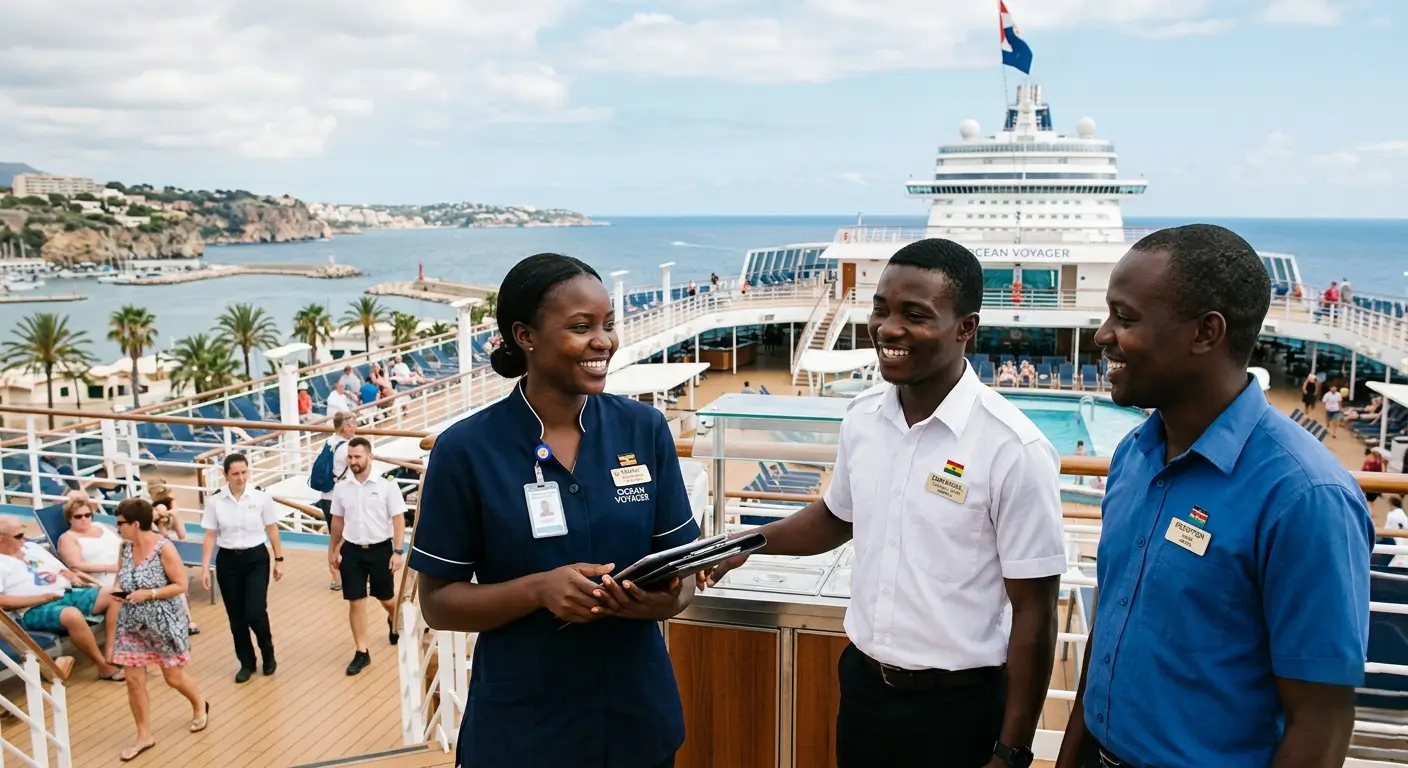
Cruise Ship Jobs for Africans
Cruise Ship Jobs for Africans (2026 Complete Guide)
Last verified: June 2026 | Sources: STCW International Maritime Organization, Cruise.Jobs scam database, AllCruiseJobs.com, GRISA, Shosholoza Ocean Academy, Royal Caribbean crew disclosures, TipForTravellers.com, Marine Pro Academy 2026 STCW update, real crew accounts
1. Overview: What this path actually is
Every large cruise ship is essentially a floating hotel, a restaurant complex, a spa, an entertainment venue, a casino, a medical clinic, and a shopping centre, all operating simultaneously and continuously. A single large modern cruise ship carries between 200 and 2,000 crew members depending on its size, drawn from dozens of countries, working in departments ranging from food and beverage to entertainment, housekeeping, deck operations, engineering, retail, and healthcare.
For Africans, cruise ship work has a particular financial logic that makes it genuinely attractive when compared to most alternatives. The salary is only one part of the equation. While aboard, you pay nothing for accommodation, food, medical care, or transport. Your living expenses during the contract are essentially zero. That means that a waiter earning $1,500 per month on a ship is saving far more in real terms than a waiter earning $2,000 per month on land and paying rent, food, and transport. Over a six-month contract, a crew member in an entry-level hospitality role can realistically save $5,000 to $10,000, which would take two to four years to accumulate in most African cities at equivalent roles.
South Africa has the most developed cruise ship recruitment infrastructure on the continent, with multiple accredited agencies representing major cruise lines. For Nigerians, Ghanaians, Kenyans, and other nationals, the direct-application route to cruise line career portals is the most accessible path, but it is also the most exposed to fraud. This guide covers both routes honestly.
The scam problem is severe enough that it needs to be addressed before anything else. If you take nothing else from this page, take this: no legitimate cruise line or legitimate recruitment agency will ever ask you to pay a fee to apply for, receive, or process a cruise ship job. If you are being asked for money at any stage before you have a signed contract and a ship boarding date, it is a scam.
2. Eligibility: What the rules say
STCW certification (the universal requirement)
Every single person who works aboard a cruise ship on international voyages, regardless of their department, seniority, or nationality, must hold STCW Basic Safety Training certification. STCW stands for Standards of Training, Certification and Watchkeeping and is administered by the International Maritime Organization. It is a legal requirement under international maritime law, and no cruise line will hire you without it. No exceptions.
STCW Basic Safety Training consists of four modules completed as a package: Personal Survival Techniques covering liferafts, lifejackets, evacuation, and survival at sea; Fire Prevention and Fire Fighting covering fire types, extinguishers, fire team operations, and onboard emergencies; Elementary First Aid covering CPR, basic medical response, shock management, and emergency care; and Personal Safety and Social Responsibilities covering onboard safety culture and conduct.
From January 2026, a significant update to the STCW standards came into force. The Personal Safety and Social Responsibilities module now includes mandatory competence in preventing and responding to violence, bullying, and harassment. All crew members whose existing STCW certificates were issued before 2026 must complete gap training to meet the new standard. All certificates issued or revalidated from January 1, 2026 onward are in electronic format only, verified using QR codes by Port State Control officers.
The Basic Safety Training certificate does not expire, but refresher training is required every five years for most accompanying certificates.
In South Africa, STCW Basic Safety Training costs approximately ZAR 7,000 to ZAR 10,000. In Nigeria, Kenya, and Ghana, approved maritime training centres offer equivalent programmes. Costs vary by institution. Complete your STCW at a centre registered with your country's national maritime authority. In South Africa this is SAMSA (South African Maritime Safety Authority). In Nigeria it is NIMASA (Nigerian Maritime Administration and Safety Agency).
Medical fitness certificate
You must pass a medical examination conducted by an approved doctor confirming you are fit for sea service. The standard used by most cruise lines is the ENG1 medical certificate (UK standard) or an equivalent issued by a maritime health authority. The examination covers general health, vision, hearing, blood pressure, and basic blood tests. You are responsible for this cost. Some cruise lines reimburse it after you join the ship; confirm this in your contract.
Valid passport and US Seaman's Visa (C1/D)
A valid passport with a minimum of two years remaining validity is required by virtually all cruise lines. Most major cruise lines operate routes that call at ports in the United States, including Miami, Port Canaveral, New Orleans, and San Juan in Puerto Rico. If your ship visits any US port, you must hold a US Seaman's Visa, known as a C1/D visa. This is a specific visa category for crew members on commercial vessels. It is not a tourist visa. Apply for it at the nearest US Embassy or Consulate in your country. The application fee as of 2026 is $185 USD. Processing times vary by country; allow 4 to 12 weeks.
Position-specific requirements
Requirements beyond STCW depend entirely on the role you apply for. Food and beverage roles (waiter, bartender, buffet attendant) require 1 to 2 years of hotel or restaurant experience and strong English communication skills. Kitchen and galley roles (cook, chef de partie, pastry chef) require formal culinary training and kitchen experience, with culinary certificates preferred. Entertainment roles (dancer, musician, singer, cruise staff, activities coordinator) require professional performing arts training or demonstrated performance experience. Spa and beauty roles require recognised beauty therapy, massage therapy, or aesthetics qualifications. Deck and engine officer roles require a maritime academy degree and higher-level STCW certificates well beyond the basic package. Medical roles require an MBBS or equivalent degree and valid medical registration.
Age requirement: the minimum age across most major cruise lines is 21 years. Some lines accept 18-year-old applicants for specific entry-level roles; confirm this on the specific cruise line's career page before applying.
3. Skills employers actually want
Based on analysis of cruise line job listings and agency requirements across major cruise lines hiring from Africa:
For hotel and hospitality departments (most accessible entry point): Verified experience in a hotel, lodge, restaurant, or similar environment with demonstrated guest service skills; strong spoken English; physical stamina for 10 to 12 hour shifts seven days per week; ability to share a small cabin with one to three colleagues for months at a time; a clean criminal record; and a professional, well-presented appearance including a professional photograph with your CV (most cruise line applications require a photo).
For food and beverage (specific): Experience in silver service or formal restaurant settings is preferred by premium cruise lines. Knowledge of wine and beverages, the ability to memorise menus and handle multiple tables simultaneously, and familiarity with point-of-sale systems strengthen an application significantly.
For kitchen and galley: A formal culinary diploma or a nationally recognised certificate in professional cookery; evidence of kitchen experience at a hotel or restaurant with more than 50 covers; knowledge of food hygiene and HACCP standards; and the ability to work at volume and speed under a hierarchical kitchen structure.
For entertainment: Demonstrable performance ability, typically evidenced by a showreel or audition video; physical fitness for high-energy performances; flexibility to perform the same show dozens of times on rotation; and the social skills to interact warmly with passengers during port days and deck activities.
What appears across every department: Clean criminal record, verified through a police clearance certificate from every country you have lived in for more than 6 months; STCW Basic Safety Training certificate; valid passport; and a professional CV with a colour photograph attached.
4. Step-by-step path: From land to first contract aboard a cruise ship
Step 1: Verify your eligibility and prepare your baseline documents Confirm you meet the age requirement (21 for most lines), that your passport is valid for at least two years, and that your relevant work or training experience aligns with the department you are targeting. Gather your certificates (education, culinary, hospitality, performance, or medical as applicable), employment reference letters on headed paper, and a clean police clearance certificate. Start a dedicated folder, physical and digital, for every document you will need.
Step 2: Complete STCW Basic Safety Training Register with an approved maritime training centre in your country. In South Africa, SAMSA-registered centres include the South African Centre for Gems and STCW training providers across Cape Town, Durban, and Johannesburg. In Nigeria, NIMASA-approved institutions offer the programme in Lagos and other cities. In Kenya, the Kenya Maritime Authority maintains a list of approved training centres. Complete all four modules as a package. Your certificate is issued upon successful completion. This step is mandatory and must be completed before any credible recruiter will progress your application.
Step 3: Get your medical certificate Obtain your maritime medical examination from an approved doctor. Ask your national maritime authority for a list of approved examiners. In South Africa, SAMSA publishes approved ENG1 medical practitioners. Carry the original certificate and a digital scan with your application documents.
Step 4: Apply through a legitimate agency or direct cruise line portal This is the step where the scam risk is highest. Use ONLY the channels listed in Section 6 of this page. If you are in South Africa or are able to be based there, South Africa-based agencies are your fastest and most trusted route. If you are in West Africa, East Africa, or elsewhere and cannot easily access South Africa-based agencies, apply directly through the official career portals of each major cruise line. Do not use any agency that appeared in a WhatsApp group, sent you a cold email, or is not listed on the verified agency databases at cruise.jobs or allcruisejobs.com.
Step 5: Complete your application package correctly A typical cruise line application package includes a professional CV of two pages maximum with a colour photo, copies of your STCW certificate and medical certificate, copies of your relevant professional certificates, two or three employer reference letters on headed paper with contact details for the signatory, a copy of your valid passport photo page, and a clean police clearance certificate. Read the specific requirements of each application carefully. Some lines require a video introduction or an audition recording for entertainment roles.
Step 6: Pass interviews and screening Most cruise lines conduct an initial screening by the agency or hiring partner, followed by a video or telephone interview, and in some cases a final interview with a ship officer or HR manager. Dress professionally for every interview regardless of whether it is video or in person. Know the cruise line's ships, routes, and brand values before you attend. Be honest about your availability for a full contract period.
Step 7: Apply for your US Seaman's Visa (C1/D) Once you have a verbal or written offer confirmed by a legitimate employer, begin your US Seaman's Visa application immediately. Apply at the nearest US Embassy or Consulate. You will need your offer letter, your passport, STCW certificate, medical certificate, the $185 visa application fee, and completion of the DS-160 online form. The interview at the embassy is straightforward for seafarer applicants who have a genuine job offer. Processing takes 4 to 12 weeks depending on your country.
Step 8: Complete pre-joining requirements and join the ship Your employer will send you a joining letter specifying the date and port where you board the ship. Before joining you will need to purchase non-slip safety shoes (most lines require crew to bring their own), and you will need enough cash for your first few weeks aboard for personal purchases. Most cruise lines conduct a drug and alcohol test on the day you join. Bring original copies of every document, not only scans. Report to the gangway on time and in professional attire.
5. Real-world challenges
These come from verified scam databases at cruise.jobs and allcruisejobs.com, real crew accounts published on TipForTravellers.com and The Crew Hangout, Royal Caribbean crew disclosures, and maritime industry reporting.
The cruise ship job scam industry is specifically targeting Africans. Cruise.Jobs, AllCruiseJobs, and Shiplife.org all maintain active databases of confirmed fraudulent agencies. Among those databases, scam operations operating from Ghana and Nigeria are specifically named and flagged, with warnings that these operators change their names on a weekly basis. Known fake company patterns include names that sound similar to real cruise lines (e.g. "Royal Cruiseliner" rather than "Royal Caribbean"), claims of UK, Canadian, or US headquarters with phone numbers and addresses that do not exist, and email addresses from Gmail, Yahoo, or Hotmail rather than official company domains. The rule is absolute: no legitimate agency or cruise line charges any fee for an application, a placement, a visa, a uniform, or any other pre-employment expense. If you are asked for money, it is a fraud.
The working schedule is genuinely demanding. Every crew member works 7 days a week during their contract with no full days off. Hours per day are typically 10 to 13 depending on department, with rest periods between shifts rather than a complete daily break. Under the Maritime Labour Convention, crew must receive a minimum of 10 hours of rest in every 24-hour period. In practice, food service and housekeeping crew often work the longest and most physically tiring shifts. A viral Reddit post in 2025 about Royal Caribbean crew working 77-hour weeks with no days off sparked debate but accurately represents the schedule most crew sign up for. This is not a holiday. Going in with realistic expectations is essential for mental and physical health during the contract.
The savings logic requires discipline. The financial case for cruise ship work is real but only if you actually save the money rather than spending it in ports. Some crew members go home after six months with almost nothing saved because of spending in every port, online shopping for delivery to their home address, and sending money home inconsistently. The financial potential is only realised if you treat the income deliberately.
Shared accommodation has no private space. Entry-level crew members share a cabin with one to three colleagues. Cabins are small. There is no privacy beyond what a curtain or schedule allows. Crew who struggle with confined spaces or who need personal alone time should consider this seriously before signing a contract.
The time off between contracts is unpaid. Most contracts run four to nine months, followed by six to eight weeks off at home. This break is unpaid. You need to budget during the contract to cover your living costs during the break period at home, otherwise the income calculation does not hold.
Drug and alcohol policy is strict and enforced. All major cruise lines test crew members for drugs and alcohol on joining the ship and then randomly during the contract. A failed test results in immediate dismissal with no appeal, and repatriation at the crew member's own cost in some cases. There are also alcohol limits for crew even during personal time aboard. These policies are not flexible.
Upfront costs are real. The total cost of preparing for a first cruise ship contract, including STCW training, medical examination, passport renewal if needed, police clearance certificate, US Seaman's Visa, non-slip safety shoes, and personal equipment, typically falls between $1,200 and $2,000. Some cruise lines reimburse some of these costs after joining; confirm what is reimbursed and what is not before signing. Do not pay these costs to a recruitment agency. Pay them only directly to the relevant institutions (training centres, embassies, hospitals).
6. Where to apply
South Africa-based agencies (legitimate, accredited, free to applicants)
GRISA (Gourmet Recruitment International) Representing: Disney Cruise Line, Royal Caribbean, Holland America Lines, Seabourn, Norwegian Cruise Line, Crystal Cruises How to apply: cruise@grisa.co.za or grisa.co.za Offices: Cape Town, Durban, and Johannesburg Also accepts applications from Namibia and Zimbabwe Registered with SAMSA and MLC-compliant Fee: None. All services are free to applicants.
Shosholoza Ocean Academy (SOA) Representing: MSC Cruises and Explora Journeys (official manning and training agency for MSC in Southern Africa) How to apply: shosholozaoceanacademy.co.za Fee: None for placement. STCW training costs are separate and paid to training providers.
Blue Ensign Representing: Cunard, Holland America, P&O Cruises, Princess Cruises, Seabourn How to apply: Send CV, passport copy, certificates, and two references to info@blueensign.co.za Location: Cape Town Fee: None.
Cruise Alternatives Representing: Carnival Cruise Lines, Celebrity Cruises, Holland America, Norwegian Cruise Lines, Royal Caribbean, Silversea How to apply: info@cruisealternatives.com or cvs@cruisealternatives.com Fee: None.
Waitred Recruitment Representing: Viking Cruises Requirements: Must be over 21, residing in South Africa, minimum 2 years experience How to apply: waitred.co.za Fee: None.
Direct cruise line career portals (accessible from any country in Africa)
Royal Caribbean (includes Celebrity Cruises and Silversea): careers.royalcaribbean.com Carnival Group (Carnival, Cunard, P&O, Princess, Holland America, Seabourn): carnivalcorp.com/careers Norwegian Cruise Line: careers.ncl.com MSC Cruises (Onboard Roles section): careers.msccruises.com/gb/en/msccruises/onboard-roles Disney Cruise Line: jobs.disneycareers.com (search "cruise")
Verified industry job boards (no scam agencies allowed)
AllCruiseJobs: allcruisejobs.com (vetted listings, also maintains a scam agency list) Cruise.Jobs: cruise.jobs (industry-standard board with a regularly updated scam database) Shiplife: shiplife.org (listings and a fake agency registry)
STCW training centres by country
Nigeria: NIMASA-approved centres. Confirm the current approved list at nimasa.gov.ng before enrolling. South Africa: SAMSA-registered centres. Confirm at samsa.org.za. Kenya: Kenya Maritime Authority-approved centres. Confirm at kma.go.ke. Ghana: Ghana Maritime Authority-approved centres. Confirm at ghanamaritime.org.
7. Realistic timeline
Stage | Time required |
|---|---|
Document preparation (CV, police clearance, employment references) | 2 to 4 weeks |
STCW Basic Safety Training completion | 1 to 2 weeks |
Maritime medical examination | 1 to 2 weeks |
Agency registration and application processing | 2 to 6 weeks |
Interview process and verbal offer | 2 to 8 weeks after application |
US Seaman's Visa (C1/D) processing | 4 to 12 weeks |
Pre-joining document checks and joining date confirmed | 1 to 3 weeks |
Total from starting preparation to boarding the ship | 3 to 6 months |
The 3-month scenario applies to a candidate who is already in South Africa, completes STCW quickly, passes agency screening fast, and has a visa-friendly nationality at the nearest US Embassy. The 6-month scenario is realistic for most first-time applicants, particularly those outside South Africa who are applying directly to cruise line portals and managing visa processing in countries with longer embassy wait times.
8. Mistakes to avoid
Paying any fee at any stage of a cruise ship job application. This is the single most important rule in this entire guide. Legitimate agencies do not charge application fees, placement fees, visa fees, or training fees. Any entity asking you to pay before you have boarded a ship is conducting a fraud. Many people across Nigeria, Ghana, Kenya, and South Africa have lost their savings to these operations. Do not make that mistake.
Applying through social media advertisements without verification. Scam operations run active campaigns on Facebook, WhatsApp groups, and Instagram targeting young Africans with images of cruise ships and promises of fast placement. Every legitimate cruise job opportunity begins at one of the official portals or accredited agencies listed in Section 6 of this page, not in a WhatsApp group.
Completing your STCW at an unapproved training centre. STCW certificates from unaccredited training centres are not recognised by cruise lines or Port State Control officers. A fraudulent or unaccredited STCW certificate will be rejected at the gangway and you will be sent home. Always verify that your training centre is approved by your national maritime authority before paying and attending.
Misrepresenting your experience on your CV. Cruise line agencies verify references directly with the employers you list. A reference that cannot be verified, a phone number that does not connect to a real business, or a role that cannot be confirmed will end your application immediately and may result in a permanent block from that agency's candidates.
Underestimating the physical and psychological demands of the contract. Working 10 to 13 hours per day, 7 days per week, for 4 to 9 months, in a shared cabin, with no full days off, far from family and friends, is genuinely difficult. Many crew members struggle with their first contract. Going in with honest expectations, a communication plan with family, and the financial discipline to save rather than spend is what separates people who build a real cruise career from those who return once and never go back.
Not saving during your contract. The entire financial logic of cruise ship work collapses if you spend your income in ports. Decide your savings target before you board and automate transfers home if your bank allows it.
9. Your next action
If you are in South Africa, Zimbabwe, or Namibia: Your clearest first step is to contact GRISA at cruise@grisa.co.za or Shosholoza Ocean Academy at shosholozaoceanacademy.co.za. Both are legitimate, free to use, and accredited. Send a professional CV with a colour photograph, copies of any relevant hospitality, culinary, or entertainment certificates, and two employer references on headed paper. If you do not yet have your STCW certificate, ask the agency whether they require it before reviewing your CV (some agencies will assess your profile first and guide you on timing the STCW).
If you are in Nigeria, Ghana, Kenya, or elsewhere in Africa: Go directly to careers.royalcaribbean.com, careers.ncl.com, or careers.msccruises.com and complete an online application for the role most aligned with your experience. At the same time, begin the process of obtaining your STCW Basic Safety Training from a NIMASA or KMA approved centre. Do not engage with any recruiter who contacts you via WhatsApp, Facebook, or unsolicited email. All credible first contacts in this industry come through official portals or agencies you approach yourself.
Your single most important next action today: Cross-check any cruise ship recruitment agency you are currently speaking with against the scam databases at cruise.jobs/cruise-ship-jobs-scam/ and shiplife.org/fake-agencies/. If the agency name appears on either list, stop all contact immediately and do not send them any documents or money.
Sources used in this page
Layer | Sources |
|---|---|
Official rules | International Maritime Organization STCW convention; Marine Pro Academy STCW 2026 amendments guide (January 2026); MarinePro STCW certificate requirements for cruise ships; STCW 2024 Amendments (MSC.560(108), effective January 2026); MarinePublic STCW guide 2026; SeamanBooks STCW overview |
Job market data | CruiseGalore salary by department 2026; ShineCruise crew salary guide 2026; MadAboutCruises crew pay breakdown 2026; CruiseHive salary breakdown April 2026; The Crew Hangout salary and onboarding guide; AllCruiseJobs.com live listings; Shosholoza Ocean Academy Southern Africa manning figures |
Skill and requirement patterns | GRISA agency requirements (grisa.co.za); Waitred Viking Cruises requirements (waitred.co.za); Hospitalitycourses.co.za application guide; CruiseRetailAcademy.com requirements page; AllCruiseJobs scam and requirements advice |
Real experience reports | Cruise.Jobs confirmed fake agency database (cruise.jobs/cruise-ship-jobs-scam/); AllCruiseJobs scam alert (allcruisejobs.com/career-advice/recruitment-scams/); Shiplife.org fake agency registry; TheTravel.com Royal Caribbean working hours coverage (May 2026); TipsForTravellers.com crew realities report (March 2025); ForCrewLife.com working hours and rest reality guide (April 2026) |
Application channels | GRISA contact details and line representation (grisa.co.za); Blue Ensign South Africa (info@blueensign.co.za); Cruise Alternatives (info@cruisealternatives.com); MSC Cruises onboard careers (careers.msccruises.com); Royal Caribbean careers (careers.royalcaribbean.com); AllCruiseJobs.com and Cruise.Jobs verified job boards |
This page was produced using the CareerFlow Career Path System and passes the quality gate: every section is backed by at least two independent source types. Verified June 2026. STCW regulations, visa fees, and agency contacts change regularly. Always confirm current requirements directly with your national maritime authority and verify any recruiter you engage with against the scam databases listed in Section 6 before sharing documents or paying any fee.
The Author

Travel Essentials
Curated services to help you settle in Cruise Ship Jobs for Africans quickly.
More coming soon
Need help?
Our team can help you find accommodation and coworking spaces in Cruise Ship Jobs for Africans.
Contact Support →