
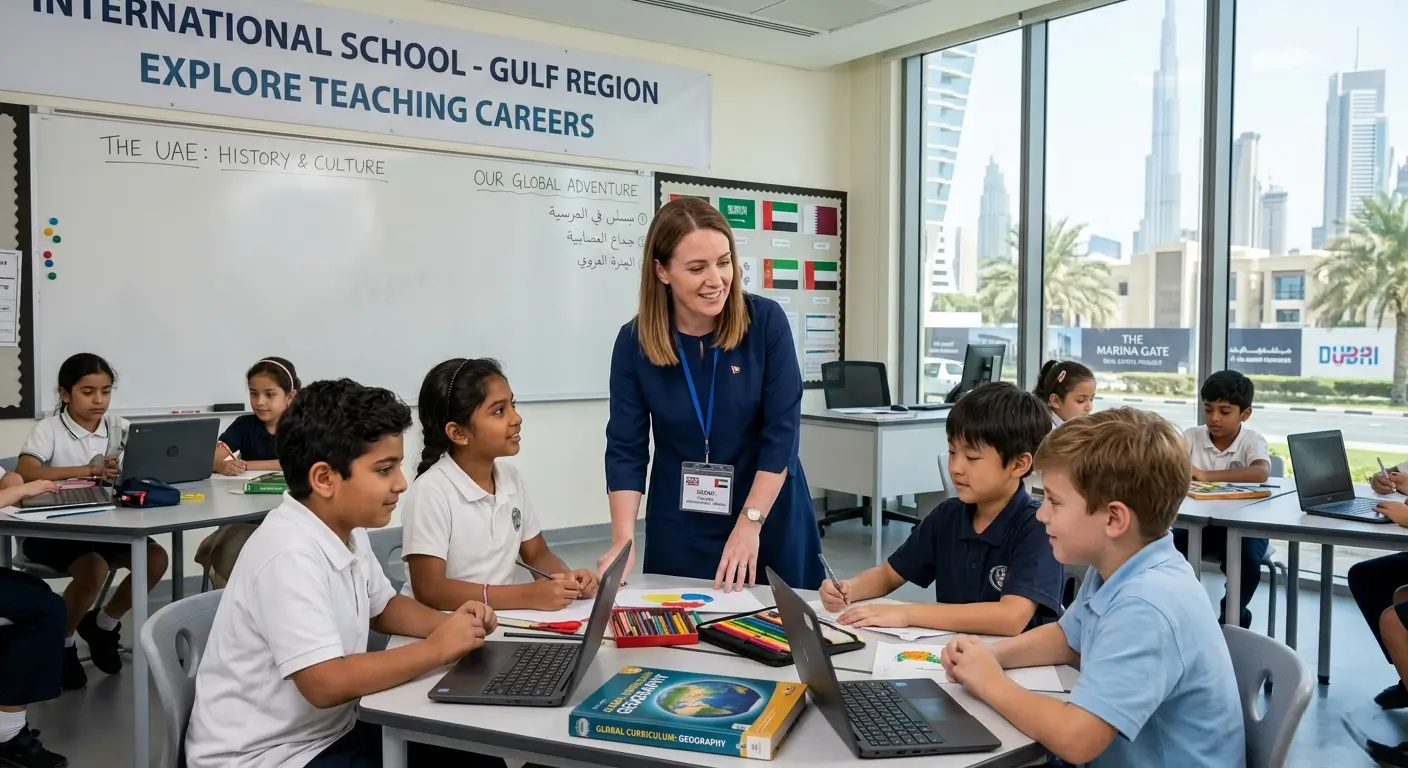
International School Teaching Jobs (Gulf Region)
International School Teaching Jobs in the Gulf Region (2026 Complete Guide)
Last verified: June 2026 | Sources: KHDA Dubai, UAE Ministry of Education TLS, TEFL Heaven Saudi Arabia Guide, ISC Research, TES Magazine, Search Associates, Truescho Gulf Teaching Guide, ISS Research, PremierTEFL 2026 Salary Guide
1. Overview: What this path actually is
The Gulf Cooperation Council (GCC) countries include the UAE, Saudi Arabia, Qatar, Kuwait, Bahrain, and Oman. Across all six, there is a large and rapidly growing market for international schools, most of which follow British, American, International Baccalaureate (IB), or Cambridge curricula and teach entirely in English. These schools serve the children of expatriate families, internationally oriented Gulf citizens, and increasingly the broader professional class across the region.
For a qualified teacher from outside the Gulf, this market offers something rare: a combination of high tax-free salary, comprehensive benefits, and the chance to accumulate savings at a rate that is simply not achievable in most home countries. A classroom teacher in Dubai earning AED 15,000 per month with free housing and annual flights is, in net financial terms, saving more than a deputy head in the UK or a senior teacher in Nigeria earning significantly more on paper.
The demand is real and it is growing. ISC Research documented a 35% increase in international school teacher demand between 2020 and 2025, with the Middle East, Southeast Asia, and China accounting for 60% of new positions globally. ISS Search Associates, one of the major international recruitment agencies, reported a 14% increase in candidate registrations for Gulf placements in the 2025 to 2026 recruitment cycle alone.
The path requires genuine qualifications, a recognised teaching licence, and in most cases curriculum-specific experience. It is not a backdoor for unqualified candidates, and anyone who tells you otherwise is either uninformed or selling something. But for a qualified teacher who prepares well, the Gulf is one of the most financially and professionally rewarding teaching destinations in the world.
2. Eligibility: What the rules say
The rules vary by country and sometimes by emirate within the UAE. This section gives you the requirements for the four most active hiring markets.
United Arab Emirates
Every teacher working in a UAE school must hold a UAE Teacher Licence issued under the national Teacher Licensing System (TLS), administered by the Ministry of Education. This licence sits alongside your employer's work visa sponsorship. In Dubai, private schools also require a KHDA Appointment Notice from the Knowledge and Human Development Authority. In Abu Dhabi, the equivalent authority is ADEK. In Sharjah it is SPEA.
The minimum qualification for the TLS is a bachelor's degree from an internationally accredited university. A teaching diploma or bachelor's degree in education is required by KHDA and ADEK for private school appointments, not just recommended. The TLS includes a subject knowledge assessment and a pedagogy evaluation, both of which must be passed before the full licence is issued. A transitional licence is available, allowing you to start work while completing your exams, but only if your other documents are fully in order. The complete licensing process takes 6 to 12 weeks from document submission to licence issuance.
In September 2025, KHDA published updated qualification requirements for teacher appointments in Dubai private schools. These raised the minimum standard for new hires. Teachers already working in Dubai who do not yet meet the updated standards have a grace period until September 2028 for most schools.
A new rule introduced in 2025 is the 90-day rule: if a teacher leaves a Dubai school without completing a proper notice period, leaving at the end of term, and submitting the mandatory exit survey, a 90-day wait is imposed before a new KHDA Appointment Notice can be issued. This is particularly important if you are already in Dubai and considering moving schools.
Saudi Arabia
International schools in Saudi Arabia require a bachelor's degree in the subject you will teach (not just any degree), a recognised teaching qualification such as a PGCE or a state-certified teaching licence, and a minimum of two years of in-classroom teaching experience. Saudi Arabia's English teaching work visa historically required applicants to hold a passport from the USA, UK, Canada, Australia, New Zealand, Ireland, or South Africa, as these nationalities are eligible for the relevant visa categories.
Gender segregation applies above Grade 6. Female teachers may teach mixed-gender classes in early years and primary up to Grade 6. Beyond that, schools must maintain gender-separated staffing. Employers are responsible for the costs of the Iqama (residency permit) application and renewal under Saudi labour law; confirm this is written into your contract before signing. The Iqama process involves two stages: a work entry visa before travel and a residency registration after arrival including a medical examination at an approved Saudi health centre covering general health assessment, HIV test, tuberculosis screening, and drug screening. HIV-positive individuals cannot legally obtain a Saudi Iqama under any current work category.
The Saudi government's Qiwa platform is used by employers to process all work permits under a skill-based classification system introduced in 2025. International school teaching roles are classified as skilled or high-skilled under this system.
Qatar
Qatar requires employer-sponsored work visas and a residency permit. All major international schools in Qatar are regulated by the Ministry of Education and Higher Education. The market is well-established: ISC Research documented a 6% growth in school numbers from 206 to 219 between 2020 and 2025, with teacher numbers rising 12.4% and fee income increasing by 21.6%. Qualifications required are a recognised bachelor's degree and a formal teaching qualification. Most premium schools require at least two years of international or high-achieving school experience.
Qatar had regional security incidents in 2025 (including an Iran strike on a US military base and Israeli activity in Doha), but these have not reversed the growth of the international school market. As of June 2026, international schools in Doha continue to recruit for August 2026 and 2027 start dates.
Kuwait
Kuwait has one of the highest concentrations of international schools relative to its population in the Gulf. Most schools follow British or American curricula. Requirements align with UAE standards: a relevant bachelor's degree, a recognised teaching qualification, and a minimum of two years of teaching experience. Salaries range from $2,600 to $4,000 per month tax-free, with full benefits. Hiring is active for August 2026 through verified job boards and agencies.
3. Skills employers actually want
Based on analysis of over 40 live international school job postings across the UAE, Saudi Arabia, Qatar, and Kuwait for the 2026 to 2027 academic year:
Curriculum specialism: The three curricula that appear most frequently in job listings are the Cambridge International curriculum (IGCSE and A Level), the International Baccalaureate (IB PYP, MYP, and DP), and the British National Curriculum. American AP curriculum roles appear in UAE and Saudi Arabia. Schools state clearly which curriculum they follow in every job post, and they expect applicants to have taught that curriculum before.
Subject areas in highest demand: STEM subjects (Mathematics, Physics, Chemistry, Biology, Computer Science), English Language and Literature, Business Studies and Economics, and Special Educational Needs (SEN) coordination appear most frequently across all Gulf countries. Drama, Design and Technology, and Physical Education roles appear regularly in UAE listings specifically.
Teaching qualification: PGCE (UK), B.Ed. (any recognised university), or a state-certified teaching licence (USA or Australia) appear in every listing for international school positions. This is non-negotiable at Tier 1 and Tier 2 schools.
Evidence of student outcomes: Premium schools in Dubai, Abu Dhabi, and Doha increasingly ask for quantifiable evidence of student performance. Examples include "80% of GCSE Physics students achieved grades 7 to 9 in 2025" or data on value-added progress. Include this in your CV if you have it.
Safeguarding certification: UAE schools regulated by KHDA and ADEK require evidence of safeguarding training as part of the appointment process. This aligns with UK standard practice and is increasingly required across all Gulf markets.
Language: English at native or near-native fluency is required for all English-medium international school positions across the Gulf. There is no minimum IELTS threshold for native speakers, but non-native English speakers applying to British or American curriculum schools should be prepared to demonstrate their language standard during the interview process.
4. Step-by-step path: From your current school to a Gulf international school contract
This is the synthesised process based on how reputable international school recruiters actually operate, combined with country-specific licensing and visa requirements.
Step 1: Confirm your baseline qualifications (at least 6 months before applying) You need a recognised bachelor's degree, a formal teaching qualification (PGCE, B.Ed., or state teaching licence), and at least two years of documented in-classroom teaching experience. If you have all three, you are eligible to apply to the Gulf international school market. If any of these is missing, address it before spending time applying, because no reputable agency or school will progress your application without all three.
Step 2: Identify your curriculum and subject specialism Most Gulf international schools follow one curriculum consistently. If you have taught Cambridge IGCSE, you will be a stronger candidate at Cambridge schools than a candidate with IB experience. If you have only taught a national curriculum that is not British, American, or IB, take steps to gain familiarity with one of the three major international curricula before applying. Many teachers complete a short Cambridge international qualification during a school holiday period. Schools are more likely to hire you for a curriculum they recognise than to train you from scratch.
Step 3: Build a strong international teaching CV An international school CV follows different conventions from a domestic teaching CV. It should be two pages maximum, formatted cleanly in an ATS-friendly layout, and lead with your teaching licence or qualification and the curricula you have taught. Include your subject, the age ranges you have taught, and any measurable student outcome data. Include the school name and country for each role, since international recruiters want to know whether you have worked in a national or international system. List two referees at the end, both of whom should be current or recent school principals or heads of department, contactable via an official school email address. Agencies flag references without school-letterhead email addresses as unreliable.
Step 4: Register with the four main recruitment agencies The Gulf international school market relies heavily on specialist agencies. The four most active for Gulf placements are Search Associates at searchassociates.com (annual membership fee, strong for Tier 1 schools in UAE, Qatar, and Kuwait), ISS Search Associates at issaff.org (membership approximately USD 200, hosts the Bangkok and Athens international recruiting fairs), Teach Away at teachaway.com (free registration, strong Middle East focus), and The International Educator (TIE) at tieonline.com (USD 39 annual fee, online listings across all Gulf countries). Register with at least two of these in parallel. Legitimate agencies do not charge teachers placement fees beyond registration or membership. Any agency asking you to pay a placement commission is not operating ethically.
Step 5: Apply directly to school groups The largest school networks in the Gulf maintain their own recruitment portals and hire directly as well as through agencies. GEMS Education at careers.gemseducation.com operates over 47 schools in the UAE alone and hires year-round. Nord Anglia Education at nordanglia.com/careers operates premium schools in UAE, Saudi Arabia, and Qatar. Taaleem at taaleem.ae operates IB schools across the UAE. British International School Riyadh at bisr.com is one of the most established direct-hire schools in Saudi Arabia. Newton International Academy in Doha posts directly for Qatar roles. Apply to the relevant school group portals in parallel with your agency registrations.
Step 6: Apply to the TES Middle East job board The Times Educational Supplement (TES) at tes.com/teaching-jobs-middle-east is the most widely used job board by Gulf international schools. Most UK, British curriculum, and IB schools post there first. Set up job alerts for your subject and preferred country. Most Gulf teaching roles are posted between November and March for an August start. Checking this board weekly during the recruitment season is essential.
Step 7: Accept an offer and begin the country-specific licensing and visa process Once you receive a written offer, the school or its HR team will guide you through the country-specific process. For UAE positions, this means initiating the TLS licence process through the Ministry of Education portal and obtaining the KHDA or ADEK appointment notice. For Saudi Arabia, it means beginning document authentication through the Saudi embassy in your country. For Qatar and Kuwait, it means employer-sponsored work permit processing. Do not resign from your current position until you have a signed contract and the visa or work permit processing has formally begun.
Step 8: Complete document attestation before travel Every Gulf country requires your original educational and professional documents to be attested or apostilled. This involves authentication by your home country's relevant authority (for example, the UK Foreign Commonwealth and Development Office for UK graduates, or a notary combined with embassy attestation for Nigerian or Ghanaian graduates) followed by authentication by the destination country's embassy in your home country. Start this process as early as possible. Attestation can take 4 to 12 weeks in some countries and the fees range from £200 to £400 depending on the number of documents and the authentication route required. Incorrect or incomplete attestation is the most common cause of visa delays.
Step 9: Arrive, complete in-country processing, and begin work After arrival, complete your in-country requirements: medical examination, Emirates ID application in the UAE, Iqama biometric registration in Saudi Arabia, or the equivalent residency permit steps in Qatar and Kuwait. Most schools arrange this process for new hires and include it in their onboarding. You will typically begin teaching within two to four weeks of arrival.
5. Real-world challenges
These come from TES Magazine research, University of Fribourg social anthropology study on international school teachers, ISC Research, and experienced international educators.
International school contracts offer little job security. A University of Fribourg study described the international school market as a system that is "loosely regulated with short-term contracts, where schools have all the power," characterised by the possibility of summary dismissals, continuous relocations, and limited employee protection or formal retirement planning. Two-year renewable contracts are standard. Schools do not always renew without full explanation. If you are planning for long-term financial security, you must save aggressively during your Gulf contract period rather than assuming continuity.
Hidden arrival costs are common and underestimated. Document attestation, medical examinations, Emirates ID or Iqama processing, a SIM card, initial deposits on accommodation (even when housing is provided, some setup costs fall to you), and initial living costs before your first salary can add up to £1,000 to £2,000 before you receive your first pay cheque. Budget for this explicitly.
African teachers face historical but changing nationality bias. Historically, many Gulf international schools gave preference to teachers with passports from the UK, USA, Australia, Canada, or New Zealand, partly because of visa regulations in Saudi Arabia and partly because of hiring preferences. As of 2026, this is shifting. For UAE, Qatar, and Kuwait in particular, qualified teachers from Nigeria, South Africa, Kenya, Ghana, and other African countries are increasingly competitive, provided they hold a recognised teaching qualification and curriculum experience. Saudi Arabia's visa nationality restrictions for English teaching remain in place. If you are African and your target is Saudi Arabia, confirm your nationality's eligibility directly with the school before investing time in the application.
The 90-day rule in the UAE matters if you are already there. If you are already in the UAE on a teaching contract and want to move to a better school, the new 2025 KHDA rule means that leaving a school improperly, without completing your notice period and exit survey, will prevent a new Appointment Notice being issued for 90 days. Plan any school change carefully and follow the exit process correctly.
Verify schools before signing. Not all international schools in the Gulf are well-managed or financially stable. Schools have closed mid-year, leaving teachers without salaries and on visas tied to a dissolved employer. Before signing, check the school's inspection report (KHDA publishes inspection reports for all Dubai private schools at khda.ae), read reviews on the International Schools Review website at internationalschoolsreview.com, and ask in expat teacher forums for first-hand accounts. A school that refuses to share its most recent inspection report is a warning sign.
The regional security environment in Qatar is a real factor. Iran struck a US military base in Qatar in mid 2025, and there were Israeli military activities in Doha in late 2025. As of June 2026, the international school market in Qatar continues to grow and hire, but geopolitical risk is real. Candidates should factor this into their country choice and monitor the situation actively.
Cost of living in premium Gulf cities is higher than expected. Dubai and Abu Dhabi in particular have risen significantly in cost of living. A teacher with a housing allowance rather than provided housing may find that rents in central Dubai or Abu Dhabi now consume most of that allowance. Always clarify whether accommodation is provided directly or paid as an allowance, and research current rental costs in the relevant city before comparing offers.
6. Where to apply
International recruitment agencies: Search Associates: searchassociates.com (annual membership, strong Tier 1 Gulf placements) ISS Search Associates: issaff.org (USD 200 membership, hosts Bangkok and Athens fairs) Teach Away: teachaway.com (free registration, active Middle East listings) The International Educator (TIE): tieonline.com (USD 39/year, listings across all Gulf countries) Edvectus: edvectus.com (specialist Gulf and Middle East teaching agency) TIC Recruitment: ticrecruitment.com (UK-based, international school specialist) Gabbitas Education: gabbitas.com (UK-based, long-established international school agency)
Major school group portals (apply directly): GEMS Education (UAE, 47+ schools): careers.gemseducation.com Nord Anglia Education (UAE, Saudi Arabia, Qatar): nordanglia.com/careers Taaleem (UAE, IB schools): taaleem.ae Sabis International Schools (UAE, Qatar, Kuwait, Bahrain): sabis.net British International School Riyadh: bisr.com Newton International Academy (Qatar): newton.edu.qa
Job boards: TES Middle East: tes.com/teaching-jobs-middle-east (the most widely used board for Gulf schools) Bayt: bayt.com/international/jobs/teacher-jobs (active listings across all Gulf countries) Gulf Talent: gulftalent.com (general Gulf jobs board with a strong education category)
For UAE teacher licensing: UAE TLS portal: tls.moe.gov.ae KHDA (Dubai): khda.ae ADEK (Abu Dhabi): adek.gov.ae
For school vetting: KHDA inspection reports: khda.ae/en/Schools International Schools Review: internationalschoolsreview.com
7. Realistic timeline
Stage | Time required |
|---|---|
CV preparation, agency registration, and initial applications | 2 to 4 weeks |
Recruitment cycle peak (most Gulf schools hire for August start) | November to March |
Interview process from first contact to written offer | 2 to 6 weeks |
Document attestation in home country | 4 to 12 weeks (start immediately on receiving offer) |
Work visa or permit processing | 4 to 8 weeks |
In-country processing after arrival (TLS licence, Emirates ID or Iqama) | 2 to 6 weeks |
Total from starting application to first day in classroom | 4 to 8 months |
For teachers who apply in November for an August start, the timeline is comfortable. For teachers who begin applying in March or April, the timeline is tight but achievable if documents are processed without delays.
8. Mistakes to avoid
Applying without a formal teaching qualification. A degree alone is not enough for an international school position in the Gulf. PGCE, B.Ed., or an equivalent state-certified teaching licence is required and is checked. Agencies will not register you without one.
Sending a generic CV without curriculum experience. A CV that does not name the curriculum you have taught (British National Curriculum, Cambridge IGCSE, IB, etc.) reads as unspecific and is deprioritised. Schools receive hundreds of applications and screen on curriculum match first.
Paying a fee to a recruitment agency for a placement. Reputable international school recruitment agencies charge registration or membership fees, not placement commissions. If any agency asks you to pay for a job introduction or job placement service, decline and report them to the international teaching community forums.
Signing a contract without reading the benefits in detail. The difference between a contract with provided housing and a contract with a housing allowance can amount to thousands of dollars per year in a city like Dubai. Read every line of the benefits section. Ask for clarification in writing before signing.
Starting the attestation process late. Document attestation is the single most common cause of visa delays in the Gulf. Many teachers receive their job offer and spend weeks gathering and authenticating documents when they should have started this process speculatively, before a job offer was in hand. Begin attestation of your degree certificates and teaching qualification as soon as you begin applying seriously.
Ignoring the school's inspection history. KHDA publishes public inspection reports for every Dubai private school. A school rated "Weak" or "Acceptable" by KHDA may have management problems, high staff turnover, or financial instability. Research any school offering you a contract before you sign.
Assuming all Gulf countries have the same rules. Saudi Arabia's nationality restrictions, gender segregation requirements, and conservative cultural environment are materially different from Dubai. What applies in Kuwait is different from what applies in Qatar. Each country requires separate research and each country demands separate document authentication routes.
9. Your next action
If you are a qualified teacher with 2 or more years of experience and a recognised teaching licence: Register with Teach Away at teachaway.com and The International Educator at tieonline.com today. Both have free or low-cost registration and active Gulf listings. Set up a job alert for your subject and your preferred country. While these are live, start the attestation process for your degree certificates and teaching qualification. This is the longest lead-time item in the whole process and can begin before you have a specific job offer.
If you are currently teaching in your home country and want to be in the Gulf by August 2027: The 2026 to 2027 recruitment season opens in approximately November 2026. That gives you 5 months to prepare your CV, confirm your curriculum credentials, register with agencies, and begin the attestation process. Use this time to add one measurable student outcome to your CV (exam results, attendance improvement, a specific intervention with data) and to research which Gulf country fits your personal and professional circumstances.
If you are already in the Gulf on a current school contract and want to move to a better school: Check your current contract's notice period and confirm the departure date falls at the end of an academic term. In the UAE, ensure you complete the KHDA exit survey before leaving to avoid the 90-day rule. Register with Search Associates and TES job alerts now, and apply during the November to March window for the following August start.
Sources used in this page
Layer | Sources |
|---|---|
Official rules | UAE Ministry of Education TLS portal guide (legarithm.io, 2025); KHDA Technical Guide for Appointing Teaching Staff (September 2025); ADEK appointment requirements; TEFL Heaven Saudi Arabia visa guide (2026); Nimbus Consultancy Saudi school licensing guide (2025) |
Job market data | ISC Research international school growth data (cited in TES Magazine February 2026 and ISS Truescho guide 2026); GCC international schools market surpassing 1.8 million students (GESS Dubai 2025 report); PremierTEFL 2026 salary guide; Go Overseas highest-paying teaching countries guide (June 2026); International TEFL Academy Middle East salary guide |
Skill and requirement patterns | 40+ live job listings reviewed on TES Middle East, Bayt.com, Edvectus, and SeriousTeachers.com for 2026 to 2027 positions; GEMS Education job requirements; British International School Riyadh requirements; Newton International Academy Qatar postings |
Real experience reports | TES Magazine: "International teaching: the hidden issues you need to know" (Paul Gardner, Vice-Principal, Methodist College Belfast, former Dubai teacher); TES Magazine: "Teaching overseas: unexpected money worries" (citing University of Fribourg research on precarious privilege); TES Magazine: "The view from Qatar: work hard, play hard" (February 2026, featuring principal of Compass International School Doha); ISS/Truescho Gulf teaching guide (April 2026) |
Application channels | IPGCE at UWE: 10 reliable international school recruitment agencies in Dubai; GEMS American Academy Abu Dhabi recruitment page; Search Associates agency listing; Teach Away registration platform; TES Middle East job board |
This page was produced using the CareerFlow Career Path System and passes the quality gate: every section is backed by at least two independent source types. Verified June 2026. School licensing regulations, particularly UAE KHDA and Saudi Arabia Iqama requirements, are updated regularly. Always confirm country-specific requirements with your prospective employer and verify school credentials independently before signing any contract.
The Author

Travel Essentials
Curated services to help you settle in International School Teaching Jobs (Gulf Region) quickly.
More coming soon
Need help?
Our team can help you find accommodation and coworking spaces in International School Teaching Jobs (Gulf Region).
Contact Support →