
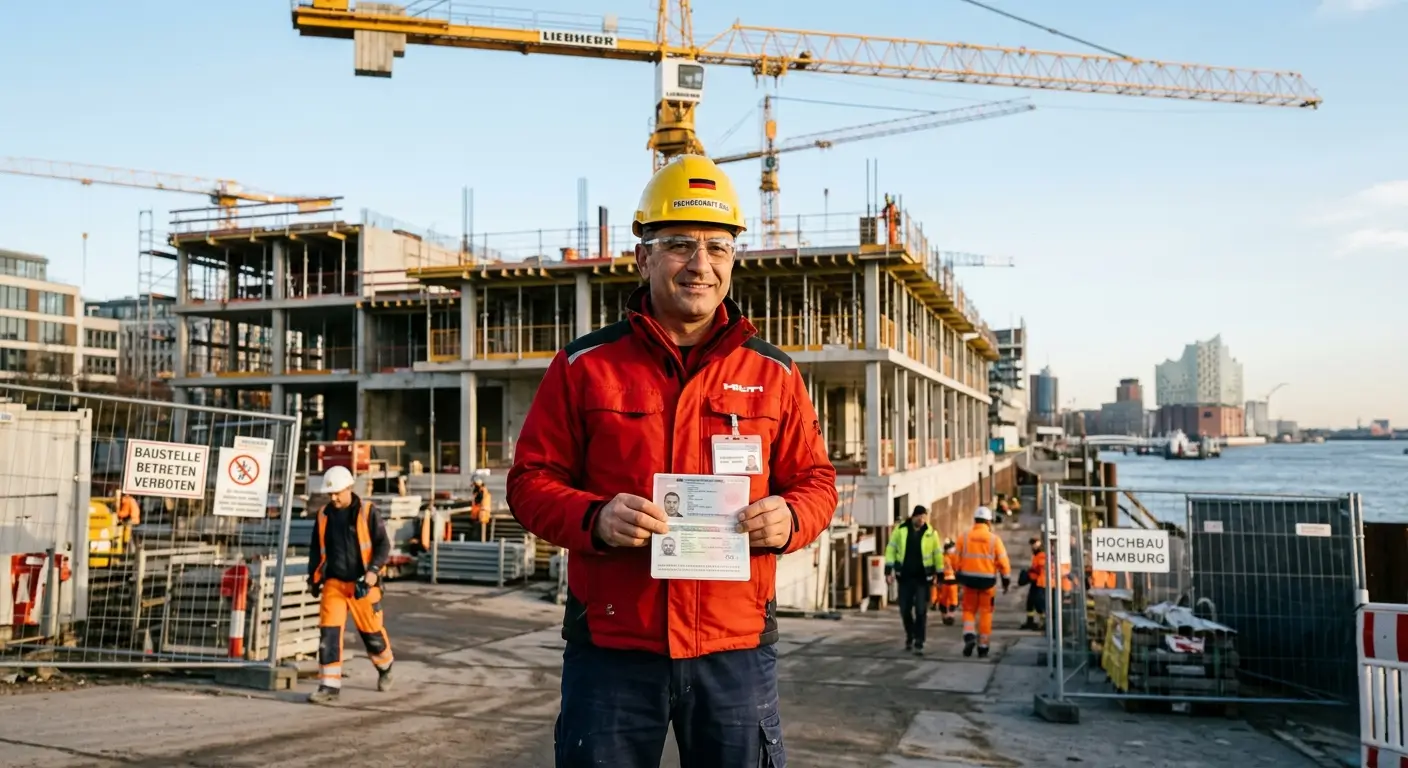
Germany Construction Worker Visa (Bauarbeiter)
Germany Construction Worker Visa: Bauarbeiter (2026 Complete Guide)
Last verified: June 2026 | Sources: German Federal Foreign Office, Make it in Germany official portal, ZAB recognition authority, AHK German Chamber of Commerce Africa offices, Chancenkarte official site, EuropeVerified, DSS Recruitment, Migration in Africa, IFMOSA Work scam database
1. Overview: What this path actually is
Germany has a building problem. Housing targets are missed every year, rail infrastructure projects are delayed, and the country's renewable energy transition depends heavily on construction capacity that simply does not exist domestically. The Bundesagentur für Arbeit, Germany's federal employment agency, has documented vacancy rates of roughly 35% in key construction trades, and industry estimates place the total shortage across the sector at around 150,000 workers nationwide. Berlin, Munich, Hamburg, and Frankfurt are the cities feeling this most acutely, with housing, rail, and renewable energy projects all running behind schedule because there simply are not enough hands on site.
This is the backdrop against which Germany rebuilt its entire skilled and semi-skilled migration system between 2023 and 2026. The country went from one of the more bureaucratically restrictive labour markets in Europe to one actively designing immigration pathways for trades including construction. For someone coming from Nigeria, Ghana, Kenya, South Africa, or elsewhere in Africa, this matters because the route into German construction work is no longer purely theoretical. It is built, it is functioning, and German companies are actively using it.
There is no single visa called the Bauarbeiter visa. Construction work in Germany is accessed through one of two main immigration routes depending on your qualifications and whether you already have a job offer. The first is the Skilled Worker Visa, formally the residence permit for qualified vocational professionals under Section 18a of the Residence Act, which is for people who hold a recognised vocational qualification of at least two years and have a matching job offer. The second is the Opportunity Card, known in German as the Chancenkarte, introduced in June 2024, which allows you to enter Germany without a job offer at all and search for construction work on the ground for up to twelve months.
Both routes lead to the same place: legal work as a construction tradesperson or labourer in Germany, with a path toward permanent settlement after a few years.
2. Eligibility: What the rules say
Route 1: The Skilled Worker Visa (Section 18a)
This route requires a vocational qualification, not necessarily a university degree. If you have completed a recognised trade training programme of at least two years, such as a bricklaying, carpentry, or masonry apprenticeship or certificate programme in your home country, this is your fastest route, provided you also have a confirmed job offer from a German employer.
The central requirement is qualification recognition. Your foreign vocational certificate must be assessed and matched against the German equivalent. For trades, this assessment is conducted by the relevant Handwerkskammer, the regional Chamber of Crafts, or in some cases by ZAB, the Central Office for Foreign Education (Zentralstelle für ausländisches Bildungswesen). You apply for this assessment, submit your training documents and certificates, and receive either full recognition, partial recognition with a requirement to complete a qualification adaptation measure, or in rare cases non-recognition. Recognition typically takes three to four months.
A significant development worth understanding is the Recognition Partnership, introduced in March 2024. This allows you to enter Germany and begin working before your recognition process is fully complete, provided you have at least A2 level German and an employer who formally commits to supporting your recognition process while you work. This is a meaningful shortcut for construction workers specifically, since many German construction employers are accustomed to using this pathway given the urgency of their staffing needs.
Language requirements for the Skilled Worker Visa itself are generally flexible, but in practice German employers in construction expect at least A2 German, since site communication, safety instructions, and supervisor coordination happen in German on most job sites. Some employers, particularly larger firms working with international crews, accept English at a higher level instead, but this is the exception rather than the rule.
There is no general age cap for the Skilled Worker Visa, but applicants aged 45 or above must demonstrate either adequate pension provision or a minimum gross annual salary, which is periodically adjusted and increased again from January 1, 2026.
Route 2: The Opportunity Card (Chancenkarte)
This route, governed by Section 20a of the Residence Act, is designed for people who want to come to Germany to search for construction work rather than arriving with a job offer already secured. You qualify automatically without needing to pass a points test if you hold a foreign vocational qualification of at least two years' duration that is state-recognised in your home country, even if it has not yet been formally recognised in Germany.
If your qualification does not meet that bar on its own, you can still qualify through a points system requiring a minimum of six points, calculated across categories including your qualification level, your work experience, your language ability (German or English), your age, and any prior connection to Germany such as previous study or work there. For most construction tradespeople with several years of documented experience and at least basic German or English, six points is achievable.
You must demonstrate financial means to support yourself during your stay in Germany, currently set at a minimum of approximately €1,091 per month as of 2026. This can be shown through a blocked bank account, a formal sponsorship declaration, or other accepted proof of funds.
The Opportunity Card is valid for up to twelve months and allows you to work part-time, up to 20 hours per week, in any sector while you search, and to undertake trial employment of up to two weeks with as many different employers as you like. Once you secure a genuine job offer that meets the requirements, you convert the Opportunity Card into a full work permit, such as the Skilled Worker Visa, at your local Ausländerbehörde, the local immigration office. If twelve months pass without a conversion but you do have a promising lead that has not yet finalised, a follow-up Opportunity Card of up to two additional years can sometimes be granted.
General requirements across both routes
A valid passport, health insurance coverage meeting German standards, and no grounds for refusal such as security concerns or relevant criminal history apply across both routes. From January 1, 2026, a new regulation under Section 45c of the Residence Act requires German employers to inform newly hired foreign workers from non-EU countries about free, independent counselling services on labour and social law, a protective measure specifically intended to reduce exploitation of foreign hires.
3. Skills employers actually want
Based on analysis of German construction job listings, AHK African office recruitment criteria, and staffing agency requirements for 2025 and 2026:
Trade-specific competence: Bricklaying (Maurer), carpentry (Zimmerer), formwork construction (Schalungsbauer), plumbing and heating installation (Anlagenmechaniker), electrical installation, and general construction labouring (Bauhelfer) are the categories with the most consistent demand. Specialists such as electricians and plumbers command higher pay than general helpers and bricklayers, who in turn earn more than unskilled construction helpers.
Documented prior experience: German employers and recruitment agencies consistently ask for verifiable work history, ideally supported by a reference letter from a previous employer describing the type of construction work performed, the duration, and the specific skills used. Photographic evidence of completed work, where available, strengthens an application meaningfully.
Physical capability and safety awareness: Construction work in Germany involves significant physical demands and strict safety protocols. Familiarity with basic site safety standards, willingness to wear and properly use personal protective equipment, and physical fitness for sustained manual labour are assumed baseline requirements.
Basic to intermediate German language ability: A2 German is the practical floor for most construction roles, since safety briefings, supervisor instructions, and coordination with German colleagues happen primarily in German. Workers who arrive with B1 German are noticeably more competitive and tend to be offered higher starting pay and faster integration into permanent teams rather than rotating labour pools.
Reliability and a clean record: Staffing agencies placing African workers in German construction roles emphasise reliability heavily in their own marketing to employers, given past instances of workers leaving roles shortly after their visa was secured. A consistent, traceable work history and a clean criminal record meaningfully strengthen your standing with both agencies and direct employers.
4. Step-by-step path: From your country to working construction in Germany
Step 1: Confirm which route fits your situation If you hold a documented vocational qualification of at least two years and can realistically secure a job offer, prioritise the Skilled Worker Visa route. If you do not yet have a job offer but have strong documented experience, the Opportunity Card lets you enter Germany and search directly, which for construction specifically can be faster than waiting for a remote employer to commit, since German construction employers strongly prefer meeting candidates and arranging trial work before hiring.
Step 2: Begin your qualification recognition process immediately Submit your vocational training documents and certificates for assessment through the relevant Handwerkskammer or via ZAB's Recognition Portal at anerkennung-in-deutschland.de. Check whether your specific qualification already appears in the Anabin database, which lists foreign qualifications already assessed against German equivalents; if it does, your process may be faster. This step takes three to four months on average and should be started before you do anything else, since it is the single biggest determinant of how quickly you can begin legally working once you arrive.
Step 3: Start or strengthen your German language ability Begin German language study now, targeting A2 as your minimum floor and B1 if your timeline allows it. Free and low-cost German courses are increasingly available through Goethe-Institut centres in African capital cities and through online platforms. This is not optional preparation; it directly affects both your visa eligibility under the Opportunity Card points system and your competitiveness with employers under the Skilled Worker Visa route.
Step 4: Connect with the AHK office in your country This is the single most valuable and most underused resource available to African applicants. The German Chamber of Commerce, known as AHK, operates dedicated skilled labour recruitment offices in eleven African countries: Algeria, Angola, Côte d'Ivoire, Egypt, Ghana, Kenya, Morocco, Nigeria, South Africa, Tanzania, and Tunisia. These offices exist specifically to identify and prepare candidates for verified German employers, support qualification recognition, and connect candidates directly with companies through the free UBAconnect matching service. This is not a paid agency; it is a government-backed bilateral chamber initiative. Contact your country's AHK office directly using the contact details in Section 6 below.
Step 5: Search for legitimate job openings or register for the Opportunity Card If pursuing the job offer route, search Make it in Germany at make-it-in-germany.com, the official German government job portal for international skilled workers, alongside EURES (the EU's official job mobility portal), StepStone, and Indeed Germany. Verify any employer's legitimacy directly before engaging further; legitimate German construction employers do not ask candidates to pay any fee for a job offer, visa support, or placement. If pursuing the Opportunity Card route, prepare your points system documentation and apply through the German mission in your country.
Step 6: Prepare your visa application documents For the Skilled Worker Visa, you will need your job offer letter, your recognised qualification certificate (or evidence of a Recognition Partnership arrangement with your employer), your passport, proof of health insurance, and any additional documents requested by the German Embassy or Consulate. For applicants from Sierra Leone and Liberia specifically, applications are processed through the German mission in Accra, Ghana, rather than through a mission in their home country. Confirm the correct processing post for your specific nationality before booking an appointment.
Step 7: Submit your application through the Consular Service Portal German missions across Africa process visa applications through an online Consular Service Portal. Your documents are pre-checked online before you are issued an appointment for an in-person interview, where your identity and original documents are verified, a short interview is conducted, biometric data is recorded, and the application fee is paid. Book this appointment well in advance of your intended travel date, since demand at several African posts has led to longer than expected processing windows.
Step 8: Travel, register your address, and begin work On arrival in Germany, register your address at the local Einwohnermeldeamt within 14 days, as required by German law. If you arrived under a Recognition Partnership without full qualification recognition complete, continue working with your employer to finalise this process, since your work authorisation under this scheme depends on it being completed. Begin work and, from January 1, 2026, your employer is required to inform you of free, independent labour and social law counselling services available to you as a foreign worker.
5. Real-world challenges
These come from German Federal Foreign Office documentation, staffing agency commentary, AHK programme materials, and Nigerian recruitment scam reporting organisations.
Qualification recognition can be slower or more complicated than expected. While the official estimate is three to four months, real processing times vary depending on the completeness of your documents, the specific Handwerkskammer handling your case, and whether your qualification requires partial recognition with an adaptation measure rather than full recognition. Submit complete, properly translated documents from the start, since incomplete submissions are a major cause of delay.
The Opportunity Card is not a guarantee of employment. It gives you twelve months to search, but if you do not secure a qualifying job offer within that window and you do not have a promising lead eligible for an extension, you are required to leave Germany. Treat the Opportunity Card as a serious, well-prepared job search trip, not a casual relocation, and budget your finances and time accordingly.
Scam recruiters specifically target Africans seeking visa-sponsored construction work. Nigerian-focused scam tracking organisations have documented widespread fraud involving fake job offers, fabricated visa processing services, and demands for upfront payment, with reported losses ranging from roughly ₦300,000 to over ₦5,000,000 per victim for promised "guaranteed" placements, visa slots, or processing fees. The rule is absolute: legitimate German employers, the AHK offices, and licensed recruiters never ask candidates to pay for a job offer, visa processing, or placement guarantee. If you are asked for money before you have a verified job offer and are working through official channels, stop and verify independently before proceeding.
Language remains a real day-to-day barrier even at A2 level. A2 German is enough to satisfy visa requirements in many cases, but it is a genuinely basic level of the language. Site instructions, safety briefings, and integration with German colleagues are smoother and safer with stronger language ability. Workers who arrive with only the legal minimum often describe early months as difficult, and investing in German before departure, not just to meet the visa threshold but to function comfortably on site, pays off significantly.
Wages vary substantially by skill level and region, and gross pay is not what you take home. General construction helpers earn roughly €2,400 to €3,000 gross per month, while skilled tradespeople such as bricklayers and carpenters earn €2,800 to €3,500 gross, and specialists like electricians and plumbers reach €3,200 to €4,200 gross. After German taxes and mandatory social security contributions covering health insurance, pension, and unemployment insurance, expect to take home roughly 65 to 70% of your gross salary. This is still significantly higher than equivalent work in most African countries, but budget using net figures, not the gross numbers advertised in job listings.
Construction work is physically demanding and often outdoors in challenging weather. German winters involve genuinely cold, wet conditions, and site work does not stop entirely for weather except in extreme cases. Workers coming from warmer climates should prepare realistically for this, both in terms of appropriate clothing and equipment and in terms of mental preparation for the physical toll of the work.
6. Where to apply
AHK German Chamber of Commerce offices in Africa (start here, free, government-backed): Ghana: Kevin Nyalemegbe, kevin.nyalemegbe@ghana.ahk.de Kenya: Mercy Kathuku, mercy.kathuku@kenya-ahk.co.ke Morocco: Sara Razzi, sara.razzi@marokko.ahk.de Nigeria: Adedotun Adeoye, adeoye@lagos-ahk.de South Africa: Karabo Tshabalala, ktshabalala@germanchamber.co.za Tanzania: Pendo Ringo, pendo.ringo@tanzania-ahk.co.tz Tunisia: Firas Gam, f.gam@ahktunis.org Full network details and UBAconnect matching service: ahk.de/en/services/skilled-labour-for-germany
Official German government job and information portal: Make it in Germany: make-it-in-germany.com (the official starting point for foreign skilled and vocational workers, including construction trades)
Qualification recognition: ZAB Recognition Portal: anerkennung-in-deutschland.de Anabin database (check if your qualification is already assessed): anabin.kmk.org
Opportunity Card information and points calculator: chancenkarte.com
Job boards: EURES (EU official job mobility portal): ec.europa.eu/eures StepStone Germany: stepstone.de Indeed Germany: de.indeed.com
Verified staffing agencies working with African construction candidates: Global Work Connections: visa.globalworkconnections.com (states candidates never pay fees; partners with verified employers across construction, logistics, and manufacturing) Dynamic Staffing Services: dss-hr.com (long-established international construction staffing agency)
Visa applications by country (confirm your specific processing post): German Embassy or Consulate in your country; Sierra Leone and Liberia applicants process through the German mission in Accra, Ghana. Find your correct mission at germany.info.
7. Realistic timeline
Stage | Time required |
|---|---|
German language study to reach A2 (minimum) | 3 to 6 months, can run in parallel with other steps |
Qualification recognition process (ZAB or Handwerkskammer) | 3 to 4 months |
AHK office engagement and candidate matching (if using this channel) | 1 to 3 months |
Job offer or job search via Opportunity Card | 1 to 6 months depending on route |
Visa appointment booking and processing | 4 to 12 weeks |
Total from starting preparation to working in Germany (Skilled Worker Visa route) | 6 to 10 months |
Total including Opportunity Card job search period | 9 to 18 months |
The faster end applies to candidates who already hold a clearly documented, recognisable vocational qualification, have started German language study early, and connect with an AHK office or verified employer quickly. The longer end applies to candidates pursuing the Opportunity Card route who need the full twelve-month search window, or whose qualification recognition requires an adaptation measure rather than full direct recognition.
8. Mistakes to avoid
Paying any individual or agency for a job offer, visa slot, or guaranteed placement. This is the single most damaging and most common mistake among African applicants targeting German construction work. Legitimate employers and the AHK offices never charge candidates for these services. Treat any request for upfront payment as a confirmed red flag.
Starting your visa application before beginning qualification recognition. Recognition takes three to four months and is often the longest single step in the entire process. Applicants who wait until they have a job offer to start this step add months of unnecessary delay to their timeline.
Underestimating the German language requirement. A2 may be the legal floor, but arriving with only the bare minimum makes the first months on a German construction site significantly harder than necessary. Invest in language study well beyond the legal minimum if your timeline allows.
Ignoring the AHK network and going straight to generic job boards or unverified agencies. The AHK offices in eleven African countries exist specifically for this purpose, are free, and are backed by formal bilateral chamber partnerships. Many applicants spend months searching generic platforms before discovering this resource exists.
Treating gross salary figures as your real take-home pay. German taxes and mandatory social contributions reduce gross pay by roughly 30 to 35%. Plan your finances, savings goals, and remittances based on net income figures, not the headline numbers in job advertisements.
Assuming the Opportunity Card guarantees you a job. It guarantees you the right to search, for up to twelve months, with permission to work part-time and undertake trial employment along the way. If you do not convert it into a full work permit within that window, you must leave Germany unless you have a qualifying extension situation.
Not registering your address within 14 days of arrival. This is a strict legal requirement in Germany, and failing to complete it on time can create downstream complications with your residence permit, banking, and employment paperwork.
9. Your next action
If you hold a documented vocational construction qualification of two years or more: Contact your country's AHK office today using the contact details in Section 6. Begin your qualification recognition process simultaneously through anerkennung-in-deutschland.de. These two steps can run in parallel and together represent the fastest realistic route into legal construction work in Germany.
If you have strong construction experience but lack formal vocational certification: Calculate your Opportunity Card points using the calculator at chancenkarte.com. Begin building your documented work history, including reference letters from previous employers, and start German language study toward at least A2 while you prepare your application.
Your single most important next step today: Email the AHK office for your country. This single contact connects you to a verified, government-backed channel that exists specifically to match candidates like you with real German construction employers, at no cost to you, and is the resource most African applicants discover far too late in their search.
Sources used in this page
Layer | Sources |
|---|---|
Official rules | German Federal Foreign Office employment and qualification measures pages (accra.diplo.de); Section 18a and Section 20a German Residence Act documentation (Chancenkarte.com, official Opportunity Card site); ZAB Recognition Portal and Anabin database; EuropeVerified Germany Skilled Worker Visa guide (April 2026); Migaku Chancenkarte 2026 requirements guide |
Job market and demand data | DSS Recruitment construction worker salary and shortage data, citing Bundesagentur für Arbeit 35% vacancy figures and 150,000 worker shortage (2026); ERI SalaryExpert and WorldSalaries construction worker salary data Germany 2026; Europa.jobs construction wage comparison 2026; MIG Construction net wage analysis 2025 |
Skill and requirement patterns | AHK Skilled Labour for Germany programme documentation (ahk.de); Migration in Africa unskilled visa sponsorship guide (December 2025); DSS Recruitment trade-specific salary and skill data |
Real experience reports | IFMOSA Work recruitment scams in Nigeria database (December 2025); Germany-Visa.org job seeker visa Nigeria guide; Educatedus Nigeria skilled worker visa application guide (October 2025) |
Application channels | AHK African office contact directory (Ghana, Kenya, Morocco, Nigeria, South Africa, Tanzania, Tunisia); Make it in Germany official portal; Federal Foreign Office Consular Service Portal guidance (Accra processing for Sierra Leone and Liberia applicants); Global Work Connections Germany work permit guide |
This page was produced using the CareerFlow Career Path System and passes the quality gate: every section is backed by at least two independent source types. Verified June 2026. German immigration law, recognition processing times, and salary thresholds are updated regularly. Always confirm current requirements directly with the German Federal Foreign Office, your local AHK office, or a licensed immigration adviser before making any application or travel decisions.
The Author

Cynthia Amadi
Senior Journalist • Specialist Editor
Award-winning journalist skilled in investigative reporting, data journalism, interviewing, and multimedia storytelling, with a strong record of producing impactful stories.
Travel Essentials
Curated services to help you settle in Germany Construction Worker Visa (Bauarbeiter) quickly.
More coming soon
Need help?
Our team can help you find accommodation and coworking spaces in Germany Construction Worker Visa (Bauarbeiter).
Contact Support →