
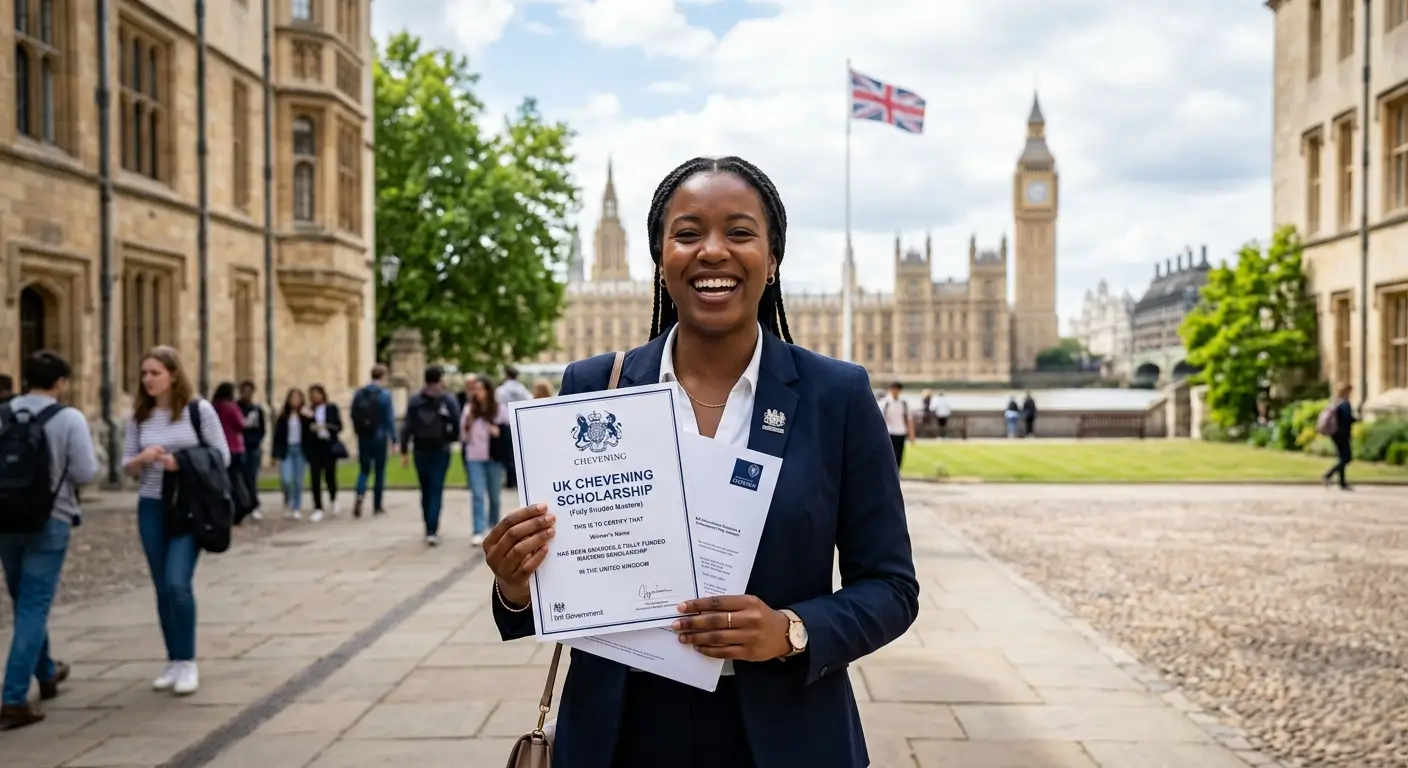
UK Chevening Scholarship (Fully Funded Masters)
UK Chevening Scholarship: Fully Funded Masters Degree (2026 Complete Guide)
Last verified: June 2026 | Sources: Chevening official website (chevening.org), UK Foreign Commonwealth and Development Office, Global Admissions Chevening guide 2027 to 2028, ScholarshipUnion success rate analysis, Afrokonnect Nigeria guide, Pathlins Nigeria insider guide, Medium alumni accounts
1. Overview: What this opportunity actually is
Chevening was established in 1983 and is funded by the UK Foreign, Commonwealth and Development Office along with partner organisations. It is not a traditional academic scholarship that simply rewards good grades. It is explicitly a leadership development programme. The UK government's stated purpose is to identify people who are already showing leadership potential in their careers and communities, fund their master's study in the UK for one year, and send them home to apply what they have learned. Over 60,000 Chevening alumni from more than 160 countries now hold influential positions in government, business, media, civil society, and academia.
For African applicants, this programme carries particular weight. Nigeria has been a Chevening partner country since 1984 and is one of the largest recipients globally, with high-volume applicant numbers from across the country every year. Other African countries including Kenya, Ghana, South Africa, and many more are also eligible, each with their own annual allocation of awards determined by British diplomatic priorities rather than simply applicant volume.
What makes Chevening genuinely different from most scholarships is its scope. There are no restrictions on subject area. You can study engineering, public health, international relations, creative writing, computer science, or virtually any other field, at any UK university that offers a one year master's programme. This flexibility is part of what makes it one of the most sought after scholarships in the world, and part of why the competition is as intense as it is.
2. Eligibility: What the rules say
Citizenship and basic requirements
You must be a citizen of a Chevening eligible country. Most African countries are included, though the full list should always be checked directly on chevening.org since eligible countries can change. You must not hold British or dual British citizenship. You must intend to return to your home country for a minimum of two years after your scholarship ends. This is not a soft suggestion. It is described by Chevening itself as a firm commitment central to the programme's purpose, and applications that hint at an intention to remain in the UK after graduation are viewed unfavourably by selection committees.
Work experience
You need at least 2,800 hours of work experience completed after finishing your undergraduate degree. This roughly equates to two years of full time work, though it can be accumulated across a different time period and does not need to be continuous. Chevening calculates this automatically by multiplying the weeks you worked by the hours per week, typically assuming 35 to 60 hours per week and 40 to 50 weeks per year depending on what you report. This is one of the most common sources of avoidable error in applications. Entering unrealistic hours, double counting overlapping roles, or miscalculating weeks worked are flagged repeatedly by Chevening as application mistakes. If you do not yet have enough qualifying experience, Chevening's own guidance recommends waiting for a future cycle rather than submitting an underqualified application.
Academic qualification
You must hold an undergraduate degree that qualifies you for a UK master's programme. You must have completed your undergraduate studies at least two years before the application deadline, even if you have not yet physically received your certificate, though you will need the certificate itself by the time of your interview. Having a previous master's degree does not disqualify you, but if you already hold one, you will need to explain clearly and convincingly why a second master's degree in the UK is necessary for your specific career goals and how it differs meaningfully from what you have already studied.
University applications
As part of your Chevening application, you must apply to three different and eligible UK university courses. You do not need to have these offers in hand before you submit your Chevening application itself. You apply to Chevening first, and if you progress through the process, you secure your three university offers afterward. You must have received an unconditional offer from at least one of your three course choices by a specific deadline that Chevening sets each cycle, typically in early July of the year your programme is due to start.
No age limit, no English test requirement from Chevening itself
There is no upper age limit for Chevening applicants. Most applicants are in their twenties and thirties but older applicants are not disadvantaged and are sometimes viewed favourably given their typically clearer sense of career direction. Chevening itself does not require a separate English test score as part of its own application. However, the UK universities you apply to almost certainly will, so you should plan to sit IELTS or an equivalent test regardless, since strong English is also essential for writing your essays and performing well at interview.
3. What actually makes an application successful
This is where most guidance about Chevening becomes either too vague to act on or too generic to differentiate one applicant from another. Based on Chevening's own published guidance, reading committee feedback, and consistent patterns identified by former scholars and education consultants, here is what genuinely separates a strong application from a weak one.
The four essays and what each one is actually testing
Every applicant submits four essays, each with a strict word limit, typically around 300 words each. They cover Leadership and Influence, Networking, Career Plan, and Study in the UK. Each essay is evaluating something distinct, and treating them as interchangeable opportunities to repeat your general accomplishments is one of the most common reasons strong candidates underperform.
The Leadership and Influence essay is assessing your ability to lead, persuade, and create measurable impact, not simply your job title or seniority. Chevening wants specific, concrete examples that go beyond a role description to show actions you personally took and the results that followed.
The Networking essay is assessing your ability to build and sustain meaningful professional relationships over time. It should describe how a specific relationship formed, what you personally contributed to it, what you gained, and how you have sustained or developed it since.
The Career Plan essay is assessing whether your post degree goals are specific, realistic, and clearly connected to the course you are applying for. Vague statements about wanting to "make a difference" or "contribute to development" without specific detail are the single most commonly cited weakness in this essay.
The Study in the UK essay is assessing how well you have actually researched your first choice course and university, including specific modules, faculty, or research strengths that are relevant to your goals. Generic praise for the UK or for a university's reputation without specific course level detail signals to reviewers that you have not done the research.
The STAR method
Former scholars and education consultants consistently recommend the STAR structure, Situation, Task, Action, Result, particularly for the Leadership and Networking essays. Describe the context briefly, explain what needed to happen, detail the specific action you personally took, and close with a measurable outcome. Two or three well developed examples using this structure consistently outperform a long list of achievements mentioned briefly.
Why your application should read like it was written for Chevening specifically
A pattern repeatedly noted by education consultants and scholarship reviewers is the difference between an application built around wanting a degree and one built around what you intend to do with it. Chevening selects future leaders who will use a UK master's degree to create change in their home country. An essay that focuses primarily on your personal desire to study, travel, or improve your own circumstances reads fundamentally differently from one that names a specific problem in your country, sector, or community that you intend to work on, and explains how the specific course and the specific Chevening network will help you do that. The strongest applications are written for Chevening alone, not adapted from a generic personal statement template used across multiple scholarship applications.
Your two referees matter more than most applicants assume
A reference from a manager who has worked closely with you for an extended period and can speak to specific examples of your leadership consistently carries more weight than a reference from a more senior or more impressive sounding person who knows you only superficially. Brief your referees properly. Tell them specifically which Chevening criteria you need them to address and remind them of specific projects or moments they witnessed that demonstrate those qualities.
4. Step-by-step path: From application to studying in the UK
Step 1: Confirm your eligibility thoroughly before you begin (3 to 6 months before the application opens) Check the current list of Chevening eligible countries at chevening.org. Calculate your work experience hours carefully using Chevening's own method of weeks worked multiplied by hours per week. If your total falls short of 2,800 hours, do the honest calculation of when you will cross that threshold and consider whether to apply in the current cycle or wait for the next one. Confirm your undergraduate degree was completed at least two years before the relevant deadline.
Step 2: Research UK universities and courses well in advance Before the application opens, identify three UK universities and courses that genuinely align with your career goals. Read the course pages in detail, note specific modules, identify relevant faculty members or research centres, and understand what makes each course distinct. This research becomes the backbone of your Study in the UK essay, and reviewers can tell immediately when an applicant has done this work properly versus superficially.
Step 3: Draft your four essays before the application window opens The application window typically opens in early August and closes in early October, giving you roughly two months. Do not wait until the window opens to start writing. Begin drafting in the months before, using the STAR method for Leadership and Networking, and a clear SMART framework, specific, measurable, achievable, realistic, time bound, for your Career Plan essay. Write multiple drafts. Have someone who understands Chevening's selection criteria review your essays critically before submission, ideally a Chevening alumnus from your country or a mentor familiar with the programme.
Step 4: Identify and brief your referees early Choose two referees who know your work closely, ideally a current or recent manager and one other professional or academic referee. Approach them well before the deadline, explain specifically what Chevening is looking for, and remind them of specific examples they could draw on. Give them at least four weeks before the deadline to complete their reference.
Step 5: Submit your application through the official online portal Applications can only be submitted through the Chevening online application system at chevening.org. There is no alternative submission route. Complete every section accurately, including your work experience calculation, your three university course choices (which must be different and genuinely eligible, not duplicate courses at the same institution), and your four essays. Submit before the deadline, which for the 2026 to 2027 cycle was October 7, 2026, with the next cycle expected to open in August 2027.
Step 6: Wait for the shortlisting decision Chevening reviews all submitted applications and shortlists candidates for interview. Out of roughly 60,000 global applicants, approximately 6,000 are typically shortlisted for interview. This stage alone eliminates the large majority of applicants, which is why the quality of your initial essays matters enormously.
Step 7: Attend your interview Shortlisted candidates are invited to interviews, typically held at the British Embassy or High Commission in their country between March and April. Interviews last 20 to 30 minutes with a panel of two to four people, often including British diplomatic staff, Chevening alumni, and sometimes academics. The panel is assessing your leadership qualities, the clarity of your career vision, and how convincingly you can articulate the impact you intend to create. Prepare specific examples in advance using the STAR method and practise speaking about your own achievements directly and confidently rather than deflecting credit, which is one of the most common interview mistakes Chevening itself has flagged publicly.
Step 8: Secure your unconditional university offer If you are conditionally selected after your interview, you must then apply formally to your chosen UK universities and secure at least one unconditional offer by the deadline Chevening sets, typically in early July. You manage this process yourself, working directly with the universities.
Step 9: Receive your final outcome Final decisions are communicated by email, typically around June, though the exact timing varies by cycle. If you are not selected at this stage, you may be placed on a waitlist, which is not a rejection but a reserve position. Movement from the waitlist can happen any time between July and September as other offered candidates decline their place.
Step 10: Prepare for and begin your programme If awarded, Chevening manages your visa support, travel arrangements, and pre-departure briefings. Programmes typically begin in September or October. You cannot defer your offer to a following year if selected, so be certain of your readiness before accepting.
5. Real-world challenges
These come from Chevening's own published guidance on common application errors, alumni accounts, and analysis of scholarship rejection patterns across multiple cycles.
The acceptance rate is genuinely brutal, but the headline number understates your real odds if you prepare properly. The global acceptance rate sits at 2 to 3%, with roughly 50,000 to 65,000 applications competing for around 1,500 to 1,800 awards. However, a significant portion of that applicant pool submits incomplete, generic, or poorly prepared applications. Education consultants who have reviewed large numbers of applications consistently note that the realistic success rate for a well prepared, strategically written application is meaningfully higher than the headline 2 to 3% figure, since so many applicants are eliminated at the basic eligibility or quality stage before genuine competition even begins.
AI generated essays lead directly to rejection. Chevening states this explicitly in its own official guidance: relying on AI tools to write your application will lead to rejection. This is not a vague warning. Selection committees read thousands of applications every cycle and have become adept at identifying generic, impersonal writing that lacks authentic specific detail. Your essays must come from your own voice, your own specific experiences, and your own genuine reasoning.
Country allocation is not equal and is not based purely on applicant quality. Some countries receive 50 or more awards in a given year while others receive only 3 to 10, based on British diplomatic priorities rather than applicant volume or quality alone. Nigeria, alongside India, Pakistan, Bangladesh, and Turkey, typically receives larger allocations because of high historical application volume and established diplomatic relationships, but this also means the absolute number of competing applicants within Nigeria is larger. You are not competing against the full global pool. You are competing against other applicants from your own country for your country's specific allocation.
Getting shortlisted is the hardest single barrier in the entire process. Out of roughly 60,000 applicants, around 6,000 are typically shortlisted for interview, and from there, roughly 1,500 to 1,800 are ultimately selected. This means the essay stage, not the interview, eliminates the largest proportion of applicants. Investing the majority of your preparation time in writing genuinely strong, specific, well researched essays is a better use of effort than treating the essay stage as a formality before the "real" interview challenge.
Rejection is common even for genuinely strong candidates, and reapplying is normal. Multiple published accounts, including from education consultants who have tracked individual applicants across cycles, describe candidates with strong academic records and genuine achievements being rejected on a first or even second attempt, then succeeding after a substantial rewrite that shifted the focus from wanting to study toward what they specifically intended to do afterward. Chevening's own materials acknowledge that many successful scholars were rejected on their first attempt. If you are not selected, this does not mean your profile is fundamentally weak. It often means your essays need a fundamental reframing, not just minor editing.
Don't make irreversible life decisions before you have a final outcome. Alumni accounts consistently warn against resigning from your job, spending savings, or telling your wider network before you have official written confirmation, regardless of how well an interview seemed to go. The process from application submission to final confirmation can take up to nine months, and outcomes are only ever confirmed through official Chevening communication channels, never through social media rumours or informal leaks, which circulate every cycle and should be ignored entirely.
6. Where to apply
The official Chevening application portal (the only legitimate submission route): chevening.org
Chevening eligibility checker and full criteria: chevening.org/resource-hub/guidance/eligibility/
Chevening's own guidance on common application errors (essential reading before you start): chevening.org/resource-hub/guidance/common-errors/
Country-specific Chevening pages: Search "Chevening [your country name]" on chevening.org to find your country's specific page, which lists your country's eligibility status and any country-specific guidance from the local British Embassy or High Commission.
For Nigerian applicants specifically: The British High Commission in Abuja manages Nigerian applications directly. Country-specific updates are typically posted on the Chevening Nigeria page at chevening.org.
For essay writing guidance directly from Chevening: chevening.org/resource-hub (includes reading committee feedback and a step by step guide to the online application system)
7. Realistic timeline
Stage | Typical timing |
|---|---|
Eligibility confirmation and university research | 3 to 6 months before application opens |
Essay drafting and refinement | 2 to 3 months before application opens |
Application window | Early August to early October |
Application review and shortlisting | October to February |
Interviews | March to April |
Conditional selection notification | April to June |
University application and unconditional offer deadline | Typically early July |
Final outcome confirmation | June |
Programme start | September or October |
Total from starting preparation to arriving in the UK | 12 to 14 months |
The entire process from application submission to programme start takes approximately nine months on its own. Adding genuine preparation time before the application window opens brings the realistic total closer to twelve to fourteen months from when you first begin seriously preparing.
8. Mistakes to avoid
Submitting essays that focus on what Chevening will do for you rather than what you will do with it. Chevening invests in people who will create impact. An essay centred on personal benefit rather than the specific change you intend to create in your home country consistently underperforms.
Miscalculating your work experience hours. This is flagged explicitly and repeatedly by Chevening as a common and entirely avoidable error. Calculate carefully using actual weeks worked multiplied by actual hours per week, and do not round up or estimate generously.
Applying to duplicate courses at the same university, or three courses that are not genuinely distinct. Chevening requires three different and eligible courses. Applications with duplicate entries cannot be considered.
Using AI tools to draft or polish your essays. Chevening states directly that this leads to rejection. Selection committees can identify generic, impersonal writing, and authentic, specific personal voice is part of what is being assessed.
Treating all four essays as the same opportunity to repeat your CV. Each essay assesses a distinct quality. Reusing the same examples across multiple essays, or failing to tailor each essay to what it is specifically testing, weakens your overall application.
Choosing referees based on seniority rather than depth of knowledge of your work. A referee who knows your work closely and can speak with specific detail is more valuable than a more impressive title attached to someone who knows you only superficially.
Making major life decisions before receiving your official outcome. Do not resign from employment, spend savings earmarked for relocation, or publicly announce your scholarship before you have official written confirmation from Chevening, regardless of how confident you feel after your interview.
Giving up after one rejection. Many successful Chevening scholars, including documented cases of Nigerian applicants, were rejected on a first or second attempt before a substantially reworked application succeeded. A rejection is information about what to change, not a verdict on your overall potential.
9. Your next action
If you meet the eligibility requirements and the next application window has not yet opened: Begin your university and course research now. Visit the websites of three UK universities offering programmes aligned with your career goals, and start identifying specific modules and faculty that connect directly to your intended work after graduation. This research forms the foundation of your strongest essay and cannot be rushed once the application window opens.
If you are unsure whether you currently meet the 2,800 hour work experience requirement: Calculate it now using Chevening's own method, weeks worked multiplied by hours per week. If you fall short, identify exactly when you will cross the threshold and plan your application cycle accordingly, rather than submitting an application Chevening's own guidance suggests should wait.
If you have previously applied and were not selected: Review your essays honestly against the four criteria, Leadership and Influence, Networking, Career Plan, and Study in the UK, and identify whether your application focused more on your desire to study than on the specific impact you intend to create. A substantial reframing, not just minor edits, is usually what separates a second successful attempt from a repeated rejection.
Your single most important next step today: Go to chevening.org/resource-hub/guidance/common-errors/ and read Chevening's own list of common application mistakes in full. This single page, written directly by the programme that will be evaluating your application, is the most reliable preparation resource available and takes less than fifteen minutes to read.
Sources used in this page
Layer | Sources |
|---|---|
Official rules | Chevening eligibility criteria page (chevening.org/resource-hub/guidance/eligibility); Chevening common application errors page (chevening.org/resource-hub/guidance/common-errors); Chevening South Africa and Ghana country pages (chevening.org); DHET South Africa Chevening listing (internationalscholarships.dhet.gov.za) |
Demand and acceptance data | ScholarshipUnion Chevening success rate analysis (guides.scholarshipunion.com); Global Admissions Chevening 2027 to 2028 guide; Medium alumni acceptance rate analysis (milin_study); UpGrad Chevening 2026 eligibility and statistics guide; Afrokonnect Nigeria Chevening 2027 guide (1,500+ Nigerians awarded since 1984) |
Essay and application requirement patterns | Chevening official essay topics and instructions (ielts-latam.com summary of official questions); UpGrad Chevening essays guide 2026; ScholarshipTab Chevening essay writing guide 2026; Menterprise Africa STAR approach guide; AMI Education Chevening essay guidance |
Real experience reports | Chevening official "3 common interview mistakes" article (chevening.org/news); Medium alumna account, Diana Ishaqat, Jordan (personal Chevening experience); StudyAndMarket scholarship mistakes analysis including documented Lagos applicant case; CheveningScholarship.com selection process roadmap and success rate breakdown; Scholacareer.com scholarship rejection pattern analysis |
Application channels | Chevening official application portal (chevening.org); Chevening resource hub (chevening.org/resource-hub); British High Commission Nigeria Chevening guidance (referenced via Pathlins and Afrokonnect country guides) |
This page was produced using the CareerFlow Career Path System and passes the quality gate: every section is backed by at least two independent source types. Verified June 2026. Chevening eligibility criteria, country allocations, and application deadlines are updated annually. Always confirm current requirements directly at chevening.org before beginning your application, and never rely on third party websites or social media for official deadlines or results.
The Author

Travel Essentials
Curated services to help you settle in UK Chevening Scholarship (Fully Funded Masters) quickly.
More coming soon
Need help?
Our team can help you find accommodation and coworking spaces in UK Chevening Scholarship (Fully Funded Masters).
Contact Support →