
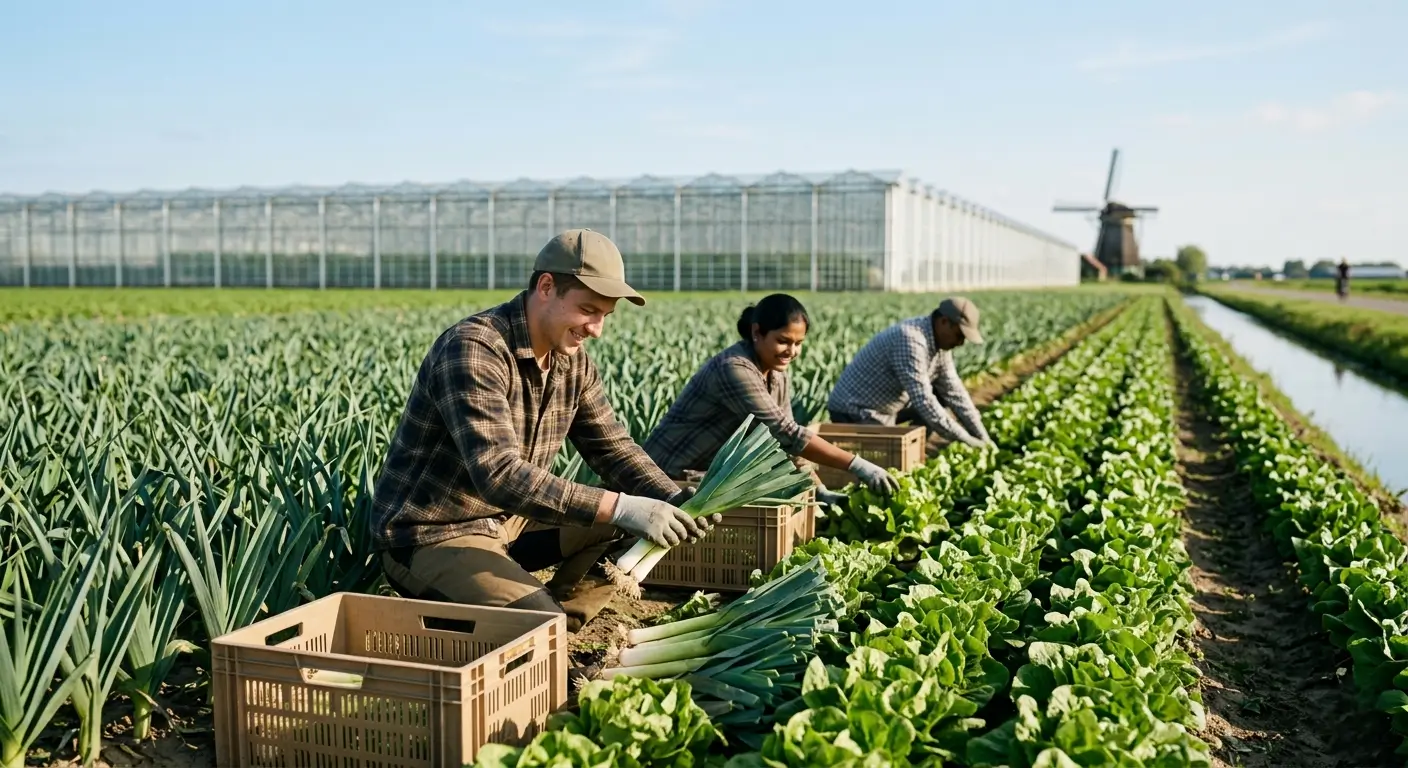
Netherlands Agricultural Worker Jobs
Netherlands Agricultural Worker Jobs: The Honest Guide (2026)
Last verified: June 2026 | Sources: OECD International Migration Outlook 2025, IND and UWV official Dutch government sources, EURES Netherlands labour market data, Erasmus University Rotterdam exploitation research, OHCHR Netherlands review, AGDAILY Dutch agriculture analysis, Playroll and Jobbatical 2026 Dutch visa guides
1. Overview: What this opportunity actually is, and the scale most guides get wrong
The Netherlands punches enormously above its weight in agriculture. Despite its small geographic size, it is the world's second largest agricultural exporter by value, behind only the United States, and roughly two thirds of the country's land is used for agricultural purposes. Dutch greenhouse horticulture, dairy, flower growing, and fruit and vegetable production are genuinely world leading industries, concentrated particularly in regions including Limburg, North Holland, Gelderland, and the Westland greenhouse district near The Hague.
This scale does create real demand for seasonal labour. What requires correction is the assumption, repeated across a number of websites, that this demand translates into a large, open visa quota for non-EU applicants including Africans. It does not, and the actual structure of the Dutch agricultural labour market explains why.
Dutch agriculture relies overwhelmingly on workers from within the European Union, not from outside it. This is fundamentally different from how the labour market works in countries with significant non-EU sponsored worker programmes. Official OECD migration data for the Netherlands shows that in a recent reporting year, only around 2,500 permits were issued to genuine temporary and seasonal labour migrants from outside the EU, while a separate figure of roughly 193,000 intra-EU postings was recorded, an 11% increase on the year before. These intra-EU postings are EU citizens, predominantly Polish, Romanian, and Bulgarian workers, who can live and work in the Netherlands freely without any visa or work permit at all, under the same EU freedom of movement principle that allows a Dutch citizen to work in France or Germany without a permit.
This is the honest structural picture. The Netherlands' seasonal agricultural workforce is, by an overwhelming margin, an EU internal labour market. The non-EU pathway exists, is legally real, and is what the rest of this guide focuses on, but it is a narrow, employer dependent route, not an open quota system, and understanding this from the start will save you from chasing a version of this opportunity that does not actually exist at the scale some content implies.
2. Eligibility: What the rules actually say
Why most agricultural workers in the Netherlands do not need any visa at all
EU citizens benefit from freedom of movement and can work in Dutch agriculture without a visa, a work permit, or employer sponsorship of any kind. This is the dominant source of Dutch farm labour and the reason large-scale, casual seasonal recruitment campaigns you may see advertised are frequently targeted at Polish, Romanian, or Bulgarian workers specifically, since for them, the process is genuinely as simple as accepting a job and travelling, with none of the visa steps that apply to non-EU nationals.
The genuine legal pathway for non-EU, including African, applicants
If you are not an EU, EEA, or Swiss citizen, you need a valid Dutch work permit before you can legally work in Dutch agriculture, and the specific permit type depends on the length and nature of your intended work.
For seasonal work of under 90 days, the relevant permit is generally the TWV (Tewerkstellingsvergunning, or work permit), which your employer applies for. For longer engagements exceeding 90 days, the relevant permit is the GVVA (Gecombineerde Vergunning voor Verblijf en Arbeid), the Combined Permit for Residence and Work, which bundles your residence and work authorisation into a single application.
The central requirement that makes this pathway genuinely difficult, and the part most simplified guides skip over, is the labour market test. Before your employer can secure approval to hire you, Dutch law under Article 8 of the Wet arbeid vreemdelingen, the Foreign Nationals Employment Act, requires that the vacancy be advertised and registered with UWV, the Employee Insurance Agency, for a minimum of five weeks, specifically to confirm that no suitable candidate from within the EU or EEA is available to fill the role first. Only after this test is satisfied, and UWV is reasonably confident the role genuinely cannot be filled locally or from within the EU, will approval for a non-EU hire generally be granted.
Specific permit categories that bypass this labour market test, such as the Highly Skilled Migrant visa or the EU Blue Card, exist for other types of work, but they are not designed for or generally available to entry level seasonal agricultural roles, which are typically classified at a skill and salary level well below these thresholds.
What your employer needs to be
Your prospective Dutch employer needs to be a legitimate, registered business with the Dutch Chamber of Commerce, the KvK, in good financial standing, with no history of violating Dutch immigration or labour law. For the GVVA route specifically, your employer generally needs to be a recognised sponsor registered with the IND, the Dutch Immigration and Naturalisation Service. As of 2026, IND application fees for the most common permits sit at €423 for the combined GVVA single permit, the Highly Skilled Migrant permit, the EU Blue Card, and intra-company transfer applications, while the Orientation Year visa and seasonal labour permits specifically carry a lower fee of €254.
What you need as the individual applicant
A confirmed, genuine job offer from a specific Dutch agricultural employer who is willing and able to navigate this sponsorship process. Health insurance meeting Dutch requirements. Suitable accommodation, which under Dutch regulation your employer is generally expected to help arrange, though, as covered honestly in the real world challenges section below, the actual quality of this accommodation varies considerably and has been the subject of serious documented concern. A valid passport and standard health and character documentation consistent with any Dutch visa application.
3. Skills employers actually want
Based on Dutch agricultural employer requirements as documented across official Dutch work permit guidance and recruitment platforms:
Physical fitness for sustained manual or repetitive labour. Dutch greenhouse and field work, including fruit and vegetable harvesting, flower cutting, and packing line work, involves long shifts, often standing or in repetitive motion, and employers expect genuine physical capability for this type of work.
Reliability across the full agreed contract period. Because UWV's labour market test process places real administrative burden on an employer to justify hiring a non-EU worker, employers taking on this process want strong assurance that the worker will complete the full season, since the cost and effort of replacing a worker who departs early is considerably higher than with the simpler intra-EU hiring process most Dutch agricultural businesses default to.
Basic English or Dutch communication ability. While not universally mandatory, the ability to understand safety instructions and basic workplace communication, in Dutch or in English on larger, more internationally staffed operations, is a genuine practical advantage in both securing a role and functioning safely and effectively once working.
Documented prior work experience, particularly anything physically comparable. While many entry level roles provide on the job training, demonstrable prior experience in physical or agricultural work, properly referenced, strengthens an application and can influence which of several candidates an employer chooses to pursue through the more demanding non-EU sponsorship process specifically.
4. Step-by-step path: From your country to legitimate seasonal agricultural work in the Netherlands
Step 1: Understand clearly that you need a specific employer before any visa process can begin There is no general non-EU seasonal worker application pool for the Netherlands. Your path begins with finding a genuine Dutch agricultural employer willing to take on the UWV labour market test and sponsorship process specifically to hire you, rather than simply hiring from within the EU as most Dutch agricultural businesses do by default.
Step 2: Search EURES and Dutch job platforms specifically for roles explicitly open to non-EU applicants Search the EURES portal, the European Union's official job mobility platform, for Dutch agricultural listings, and read each one carefully for explicit confirmation that non-EU sponsorship is offered, since the majority of listings on Dutch job boards are written with EU applicants in mind and do not mention sponsorship at all because it is not relevant to most candidates applying.
Step 3: Approach Dutch agricultural staffing agencies with informed caution Large staffing agencies, including Otto Work Force and similar uitzendbureaus, agency labour providers, place significant numbers of seasonal agricultural workers in the Netherlands and are legitimate, registered businesses operating at real scale. However, independent investigative journalism and academic research, detailed honestly in the challenges section below, have documented genuine complaints regarding housing standards and working conditions associated with some of these agencies. Engage with any staffing agency as you would any major employer relationship: ask specific questions about accommodation standards, request a written contract before travelling, and verify the agency's registration and standing independently rather than relying solely on their own marketing material.
Step 4: Confirm explicitly that the employer or agency understands and is prepared for the UWV labour market test process A genuine, well prepared Dutch agricultural employer interested in hiring you as a non-EU national should be able to explain the TWV or GVVA process to you directly, including realistic timelines. If a prospective employer or agency seems unfamiliar with this process, or suggests it can be bypassed or expedited informally, treat this as a serious warning sign, since the labour market test is a structural legal requirement, not a formality that can be skipped.
Step 5: Prepare your documentation while the employer's process proceeds While your prospective employer manages the UWV vacancy notification and subsequent sponsorship application, prepare your own documents: a valid passport, health insurance arrangements meeting Dutch standards, and any reference letters or documentation of prior relevant work experience that strengthen your overall application.
Step 6: Allow the full UWV labour market test period to run its course The mandatory UWV vacancy notification period runs a minimum of five weeks under Article 8 of the Wet arbeid vreemdelingen, before your employer's TWV or GVVA application can even be submitted for final processing. Build this into your own planning and timeline expectations honestly from the outset.
Step 7: Receive your permit decision and apply for entry if required Once UWV and the IND approve the application, you will receive confirmation of your permit. Depending on your nationality, you may also need to apply for an entry visa, an MVV, at the Dutch embassy or consulate in your country, before travelling, particularly for longer GVVA-based engagements.
Step 8: Travel, register, and understand your rights from day one On arrival, register with your local Dutch municipality as required. Before beginning work, request and keep a copy of your written employment contract, and familiarise yourself with the Fair Work organisation, Nederland Tegen Mensenhandel's broader resources, and your right to receive proper, documented pay slips, since the documented research covered below shows these basic protections are not always honoured in practice across this specific sector.
5. Real-world challenges
These come from peer reviewed academic research conducted at Erasmus University Rotterdam, a 2025 review of the Netherlands by the United Nations Committee on Economic, Social and Cultural Rights, investigative journalism from CorpWatch and Follow the Money, and OECD migration statistics.
The non-EU pathway is genuinely narrow, and most existing recruitment infrastructure is built around EU workers, not African applicants. With only around 2,500 non-EU temporary and seasonal labour permits issued in a recent reporting year against roughly 193,000 intra-EU postings, the practical reality is that very few Dutch agricultural employers have ever gone through the non-EU sponsorship process, and most have no need to, since EU labour remains readily available to them without any of the administrative steps required for a non-EU hire. This is the honest, structural reason this pathway is harder for African applicants specifically, not a reflection of capability or eligibility, but a reflection of which labour channels Dutch employers already use by default.
Documented, serious labour exploitation exists across the Dutch low wage migrant labour sector, including agriculture. A criminologist at Erasmus University Rotterdam spent twelve months working undercover across construction, logistics, and agrifood sectors in the Netherlands for his doctoral research, and found that migrant workers are often underpaid, face unsafe situations, and live under conditions he characterised as a structural, system-wide problem rather than the result of a few bad employers, with companies and employment agencies systematically shifting responsibility for worker welfare onto each other. His research documented missing pay slips, unrecorded overtime, and workers without experience being assigned dangerous tasks without proper supervision or training. This research focused on the broader migrant labour population in the Netherlands, predominantly Central and Eastern European workers, but the structural conditions it describes apply to the agricultural sector generally and are directly relevant to any worker, including a non-EU African applicant, entering this specific labour market.
Housing conditions specifically have been a recurring, documented concern. Independent reporting has included specific, named accounts of inadequate worker accommodation, including overcrowded living arrangements, lack of basic privacy, and unreliable heating, associated with some of the larger staffing agencies operating in this space. A 2020 Dutch parliamentary task force led by former politician Emile Roemer produced 50 specific recommendations to improve seasonal and migrant worker housing and conditions following sustained public concern, and the Dutch government itself, in its most recent United Nations human rights review in 2025, acknowledged ongoing housing shortage challenges specifically affecting migrant workers and outlined new legislative measures, including a requirement that public housing programmes address migrant worker housing needs directly, with substantial government funding allocated through 2029 toward affordable housing including a minimum social housing component.
Wage and contract disputes affecting agency workers remain an active, current issue. Reporting in early 2026 documented an ongoing wage dispute affecting the broader Dutch temporary agency workforce, of which more than half were born abroad as of 2024, the majority from Poland, with labour advocates describing a system in which workers frequently are not aware of their full pay entitlements and the overall structure makes it difficult for workers to verify or enforce their rights independently.
Genuine legal protections and support resources do exist, and using them matters. The Dutch government has acknowledged these problems directly and points to the Fair Work organisation as a resource that helps migrant workers understand and claim their labour rights, including unpaid wages. The Dutch Supreme Court has also taken seriously documented cases of exploitation in this exact sector, with one ruling specifically identifying systematic underpayment and the provision of poor, excessively expensive housing as clear indicators of labour exploitation on a Dutch strawberry farm. Knowing these protections exist before you travel, and knowing specifically where to turn if your actual working or housing conditions do not match what you were promised, is essential preparation for anyone entering this sector.
This is honest context for any worker considering this path, not a reason to assume every employer behaves this way. Many Dutch agricultural employers operate properly and lawfully. The purpose of including this research is to ensure you go into any agreement with realistic expectations, a written contract in hand, and knowledge of where to turn if conditions do not match what was promised, not to suggest the entire sector operates this way.
6. Where to apply, and where to verify before applying
Official Dutch government sources for verifying any visa or permit claim directly: IND (Immigration and Naturalisation Service): ind.nl UWV (Employee Insurance Agency, responsible for the labour market test): uwv.nl
For genuine job listings, including some open to non-EU applicants: EURES, the European Union's official job mobility portal: ec.europa.eu/eures (search Netherlands, agriculture) Indeed Netherlands: nl.indeed.com
Major Dutch agricultural staffing agencies (approach with the informed caution outlined in Section 5): Otto Work Force: ottoworkforce.com (large scale agricultural and logistics staffing; verify specific contract and accommodation terms directly and in writing before accepting any placement)
For understanding and protecting your labour rights once in the Netherlands: Fair Work (Nederland Tegen Mensenhandel resource for migrant labour rights and reporting exploitation): fairwork.nl Explify (independent organisation supporting migrant workers in understanding their rights, primarily serving the Polish worker community but a useful model and reference point): explify.nl
For verifying any specific employer's legitimacy: Dutch Chamber of Commerce business registry: kvk.nl (search any prospective employer's registration directly before proceeding with an application)
7. Realistic timeline
Stage | Time required |
|---|---|
Searching for and securing a genuine Dutch employer willing to sponsor a non-EU hire | 2 to 6 months, highly variable given limited existing recruitment infrastructure |
Mandatory UWV labour market test (vacancy notification period) | Minimum 5 weeks |
TWV or GVVA permit processing after labour market test | 2 to 8 weeks |
Entry visa (MVV) application if required | 2 to 6 weeks |
Total from starting your search to arriving in the Netherlands | 4 to 9 months |
As with Germany's equivalent pathway, the real bottleneck for an African applicant is finding a willing, prepared employer, not the formal permit process itself once that employer relationship exists.
8. Mistakes to avoid
Trusting any claim of a large, open non-EU seasonal visa quota for the Netherlands without checking it against OECD or official Dutch government figures. The genuine numbers show a narrow non-EU pathway, not an open quota system, and confusing intra-EU worker postings with non-EU sponsored visas produces a badly misleading impression of accessibility.
Assuming any staffing agency relationship is automatically safe simply because the agency is large and well known. Documented research has named specific, serious housing and labour condition complaints associated with some of the largest agencies operating in this exact space. Ask specific, direct questions about accommodation standards and contract terms before accepting any placement, and get everything in writing.
Travelling without a written contract in hand. Documented research on this sector specifically highlights missing pay slips and undocumented working arrangements as a recurring problem. Insist on a complete, written employment contract before you travel, not a verbal assurance.
Underestimating the mandatory five week UWV labour market test as a formality that can be skipped or expedited informally. This is a structural legal requirement under Dutch law. Any employer or agency suggesting otherwise should be treated with serious caution.
Not knowing where to turn if your actual conditions do not match what was promised. Familiarise yourself with the Fair Work organisation and your basic labour rights under Dutch law before you travel, not after a problem has already arisen.
Assuming this pathway works the same way as Germany's equivalent seasonal worker route. While structurally similar in requiring employer sponsorship and a labour market check, the specific permit names, fees, and processes differ. Verify Dutch-specific requirements directly rather than assuming details from a different country's system apply here.
9. Your next action
Your first and most important action regardless of anything else: Search EURES directly at ec.europa.eu/eures for current Dutch agricultural listings, reading each one carefully for explicit confirmation of non-EU sponsorship availability, since this single step will give you a realistic, current sense of how many genuine opportunities actually exist right now, rather than relying on secondary content with unverified quota claims.
If you are considering working with a staffing agency such as Otto Work Force: Before agreeing to anything, request specific written detail on accommodation standards, the exact terms of your contract, and your wage rate after any deductions, and independently verify the agency's registration through the Dutch Chamber of Commerce registry at kvk.nl.
If you want to understand your rights before committing to any Dutch agricultural job: Visit fairwork.nl and review the resources available to migrant workers in the Netherlands, so you know exactly where to turn and what your protections are before you accept any offer, not only after you arrive.
Sources used in this page
Layer | Sources |
|---|---|
Official rules | IND official work permit guidance (ind.nl); UWV labour market test requirements under Article 8 Wet arbeid vreemdelingen; Playroll Netherlands work permit and visa fee guide 2026 (€423 and €254 IND fees, UWV five week vacancy notification requirement); Jobbatical Netherlands visa guide 2026 (GVVA, TWV, labour market test structure) |
Job market and demand data | OECD International Migration Outlook 2025, Netherlands country chapter (2,500 non-EU temporary and seasonal labour permits versus 193,000 intra-EU postings in 2023); AGDAILY analysis of the Dutch seasonal farm labour model (66% of Dutch land used for agriculture, reliance on intra-EU mobility); EU labour market quarterly statistics, European Commission (2026) |
Skill and requirement patterns | Pamgro and Playroll Netherlands employer work permit guides (skills and qualifications alignment requirements); Hijraleek Netherlands Farm Work Visa guide (role types and regional concentration, read alongside the corrected quota figures above) |
Real experience reports | Erasmus University Rotterdam research summary of Ruben Timmerman's doctoral dissertation "By Invisible Hands: Work, Exploitation, and the Migrant Division of Labour" (June 2025); OHCHR summary of the Committee on Economic, Social and Cultural Rights review of the Netherlands (September 2025); CorpWatch investigative report on Dutch employment agencies and migrant worker housing, including named accounts associated with Otto Workforce; Follow the Money investigative report on Dutch temporary agency worker wage disputes (March 2026); International Institute of Social Studies, Erasmus University Rotterdam, "Migrant Labour in Dutch Agriculture: Regulated Precarity" research project summary |
Application channels | EURES official EU job mobility portal; IND and UWV official Dutch government portals; Otto Work Force company information; Fair Work (Nederland Tegen Mensenhandel) migrant worker rights resource; Dutch Chamber of Commerce (KvK) business registry |
This page was produced using the CareerFlow Career Path System and passes the quality gate: every section is backed by at least two independent source types. Verified June 2026. A significant volume of online content overstates the scale of the non-EU seasonal worker pathway into the Netherlands by conflating it with EU freedom of movement figures. Always verify current permit requirements directly at ind.nl and uwv.nl, and research any employer or staffing agency's accommodation and contract terms thoroughly and in writing before accepting any placement.
The Author

Amel Walter
Registered Dietitian-Nutritionist • Gerontological Nutritionists
RDN with 3+ yrs clinical exp: assess patient needs, manage disease, create therapeutic meal plans in hospital teams. Turns nutrition science into realistic, patient-centric diets to improve outcomes.
Travel Essentials
Curated services to help you settle in Netherlands Agricultural Worker Jobs quickly.
More coming soon
Need help?
Our team can help you find accommodation and coworking spaces in Netherlands Agricultural Worker Jobs.
Contact Support →