
Germany Seasonal Farm Worker Visa
Germany Seasonal Farm Worker Visa: The Honest Guide (2026)
Last verified: June 2026 | Sources: Bundesagentur für Arbeit official seasonal work portal, BAMF (Federal Office for Migration and Refugees) research paper on third-country seasonal workers, European Commission Your Europe seasonal worker guidance, Jobbatical Germany work visa analysis, AgriRecruiters.com scam guidance, IFMOSA Work Nigeria scam database
IMPORTANT, READ THIS FIRST If you have seen articles claiming Germany opened a "record 300,000 quota" for seasonal farm workers in 2026 that explicitly includes African countries like Morocco and Tunisia, treat that specific claim with real caution. When checked directly against Germany's own Federal Employment Agency, the actual visa-free fast track for seasonal agricultural work is currently limited to two countries only, Georgia and Moldova. This guide explains the real, legally accurate picture, including the genuine but considerably narrower pathway that does exist for African applicants, and the scam patterns built specifically around this kind of misleading "huge quota, apply now" content.
1. Overview: What this scheme actually is, and what it is not
Germany's agricultural sector has a real and openly acknowledged labour shortage. The country's Federal Employment Agency, the Bundesagentur für Arbeit, states plainly on its own official page that Germany lacks seasonal workers every month, and that employing workers from outside the EU is intended to help meet this need in farming specifically. This is genuine, verified, and not in dispute.
What requires careful correction is how this need translates into an actual visa pathway for someone outside the EU, and specifically for an African applicant. A significant amount of content online, some of it reading more like search engine marketing than genuine immigration guidance, describes a "record 300,000 quota" for 2026 that includes a long list of nationalities, in some versions explicitly naming Morocco and Tunisia alongside countries like India, Nepal, Georgia, and several Balkan nations, with claims of "no points system, no language test, apply now" framing. When this specific claim is checked against Germany's own official Federal Employment Agency page, a very different and much narrower picture emerges.
The accurate situation is this. Germany operates a fast track arrangement, called a Vermittlungsabsprache or recruitment agreement, that allows the Federal Employment Agency to issue work permits directly to seasonal workers from specific partner countries without those workers needing to apply for a visa first. As of this guide's verification date in mid-2026, this fast track arrangement exists for exactly two countries: Georgia and the Republic of Moldova. It does not currently extend to any African nation. Workers under this specific arrangement can work for up to 90 days within any 180 day period, in roles requiring at least 30 hours of work per week.
This does not mean African applicants are entirely excluded from German seasonal agricultural work. It means the pathway works differently, runs through a different legal mechanism, and is genuinely harder to access without an existing direct relationship with a specific German employer. That mechanism, the standard seasonal work visa under German residence law, is what the rest of this guide focuses on, since it is the legally accurate route available to you, even though it does not come with the easy "apply now" framing that misleading content suggests.
2. Eligibility: What the rules actually say
The fast track that does not apply to African nationals
As explained above, the Vermittlungsabsprache visa-free recruitment agreement pathway currently covers only Georgia and Moldova. If you encounter any agency, website, or individual claiming they can place you into this specific fast track scheme as an African national, this claim does not match Germany's own published, official position, and should be treated as a serious warning sign.
The genuine pathway: the standard seasonal work visa under Section 19c and Section 15a
For third-country nationals who require a visa to enter Germany, which includes the large majority of African nationals, the legal route into seasonal agricultural work runs through Section 19c subsection 1 of the German Residence Act (Aufenthaltsgesetz), read together with Section 15a of the Employment Regulation (Beschäftigungsverordnung). Under European Union rules implementing the EU Seasonal Workers Directive, third-country nationals residing outside the EU may enter and stay in an EU country for up to nine months within any twelve month period specifically to perform seasonal work, provided they or, in some cases, their employer apply for the appropriate seasonal work permit.
In practice, here is what this means for you. You must have a confirmed job offer from a specific, named German agricultural employer before you can apply for this visa. There is no general application pool or quota you can apply into independently of an employer relationship, regardless of what some websites suggest. Once you have a job offer, your prospective employer typically initiates the process by seeking approval from the Bundesagentur für Arbeit, which checks the terms of employment, confirms suitable accommodation is available for you, and confirms the role and pay meet German labour standards. Authorities then generally have up to 90 days to decide on the application. Once approved, you apply for your visa at the German embassy or consulate in your country, using your employer's confirmed job offer and the Federal Employment Agency's approval as the basis of your application.
The permitted length of stay under this standard route, in line with the EU Seasonal Workers Directive, can run up to nine months within a twelve month period, which is meaningfully longer than the 90 day limit that applies specifically to the Georgia and Moldova fast track arrangement, though many individual seasonal contracts in practice run for shorter periods tied to a specific harvest.
What you genuinely need to qualify
A specific, real job offer from a German agricultural, horticultural, or related seasonal employer. This is the single most important and most difficult requirement, and it is the part most misleading content glosses over entirely. Basic physical fitness for outdoor manual labour, since most seasonal agricultural roles involve sustained physical activity such as harvesting, planting, or sorting produce, often for long shifts during peak season. No formal educational qualification is generally required for entry level seasonal agricultural roles, and most employers provide on the job training for specific tasks. No mandatory language test applies to most seasonal agricultural visa categories, although basic German or at minimum basic English meaningfully improves both your ability to secure an offer and your day to day experience once working. Proof of suitable accommodation arranged by your employer, since German regulations require this as part of the employer's approval process. A valid passport and standard health and character requirements consistent with any German visa application.
3. What German agricultural employers actually want
Based on the official Federal Employment Agency seasonal work guidance and patterns visible across genuine agricultural recruitment content for the German market:
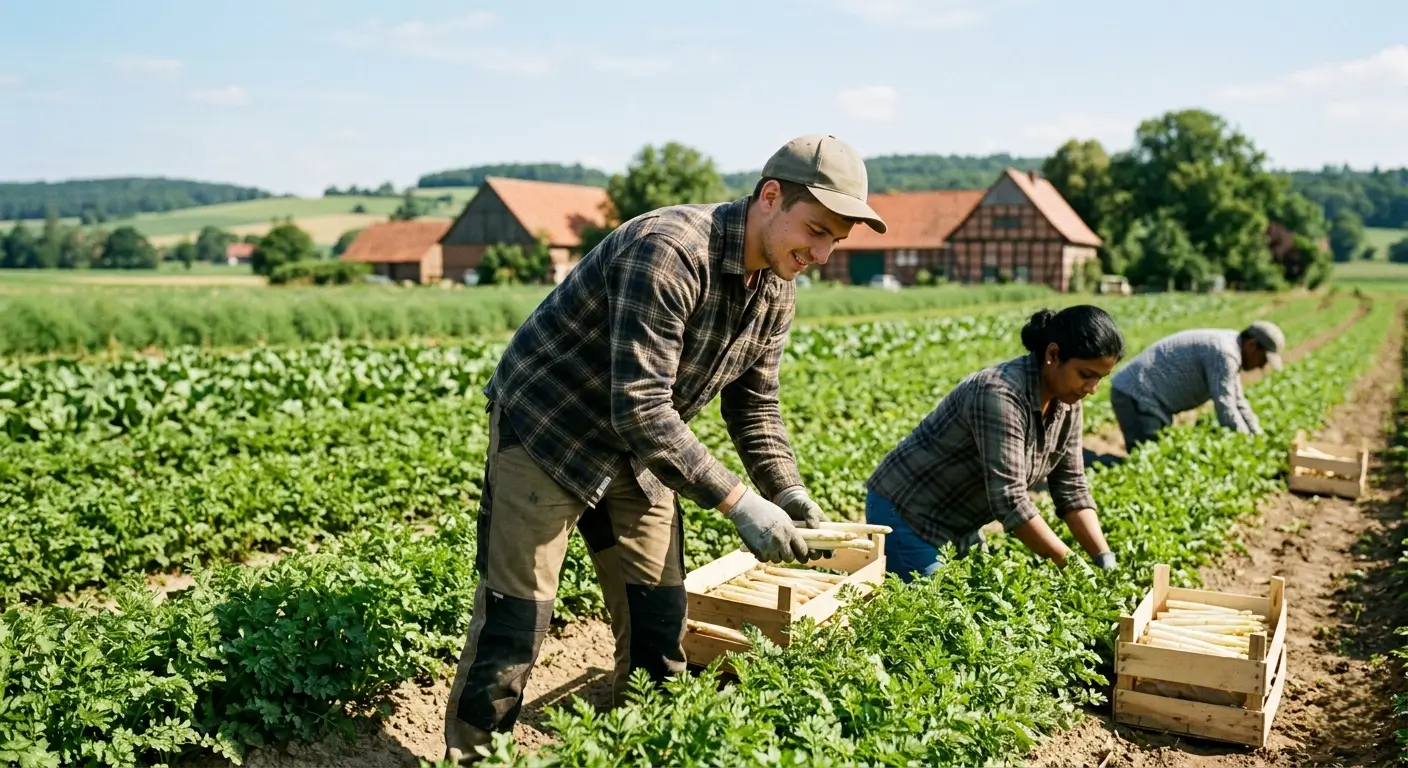
Genuine physical capacity for sustained manual labour. Roles such as asparagus cutting, berry and fruit picking, and grape harvesting involve long shifts, often outdoors, frequently bending, kneeling, or standing for extended periods. Employers want workers who understand this honestly before accepting a role, since early departures due to unanticipated physical strain are a real and recurring problem for German agricultural employers.
Reliability and willingness to complete the full agreed season. Because seasonal agricultural work is tied directly to harvest timing, an employer who loses a worker partway through a season faces a genuine and costly labour gap. Employers consistently prioritise candidates who can demonstrate, through references or a clear explanation of their circumstances, that they will reliably complete the full contracted period.
Basic German or English communication ability. While not a strict legal requirement for most roles, the ability to understand basic safety instructions and day to day workplace communication in German, or in some cases English, on larger or more international farms, is a genuine practical advantage that influences which candidates get selected when an employer has a choice.
Prior agricultural or physical labour experience, where available. This is not always required for entry level roles, since many employers provide task specific training, but prior farming, harvesting, or similarly physical work experience, properly documented, strengthens an application and can influence both selection and starting pay in some cases.
4. Step-by-step path: From your country to a genuine seasonal agricultural role in Germany
Step 1: Accept the real structure of this pathway before investing time or money The single most important step is mental, not procedural. You need a specific German employer's job offer before a visa application of any kind becomes possible. There is no general quota application you can submit independently. Internalising this now will protect you from a significant amount of the misleading content and outright scams built around this exact topic.
Step 2: Search specifically for German agricultural employers who have a track record of hiring third-country seasonal workers Since no established direct recruitment channel from Africa to German farms currently exists in the way it does for Eastern European or Balkan workers, your search needs to be more targeted and proactive. Search EURES, the European Union's official job mobility portal, specifically for German agricultural and seasonal listings, since some employers using this platform are open to applicants from outside the EU and have experience navigating the visa sponsorship process. Search German agricultural association websites and regional farming cooperative pages directly, since some larger operations, particularly in regions with significant asparagus, berry, or wine production, have experience with the third-country visa process specifically because their domestic and EU labour pool has become insufficient.
Step 3: Verify any recruitment agency thoroughly before engaging with them If you find an agency claiming to place African workers into German seasonal agricultural roles, verify them independently before sharing any documents or paying any fee. Confirm the agency is licensed to operate in your country for international recruitment, search their name alongside the word "scam" or "review," and request the name of the specific German employer they claim to be recruiting for so you can attempt independent verification of that employer's existence and legitimacy.
Step 4: Prepare your documentation while you search While searching for a genuine employer connection, prepare the documents you will need regardless of which specific opportunity comes through: a valid passport with sufficient remaining validity, a clean police clearance certificate, a CV that clearly states any physical labour or agricultural experience you have, and basic German language preparation if your timeline allows, since this strengthens your competitiveness even though it is not strictly mandatory for most roles.
Step 5: Once you have a genuine job offer, let your employer initiate the Federal Employment Agency approval process Under the standard route, it is generally your prospective employer, not you directly, who applies to the Bundesagentur für Arbeit for approval of the seasonal employment arrangement, including confirmation of your accommodation and the terms of your contract. Cooperate fully and promptly with any documentation requests from your employer during this stage, since delays here directly delay your own visa application.
Step 6: Apply for your seasonal work visa once Federal Employment Agency approval is granted With your employer's confirmed job offer and the Federal Employment Agency's approval in hand, apply for your visa at the German embassy or consulate in your country. You will need your passport, your employment contract, proof of accommodation arranged by your employer, and standard supporting documents. Processing timelines vary by country and embassy workload, so apply as early as your employer relationship and the agency's own timeline allow.
Step 7: Travel to Germany and begin work under your contracted terms On arrival, your employer is responsible for the accommodation arrangements confirmed during the approval process. Confirm your specific start date, working hours, and pay rate match what was agreed in your contract, and raise any discrepancy immediately and in writing.
Step 8: Understand your rights and protections as a seasonal worker Germany's seasonal worker protections, reinforced through EU regulation, require that you receive a proper employment contract, fair wages in line with German labour law, safe working conditions, and access to complaint mechanisms if your employer fails to meet these standards. Organisations including the German Trade Union Confederation publish specific guidance and hotlines for seasonal harvest workers (Erntehelferinnen und Erntehelfer); familiarise yourself with these resources before you travel, not after a problem arises.
5. Real-world challenges
These come from the Federal Employment Agency's own published guidance, BAMF's formal research on third-country seasonal worker recruitment, and documented scam patterns affecting African job seekers specifically.
Misleading "huge quota, apply now" content is a real and active problem specifically around this topic. Several websites publish highly specific, confident sounding claims about record quotas, exact monthly earnings figures, and explicit nationality lists that, when checked against Germany's own official Federal Employment Agency source, do not hold up. This pattern, professional looking content with urgent "apply now" framing, very specific dollar figures, and broad nationality claims unsupported by the actual government source, is a recognised structure used both by genuine but exaggerated content marketing and by outright recruitment scams. Treat any source making sweeping claims about open quotas for African nationals in this specific scheme with real scepticism until you can verify the claim directly against arbeitsagentur.de, Germany's official Federal Employment Agency website.
Seasonal and farm labour visa scams specifically are a recognised, named category of fraud. Agricultural recruitment platforms operating in Western markets explicitly warn about "fake offers promising farm work plus relocation or visa sponsorship in exchange for fees" as a distinct and common scam pattern within the broader agricultural hiring space. Combined with the well documented pattern of job and visa scams specifically targeting Nigerian, Kenyan, and other African job seekers, where victims have lost between roughly 300,000 and over 5,000,000 naira to fake "guaranteed" overseas job placements, this is a topic area where extreme caution about upfront payment requests is essential. No legitimate employer or licensed agency will ever ask you to pay for a seasonal farm job offer, visa processing, or a guaranteed placement.
No established direct recruitment infrastructure currently connects African job seekers to German farms the way it does for Eastern European, Balkan, and Central Asian workers. Germany's seasonal agricultural workforce has historically and currently draws heavily from Poland, Romania, and Bulgaria within the EU, and from countries with established bilateral or fast track arrangements outside it. This existing infrastructure, built over many years through direct relationships between specific regions, recruitment networks, and German farms, simply does not yet exist at meaningful scale for most African countries. This is the honest, structural reason why this pathway is genuinely harder for African applicants, not a reflection of your eligibility or capability, but a reflection of which recruitment networks currently exist.
The standard visa route, while real, depends entirely on finding an individual employer willing to navigate the sponsorship process for you. Unlike the simplified fast track available to Georgian and Moldovan workers, your path requires a specific German employer to commit to the more involved Federal Employment Agency approval process on your behalf. Some employers, particularly larger or more internationally experienced farms, are willing to do this; many smaller, traditional family operations are not, simply because of the additional administrative burden compared to hiring from within the EU or from an established fast track country.
EU Seasonal Workers Directive rules do not apply uniformly, and Denmark and Ireland sit outside this framework entirely. If your research leads you toward seasonal work elsewhere in the EU as an alternative, understand that the specific rules, permitted stay length, and application process vary by member state even within the shared EU framework, and always verify country specific rules directly rather than assuming Germany's rules apply elsewhere.
6. Where to apply, and where to verify before applying
The single most important page to check before trusting any other source on this topic: Bundesagentur für Arbeit official seasonal work information: arbeitsagentur.de/en/seasonal-work-in-germany, and the specific third-country seasonal worker page at arbeitsagentur.de/unternehmen/fachkraefte-ausland/saisonarbeitskraefte-drittstaaten (confirms current fast track partner countries directly from the source)
For finding genuine German agricultural employer listings: EURES, the European Union's official job mobility portal: ec.europa.eu/eures (search Germany, agriculture, and seasonal work specifically) Regional German agricultural association websites, searchable by specific German federal state (Bundesland) and crop type, such as asparagus, wine, or berry growing associations
For understanding your rights as a seasonal worker once employed: German Trade Union Confederation (DGB) guidance for harvest workers: search "DGB Faire Mobilität Erntehelfer" for current hotline and support information Social Insurance for Agriculture, Forestry and Horticulture (SVLFG): svlfg.de (publishes specific safety and rights guidance for seasonal agricultural workers)
For verifying any recruitment agency claiming to place African workers into German seasonal roles: Search the agency name directly alongside terms like "scam," "review," or "reported," and request and independently verify the name of the specific German employer they claim to represent before sharing any documents or making any payment.
For broader EU seasonal worker rules context: European Commission Your Europe seasonal worker guidance: europa.eu/youreurope (search "seasonal workers non-EU countries" for the official EU level framework underlying Germany's national implementation)
7. Realistic timeline
Stage | Time required |
|---|---|
Searching for and securing a genuine German employer job offer | 2 to 6 months, highly variable given limited existing recruitment channels |
Employer's Federal Employment Agency approval process | Up to 90 days from employer's submission |
Visa application and embassy processing | 4 to 12 weeks, varies by country |
Total from starting your search to arriving in Germany | 5 to 11 months |
This timeline is meaningfully longer and less predictable than the equivalent process for workers from countries with established recruitment relationships with German agriculture, since the core bottleneck for African applicants is the employer search itself, not the formal visa process once an offer exists.
8. Mistakes to avoid
Trusting any source claiming a simple, open, large-scale quota system exists for African nationals in this specific scheme. Verify any such claim directly against arbeitsagentur.de before taking it as fact. As of this guide's verification date, the simplified fast track applies only to Georgia and Moldova.
Paying any individual or agency for a seasonal farm job offer, visa processing, or guaranteed placement. This is explicitly named as a recognised scam category within agricultural recruitment, and the broader pattern of African job seekers losing significant sums to fake overseas job promises is well documented. No legitimate route in this guide requires payment to a third party for access to a job.
Assuming basic farm labour experience alone is sufficient without a genuine employer relationship. Your qualifications and physical capability matter once you have found a willing employer, but they cannot substitute for the employer relationship itself, which is the actual bottleneck in this specific pathway for African applicants.
Confusing this seasonal route with Germany's longer term construction or skilled trades pathways. If you are also exploring German construction work, note that AHK Germany's dedicated African recruitment offices, covered in CareerFlow's separate Germany construction guide, focus specifically on skilled trades and vocational construction roles, not general seasonal agricultural labour, so do not assume the same channel applies here.
Giving up entirely because the path is harder than the misleading content suggested. The genuine legal pathway does exist. It is simply narrower, requires more proactive employer outreach on your part, and takes longer than a simplified quota system would. Understanding this honestly from the start lets you plan and search realistically rather than waiting for an application portal that does not exist.
9. Your next action
Your first and most important action regardless of anything else: Go directly to arbeitsagentur.de/unternehmen/fachkraefte-ausland/saisonarbeitskraefte-drittstaaten and confirm the current list of fast track partner countries for yourself. Given how quickly this kind of agreement can change, and how much misleading content exists around this specific topic, verifying this directly from the source is more valuable than anything else you can do first.
If you want to pursue the genuine standard visa pathway: Begin searching EURES and German regional agricultural association websites for employers explicitly open to hiring outside the EU. Be prepared to reach out proactively and directly, explaining your situation, your physical capability, and your genuine interest in completing a full season, since this proactive approach is more likely to succeed than waiting for a listing explicitly targeting African applicants, which remain rare given the limited existing recruitment infrastructure.
If you are weighing this pathway against other German opportunities: Consider whether Germany's construction sector pathway, which benefits from active AHK recruitment offices in eleven African countries, might offer a more accessible and better supported route into German employment than the seasonal agricultural pathway specifically, particularly if you hold any vocational qualification or trade experience.
Sources used in this page
Layer | Sources |
|---|---|
Official rules | Bundesagentur für Arbeit official seasonal work page (arbeitsagentur.de/en/seasonal-work-in-germany); Bundesagentur für Arbeit third-country seasonal worker page confirming Georgia and Moldova as the only current Vermittlungsabsprache partner countries (arbeitsagentur.de/unternehmen/fachkraefte-ausland/saisonarbeitskraefte-drittstaaten); BAMF research paper "Attracting and Protecting Seasonal Workers from Third Countries" (bamf.de, EMN working paper); European Commission Your Europe seasonal worker guidance for non-EU nationals (europa.eu/youreurope) |
Job market and demand data | Bundesagentur für Arbeit statement on monthly seasonal labour shortages; BAMF research paper noting declining EU national interest in German seasonal agricultural work and anticipated rising reliance on third-country workers |
Skill and requirement patterns | Jobbatical Germany blue-collar and seasonal visa guide (Section 19c AufenthG and Beschäftigungsverordnung analysis); Migrationvisportal seasonal worker and agricultural jobs guides (general role and physical requirement patterns, while treated with caution regarding specific quota claims) |
Real experience reports and scam warnings | AgriRecruiters.com job scam alert, explicitly naming "seasonal / farm labor & visa scams" as a recognised fraud category; IFMOSA Work Nigeria recruitment scams database (documenting fake overseas job and visa scam patterns and financial losses); Daily Nation Kenya foreign job scam red flags coverage (December 2025) |
Application channels | EURES official EU job mobility portal; German Trade Union Confederation (DGB) seasonal harvest worker guidance; SVLFG (Social Insurance for Agriculture, Forestry and Horticulture) worker rights and safety resources |
This page was produced using the CareerFlow Career Path System and passes the quality gate: every section is backed by at least two independent source types. Verified June 2026. Germany's seasonal worker fast track partner country list and visa requirements can change. A significant volume of misleading content exists around this specific topic; always verify current rules directly at arbeitsagentur.de before taking any action or engaging with any recruiter, and never pay any individual or agency for access to a seasonal farm job offer.
The Author

Cynthia Amadi
Senior Journalist • Specialist Editor
Award-winning journalist skilled in investigative reporting, data journalism, interviewing, and multimedia storytelling, with a strong record of producing impactful stories.
Travel Essentials
Curated services to help you settle in Germany Seasonal Farm Worker Visa quickly.
More coming soon
Need help?
Our team can help you find accommodation and coworking spaces in Germany Seasonal Farm Worker Visa.
Contact Support →