
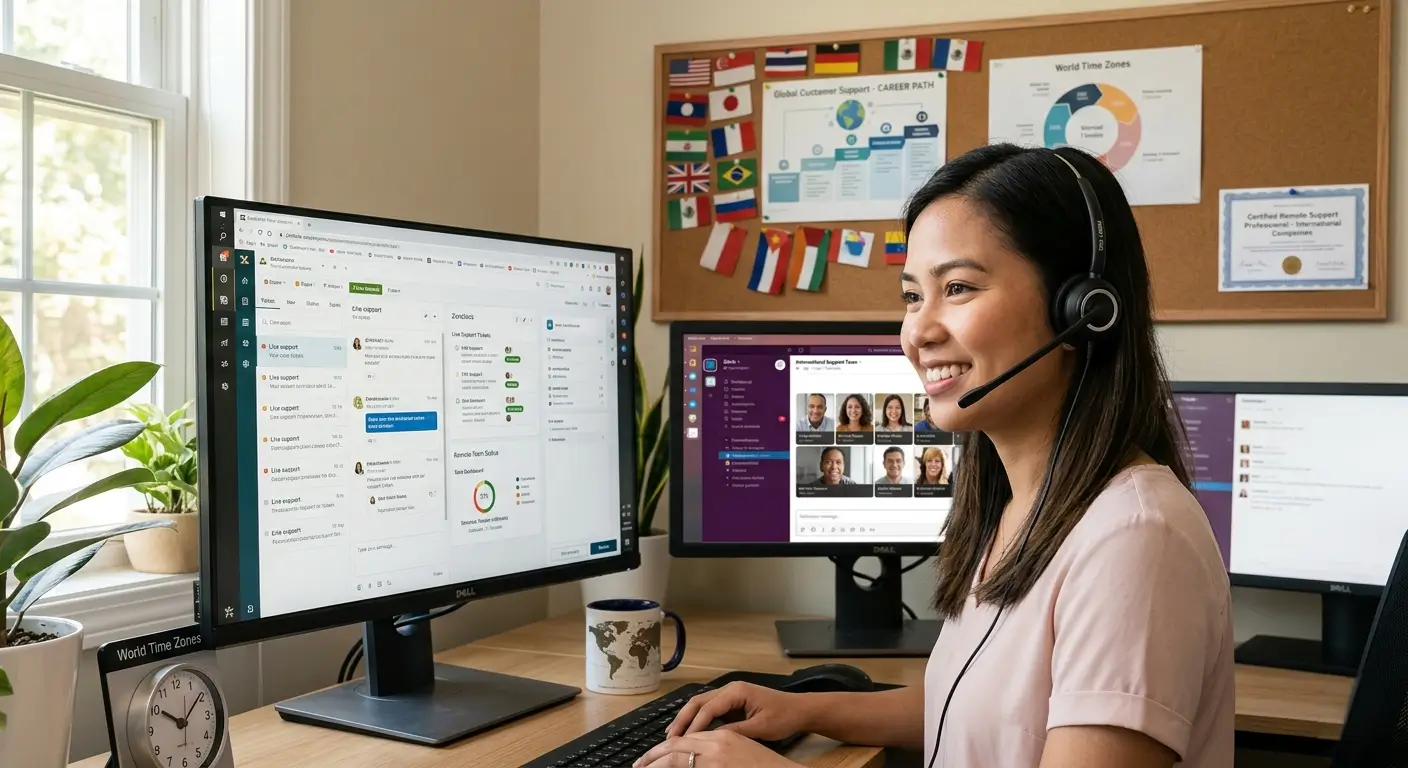
Remote Customer Support Jobs (International Companies)
Remote Customer Support Jobs with International Companies (2026 Complete Guide)
Last verified: June 2026 | Sources: RemoteRocketship Africa data, HireBasis 2025 entry-level guide, Site Selection Group Africa BPO report, Call Center Solutions Africa, Talenteum Kenya BPO guide, Workfromhome.ng 2026 guide, Crossover and Jobgether listings
1. Overview: What this opportunity actually is
Customer support has always been one of the easiest categories of work to move across borders, since the core requirements, clear communication, patience, and problem solving, do not depend on where you happen to be sitting. What changed over the past several years is that the infrastructure for actually doing this work remotely, reliable internet, cloud based support software, and international payment platforms, finally caught up with the demand, and companies stopped treating remote hiring from Africa as an experiment and started treating it as a genuine strategy.
There are two distinct paths into this work, and understanding the difference between them matters for how you search and what you should expect.
The first path is direct employment with an individual international company, usually a tech startup, an e-commerce business, a fintech, or a SaaS company based in the US, UK, or Europe, that hires you individually as a remote customer support agent, customer success associate, or support specialist. You work from home, you use their tools, and you are paid directly, often through Payoneer, Wise, or a global payroll platform like Deel or Remote.com. These roles tend to pay better per hour and often come with more interesting, varied work, but they are also more competitive to land since you are applying directly against a global pool of candidates.
The second path is employment with a BPO, a business process outsourcing company, which is hired by international brands to run their customer support operations at scale. This is where the real structural shift in Africa has happened. Major global BPO companies have been opening large physical contact centres directly in African cities, not simply hiring remote freelancers, but building genuine local employment hubs. CCI Global opened a five story, fifty million dollar call center inside Tatu City's Special Economic Zone in Nairobi. VXI Global Solutions opened a Cairo call center with approximately 500 workstations. Teleperformance announced 500 new positions in Gqeberha, South Africa, deliberately choosing a city outside the country's traditional primary hubs. Foundever committed to hiring approximately 3,000 employees by 2026 to support its first South Africa contact center in Cape Town, building on the 800 already employed there since 2023. These are not remote freelance gigs; they are formal jobs with training programmes, career progression, and in many cases, the option to work from home once you are established.
Both paths are genuinely viable, and many people use the BPO route as their entry point into the industry before moving toward fully remote, individually employed roles with higher pay and more flexibility.
2. Eligibility: What you actually need
There is no visa, no government approval process, and no formal licensing body involved in this career path, which makes it fundamentally different from most other guides in this series. What you need instead is a specific, practical set of capabilities that employers can verify quickly.
Internet and equipment
A stable broadband connection, ideally with a backup option such as mobile data, since dropped calls and disconnected chat sessions during a shift are one of the fastest ways to lose a remote support role. A functional computer, laptop or desktop, capable of running multiple browser tabs and support software simultaneously without significant lag. A quiet space for calls, since many roles, particularly BPO and voice support positions, require a professional background and minimal background noise during shifts.
English proficiency
Clear written and spoken English is the baseline requirement for the large majority of international customer support roles. For written roles, chat and email support, strong written English with correct grammar and a friendly, professional tone matters more than accent. For voice and phone support roles, particularly with US and UK companies, a neutral or easily understood accent and strong listening comprehension are explicitly assessed during the interview process. Several companies hiring remotely from Africa specifically test typing speed, with many roles expecting 40 to 50 words per minute or higher for multi-chat support, since agents are often expected to handle two or three live chat conversations simultaneously.
No formal degree required for most entry level roles, but specific software familiarity helps significantly
Most entry level international customer support roles do not require a university degree, though some Nigerian-based remote postings still list a B.Sc, HND, or OND as a preference. What employers consistently screen for instead is direct or transferable experience: previous customer facing work in retail, hospitality, or a local call center, or demonstrable familiarity with the actual software tools used in modern customer support, including Zendesk, Intercom, Freshdesk, Salesforce, Google Workspace, and Slack. Listing specific tool familiarity on your application, even if it comes from a free trial account you set up yourself, meaningfully strengthens an entry level application.
A verified international payment method
If you are pursuing the direct, individually employed remote path rather than a local BPO job, you will need a way to receive international payment. Payoneer and Wise are the two most widely accepted options across African countries for receiving salary payments from international employers, and increasingly, companies use global employment platforms like Deel or Remote.com, which handle payroll, tax compliance, and payment directly and are generally more reliable than relying on a smaller company's ad hoc international transfer process.
A clean, verifiable work history
Customer support roles, more than almost any other remote category, depend on trust, since agents are often given access to customer data, payment systems, and account management tools. Employers and BPOs consistently run reference checks and, particularly for BPO roles, sometimes formal background checks. A documented, verifiable employment history, even from informal or local roles, with contactable references, is a real asset in this specific field.
3. Skills employers actually want
Based on analysis of job listings reviewed across RemoteRocketship's Africa-specific customer support database, Glassdoor, MyJobMag, and Crossover postings targeting Nigerian and broader African candidates:
Communication fundamentals that appear in nearly every listing: Excellent verbal and written communication skills, the ability to de-escalate frustrated customers calmly, and the ability to explain technical or procedural information in plain, accessible language.
Specific software and tool fluency: Zendesk, Intercom, and Freshdesk appear repeatedly across listings as the core ticketing systems agents are expected to use, sometimes from day one and sometimes taught during paid onboarding. Familiarity with Salesforce for customer relationship management appears frequently in more senior or customer success oriented roles. Google Workspace and Slack are near-universal baseline expectations for internal team communication.
Typing speed and multi-tasking capability for chat-based roles: Several companies hiring remotely explicitly test for typing speed, generally expecting 40 to 50 words per minute with high accuracy, since live chat agents are frequently expected to manage multiple simultaneous customer conversations.
Prior customer-facing experience, even informal: Experience in retail, hospitality, a local call center, or any role involving direct customer interaction is consistently treated as directly relevant and transferable, even when it was not labelled "customer support" in your home country.
Problem solving and technical troubleshooting ability for tech support roles: A meaningful subset of customer support roles, particularly with SaaS and tech companies, are technical in nature, requiring agents to diagnose and resolve product issues rather than handle general inquiries. Some companies, including Crossover, specifically recruit candidates with a software development, engineering, or technical product background into customer support roles and administer a coding assessment as part of the hiring process, reflecting how technical some of these positions have become.
Availability for shift-based scheduling, including evenings and weekends: Because international customer support often needs to cover time zones that do not align neatly with African business hours, willingness and ability to work evening, night, or weekend shifts, generally without exceeding 40 hours a week, is a near-universal practical requirement, particularly for companies serving US or European customers.
4. Step-by-step path: From zero to your first international customer support role
Step 1: Decide which of the two paths fits your situation right now If you want structured training, a clear progression path, and the security of a formal local employer, target the BPO route through companies physically hiring in African cities. If you want higher pay potential, more flexible remote work, and are comfortable navigating international payment platforms and a more competitive direct application process, target the individually employed remote path. Many people start with the first and transition to the second once they have a track record.
Step 2: Build your baseline skill profile Take a free typing speed test and aim for at least 40 words per minute with high accuracy; this single, measurable number appears repeatedly in job requirements and is worth confirming and being able to state confidently in your application. Take a free English proficiency assessment if you have any uncertainty about your level, and keep the result to reference. Create a free trial account with Zendesk or Freshdesk and spend a few hours familiarising yourself with how a ticketing system actually works; you do not need certification, but hands-on familiarity is noticeable in interviews.
Step 3: Build a focused, one-page CV List your name, location, and time zone clearly at the top, since employers hiring across time zones screen for this immediately. State your typing speed and English proficiency level explicitly if strong. List specific tools you are familiar with by name: Zendesk, Intercom, Freshdesk, Salesforce, Google Workspace, Slack. Describe any customer-facing experience in concrete terms, including the volume of interactions you handled and any measurable outcomes, such as resolution time or customer satisfaction scores, if you have access to them.
Step 4: Set up your international payment method if pursuing direct remote employment Create and fully verify a Payoneer or Wise account before you need it, not after you receive an offer, since verification can take days and you do not want it holding up your start date. If a prospective employer mentions they pay through Deel or Remote.com, no separate setup is generally needed on your end beyond completing their onboarding.
Step 5: Apply to BPO companies with confirmed African hiring operations Apply directly through the careers pages of companies actively building African operations: Teleperformance, Concentrix, Foundever, CCI Global, and VXI Global Solutions. These companies run structured, large scale recruitment specifically in Kenya, Egypt, and South Africa, with established application processes, group assessments, and paid training programmes. Treat this as a formal job application process: dress professionally for any video interview, prepare specific examples of past customer interactions, and research the specific company and the client accounts they support in your target location if this information is publicly available.
Step 6: Apply directly to international companies for individually employed remote roles Search dedicated remote job boards rather than general job boards, since they filter specifically for roles open to international or African applicants. Use RemoteRocketship's Africa-specific customer support listings, Himalayas, and Jobgether's Africa and Nigeria specific customer support categories. Read each listing carefully for explicit confirmation that the company hires from your specific country, since some remote listings are open globally while others are restricted to specific regions despite being labelled "remote."
Step 7: Prepare specifically for the interview format these roles use Customer support interviews frequently include a role play exercise, where you are asked to respond to a sample customer complaint or technical issue in real time, either in writing or verbally. Practice this specifically: pick three common customer service scenarios, such as a late delivery, a billing dispute, and a confused first time user, and rehearse calm, structured, empathetic responses to each. Some companies, including Crossover, administer a general coding or technical assessment even for customer support roles, particularly technical support positions, so confirm in advance what the assessment will cover if you can.
Step 8: Negotiate your schedule and confirm payment terms before accepting Before accepting any offer, confirm explicitly which shift pattern you will be working, since international customer support roles frequently require evening, night, or weekend coverage to match customer time zones. Confirm your exact payment method, currency, and pay date in writing. For BPO roles, confirm whether the position is based in a physical office or offers remote or hybrid flexibility, since this varies by company and location even within the same employer.
Step 9: Complete onboarding and build your track record Most legitimate employers, both BPOs and individual companies, provide paid onboarding and training before you begin live customer interactions. Use this period deliberately to learn the specific tools and processes thoroughly, since strong performance in your first 90 days is what unlocks internal transfers to better paying or more specialised roles, remote flexibility if you started in an office based BPO role, or strong references for your next application.
5. Real-world challenges
These come from HireBasis's entry level guidance, RemoteRocketship's Africa salary data, and patterns documented across Nigerian and broader African remote job platforms.
Scam postings specifically target this exact job category. Vague "earn dollars from home" advertisements, postings with no named company domain, and listings that ask you to pay for training materials, equipment, or a "registration fee" before you can start are extremely common in the customer support and virtual assistant space specifically, because the entry barrier is genuinely low and the audience searching for these roles is large. The practical filtering advice that consistently appears across legitimate guidance is to prioritise roles with clear training, documented playbooks, and stable schedules, and to be wary of vague "earn dollars" claims, checking instead for company domains in the email address and named, specific tools like Zendesk or Intercom in the job description, since legitimate employers describe their actual workflow rather than just the pay.
Application volume is genuinely high, and AI-driven filtering means many qualified candidates never reach a human reviewer. Remote hiring across the industry has matured into a stable but highly competitive phase, with companies receiving large numbers of applications for each open role, many of them generic or AI generated, and applicant tracking systems filtering out a significant share before a recruiter ever reviews them. A CV that names specific tools, includes a measurable typing speed, and avoids generic phrasing copied from a template stands out specifically because so many competing applications do not.
Pay varies enormously depending on whether you are hired locally through a BPO or directly by an international company. Average remote customer support salaries across Africa, calculated from a broad sample of postings, average in the range of one hundred thousand dollars equivalent per year in local currency terms when calculated from South African listings specifically, though this reflects senior and specialised roles pulling the average up; entry level positions sit considerably lower, broadly in the nineteen to forty thousand US dollar range globally depending on company size and role complexity. BPO positions based physically in African contact centres typically pay local market rates rather than US or UK equivalent rates, even though the BPO itself serves international clients, since the employment relationship and pay scale are tied to the local labour market, not the end client's country. Understand which pay structure you are entering before accepting an offer, since the same job title can mean very different things depending on which path you took.
Shift work against international time zones is a genuine lifestyle adjustment. Supporting US or UK customers from Africa frequently means working evening, night, or early morning hours to align with the client's business day. This is not a minor detail; it is a structural feature of the work that affects sleep, family time, and daily routine, and it should be weighed honestly before accepting a role rather than discovered after starting.
Currency conversion meaningfully amplifies the value of dollar or pound denominated pay, but only for the individually employed remote path. For South African workers specifically, a remote customer support role paying around two thousand US dollars a month converts to a substantial sum in Rand terms given the exchange rate, and this dynamic, earning in a strong foreign currency while living with local costs, is the central financial logic that makes individually employed remote work attractive across the continent. This advantage does not apply in the same way to BPO roles paid in local currency at local market rates.
Career progression within BPOs is real but takes time, while direct remote roles offer faster but less structured growth. BPO companies, given their scale and the volume of new contact centres opening across Africa, generally offer formal promotion pathways, team lead and quality assurance roles, and sometimes the option to move into remote or hybrid arrangements after building tenure. Individually employed remote roles offer fewer formal structures but can move faster for strong performers who proactively seek out additional responsibility or use one role as a stepping stone to a better paying position elsewhere.
6. Where to apply
Major BPO companies actively hiring in African cities (start here for structured roles with training): Teleperformance: teleperformance.com/careers (search South Africa, including Gqeberha and existing operations) Concentrix: concentrix.com/careers (search South Africa and broader African operations) Foundever: foundever.com/careers (Cape Town operation actively scaling toward 3,000 employees) CCI Global: ccicareers.com or search "CCI Global Kenya careers" (Nairobi and Tatu City operations) VXI Global Solutions: vxi.com/careers (Cairo operation)
Africa-focused remote job boards (for individually employed direct remote roles): RemoteRocketship Africa customer support listings: remoterocketship.com/country/africa/jobs/customer-support Himalayas: himalayas.app (filter by country and "Customer Support" or specific tools like Zendesk) Jobgether: jobgether.com (has dedicated Africa and Nigeria-specific customer support categories) Workfromhome.ng: workfromhome.ng (Nigeria-focused, curated remote job listings)
General job boards with strong remote customer support listings: Indeed: indeed.com and country-specific versions including za.indeed.com (filter "remote" and "customer service") MyJobMag: myjobmag.com (strong Nigeria-specific listings, including remote roles) Glassdoor: glassdoor.com (useful for both applying and researching company reviews before accepting an offer)
For skills preparation: Zendesk free trial and self-guided training: zendesk.com Free typing speed tests: search "typing speed test" for any reputable free option such as 10fastfingers or TypingTest.com HireBasis free skills checks and English proficiency assessment: hirebasis.com
For international payment setup: Payoneer: payoneer.com Wise: wise.com Deel (used by many companies for payroll, no separate signup needed if your employer uses it): deel.com
7. Realistic timeline
Stage | Time required |
|---|---|
Skill preparation (typing test, tool familiarisation, English assessment) | 1 to 2 weeks |
CV preparation and payment platform setup | 1 week |
BPO route: application, assessment, and interview process | 2 to 6 weeks |
BPO route: paid training and onboarding before live work begins | 2 to 6 weeks |
Direct remote route: active application period until first interview | 2 to 8 weeks |
Direct remote route: interview, role play assessment, and offer | 1 to 3 weeks |
Total: BPO route, application to first paid working day | 5 to 12 weeks |
Total: direct remote route, application to first paid working day | 4 to 11 weeks |
The BPO route generally has a more predictable and structured timeline given the scale and formality of these companies' recruitment processes. The direct remote route timeline varies more, since it depends heavily on how many companies you apply to and how quickly you adapt your approach based on the responses you receive.
8. Mistakes to avoid
Responding to any posting that asks for payment before you start working. Legitimate customer support employers, whether a BPO or an individual international company, never charge you for training materials, equipment, or registration. Treat any such request as a confirmed scam signal.
Submitting a generic CV without naming specific tools or a measurable typing speed. Given how much competition exists for these roles and how heavily AI-driven filtering affects the application process, a CV that simply states "good communication skills" without specifics is functionally invisible. Name the tools. State the number.
Applying broadly without checking whether a "remote" listing is actually open to your country. Many roles labelled remote are restricted to specific regions or require existing work authorisation in a particular country. Read the full listing for explicit confirmation that applicants from your country are eligible before investing time in an application.
Underestimating the importance of the role play or scenario portion of interviews. Many candidates prepare their CV thoroughly but walk into an interview unprepared for the live or written scenario exercise that most customer support interviews include. Practice specific, common customer service situations in advance.
Accepting a shift schedule without understanding the real lifestyle impact. Confirm the actual hours, including time zone, before accepting an offer, and be honest with yourself about whether consistent evening or night shifts are sustainable for your circumstances.
Assuming BPO pay matches direct remote pay because both serve international clients. These are genuinely different pay structures. A BPO role pays local market rates set by the outsourcing company; a direct remote role with an individual international company more often pays rates closer to what the employer would offer a candidate in their own country. Understand which structure you are entering before comparing offers.
Treating a first customer support role as a permanent ceiling rather than a foundation. Strong performance in an entry level role, whether BPO or direct remote, is consistently the fastest route to internal promotion, remote flexibility, or a stronger application for a better paying role elsewhere. Build your track record deliberately rather than treating the first role as the end of the path.
9. Your next action
If you want the more structured, training-supported route into this field: Go to the careers pages of Teleperformance, Concentrix, Foundever, CCI Global, or VXI Global Solutions today and search specifically for openings in Kenya, Egypt, or South Africa, since these are the locations with the largest confirmed active hiring expansion. Apply directly through the company's own careers page rather than a third party listing where possible.
If you want to pursue individually employed, fully remote work with an international company directly: Take a free typing speed test and a free English proficiency assessment today if you have not already, and use the results to strengthen your CV immediately. Then create a profile on RemoteRocketship's Africa customer support listings or Himalayas, and set up job alerts so you see new, genuinely remote-eligible postings as soon as they appear.
Your single most important next step today regardless of which route you choose: Set up and fully verify a free Zendesk trial account, and spend two to three hours navigating it as if you were a working agent. This single, low-cost action gives you something concrete and specific to reference in every application and interview from this point forward, and it is the kind of detail that consistently separates noticed applications from the generic majority.
Sources used in this page
Layer | Sources |
|---|---|
Official rules and structural overview | RemoteRocketship Africa Customer Support job data (remoterocketship.com); Jobgether Africa and Nigeria customer support category pages; Crossover customer support role description for Nigeria (crossover.com) |
Job market and demand data | Site Selection Group, "The Rise of Call Centers and Business Process Outsourcing in Africa" (CCI Global Tatu City, VXI Global Cairo, Teleperformance Gqeberha, Foundever Cape Town expansion data); Call Center Solutions Africa market overview (South Africa ranked Top 3 global BPO destination, Deloitte 2024); Talenteum Kenya BPO and Ajira Digital programme overview |
Skill and requirement patterns | HireBasis "Best remote customer service jobs (no experience) in 2025" guide (typing speed, tool familiarity, and CV structure guidance); RemoteRocketship Africa top 10 skills analysis from 249 reviewed job postings; MyJobMag Nigeria remote customer service requirements listings; Himalayas Zendesk-specific Nigeria job listings |
Real experience reports | HireBasis scam-filtering guidance (company domain verification, named tools as legitimacy signals); Jobgether 2025 remote hiring maturity and AI-filtering analysis; Hirezar Blog South Africa remote salary and currency conversion analysis (June 2026) |
Application channels | Teleperformance, Concentrix, Foundever, CCI Global, and VXI Global Solutions careers pages; RemoteRocketship, Himalayas, Jobgether, and Workfromhome.ng job board listings; Glassdoor Nairobi call center company directory |
This page was produced using the CareerFlow Career Path System and passes the quality gate: every section is backed by at least two independent source types. Verified June 2026. BPO hiring locations, remote job board listings, and salary data shift frequently as companies expand or adjust their African operations. Always verify a specific company's current hiring status and pay structure directly before applying or accepting an offer.
The Author

Travel Essentials
Curated services to help you settle in Remote Customer Support Jobs (International Companies) quickly.
More coming soon
Need help?
Our team can help you find accommodation and coworking spaces in Remote Customer Support Jobs (International Companies).
Contact Support →