
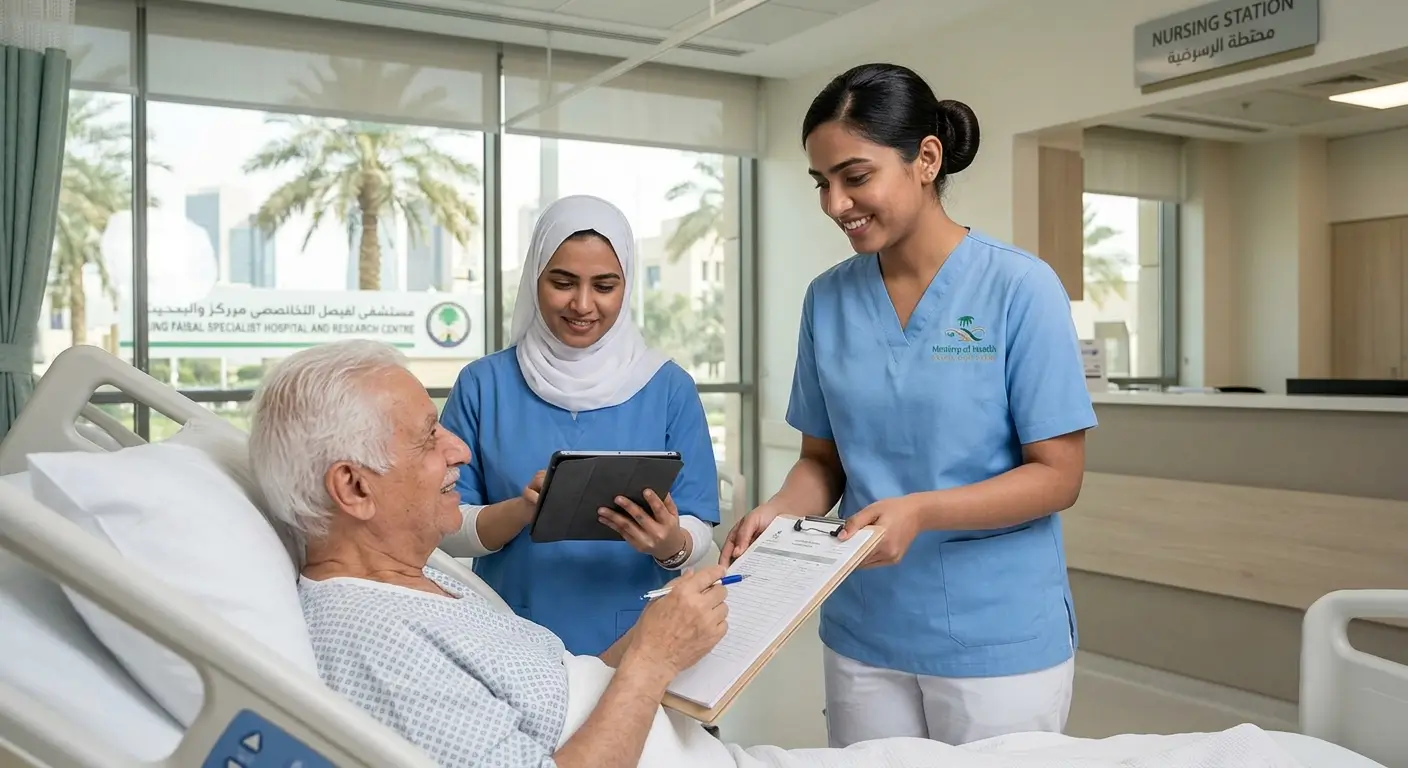
Saudi Arabia Staff Nurse Job (Recruitment Pathway)
Before you read further: three things many guides do not say clearly enough
Saudi Arabia will not lead to permanent settlement. The visa is tied to your employer. When the contract ends, your residency ends. The Gulf is for earning and saving, not permanent settlement. Nurses from across Africa who are targeting long-term immigration to a country like Canada, Australia, the UK, or Ireland should treat Saudi Arabia as a savings and experience-building chapter, not as a pathway to citizenship or permanent residency. Many nurses do exactly this, using two to five years in Saudi Arabia to clear debt, save substantially, and build a stronger professional profile before applying to PR-eligible destinations.
The Kafala system has been formally abolished, but the transition is incomplete. Saudi Arabia officially replaced the Kafala sponsorship model with a contract-based employment system in June 2025. Employers can no longer legally use sponsorship clauses to restrict worker mobility. Workers now have the right to change employers and to exit the country without employer approval. This is a genuine and significant improvement. However, issues like late salaries, contract breach, and document withholding remain possible, and domestic workers are not yet covered by the main reforms. Understanding your rights under the Qiwa digital labour platform before you arrive is important.
The Prometric exam requires real preparation. Every nurse, regardless of how many years of experience they have, must pass the Saudi Nursing Licensing Examination (SNLE) before legally practising in the Kingdom. The exam is not a formality. It tests clinical judgment and nursing competency in a multiple-choice format that favours application over memorisation. Nurses who treat it as a tick-box step tend to fail. Those who dedicate eight to twelve weeks of structured study tend to pass on the first attempt.
1. Overview
Saudi Arabia anticipates filling nearly 150,000 nursing vacancies by 2030, driven by population growth and the expansion of healthcare facilities across the Kingdom under the Vision 2030 Health Transformation Strategy. The total number of nurses in Saudi Arabia reached 235,461 in 2023, employed across public and private sectors. Foreign national nurses comprise approximately 70% of the total nursing workforce. This is not a marginal dependency on overseas labour. Saudi Arabia's healthcare system is structurally built around internationally trained nurses, and this is unlikely to change over the planning horizon of any nurse currently beginning their international career.
Saudi Arabia's healthcare expansion under Vision 2030 has created sustained demand for internationally educated nurses, and the Saudi Commission for Health Specialties admitted over 8,200 healthcare trainees across 62 programmes in 2025 alone. For nurses from Ghana, Kenya, Zimbabwe, South Africa, Tanzania, Uganda, Cameroon, Rwanda, or any other African country with established nursing education systems, Saudi Arabia represents one of the most accessible international employment markets available, with a licensing process that takes three to six months and does not require English at the level demanded by Canada, the UK, or Australia.
What Saudi Arabia offers is financially compelling: tax-free salaries, free or subsidised accommodation, annual airfare to your home country, health insurance, and end-of-service gratuity. The savings potential for a nurse with housing and transport provided is genuinely significant. Many nurses saving in Saudi Arabia for two contract cycles achieve financial positions that would take a decade of domestic nursing to replicate.
What it does not offer is a life-building pathway. You will work on contracts, live in employer-provided accommodation, and return home or move elsewhere when the arrangement ends. Some nurses find this entirely suits their goals. Others find it limiting. Knowing which category you fall into before you sign a contract is important.
2. Eligibility
Educational qualification
A Bachelor of Science in Nursing (BSN) or an equivalent degree from an accredited institution is required. Students in their final year of a BSN programme are eligible to sit the SNLE licensing examination. Fresh graduate nurses without clinical experience may face difficulty obtaining SCFHS classification and employment approval. Diploma-level nursing qualifications may be assessed at a lower classification tier, which can affect salary grade and the types of facilities willing to hire. Nurses with three-year diplomas from African nursing schools should seek pre-assessment guidance from SCFHS before beginning the full process.
Work experience
Most employers and licensing pathways require nurses to have at least two years of post-graduate clinical experience. Entry-level roles require a minimum of two years in general nursing, while specialized unit roles in ICU, NICU, or operating theatres may require two to five years in the related specialty. Leadership and educator roles typically require five or more years with management or teaching experience.
Registration from home country
A valid nursing registration or licence from your home country is required. Nurses must also provide a Good Standing Certificate issued within six months of application. This must come from the nursing regulatory body in your country, whether that is the Nursing Council of Kenya, the South African Nursing Council, the Nursing and Midwifery Council of Ghana, the Zimbabwe Nursing Council, the Nurses and Midwives Council of Nigeria, or the equivalent body in your country. If your registration has lapsed, it must be restored before you can proceed.
Language
Arabic is the official language of the Kingdom, but English is the primary working language in Saudi healthcare settings. Most employers and licensing authorities require IELTS Academic 6.0 to 6.5, or OET equivalent. Some waive this for nurses from English-medium education backgrounds, though this should be verified before assuming it applies. Nurses educated in anglophone African countries, including South Africa, Ghana, Kenya, Uganda, Zimbabwe, and Rwanda, often meet this requirement through their standard nursing education. Those educated in French-medium systems, such as in Cameroon, the Democratic Republic of Congo, Senegal, or Côte d'Ivoire, will need to demonstrate English proficiency formally.
Age
There is no published upper age limit for employment as a nurse in Saudi Arabia. However, some hospital contracts specify age limits in their individual terms, most commonly capping at 55 or 60. Confirm with the specific employer before applying.
3. Skills Employers Actually Want
A review of Saudi hospital job descriptions across Ministry of Health facilities, private tertiary hospitals in Riyadh and Jeddah, and specialist centres highlights the following consistent requirements.
Critical care and high-acuity clinical experience carries the highest weight in the Saudi market. ICU, CCU, NICU, emergency, and surgical nursing experience not only improve hiring prospects significantly but also push starting salaries toward the upper bands. Nurses who have rotated through high-acuity units in referral hospitals in Nairobi, Lagos, Accra, Harare, Cape Town, or Kigali should document this experience meticulously in their CVs.
Patient assessment and clinical decision-making skills are expected at a professional, autonomous level. Saudi hospitals with a high proportion of expatriate nursing staff have clinical environments that expect nurses to assess patients independently, escalate appropriately, and document their findings with precision.
Medication administration competency and pharmacological knowledge are scrutinised through the Prometric examination and are expected at the point of hire. The SNLE specifically tests pharmacology across nursing fundamentals, adult nursing, maternal and child nursing, and nursing management.
Documentation and electronic medical record skills are expected in all tertiary and private hospital settings. Nurses familiar with any major hospital information system have a practical advantage in the first weeks of employment.
Specialisation credentials strengthen both employability and salary significantly. Nurses with specialised credentials are prioritised by major hospitals and often qualify for senior-level positions or teaching roles. ACLS, BLS, and PALS certifications, CPD records, and any post-basic nursing qualifications are all worth highlighting.
Cultural sensitivity and adaptability appear in almost every posting. Saudi Arabia's patient population includes Saudi nationals, a large Arab expatriate community, and a significant South and Southeast Asian workforce population. Nurses who can navigate cross-cultural care settings effectively are consistently preferred.
4. Step-by-Step Path
Step 1: Gather and prepare your documents
The full document set required for SCFHS licensing is: your nursing degree certificate and official transcripts, your home country nursing licence or registration certificate, a Good Standing Certificate from your home country nursing council dated within six months, your employment experience letters with specific job titles, responsibilities, and dates, your passport biographical page, and recent passport photographs. Every document must be in English or Arabic. Documents in other languages must be officially translated and attested. Begin this collection early, as institutional response times for official documents vary across African countries and can introduce unexpected delays.
Step 2: Complete DataFlow Primary Source Verification
DataFlow is the credential verification company appointed by SCFHS to confirm the authenticity of your qualifications and experience directly with your issuing institutions. You submit scanned copies of your documents through the DataFlow portal, pay the verification fee of approximately SAR 500 to 700, and DataFlow contacts your nursing school, regulatory body, and employers to verify each document independently. This process takes approximately four to six weeks. Starting DataFlow as early as possible is critical because no other step in the licensing process can advance until a positive DataFlow report is issued.
Step 3: Apply through Mumaris Plus
Mumaris Plus is the SCFHS official digital licensing portal through which all healthcare professionals in Saudi Arabia manage their registration. Once DataFlow verification is complete, you upload your documents to Mumaris Plus and SCFHS reviews your credentials to determine whether you meet their classification requirements. If you do, you receive an eligibility number, which is valid for three months and grants permission to schedule the Prometric licensing examination.
Step 4: Sit the Saudi Nursing Licensing Examination
The SNLE assesses readiness for safe nursing practice. The format is 200 multiple choice questions split into two blocks of 100 questions, with 120 minutes per block and a 30-minute break between them. The scoring scale runs from 200 to 800, with a passing score of 500. Candidates may retake up to four times per year. The examination covers nursing fundamentals, adult nursing including medical, surgical, critical care and community, maternal and child nursing, and nursing management and leadership.
Prometric testing centres are located in Saudi Arabia, India, the Philippines, and other countries worldwide. For nurses based in Africa, centres in South Africa and Egypt allow the exam to be taken without international travel. The exam fee is approximately SAR 1,000. Study from the official SCFHS exam blueprint, use clinical judgment-focused preparation rather than pure memorisation, and attempt practice question banks in the NGN-style applied format. Eight to twelve weeks of dedicated study is the standard preparation window that experienced applicants recommend.
Step 5: Secure a job offer and complete classification
After passing the SNLE, SCFHS issues a Professional Classification Certificate that confirms your qualification title, such as Staff Nurse or Specialist Nurse. Your classification determines your professional title, scope of practice, and salary grade under Saudi hospital pay structures. This classification is what you present to employers as the basis for your contract. You can apply for jobs before completing the SNLE, as many Saudi hospitals and recruitment agencies accept and process applications in parallel with the licensing process and provide exam preparation support.
Step 6: Visa, Iqama, and deployment
The employer or recruitment agency submits a work visa application on behalf of the nurse. Upon arrival in Saudi Arabia, you complete the final registration stage, which requires a valid Iqama with authorised-to-work status. The SCFHS conducts a final review confirming your classification approval, positive DataFlow report, passing exam score, and valid residency status, then issues your Practice Licence. The licence is valid for two years and is renewable through Mumaris Plus.
Under the reforms introduced in 2025, private sector employees on formal Qiwa-registered contracts now have the right to change employers, apply for exit visas independently, and access labour courts without requiring their sponsor's approval. Verify that your employment contract is registered on the Qiwa platform as soon as you arrive.
5. Real-World Challenges
Fraudulent recruitment agents
Never pay an upfront fee to a recruiter for a Gulf nursing job. Legitimate employers cover recruitment costs. Verify any agency through your home country's labour ministry. Fraudulent agencies operating across Africa charge fees for job placement, visa processing, or "guaranteed" SCFHS fast-tracking. None of these claims are legitimate. A genuine Saudi hospital or licensed recruitment agency does not charge candidates. If any intermediary asks you to pay before a contract is signed and a visa is issued by the Saudi government, treat this as a red flag.
DataFlow delays from home country institutions
DataFlow verifies documents directly with your source institutions. The speed of the verification depends on how responsive your nursing school registrar, your national nursing council, and your previous employers are to institutional queries. Schools and regulatory bodies in some countries have backlogs of weeks or months. Contact your institutions before submitting to DataFlow, warn them that a verification request is coming, and follow up regularly. This single step causes more delays in the Saudi pathway than any other.
Contract versus reality gaps
Workplace incivility, hierarchical organisational culture, and structural power imbalances remain documented challenges for foreign national nurses in Saudi Arabia, particularly those from Africa and Asia. Before signing any contract, read every clause about working hours, shift assignments, overtime payment, housing arrangements, return ticket terms, end-of-service gratuity calculation, and notice period requirements. Ask specifically whether accommodation is provided on-site or off-site, whether it is communal or private, and whether any deductions will be made from your salary. Compare the contract against the verbal offer in detail. What was described in the interview and what is in the contract must match.
Dependants and family costs
Dependants' fees in Saudi Arabia are SAR 400 per family member per month. For a nurse on a mid-range salary bringing a spouse and two children, this cost is SAR 1,200 per month, which meaningfully affects savings calculations. Some hospitals provide family housing at no cost, which changes the equation entirely. Know exactly what your employer offers before comparing offers.
Salary structure complexity
Saudi nursing salaries appear in job postings as a combination of basic salary, housing allowance, transport allowance, and other components. The headline figure in a recruitment advertisement typically includes all components combined. Always ask for the breakdown. The basic salary is what determines your end-of-service gratuity calculation, your overtime rate, and your leave pay. A headline figure of SAR 10,000 consisting of SAR 4,000 basic and SAR 6,000 in allowances has very different long-term financial implications from a package where SAR 8,000 is basic salary.
6. Where to Apply
Ministry of Health and government hospital career portals
The Saudi Ministry of Health operates hundreds of hospitals and primary health centres across the Kingdom. Government facilities typically offer fixed pay scales with automatic annual increments, stronger job security, and more comprehensive benefits packages than private facilities. MOH recruitment rounds for international nurses are advertised periodically through official channels and accredited recruitment partners.
Major hospital portals
King Faisal Specialist Hospital and Research Centre in Riyadh is widely regarded as the most prestigious Saudi public hospital and recruits internationally across multiple nursing specialties. King Fahad Medical City, also in Riyadh, is one of the largest hospital complexes in the country. The Saudi German Hospitals Group, Dr Sulaiman Al-Habib Medical Group, and the National Guard Health Affairs hospitals all run active international recruitment programmes with online application portals.
Recruitment agencies with African market presence
WeCare International (wecareint.net) specialises in linking African nurses with Saudi healthcare institutions and accepts applications from across the continent. Prodesse Health (prodessehealth.com) has an established African recruitment track record and manages DataFlow, Mumaris, and Prometric preparation for candidates. Thymic Recruitment (thymicrecruitment.com) is active in the South African market with positions in Riyadh, Al-Ahasa, and other cities. CCM Recruitment Ireland has Saudi nursing openings accessible to nurses from English-speaking African countries.
Gulf job portals
Bayt.com and Naukrigulf.com are the dominant Gulf-region job boards and carry consistent volumes of Saudi nursing postings with detailed package information. LinkedIn is increasingly active for direct hospital recruitment in the GCC. GulfTalent.com covers senior and specialist nursing roles across the region.
SCFHS Mumaris Plus portal
scfhs.org.sa houses the Mumaris Plus licensing platform and the official exam blueprints for the SNLE. All SCFHS licensing steps run through this portal.
7. Timeline Expectation
Month 1: Contact your nursing council for a Good Standing Certificate and contact your nursing school registrar to alert them that a DataFlow verification request is coming. Submit your DataFlow application with full document set. Begin English language test preparation if not already completed. Begin SNLE study.
Months 2 to 3: DataFlow verification completes. Submit Mumaris Plus application. Apply for nursing positions in parallel. Attend hospital interviews via video call. Receive eligibility number from SCFHS.
Month 3 to 4: Schedule and sit the SNLE Prometric exam. Receive results. Apply for Professional Classification Certificate from SCFHS.
Months 4 to 6: Receive SCFHS Professional Classification. Receive and accept final job offer. Employer submits work visa application. Medical examination and police clearance completed. Visa issued. Travel to Saudi Arabia.
Upon arrival: Complete Iqama registration through your employer. Confirm employment contract is registered on Qiwa. Receive practice licence from SCFHS after confirmation of Iqama status. Begin work.
This timeline assumes all documents are prepared before DataFlow submission and that institutions in your home country respond promptly. Nurses who begin the process without complete documents, or whose home country institutions are slow to respond to verification, commonly see this extend to nine months or longer.
8. Mistakes to Avoid
Paying any recruitment agent before a visa is issued. Legitimate Saudi hospital recruitment does not charge candidates at any stage. Nurses across West Africa, East Africa, and Southern Africa have lost substantial sums to fraudulent operators who promise fast-tracked Saudi placements. No legitimate intermediary collects money from the nurse.
Sending incomplete documents to DataFlow. DataFlow will return an incomplete application, which resets your timeline. Prepare the full document set and verify that every document is correctly attested and translated before submission. One missing document can add four to six weeks to the process.
Misreading the total package as the basic salary. The headline figure in a recruitment advertisement almost always includes housing and transport allowances on top of the basic salary. End-of-service gratuity, overtime, and leave pay are all calculated on basic salary alone. A nurse earning SAR 10,000 total with SAR 4,000 basic earns far less in gratuity and overtime entitlements than one earning SAR 7,000 basic with SAR 3,000 in allowances. Ask for the salary breakdown before accepting any offer.
Underestimating the SNLE. The Saudi Nursing Licensing Examination tests clinical reasoning and nursing knowledge at a level that catches poorly prepared candidates off guard. Nurses who study for six to eight weeks with application-based question banks and official SCFHS blueprint materials pass at substantially higher rates than those who revise lightly. Book your exam slot only when your preparation is genuinely complete.
Not verifying contract registration on Qiwa. Since the labour reforms of 2025, your employment contract should be registered on the Qiwa platform for your rights under the new system to be enforceable. Verify this within your first two weeks of arrival. A contract that exists only on paper and is not registered on Qiwa offers significantly weaker legal protection.
Treating Saudi Arabia as a permanent life plan. Nurses who build their entire career strategy around staying in Saudi Arabia indefinitely expose themselves to financial and personal risk if a contract is not renewed, a facility closes, or a healthcare sector restructuring reduces expatriate headcount. The Saudi Arabia chapter works best when it is planned with a clear timeline and a next destination already in view.
9. Next Action
The single most time-sensitive step is obtaining your Good Standing Certificate from your home country nursing council. Many councils across Africa issue this certificate on request but take two to four weeks to process it, and some require a formal application and payment. Contact your nursing council today, request the certificate, and ask what the turnaround time is. When that timeline is confirmed, use it to plan your DataFlow submission date, and begin your SNLE study programme in parallel while you wait. Everything else in this process can move in parallel with those two tracks.
Sources
Layer | Source | Used in sections |
|---|---|---|
Official rules | Saudi Commission for Health Specialties (SCFHS), scfhs.org.sa: Mumaris Plus licensing portal and SNLE Applicant Guide | 2, 4, 7 |
Official rules | NurseHubGCC: Saudi nursing license SCFHS Mumaris Plus and SNLE 2026 guide | 2, 4, 8 |
Official rules | SCFHS License Saudi Arabia 2026 complete guide, waqaramin.me (February 2026) | 4, 7 |
Official rules | Neelim Healthcare Consulting: new Saudi Iqama rules 2026 for healthcare expats (April 2026) | 1, 5 |
Official rules | Saudi Arabia Kafala abolition analysis, analytix.sa (May 2026) | 1, 5, 8 |
Official rules | Saudi Arabia Labour Law reforms 2025, elaqatlaw.com | 1, 4, 5 |
Official rules | ILO Governing Body report on Saudi Arabia labour conditions, November 2025 | 1, 5 |
Job market data | NurseHubGCC: nurse salary by specialty Saudi Arabia 2026 | 3, 5, 7 |
Job market data | GlobalNurseGuide: nursing jobs in the Gulf Saudi UAE Qatar 2026 (May 2026) | 1, 5, 7 |
Job market data | TijusAcademy: nurse salary in Gulf countries 2026 (June 2026) | 1, 3, 5 |
Job market data | Terratern: nurse salary in Saudi Arabia 2025 | 5, 7 |
Job market data | Wiley/Nursing Forum: insights from expatriate nurses on Vision 2030 (September 2025) | 1, 5 |
Job market data | Health SA Gesondheid: workplace incivility for foreign national nurses in Saudi Arabia (March 2026) | 1, 5 |
Skill patterns | SharpBH Global Manpower: requirements for nurses Saudi Arabia and Middle East | 3, 4 |
Skill patterns | NurseHubGCC: qualifications to work as a nurse in Saudi Arabia 2026 | 2, 3 |
Skill patterns | NurseHubGCC: Prometric exam for nurses Saudi Arabia 2026 | 3, 4 |
Real experience | NEAC Medical Exams Application Center: SCFHS Mumaris Plus licensing guide (January 2026) | 4, 8 |
Real experience | CCM Recruitment Ireland: nursing overview Saudi Arabia, SCFHS process | 4, 7 |
Real experience | Dynamic Health Staff: nursing jobs in Saudi Arabia process overview | 4, 7 |
Real experience | The Workers Rights: Kafala system reforms migrant guide (April 2026) | 1, 5 |
Application channels | WeCare International (wecareint.net): African nurses Saudi Arabia recruitment | 6 |
Application channels | Prodesse Health (prodessehealth.com): Saudi Arabia nursing recruitment process | 6 |
Application channels | Thymic Recruitment (thymicrecruitment.com): South Africa to Saudi Arabia nursing placements | 6 |
Application channels | CCM Recruitment Ireland: Saudi Arabia nurse vacancies | 6 |
Application channels | Bayt.com and Naukrigulf.com: Gulf region nursing job boards | 6 |
Application channels | GulfTalent.com: nurse salary and senior nursing roles Saudi Arabia | 6 |
The Author

Amel Walter
Registered Dietitian-Nutritionist • Gerontological Nutritionists
RDN with 3+ yrs clinical exp: assess patient needs, manage disease, create therapeutic meal plans in hospital teams. Turns nutrition science into realistic, patient-centric diets to improve outcomes.
Travel Essentials
Curated services to help you settle in Saudi Arabia Staff Nurse Job (Recruitment Pathway) quickly.
More coming soon
Need help?
Our team can help you find accommodation and coworking spaces in Saudi Arabia Staff Nurse Job (Recruitment Pathway).
Contact Support →